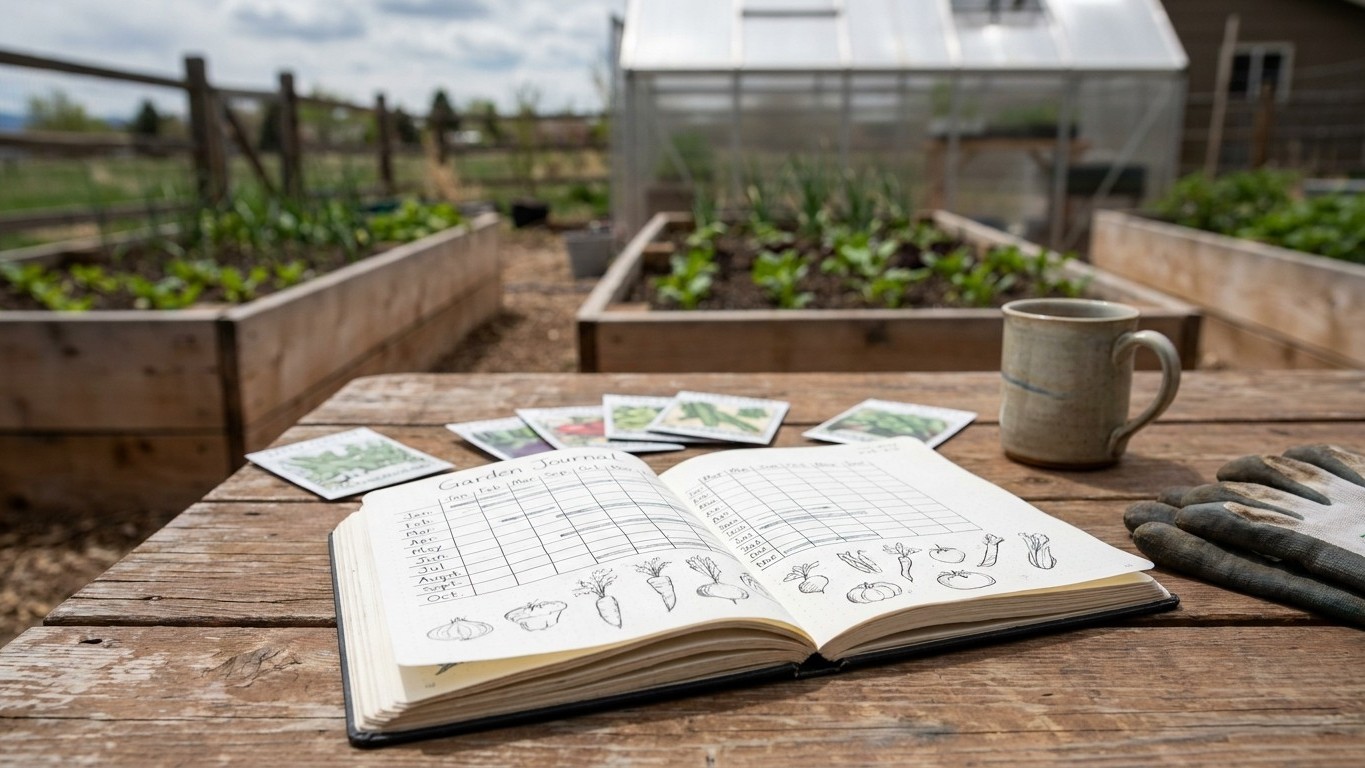

Colorado’s last spring frost falls between May 1 and May 11 in the Denver area, according to NOAA’s 1991-2020 climate normals, and the first fall frost arrives between September 30 and October 12. That window is what every seed packet and state planting calendar is built around. Check the low spots and west-facing corners of your own yard against those dates before you sow: a frost pocket can run a week or two colder than the official record.
The frost window in Colorado

Colorado’s growing season lives or dies by two dates: last spring frost near Denver falls between May 1 and May 11, first fall frost between September 30 and October 12. Everything you plant this year gets scheduled around that window, whether it’s peas going in early or tomatoes waiting for warm soil. Before you sow anything, walk your own yard and check the low spots and west-facing corners — a frost pocket there can run a week or two colder than those official dates.
Subtract one range from the other and you get the length of a typical frost-free season near Denver. In a hard year, where spring breaks late on May 11 and fall arrives early on September 30, that’s 142 days. In a mild year, with an early May 1 last frost and an October 12 first fall frost, it stretches to 164 days. Most seasons land somewhere between those two numbers, which is exactly why a planting calendar has to speak in ranges instead of picking a single date and calling it fact.
Denver sits at 5,280 feet on the high plains, and elevation does most of the work in that calculation. Mountain towns and higher foothill communities run on a far shorter clock, and some can see a frost even in July. The western slope follows its own separate pattern, shaped by the Rockies and by valleys that trap cold air differently than the plains do. If you garden outside the Denver metro, use these dates as a starting reference, not a local answer.
That range also puts Colorado in context against other climates. A gardener working from our Hawaii Planting Calendar deals with an almost frost-free year and never has to run this arithmetic at all. A gardener following our British Columbia Planting Calendar is managing a similarly elevation-driven, short-season problem in its interior valleys. Colorado’s plains sit in between: a real four-and-a-half to five-month season, bookended by frost at both ends — see What to Plant in Colorado in January for how the season starts, What to Plant in Colorado in February for how that timeline plays out ear, and What to Plant in Colorado in December for how it wraps up at the other end of the year, and What to Plant in Colorado in September for how it winds down as that first fall frost approachesly, and What to Plant in Colorado in March for how the season builds from therely, and What to Plant in Colorado in June for how it looks once the frost-free window is fully open early in the year, What to Plant in Colorado in April for the transition into the frost-free window, What to Plant in Colorado in May for the heart of the planting season, and What to Plant in Colorado in July for how that same window shapes the peak of summer growing[…] and What to Plant in Colorado in August for how the season winds down toward that first fall froste season, and What to Plant in Colorado in October for how it wraps up as fall frost approachese season, and What to Plant in Colorado in November for how the season winds down after that first fall frostf the frost-free window.
Cool-season crops
Peas, spinach, lettuce, brassicas and root crops don’t wait for the last frost. They tolerate light freezes and germinate in soil that’s still cold by summer standards, so the smart move is sowing them before the last frost date, not after it.
Peas, spinach and salad greens
Peas and spinach go in as soon as the ground can be worked with a hoe or trowel rather than clumping into mud. Counting back four to six weeks from the Denver-area last frost window of May 1 to May 11 puts that sowing window in mid-March to mid-April most years, earlier if the spring has been mild, later if snow is still sitting on the beds. Lettuce follows a similar logic but with a shorter lead time, going in roughly two to four weeks ahead of the last frost, which lands it in early to mid-April in most years.
Roots and brassica transplants
Radishes, carrots and beets can be direct-sown on the same two-to-four-week-before-frost schedule as lettuce, since none of them mind a cool, damp seedbed. Broccoli, cabbage and other brassica transplants go out a bit closer to the frost date itself, generally two to three weeks ahead, and benefit from a few days of hardening off outdoors before they’re left in the ground overnight. None of these crops need to wait for warm soil the way tomatoes and peppers do, and treating them like warm-season crops just wastes weeks of usable growing time at the front end of the season.
- Peas and spinach: four to six weeks before last frost
- Lettuce, radishes, carrots, beets: two to four weeks before last frost
- Broccoli, cabbage and other brassica transplants: two to three weeks before last frost
Warm-season crops

Tomatoes, peppers, squash, beans and corn are a different problem entirely. These plants are killed outright by frost, but the bigger issue most Colorado gardeners run into isn’t frost at all. It’s cold soil. A tomato transplant set into ground that hasn’t warmed up sits still for weeks even if the air temperature is fine, so soil temperature, not the calendar, is the real gate for this group.
Why waiting past the frost date matters
Because the last spring frost near Denver can land anywhere from May 1 to May 11, and because soil takes time to catch up even after the air warms, the safe transplant window for warm-season crops runs mid-May to late May. That gives the soil an extra week or two beyond the latest possible frost date to actually warm through, which matters more for tomatoes and peppers than for squash and beans, which germinate faster once the ground does warm.
Counting back for indoor starts
Tomatoes are typically started indoors six to eight weeks before transplant. Counting back from a mid-May to late-May set-out date puts indoor sowing at late March to early April. Peppers need a longer runway, usually eight to ten weeks, which pushes their indoor start to early to mid-March. Squash, beans and corn are usually direct-sown outdoors once the frost risk has passed and skip the indoor stage altogether, though squash can be started indoors two to three weeks ahead of transplant if you want a head start.
Days-to-maturity figures on a seed packet are counted from the transplant date, not the sowing date, and they shift by a week or two depending on how warm the summer runs. The table below applies that arithmetic to a set of named tomato varieties, using a mid-May to late-May transplant window and the earlier edge of the Denver-area fall frost range, September 30, as the frost line.
| Variety | Days to maturity | Type | First ripe (estimate) | Margin before fall frost |
|---|---|---|---|---|
| Sakura | 55 | Indeterminate | Mid July | 73 days |
| Edox | 55 | Indeterminate | Mid July | 73 days |
| Valentine | 55 | Indeterminate | Mid July | 73 days |
| Glacier | 55 | Determinate | Mid July | 73 days |
| Sun Gold | 57 | Indeterminate | Late July | 71 days |
| Supersweet 100 | 60 | Indeterminate | Late July | 68 days |
| Juliet | 60 | Indeterminate | Late July | 68 days |
| Amalfi | 68 | Determinate | Early August | 60 days |
| Cherokee Purple | 72 | Indeterminate | Early August | 56 days |
| Big Beef Plus | 72 | Indeterminate | Early August | 56 days |
| Granadero | 75 | Indeterminate | Early August | 53 days |
| Tiren | 75 | Indeterminate | Early August | 53 days |
| San Marzano II | 78 | Indeterminate | Mid August | 50 days |
| Celebrity Plus | 78 | Determinate | Mid August | 50 days |
Even the latest-maturing variety in that list, at 78 days, still clears the earliest edge of the fall frost window by roughly seven weeks. That margin is what lets Denver-area gardeners grow long-season paste tomatoes at all, but it also means there’s little room to justify a June transplant date if a cold, wet spring pushes things back.
The fall planting window
Fall crops get planted by working backward from the first frost instead of forward from the last one. Near Denver, that first fall frost falls between September 30 and October 12, and the safer of the two dates to plan around is the earlier one, September 30, since it protects against the years frost comes on schedule rather than late.
Counting backward for fall crops
Take the days-to-maturity figure printed on the seed packet, add roughly two weeks to account for the slower growth that comes with shortening daylight and cooling soil in late summer, then count that total backward from September 30. A crop listed at 50 days to maturity, for example, needs about 64 days of growing time by that math, which puts its sowing date in late July. The same arithmetic applies to any fall crop: the packet’s days-to-maturity number understates how long it will actually take once you’re planting into a cooling season, so the two-week pad isn’t optional.
Crops that improve after a light frost
Several fall crops actually taste better once they’ve been touched by cold. Kale, brussels sprouts, carrots and parsnips all convert stored starches to sugars after a light frost, which softens their flavor rather than ruining it. That’s different from a hard freeze, which will still kill or badly damage most of these plants if temperatures drop far enough below freezing for long enough. A floating row cover bought for spring frost protection does the same job in fall, buying an extra week or two at the tail end of the season when the first light frosts arrive but before the harder freezes of late October set in.
Reading a planting calendar properly
A state-wide planting calendar, this one included, is a starting point built from one weather station’s data, not an instruction sheet for every yard in Colorado. The NOAA figures used throughout this page come from a station near Denver, and Colorado’s terrain makes that a poor stand-in for anywhere far from the plains.
What actually varies
Elevation is the biggest factor. Mountain towns can run their entire frost-free season inside the window that Denver treats as early spring, and some see frost even in July. The western slope runs on its own pattern again, shaped by different air drainage and lower valley elevations than the Front Range. Even within the Denver metro, urban heat holds pavement and buildings warmer than open farmland a few miles out, and a low spot in a yard can pool cold air on a still night while a spot ten feet higher stays frost-free.
The fix isn’t a better calendar. It’s your own frost log: a season or two of notes on when frost actually hit your specific beds, checked against a simple soil thermometer before you commit warm-season transplants to the ground. That local record will outperform any statewide average within a couple of years.
Local help
For county-level frost dates, soil testing and crop-specific timing beyond what a statewide station can tell you, contact Colorado State University Extension. Its county offices track local conditions that differ from the Denver-area figures used here, particularly in the mountains and on the western slope. Our broader Colorado guides cover related topics if you’re planning a full-season garden rather than a single planting date.
Common questions
Is it too late to plant vegetables in Colorado in June?
Not for most warm-season crops. Beans, squash, and shorter-season tomatoes still have enough time to mature before the first fall frost if planted in June, though you’ll want to check the days-to-maturity math against the September 30 to October 12 fall frost window before committing to a long-season variety.
Why did my plants still freeze after the official last frost date passed?
Because that date is a range, not a guarantee. NOAA’s last-frost figure of May 1 to May 11 covers a 30 to 70 percent probability band, meaning frost risk exists on both sides of it, and a cold pocket in your specific yard can run colder than the reference station used to calculate it.
Do I need to test my soil before planting?
It’s worth doing, especially before your first season in a new bed. Colorado State University Extension offers soil testing through its county offices, and the results will tell you more about your actual planting conditions than any statewide calendar can.
How much shorter is the growing season in the mountains than near Denver?
Meaningfully shorter, though the exact figure depends on the town. Higher elevations and mountain valleys can see frost well into late spring and again as early as midsummer in some years, which is why this page’s frost dates, based on a Denver-area station, don’t apply once you’re up in elevation.
Can I plant tomatoes and peppers on the same day?
You can, but they don’t need to start indoors on the same day. Peppers generally need eight to ten weeks indoors before transplant, while tomatoes need six to eight, so peppers should go under lights a couple of weeks earlier if you want both crops to hit the same mid-May to late-May transplant date.
Related guides
- Wyoming Planting Calendar: When to Sow and Plant, Frost Dates Included
- Nebraska Planting Calendar: When to Sow and Plant, Frost Dates Included
- Hawaii Planting Calendar: When to Sow and Plant, Frost Dates Included