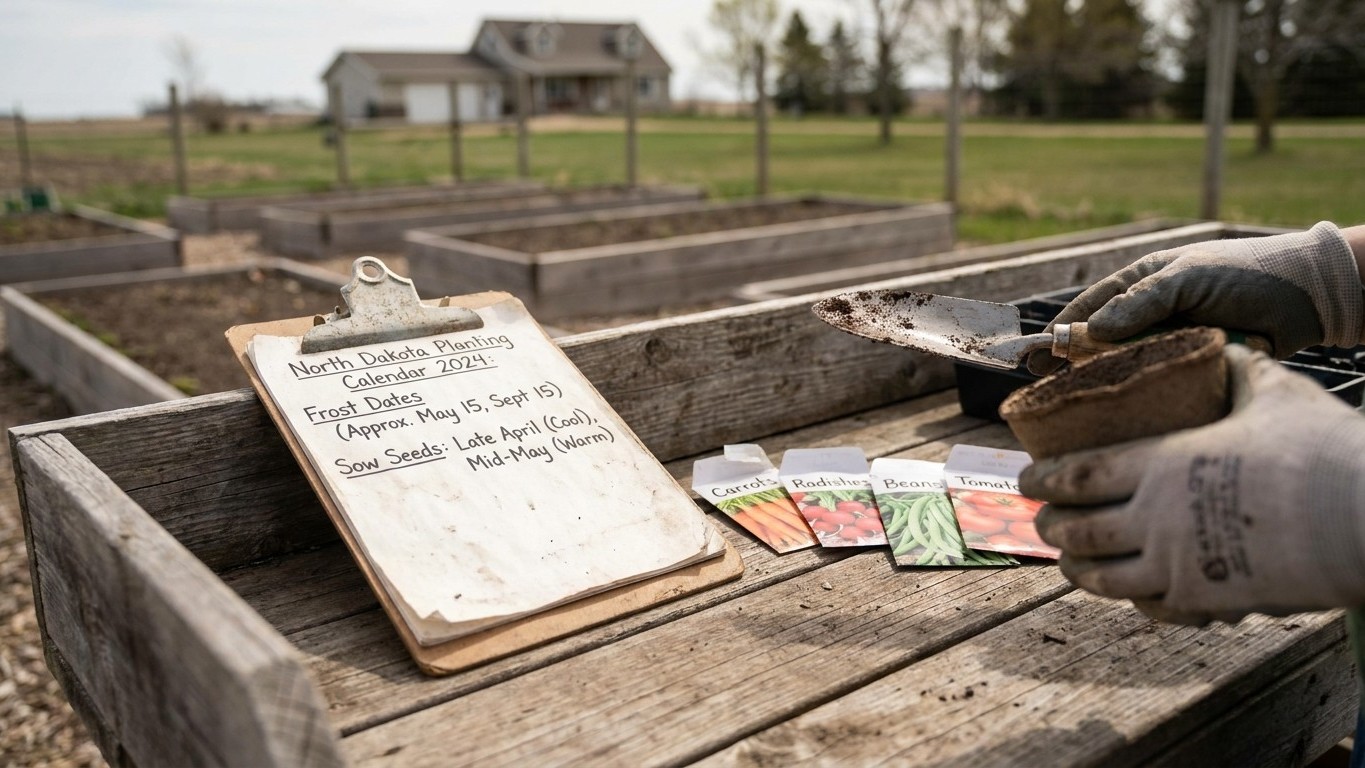

Frost is the whole question here, and in North Dakota it lands late and leaves early: figure on your last spring freeze falling sometime between May 4 and May 15, and the first fall freeze arriving between September 25 and October 5. That’s the growing season you’re working with, give or take a week if you’re in a low spot or farther north. Before you plant anything, find your own county’s frost dates and use those instead of Fargo’s.
The frost window in North Dakota

Everything in this calendar starts from one number range: NOAA’s 1991-2020 U.S. Climate Normals put the 32°F freeze probability window for the airport weather station near Fargo at May 4 to May 15 for the last spring frost, and September 25 to October 5 for the first fall frost. That’s a 30 to 70 percent probability band, not a guarantee. It means frost is reasonably likely before May 4 and reasonably unlikely after May 15, with a real chance either way in between.
Those figures come from an airport station, and airports sit in open, mowed, often slightly elevated ground that cools and warms faster than a shaded backyard or a low spot along a river. NOAA’s own data note that suburban and rural gardens typically see the last spring frost land later and the first fall frost land earlier than the reference-city figure, sometimes by one to two weeks. If your garden sits in a frost pocket, along a creek bottom, or well north of Fargo, plan for a shorter season than these numbers suggest.
How long is the growing season?
Do the arithmetic with the two ranges and you get a season length, not a single number. Count from the earliest possible last frost (May 4) to the earliest possible first fall frost (September 25) and you land around 144 days. Count from the latest possible last frost (May 15) to the latest possible first fall frost (October 5) and you land around 143 days. Either way, Fargo’s typical frost-free stretch runs roughly 140 to 150 days in most years. That’s enough for full-season tomatoes and winter squash if you start warm-season crops indoors, but it leaves little room for a second planting of anything with a long days-to-maturity number.
The far northern counties and areas at higher elevation should expect that window to run shorter on both ends. There’s no substitute for tracking your own soil temperature and watching the sky in a given year rather than trusting a single date. If you’re planning ahead for the earliest part of the season, check out What to Plant in North Dakota in January, or if you’re looking toward the tail end of the growing season, see What to Plant in North Dakota in September, or if you’re wrapping up the season and looking toward late fall, see What to Plant in North Dakota in November, or if you’re closer to planting time, see What to Plant in North Dakota in May, as well as What to Plant in North Dakota in March, and once the frost risk has passed, see What to Plant in North Dakota in June, and if you’re looking further into the growing season, see What to Plant in North Dakota in July and What to Plant in North Dakota in February, and once you’re ready to get started, check out What to Plant in North Dakota in April for early-season crops, and once your season winds down, check out What to Plant in North Dakota in December for closing out the year, and once your season winds down, check out What to Plant in North Dakota in August for late-season crops, and check out What to Plant in North Dakota in October to plan your fall garden accordingly.
Cool-season crops
Cool-season vegetables tolerate a light frost and actually germinate poorly in warm soil, so they go in the ground before the last spring frost date, not after it. Peas and spinach are the classic examples. Pea seed will germinate in soil as cool as the low 40s°F, and young spinach plants shrug off a freeze that would kill a bean seedling outright. Both can go in as soon as the soil is dry enough to work, which in a normal year in North Dakota is several weeks ahead of the May 4 to May 15 last-frost window NOAA reports for Fargo.
Lettuce sits a step behind peas and spinach in cold tolerance but still belongs in the ground well before the frost-free date. Direct-sown lettuce and transplants both handle a light frost, though a hard freeze will damage exposed leaves. Radishes are the fastest of the bunch and can go in alongside peas, since they germinate quickly in cold soil and are usually ready to pull before warm-season crops even go in.
Brassicas and roots
Broccoli, cabbage, and cauliflower transplants tolerate a light frost once they’ve hardened off, so gardeners commonly set them out a few weeks ahead of the last frost date rather than waiting for it to pass. Starting the transplants indoors gives you a jump on the short season, and hardening them off gradually (a few hours outside at a time, over a week or so) is what lets them handle that early exposure without stalling.
Root crops like carrots and beets go in as a direct sow, timed to soil workability rather than the calendar. Carrots in particular are slow to germinate in cold soil, so a bit of patience after sowing is normal and not a sign of failure. None of these cool-season crops need you to wait out the full frost window described above. That window matters for the crops in the next section.
Warm-season crops

Tomatoes, peppers, squash, beans, and corn are a different story. These crops don’t just dislike frost, they stall in cold soil even when the air temperature looks fine. A tomato transplant set into soil in the 40s°F will often sit and sulk for weeks rather than grow, and bean and corn seed can rot before it ever germinates if the ground is too cold and wet. That’s why soil temperature, not just the calendar date, is the real gate for this group.
Tomatoes: a variety comparison
For tomatoes, catalogue days-to-maturity are counted from the transplant date, not from seed, and they shift by a week or two depending on the season’s heat. Cross that figure against Fargo’s frost window and you get the table below. All the varieties here are set out in the same window, mid May to late May, chosen to fall safely after NOAA’s May 4 to May 15 last-frost range for the reference station.
| Variety | Days to maturity | Type | First ripe | Margin before fall frost |
|---|---|---|---|---|
| Sakura | 55 | Indeterminate | late July | 64 days |
| Edox | 55 | Indeterminate | late July | 64 days |
| Valentine | 55 | Indeterminate | late July | 64 days |
| Glacier | 55 | Determinate | late July | 64 days |
| Sun Gold | 57 | Indeterminate | late July | 62 days |
| Juliet | 60 | Indeterminate | late July | 59 days |
| Supersweet 100 | 60 | Indeterminate | late July | 59 days |
| Amalfi | 68 | Determinate | early August | 51 days |
| Cherokee Purple | 72 | Indeterminate | early August | 47 days |
| Big Beef Plus | 72 | Indeterminate | early August | 47 days |
| Tiren | 75 | Indeterminate | mid August | 44 days |
| Granadero | 75 | Indeterminate | mid August | 44 days |
| San Marzano II | 78 | Indeterminate | mid August | 41 days |
| Celebrity Plus | 78 | Determinate | mid August | 41 days |
Notice that even the longest-season tomato on this list, at 78 days, still clears a month or more of margin before NOAA’s earliest fall-frost figure for Fargo. That margin matters because tomato ripening slows once nights turn cool, so the last couple of weeks before frost produce less fruit than the calendar suggests.
To hit that mid-to-late May transplant window, start tomato seed indoors on the standard 6-to-8-week timeline before setting plants out. Counting back from mid-May puts the sowing date in late March to early April, and counting back from late May puts it in early to mid-April. Peppers run on a similar indoor-starting timeline but are slower to size up, so many gardeners start pepper seed a week or so ahead of tomatoes.
Beans, squash, and corn
Beans, squash, and corn are usually direct-sown rather than transplanted, and all three need warm soil to germinate reliably. Waiting until soil has warmed well past the last frost date, rather than sowing the moment the frost date passes, is the more common mistake with this group. A soil thermometer pushed a few inches into the bed tells you more than the calendar does.
The fall planting window
Fall planting works the same arithmetic as spring, just run in reverse: take the first fall frost date and count backward by the crop’s days to maturity, then add a cushion because growth slows as daylight and heat drop off through late summer. NOAA’s 1991-2020 normals put that first fall frost near Fargo at September 25 to October 5, so a quick-maturing crop sown in mid-to-late summer still has a real shot at reaching harvest before the season closes.
Counting back from fall frost
Short-season crops like radishes, baby lettuce, and spinach are the easiest fits for a fall planting, since their time from seed to harvest is measured in weeks rather than months. Because growth slows in the cooler, shorter days of late summer and early fall, extension services commonly recommend adding a two-week buffer on top of the seed packet’s days-to-maturity figure when planning a fall crop. Applied to Fargo’s frost window, that buffer means treating late September as the working deadline rather than the early-October end of the range, especially outside the immediate Fargo area where frost typically arrives sooner.
Crops that improve after frost
Some crops actually taste better once a light frost has touched them. Kale, Brussels sprouts, carrots, and spinach all convert starches to sugars in response to cold, which is why a lot of gardeners leave these in the ground deliberately through the first light frosts rather than rushing to harvest beforehand. That only applies to a light frost, not the hard freeze that follows once the season truly turns. Once nighttime lows are reliably below freezing, it’s time to bring in what’s left.
Garlic is the outlier in a fall calendar built around frost dates, since it’s planted in fall for a harvest the following summer rather than grown to maturity before winter. That timing depends more on ground freeze-up than on the first light frost, so it’s worth checking with a local source rather than working it into the days-to-maturity math used for everything else in this section.
Reading a planting calendar properly
A state-wide planting calendar, this one included, is a starting point built from one weather station’s averages, not a set of instructions for your specific yard. NOAA’s Fargo figures are useful as a baseline, but North Dakota covers a lot of ground between the Red River Valley and the higher terrain further west, and elevation alone can shift a local frost date by a meaningful margin in either direction.
Lake and river effects matter too. Low ground near water bodies collects cold air on clear, still nights and tends to frost earlier and harder than a slope or a spot with more air movement. Urban and suburban yards, by contrast, often run a little warmer than open countryside because pavement and buildings hold heat, which is part of why NOAA’s own guidance flags airport-station data as generally earlier-to-warm-up and later-to-cool-down than a typical home garden nearby.
None of that shows up in a calculated date. What does help is watching your own garden over a season or two: note when frost actually hits your beds compared to the official range, keep a soil thermometer on hand for spring planting decisions, and treat a late cold snap as a real possibility even after the “average” last frost has passed. A calendar tells you when frost is likely. Your own record tells you when it actually happens on your patch of ground.
Local help
For county-level frost dates, soil testing, and cultivar recommendations specific to your part of the state, the NDSU Extension Service is the best next step, since their county offices track conditions closer to your own garden than any statewide average can. If you’re gardening elsewhere in the region and want the same kind of breakdown, our North Dakota guides collect more detail by crop and by task.
Common questions
Is North Dakota’s frost date the same everywhere in the state?
No. The May 4 to May 15 and September 25 to October 5 figures cited here come from NOAA’s climate normals for the airport weather station near Fargo. Other parts of the state, especially higher or more northern counties, typically see a shorter frost-free window, so check with your county NDSU Extension office for local data.
Can I plant tomatoes right after the last frost date passes?
You can, but soil temperature matters as much as air temperature for tomatoes. Waiting until soil has warmed rather than transplanting the day frost risk drops is usually worth the extra week or so, since cold soil stalls root growth even if the air feels warm enough.
What happens if I get a late frost after I’ve already planted warm-season crops?
A late frost after transplanting can damage or kill unprotected tomatoes, peppers, squash, and beans. Row cover or a bucket over individual plants overnight is usually enough to get them through one cold snap, but repeated frosts mean the crop was planted before the soil and air were actually ready.
How does North Dakota’s growing season compare to warmer states?
It’s considerably shorter. A state like Florida works from a frost calendar built around mild winters and a much longer warm season, while a state like Ohio sits somewhere in between with a longer frost-free window than North Dakota’s roughly 140 to 150 days. The shorter the season, the more it matters to choose varieties on the fast end of the days-to-maturity range.
Do I need to start everything indoors given how short the season is?
Not everything. Cool-season crops like peas, spinach, radishes, and direct-sown lettuce do fine seeded straight into the garden ahead of the last frost date. It’s the warm-season, longer-maturity crops like tomatoes and peppers where starting indoors on a 6-to-8-week schedule makes the difference between a full harvest and a frost-cut-short one.
Related guides
- Minnesota Planting Calendar: When to Sow and Plant, Frost Dates Included
- South Dakota Planting Calendar: When to Sow and Plant, Frost Dates Included