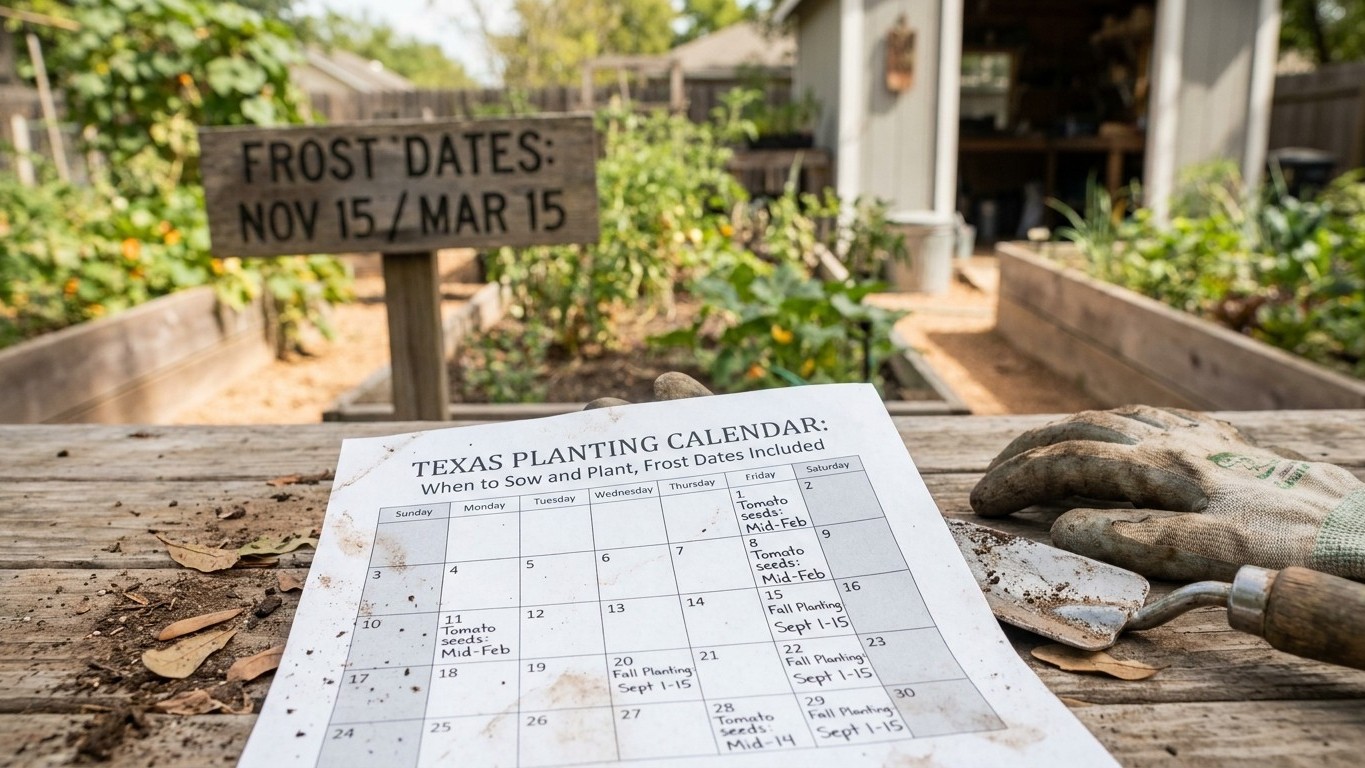

Houston’s frost-free season stretches close to ten months, running from early February to mid-December, based on three decades of freeze records at the city’s main airport weather station. Knowing What to Plant in Texas in February can help gardeners near the Gulf Coast squeeze in two complete rounds of warm-season crops — tomatoes, peppers, squash — before winter finally shuts things down. Head farther inland or north, though, and that cushion shrinks fast, often forcing a choice between a spring planting and a fall one.
The frost window in Texas

At Houston’s Bush Intercontinental Airport station (IAH), NOAA’s 1991-2020 climate normals put the last spring freeze between February 4 and March 1, and the first fall freeze between December 1 and December 19. Those two dates bracket the frost-free season measured at that single station, and they’re the closest thing to hard data this page can give for the Gulf Coast end of Texas — with What to Plant in Texas in January offering a head start on planning before that last freeze even hits.
Do the arithmetic on that window and you get a frost-free stretch of roughly nine and a half to ten months, depending on which end of each range your particular year lands on. That’s an unusually long season by American standards, and it’s why gardeners near Houston can often fit two full rounds of warm-season crops into a single year before winter closes things down — with What to Plant in Texas in March marking the start of that first spring push once the last freeze has passed.
Practically, that long window means a Houston-area gardener can plant a spring round of tomatoes, peppers or squash — see What to Plant in Texas in April for getting that spring round started — harvest through summer, keep things going with What to Plant in Texas in July as midsummer crops need attention, push through with What to Plant in Texas in August as the heat peaks, and still have time to put in a fall round before December’s freeze arrives, using What to Plant in Texas in September for getting that fall round started, What to Plant in Texas in October for timing that fall crop, What to Plant in Texas in November for what can still go in the ground as the season winds down, and What to Plant in Texas in December for the final push right before that first freeze hits — with What to Plant in Texas in May and What to Plant in Texas in June covering the crops that bridge that spring-to-summer transition. Gardeners farther north or inland, working with a shorter frost-free stretch, often have to choose between the spring round and the fall round rather than running both.
None of this holds once you leave the Gulf Coast. The Panhandle sits in a colder USDA hardiness zone entirely, with freezes arriving months earlier in fall and lingering months later in spring. Hill Country and North Texas run on their own separate calendar too, shaped by elevation and distance from the coast’s moderating effect. Treat the Houston dates as an example of how to read a frost window, not as your own planting calendar.
Even inside the Houston metro area the numbers move. Hobby Airport, closer to the coast, runs about two weeks milder than IAH on both ends of the season. If a station fifteen miles away shifts the window by two weeks, a station two hundred miles inland or a thousand feet higher will shift it by a great deal more. The single most useful thing on this page isn’t a date at all. It’s the instruction to find the NOAA normals or extension data for a station near you before you commit seed to soil.
Cool-season crops
Cool-season crops go in the ground before the last frost, not after it, because they’re built to tolerate a light freeze that would kill a tomato or pepper seedling overnight. Peas, spinach, lettuce, the brassica family (broccoli, cabbage, kale, collards) and root crops like carrots, beets and radishes all fall into this group. The trick is timing them against your local last-frost date, not against a calendar month, since that date shifts by months depending on where in Texas you garden.
Timing against the frost date, not the calendar
In the Houston area, where NOAA’s normals put the last freeze between February 4 and March 1, gardeners typically get these crops started well ahead of that window, since most cool-season vegetables germinate and grow steadily even while nights are still cold. The goal is to have plants established before the weather turns warm enough to trigger bolting, the point at which lettuce and spinach stop producing leaves and shoot up a flower stalk instead.
Peas are among the most frost-tolerant of the group and can handle nights that would badly damage warm-season seedlings. Spinach and lettuce are nearly as hardy. Brassicas sit a step behind: seedlings tolerate a light frost, but a hard freeze can still damage exposed leaves, so gardeners in the colder parts of the state often start these indoors and transplant once the worst of winter has passed, while Gulf Coast gardeners can often direct-sow earlier.
Root crops behave differently again. Carrots, beets and radishes are grown from seed sown directly in the ground rather than transplanted, and they tolerate cool soil far better than warm-season crops do. Radishes in particular grow fast enough to slot into a short cool window between two other crops.
- Peas: most frost-tolerant, sow earliest of the group
- Spinach and lettuce: hardy, bolt once days lengthen and warm
- Brassicas (broccoli, cabbage, kale): tolerate light frost, transplant rather than direct-sow in colder zones
- Carrots, beets, radishes: direct-sown, tolerate cool soil, radishes mature fastest
A floating row cover adds a few degrees of protection on a night when frost threatens crops already in the ground, buying cool-season plantings some room for error if a late cold snap arrives after you’ve sown. Whatever your zone, the working rule is the same. Cool-season crops should be finishing up, not starting, by the time your last frost date arrives and warm nights set in for good.
Warm-season crops

Tomatoes, peppers, squash, beans and corn all die at the first real frost, so the last-frost date matters here in a way it doesn’t for cool-season crops. But soil temperature matters as much as the frost date itself. Seeds and transplants of these crops sit and sulk, or rot outright, in soil that’s still cold even if the air is technically frost-free. Waiting a couple of weeks past your last frost date, until the soil has actually warmed, usually beats planting on the calendar date alone.
Counting back from transplant date
Tomato varieties are a good example of how to use catalog data alongside a frost date. Seed packets and catalogs list days to maturity counted from the transplant date, not from seed, and those figures typically shift by a week or two depending on the season. Cross that figure against your local frost window and you get both a safe transplant date and a rough harvest date. For the Houston reference territory, with NOAA’s last-frost window of February 4 to March 1, tomato transplants generally go into the ground from mid February to mid March, once the immediate frost risk has passed.
A handful of catalog varieties work out against that window like this:
| Variety | Days to maturity | Transplant window | First ripe | Margin before fall frost |
|---|---|---|---|---|
| Sakura | 55 days | mid Feb to mid March | early May | 206 days |
| Sun Gold | 57 days | mid Feb to mid March | mid May | 204 days |
| Cherokee Purple | 72 days | mid Feb to mid March | late May | 189 days |
| San Marzano II | 78 days | mid Feb to mid March | early June | 183 days |
Every variety on that list clears the Houston growing season with well over 180 days to spare, which is exactly the kind of margin a nine-to-ten month frost-free window buys you. In a shorter-season part of the state, that same 78-day San Marzano II would need a much earlier transplant date, or a shorter-season substitute, to ripen before fall frost arrives.
Starting seed indoors
Standard practice for starting tomato and pepper seed indoors is six to eight weeks before the transplant date. Counting back from a mid February to mid March transplant window puts indoor sowing at roughly late December through early February, depending on which end of the transplant window you’re aiming for and which end of the six-to-eight-week range you use. Squash, beans and corn are usually direct-sown instead once soil has warmed, since their roots resent transplanting and rarely recover well from it.
The fall planting window
Fall planting works backward from the first freeze instead of forward from the last one. Houston’s NOAA normals put the first fall freeze between December 1 and December 19, so a crop needs enough days to mature before that window arrives, with room to spare for the fact that fall growth slows as daylight shortens.
Take a fall crop that needs about 60 days to mature. Counted back from a December 1 to December 19 frost window, that lands sowing in early October. But fall days are getting shorter and cooler by the week, and plants maturing in October and November grow more slowly than the same variety would in the long days of May. Add roughly two extra weeks of buffer to cover that slowdown, and the safer sowing window moves earlier, into mid to late September for a 60-day crop in the Houston area.
Crops with a longer days-to-maturity figure need to go in even earlier, sometimes while summer heat is still in full swing, which is its own challenge for germinating cool-season seed in hot soil.
Fall is also a second window for the same cool-season crops planted in spring. Peas, spinach, lettuce and quick radishes can all go back in as the weather cools, often germinating more reliably in warm late-summer soil than they did in the cold ground of a February sowing. The difference is which direction you’re counting from. A spring sowing counts forward from the last frost, and a fall sowing counts backward from the first one.
What actually improves after a frost
Not every crop is racing to beat the freeze. Kale, collards, Brussels sprouts, carrots and parsnips all convert stored starches to sugars when exposed to a light frost, which is why cold-weather harvests of these crops often taste noticeably sweeter than the same crop grown in summer heat. That makes the fall crop worth timing deliberately rather than just squeezing in before the cutoff. A light frost right around harvest is a feature, not something to avoid.
Tender crops don’t get that benefit. Peppers, tomatoes, squash and beans still growing when frost arrives are simply finished for the season, so anything you’re still harvesting off summer plantings as NOAA’s fall frost window approaches is worth picking early rather than risking a total loss overnight.
Reading a planting calendar properly
A statewide planting calendar, including this one, is a starting point built from a single weather station. Treat it as a rough model of how frost dates and growing seasons work, then go find the numbers for your own ground.
What shifts the date where you garden
Elevation is one of the biggest factors. Ground a few hundred feet higher than a nearby valley floor can run measurably colder on a clear, still night, since cold air sinks and pools in low spots. A garden near a large lake or reservoir often runs a few degrees milder than open country nearby, because water holds heat longer than soil or air. Urban areas hold heat too. A garden in the middle of a city, surrounded by pavement and buildings, typically stays a bit warmer overnight than a rural garden a short drive away, an effect gardeners call the urban heat island.
A late cold snap is the failure mode that catches people out most often. NOAA’s climate normals describe probabilities, not guarantees. Even a 30-to-70-percent freeze window means a real chance of frost on either side of it in any given year, and a single hard freeze after you’ve set out warm-season transplants can undo weeks of head start in one night.
The same logic that separates Houston from the Panhandle separates one state from another entirely. A statewide calendar for Alaska has to deal with a frost-free season measured in weeks rather than months across much of its territory, while Oregon‘s coastal gardens are moderated by a marine influence not unlike what the Gulf does for Houston. Both illustrate the rule Texas gardeners need most: find the local station, not the state average.
Keep your own log instead of trusting any single source for more than a rough guide. Note the date of your last spring frost and first fall frost for a few years running, watch how your own soil warms in spring, and you’ll end up with a planting calendar more accurate for your yard than anything printed in a national database.
Local help
The Houston-area numbers on this page come from one NOAA weather station, and Texas is too large a state for one station to serve. Texas A&M AgriLife Extension publishes county-level planting guides and offers soil testing that tells you what your particular ground needs before you amend it. Start at the TAMU AgriLife Extension site and search for your county’s office. For more on growing across the rest of the state, our other Texas guides cover conditions outside the Gulf Coast.
Common questions
What is the actual last frost date for my part of Texas?
It depends on where you are. This page uses NOAA’s 1991-2020 normals for Houston (IAH), which put the last freeze between February 4 and March 1, but that figure only applies near the Gulf Coast. Check with your county’s Texas A&M AgriLife Extension office for data closer to your own station.
Can I plant tomatoes outside in January in South Texas?
Possibly, in the mildest coastal counties, but this page doesn’t have station data south of Houston to confirm a date. Areas right along the coast tend to run milder than IAH’s numbers, sometimes by weeks, so a local extension office or an experienced gardener nearby is a better source than guessing from Houston’s window.
What if I already transplanted and a late frost is forecast?
Cover the plants overnight rather than replanting from scratch. A bucket, cardboard box or floating row cover holds in enough ground heat to get tender seedlings through a single light frost, though a hard, prolonged freeze will still damage or kill them regardless of covering.
Why does my tomato take longer to ripen than the days-to-maturity on the packet?
Catalog days-to-maturity figures are counted from transplant under close-to-ideal conditions, and real gardens rarely match that exactly. Cooler-than-average nights, transplant shock, or a slow start in cold soil can all push the actual harvest a week or two past the printed number.
Is a Farmers’ Almanac frost date the same thing as NOAA’s?
No. NOAA’s climate normals are calculated from decades of actual temperature records at a specific station, while almanac dates are typically generic estimates not tied to a single measured location. For planning real plantings, the NOAA station-based figures, or your extension office’s local data, are the more reliable source.
Related guides
- New Mexico Planting Calendar: When to Sow and Plant, Frost Dates Included
- Oklahoma Planting Calendar: When to Sow and Plant, Frost Dates Included
- Alaska Planting Calendar: When to Sow and Plant, Frost Dates Included