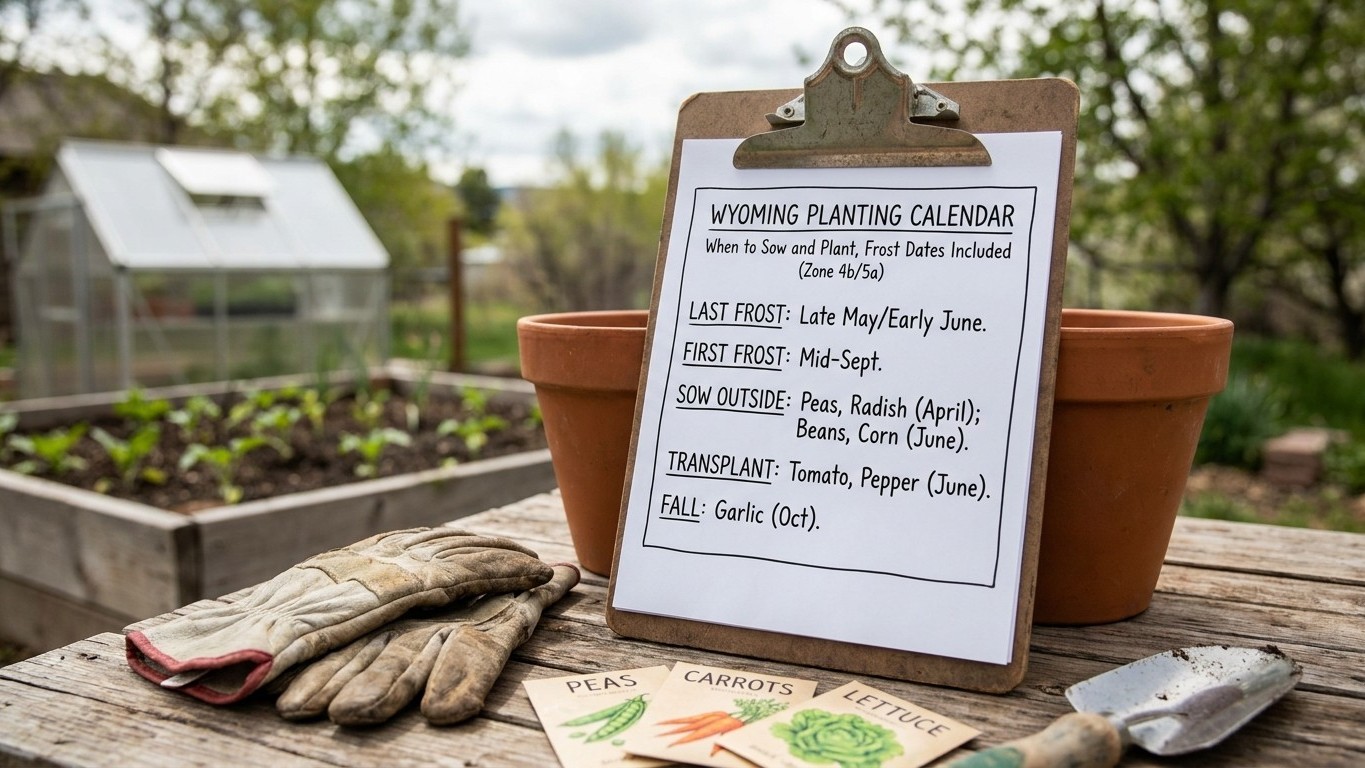

Wyoming’s growing season doesn’t start on a fixed date — it starts when your elevation says the freeze risk is finally gone, and around Cheyenne that’s after May 18. Higher ground pushes that later and cuts it shorter on the other end, so the same calendar can be wrong by weeks depending on where you actually garden. Check your elevation against Cheyenne’s before you plant anything by this or any other date.
The frost window in Wyoming

At Cheyenne, NOAA’s 1991-2020 climate normals put the last spring freeze between May 7 and May 18, and the first fall freeze between September 24 and October 5. Both figures come from the same NOAA National Centers for Environmental Information dataset, station USW00024018, which tracks the probability of a 32-degree freeze through the year. Those two windows are the backbone of nearly every planting decision on the high plains, shaping What to Plant in Wyoming in January as growers plan the season ahead, What to Plant in Wyoming in February as the earliest cold-hardy crops go in, What to Plant in Wyoming in March as the transition toward the frost-free window begins, What to Plant in Wyoming in May as the last frost dates finally arrive across the plains, What to Plant in Wyoming in June once the frost risk has cleared statewide, What to Plant in Wyoming in July as the growing season hits full stride, What to Plant in Wyoming in August as summer crops peak, also determining What to Plant in Wyoming in September as the fall freeze approaches, and shaping What to Plant in Wyoming in December once the season has fully closed out.
Stretch both ranges to their widest points and Cheyenne’s season runs about 151 days, from May 7 to October 5. Pull them to their narrowest and it’s closer to 129 days, from May 18 to September 24. That’s what a gardener actually works with: a range, not a single number. Planning around the range instead of picking one date inside it is the single habit that saves the most transplants in an average year.
Elevation changes everything
Cheyenne sits on the high plains, and even there frost risk lingers into mid-May in a cool year. Move up into the foothills, the Wind River country, or any of the mountain valleys that make up much of Wyoming, and the season compresses hard. At elevations near 6,000 feet, common across a lot of inhabited Wyoming, growers can expect something closer to 130 frost-free days in a typical year, and a freeze is possible in any month at the higher elevations still. That single fact should shape how much frost protection a garden carries, not just what day planting starts.
Treat the Cheyenne dates as the mild end of Wyoming’s range, not the state average. A garden in a mountain valley or at a materially higher elevation needs its own frost record. The county extension office is the fastest way to get one, and that’s covered further down.
Cool-season crops
Peas, spinach, lettuce, brassicas, and root crops all tolerate a light frost and most actually prefer to germinate in cold soil, so they go in before the last frost date rather than after it. The trigger is soil that can be worked, not a date on the wall.
Working backward from Cheyenne’s last frost
Peas and spinach are the hardiest of the bunch and can go in roughly four to six weeks before the last frost. Counted back from Cheyenne’s May 7 to May 18 window, that lands sowing in late March to mid-April, as soon as the soil can be worked — see What to Plant in Wyoming in April for a fuller breakdown of what goes in during that window.oil thaws and drains enough to dig. Lettuce and brassica transplants (broccoli, cabbage, kale starts) tolerate a bit less cold and go in about two to three weeks ahead of last frost, which works out to mid-to-late April into early May at Cheyenne. Root crops like carrots, beets, and radishes get direct-sown in that same window, since they don’t transplant well and need the soil temperature already trending upward.
- Peas and spinach: four to six weeks before last frost, late March to mid-April at Cheyenne
- Lettuce and brassica transplants: two to three weeks before last frost, mid-to-late April into early May
- Carrots, beets, radishes: direct-sown in the same window, once soil is workable
None of these crops need frost protection at that stage. A light freeze slows them down but rarely kills them outright, and a covered bed or cold frame buys another two to three weeks on the front end for a gardener who wants an earlier start than the bare-soil dates allow. What kills cool-season crops isn’t the cold, it’s heat: once daytime temperatures climb consistently, lettuce bolts and spinach turns bitter, so the window closes from the warm side just as much as the cold one.
Warm-season crops

Tomatoes, peppers, squash, beans, and corn all stall or rot in cold soil regardless of what the air temperature says, which is why soil temperature matters more than the frost date by itself. A calendar can tell you frost is over. It can’t tell you the soil has actually warmed enough for roots to function, and that lag is usually one to two weeks after the last frost date on the high plains.
Counting back for indoor starts
Tomato transplants at Cheyenne go into the ground late May to early June, calculated by adding a week or two of buffer onto the May 7 to May 18 frost window to let the soil catch up. Working backward from that, seeds started indoors six to eight weeks ahead of transplant land in late March to late April, depending on the variety’s own start-indoors instructions on the packet. Peppers run on a similar clock but benefit from an extra week or two indoors, since they germinate slower in cool soil than tomatoes do.
Beans, squash, and corn skip the indoor step entirely in most Wyoming gardens. They’re direct-sown once the soil has warmed past the point where the seed would otherwise rot before it germinates, which on the high plains generally means waiting past the last-frost window rather than sowing right at it.
Tomato varieties by days to maturity
Days-to-maturity figures on a seed packet are counted from transplant, not from seed, and they shift by a week or two depending on how warm the season runs. Crossed against Cheyenne’s late-May-to-early-June set-out window and its September 24 to October 5 first fall frost, the shorter-season varieties carry far more margin than the long-season ones.
| Variety | Days to Maturity | Type | Key Disease Resistance | Calculated First Ripe* | Frost Margin* |
|---|---|---|---|---|---|
| Sakura | 55 | Indeterminate | Nematodes, Tomato Mosaic Virus, Fusarium Wilt 1-2 | Late July | ~60 days |
| Edox | 55 | Indeterminate | Nematodes, Tomato Mosaic Virus, Fusarium Wilt 1-2 | Late July | ~60 days |
| Valentine | 55 | Indeterminate | Early Blight (Intermediate) | Late July | ~60 days |
| Glacier | 55 | Determinate | None listed | Late July | ~60 days |
| Sun Gold | 57 | Indeterminate | Tobacco Mosaic Virus, Fusarium Wilt 1 | Late July | ~58 days |
| Supersweet 100 | 60 | Indeterminate | Verticillium Wilt, Fusarium Wilt 1 | Late July | ~55 days |
| Juliet | 60 | Indeterminate | Late Blight, Early Blight (Intermediate) | Late July | ~55 days |
| Amalfi | 68 | Determinate | Nematodes, Late Blight, Early Blight (Intermediate) | Early August | ~47 days |
| Cherokee Purple | 72 | Indeterminate | None listed | Mid August | ~43 days |
| Big Beef Plus | 72 | Indeterminate | Nematodes, Gray Leaf Spot, Tomato Mosaic Virus | Mid August | ~43 days |
| Tiren | 75 | Indeterminate | Verticillium Wilt, Tomato Mosaic Virus, Fusarium Wilt 1 | Mid August | ~40 days |
| Granadero | 75 | Indeterminate | Nematodes, Verticillium Wilt, Tomato Mosaic Virus | Mid August | ~40 days |
| San Marzano II | 78 | Indeterminate | None listed | Mid August | ~37 days |
| Celebrity Plus | 78 | Determinate | Nematodes, Gray Leaf Spot, Tomato Mosaic Virus | Mid August | ~37 days |
*Calculated by adding each variety’s catalog days-to-maturity, counted from transplant, to a late-May-to-early-June set-out date, then checking the result against Cheyenne’s first fall frost window of September 24 to October 5 from NOAA’s normals. Catalog figures shift by a week or two with the season, and any garden outside Cheyenne should adjust for its own frost dates.
The pattern in that table matters more than any single row: a 55-day variety like Sakura or Glacier carries about 60 days of margin before frost even shows up, while a 78-day paste tomato like San Marzano II or Celebrity Plus is working with closer to 37. In a season that’s already short by national standards, that gap is the difference between a full harvest and one cut off by an early September freeze.
The fall planting window
Working backward from Cheyenne’s first fall frost of September 24 to October 5, a second round of quick cool-season crops fits into the same garden that grew spring peas or lettuce. The math is the same in reverse: take the days-to-maturity printed on the seed packet, count back from the earlier end of the fall frost window to be safe, and add roughly two extra weeks of margin because growth slows as daylight shortens through late summer.
What actually improves after a frost
Not every crop needs to dodge the frost. Kale, brussels sprouts, carrots, and spinach all sweeten after a light freeze, because the cold triggers the plant to convert stored starches into sugars as a kind of natural antifreeze. That means a fall planting of these crops doesn’t need to finish before September 24 at all. A light frost midway through the harvest window is a feature, not a problem, and a hard freeze only matters once temperatures drop far enough to damage the plant tissue outright rather than just chill it.
Crops that don’t get that benefit, like beans, squash, and warm-season tomatoes still on the vine, need to be finished or covered well before the first fall frost window opens. Row cover or a frost blanket bought a week or two of extra ripening time in most years, but it’s not a substitute for choosing a variety with enough margin in the first place, which is exactly what the table above is for.
Reading a planting calendar properly
A state-level planting calendar, this one included, is built from a single weather station and it says so for a reason. Cheyenne’s numbers describe Cheyenne. They don’t describe a garden thirty miles away at a different elevation, on a north-facing slope, or in a low spot where cold air pools on a still night.
What actually shifts the dates
Elevation is the biggest factor in Wyoming specifically, and it’s not subtle: a garden a thousand feet higher than Cheyenne can run two to three weeks behind it on both ends of the season. Urban heat does the opposite in town gardens, where pavement and buildings hold warmth and can nudge a last frost a few days earlier than the surrounding countryside. Low-lying gardens near creeks or in valley bottoms collect cold air on clear nights and frost harder and more often than a slope just above them, even at the same elevation and latitude. None of that shows up in a station-based normal, because a normal is an average of one place, not a prediction for every place.
The fix isn’t a better calendar, it’s a garden journal. Note the date of the last frost you actually see, not the date the calendar predicted, for three or four years running, and that record becomes more useful than any state-wide figure. It’s the same reason a planting calendar for Illinois reads completely differently county to county despite covering one state, and why a short-season territory like the one described in the Nunavut planting calendar can’t rely on a single frost date at all.
Local help
For dates specific to your county, and for a soil test before you commit a season’s worth of seed to unknown ground, the University of Wyoming Extension service is the first call to make. Reach it at uwyo.edu/uwe, where county offices track local frost records and soil conditions that a state-wide dataset like this one can’t. For more on gardening across the state’s varied elevations, our Wyoming guides cover the rest of the season.
Common questions
Is the Cheyenne frost date the same everywhere in Wyoming?
No. The May 7 to May 18 last-frost window and the September 24 to October 5 first-frost window are both measured at the Cheyenne station used by NOAA’s 1991-2020 normals. Higher elevations, mountain valleys, and low-lying cold-air pockets all run on their own schedule, sometimes weeks apart from Cheyenne’s.
Can I plant tomatoes right on the last frost date?
You can, but the soil usually isn’t warm enough yet for the roots to actually grow. Waiting a week or two past the last-frost window, once nighttime lows are reliably staying up, gets tomato and pepper transplants off to a faster start than planting on the calendar date alone.
What’s the fastest way to protect plants from a late frost I didn’t expect?
A floating row cover, an old bedsheet, or an overturned bucket thrown over tender transplants overnight handles most surprise late frosts. Remove the cover in the morning once temperatures climb back above freezing so the plants don’t overheat or rot under it.
Do I need a soil thermometer or can I just count days from the frost date?
A soil thermometer is worth the few dollars if you’re growing beans, squash, or corn from direct-sown seed, since cold soil rots seed before it germinates regardless of what the air temperature or frost date says. Counting days from frost gets you close for transplants, but direct-sown warm-season seed cares about the dirt, not the calendar.
Can I get two harvests out of one Wyoming garden bed in a season?
Yes, with quick cool-season crops on both ends. A bed that grows spring lettuce, spinach, or radishes ahead of the last frost can usually be cleared and resown with a second quick crop in time to mature before the first fall frost window, especially with the extra sweetness a light frost gives crops like spinach and kale at the finish.
Related guides
- Montana Planting Calendar: When to Sow and Plant, Frost Dates Included
- South Dakota Planting Calendar: When to Sow and Plant, Frost Dates Included
- Illinois Planting Calendar: When to Sow and Plant, Frost Dates Included