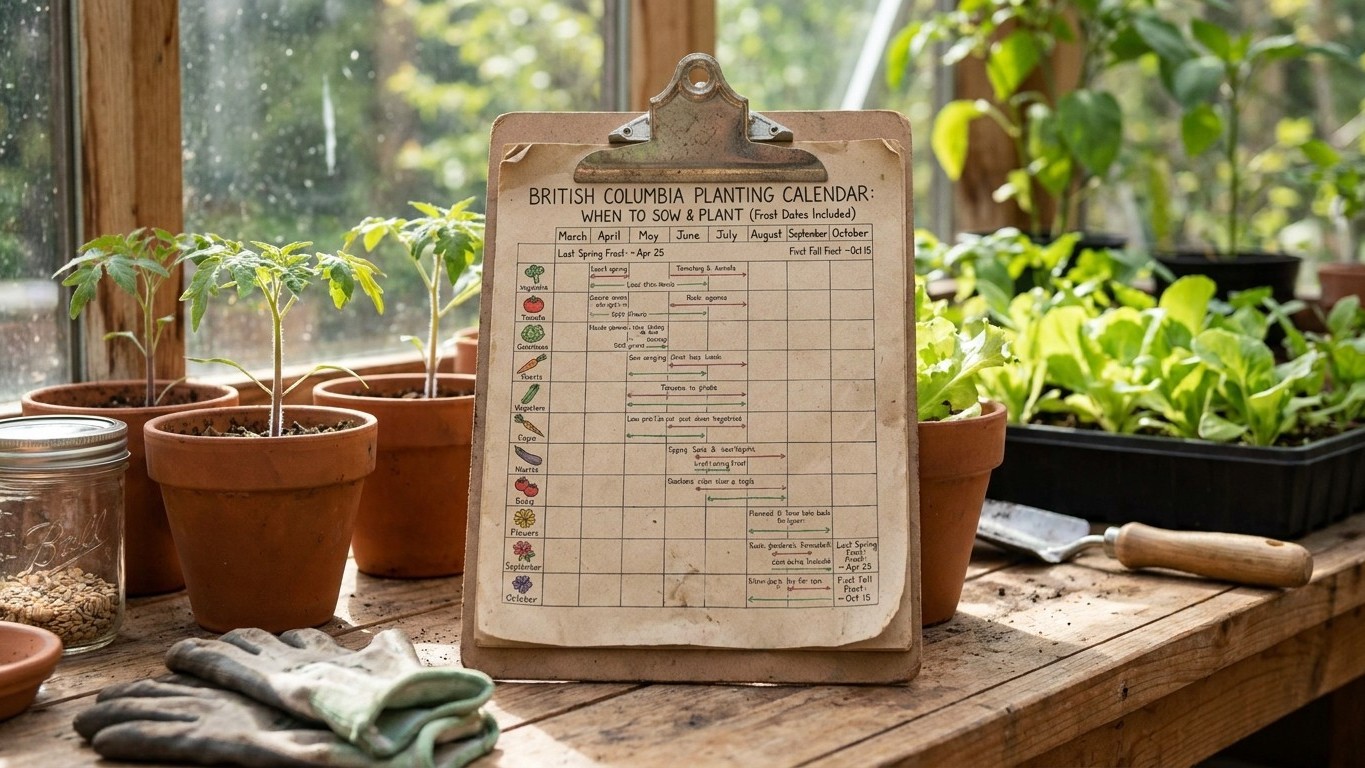

March 18 to November 10 — that’s the frost-free stretch clocked at Vancouver’s airport, roughly 237 days of growing room most of Canada would envy. But this coastal window doesn’t hold once you head past the Fraser Valley: the ocean’s moderating hand fades inland, and BC’s interior valleys and mountain towns work off a shorter, colder calendar entirely. Knowing which BC you’re gardening in changes every sowing date that follows.
The frost window in British Columbia

Everything on this calendar hangs off two numbers. Environment and Climate Change Canada’s 1981-2010 Canadian Climate Normals, recorded at Vancouver Int’l A, put the average last spring frost at March 18 and the average first fall frost at November 10. Count the days between those two dates and you get roughly 237 days of average frost-free growing at that station, which is generous by Canadian standards and one reason the Lower Mainland can grow crops that struggle further inland.
What the average actually means
A “normal” frost date is the midpoint of thirty years of records, not a promise. In one year out of two, the last spring frost at Vancouver falls after March 18, sometimes by a week or more. Treat the date as the center of a window rather than a line you can plant right up to. The same caution applies at the other end of the season: November 10 is where fall frost lands on average, and a cold snap arriving two weeks early is well within normal variation. For what indoor sowing and planning can start well ahead of that last frost date, see What to Plant in British Columbia in January, for guidance on what can go in the ground before that date arrives, see What to Plant in British Columbia in February, for what to sow once that frost date arrives, see What to Plant in British Columbia in March, for the next wave of sowing as the season warms further, see What to Plant in British Columbia in April, for what thrives once the season hits its stride, see What to Plant in British Columbia in June, for a closer look at what these dates mean for late-summer sowing, see What to Plant in British Columbia in August, for what still has time to mature as that fall frost date closes in, see What to Plant in British Columbia in November, and for planning ahead into the dormant season once frost has settled in, see What to Plant in British Columbia in December.
Vancouver Int’l A sits near sea level on the coast, and the ocean moderates temperature swings in both directions. Move inland or upslope and the window narrows fast. The Interior, the Kootenays, the Peace River region, and higher elevations anywhere in the province typically see their last frost weeks later than the coast and their first fall frost weeks earlier, which shortens the usable season considerably. If you garden outside the immediate Vancouver area, use the March 18 to November 10 window as a coastal reference point and adjust inward from both ends based on what you actually see in your own yard.
Cool-season crops
Cool-season vegetables go in the ground while frost is still a live possibility, because their germination and early growth actually prefer cold soil and their foliage shrugs off a light freeze. The trigger for these crops is soil that can be worked, not a date on the calendar, and that point typically arrives some weeks before the March 18 average last frost near Vancouver.
What goes in early
- Peas: sown directly as soon as the soil is dry enough to dig, well ahead of the last frost.
- Spinach: germinates in cold soil and tolerates hard frost once established.
- Lettuce: direct-sown or transplanted from indoor starts, shrugging off light frost but not a hard freeze.
- Brassicas (broccoli, cabbage, kale transplants): started indoors and set out while nights are still cool.
- Root crops (carrots, beets, radishes): direct-sown into cool soil, with radishes ready fastest.
The reason these crops tolerate frost that would kill a tomato comes down to how their cells handle ice formation and how their growing points are protected below the leaf canopy or below ground. That tolerance has limits. A hard, prolonged freeze will still damage exposed lettuce and brassica transplants, so a floating row cover is cheap insurance in the weeks bracketing the average frost date, particularly in a year that is running colder than normal. Once the last-frost window has clearly passed at your own site, cool-season crops sown that late will bolt to seed faster as days lengthen and warm, so most gardeners get one main cool-season sowing in before frost and a second, smaller one in late summer for a fall crop.
Warm-season crops

Tomatoes, peppers, squash, beans, and corn are killed outright by frost, so the last spring frost date sets the earliest possible transplant date. Soil temperature matters just as much. Warm-season seed and transplants germinate and root poorly in cold soil even on a frost-free night, so waiting a few extra weeks past the average frost date for the ground to actually warm through usually beats planting on the calculated date and watching transplants sulk.
Working backward from transplant date
For the tomato varieties in our catalogue, the transplant target for the Vancouver reference point is early April, a couple of weeks beyond the March 18 average last frost, which builds in margin for both the years frost lands late and the lag before soil is reliably warm. Seed packets for these cultivars generally call for starting indoors six to eight weeks ahead of that transplant date, which lands seed-starting in mid-to-late February for an early-April set-out. That’s a range to work from, not a single day, since indoor conditions and the specific cultivar shift it by a week or more either direction.
The days-to-maturity figure printed on a seed packet is counted from transplant, not from seed, and it shifts by a week or two with the season’s weather. Here’s how the tomato varieties in our catalogue line up when set out in early April at the Vancouver reference point, with first-ripe estimates and the margin of frost-free days left afterward before the November 10 average first fall frost:
| Variety | Days to maturity | Habit | Estimated first ripe | Margin before fall frost |
|---|---|---|---|---|
| Sakura | 55 | Indeterminate | Late May | 168 days |
| Edox | 55 | Indeterminate | Late May | 168 days |
| Valentine | 55 | Indeterminate | Late May | 168 days |
| Glacier | 55 | Determinate | Late May | 168 days |
| Sun Gold | 57 | Indeterminate | Late May | 166 days |
| Supersweet 100 | 60 | Indeterminate | Late May | 163 days |
| Juliet | 60 | Indeterminate | Late May | 163 days |
| Amalfi | 68 | Determinate | Early June | 155 days |
| Cherokee Purple | 72 | Indeterminate | Mid June | 151 days |
| Big Beef Plus | 72 | Indeterminate | Mid June | 151 days |
| Tiren | 75 | Indeterminate | Mid June | 148 days |
| Granadero | 75 | Indeterminate | Mid June | 148 days |
| San Marzano II | 78 | Indeterminate | Mid June | 145 days |
| Celebrity Plus | 78 | Determinate | Mid June | 145 days |
Even the longest-season paste tomato on that list, San Marzano II at 78 days, still leaves 145 days of margin before the November 10 average frost when set out in early April, which is why a coastal BC garden can ripen slicing and paste tomatoes alike without racing the calendar. Disease resistance matters as much as speed in a coastal climate where humidity runs high: Celebrity Plus and Big Beef Plus both carry resistance to gray leaf spot and tomato mosaic virus, useful where foliage stays damp longer into summer than it does further inland.
Peppers, squash, beans, and corn follow the same logic as tomatoes even without catalogue figures listed here: wait for the soil to warm well past the frost window, not just for the calendar date to clear. Gardeners relocating from a milder, longer-season state should recalibrate rather than assume the same timing applies. A grower moving from somewhere like the California Planting Calendar, where warm-season crops often go in several weeks earlier, needs to reset expectations to BC’s shorter and later warm-up.
The fall planting window
Fall planting works backward from the November 10 average first fall frost near Vancouver rather than forward from spring. Take the days-to-maturity figure for a fall crop, count back from November 10, and then add extra time on top of that figure, because growth slows measurably as day length and soil temperature drop through September and October. A crop rated for a certain number of days in the long light of June will take noticeably longer to reach the same size in fall.
Crops that improve after frost
Not every crop treats that November frost as an ending. Kale, brussels sprouts, and carrots left in the ground tend to sweeten after a light frost, because the plant converts stored starches to sugars as a form of cold protection. Spinach and some hardy lettuces can overwinter under cover in the mildest coastal gardens, resuming growth as days lengthen again in late winter. That tolerance is a reason to hold off pulling root crops the moment frost is forecast. A light frost is often the point at which flavor improves rather than a signal to harvest immediately.
The margin gardeners build in matters more in fall than in spring, because there’s no second chance if a crop runs out of season. Sowing a fall crop of lettuce or a quick root crop in mid-to-late summer, timed so its days-to-maturity plus a slowdown allowance lands comfortably before November 10, is the safer approach than sowing right at the edge of that date and hoping the season cooperates. Gardeners in the Interior or Peace region, where the first fall frost typically arrives earlier than at the coastal Vancouver reference point, need to start fall crops correspondingly sooner.
Reading a planting calendar properly
A provincial planting calendar built around one weather station is a starting point, not an instruction. British Columbia’s geography works against any single date applying everywhere. Elevation alone can shift a frost date by weeks: a valley floor in the Okanagan warms and cools differently than the slopes above it, and a garden a few hundred meters higher than its neighbor can see frost when the neighbor doesn’t.
Large bodies of water complicate things further. Lakes in the Okanagan and Kootenays hold heat and moderate the air around them, often delaying both the last spring frost and the first fall frost close to shore compared with sites just a short drive inland. Urban areas add their own effect: paved surfaces and buildings in metro Vancouver hold heat overnight, so gardens in the city core can run measurably milder than open ground in the surrounding Fraser Valley. None of that shows up in a single station’s normals.
The most useful habit is to keep your own record. Note the date of your last spring frost and first fall frost each year, watch which corners of your yard frost first, and pay attention to cold air pooling in low spots. A garden’s own microclimate, built from a season or two of direct observation, will tell you more than any provincial date ever will. It’s also worth comparing your coastal timing against a more continental climate for context: the Manitoba Planting Calendar shows a shorter, harsher frost-free window than coastal BC’s, a reminder of how much the ocean is doing for Vancouver’s growing season.
Local help
For county-level frost dates, soil testing, and crop advice specific to your part of the province, the British Columbia Ministry of Agriculture and Food is the place to start rather than relying on a single provincial average. A soil test in particular is worth the small cost before a new bed goes in, since it tells you what a calendar never can. For more region-specific planting advice, browse our other British Columbia guides.
Common questions
Is March 18 safe to plant tomatoes outside in BC?
No. March 18 is the average last spring frost at Vancouver Int’l A, and tomatoes are killed by frost outright. Catalogue timing for the tomato varieties above assumes transplanting in early April, well past that average, to cover both the years frost lands late and the lag before soil is warm enough for roots to establish.
Why does my inland garden lag so far behind the coastal dates I read online?
Most published BC frost dates, including the ones on this page, come from a coastal station near Vancouver. Interior valleys, the Peace region, and higher-elevation gardens routinely see later last-frost dates in spring and earlier first-frost dates in fall, shortening the season on both ends compared with the coast.
Can I trust days-to-maturity numbers printed on seed packets?
Treat them as estimates. They’re counted from the transplant date, not from seed, and they shift by a week or two depending on how warm and sunny the actual season turns out to be compared with the conditions the breeder tested under.
What’s the risk of planting cool-season crops too early?
The bigger risk is usually soil that’s still too wet to work rather than frost itself, since digging wet soil damages its structure. Once soil crumbles rather than clumps when you squeeze it, most cool-season crops in the list above tolerate the frost risk still remaining before the March 18 average.
Should I bother with a fall garden if the first frost is early where I live?
It still works, provided you sow early enough. Count back the days-to-maturity of a fall crop from your local first-frost date, add extra time for slower fall growth, and choose crops like carrots or kale that improve rather than suffer after a light frost.
Related guides
- Alberta Planting Calendar: When to Sow and Plant, Frost Dates Included
- Yukon Planting Calendar: When to Sow and Plant, Frost Dates Included
- Manitoba Planting Calendar: When to Sow and Plant, Frost Dates Included