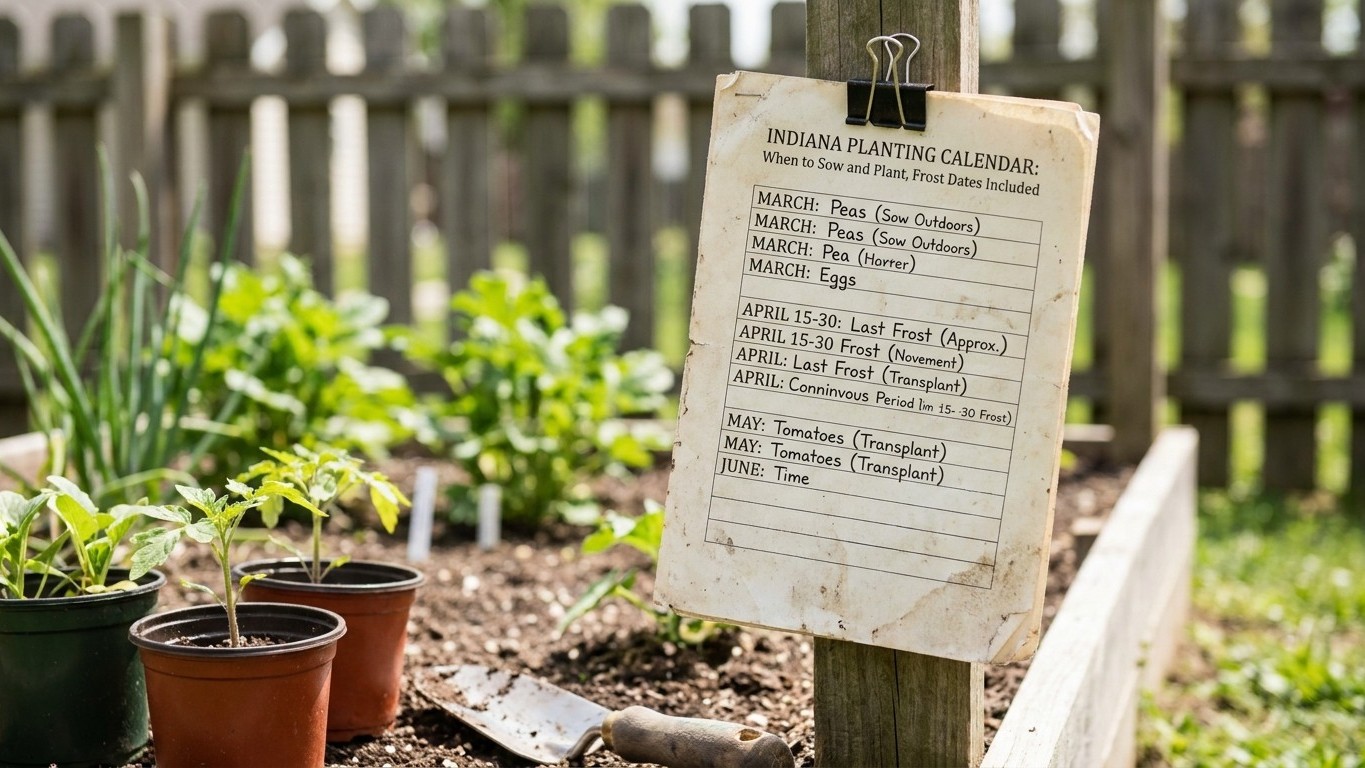

Indiana’s frost calendar isn’t the same in Gary as it is in Evansville, and that gap is exactly why the date on a seed packet keeps failing you. Your last spring frost falls somewhere between April 9 and April 21 depending on where you sit in the state, so the safe move is figuring out which end of that spread your own ground usually lands on. Start there, then build your sowing dates as offsets from it, not as fixed days on the wall.
The frost window in Indiana

Every planting date in this calendar traces back to two numbers: the last spring frost of April 9 to April 21 and the first fall frost of October 21 to October 30, both measured at the Indianapolis station under NOAA’s National Centers for Environmental Information 1991-2020 climate normals. These are freeze-probability windows, not single dates. NOAA’s data covers the range where a 32F freeze has a 30 to 70 percent chance of occurring, which is why the calendar gives a spread rather than a day to circle on the wall.
Indianapolis sits near the center of the state, and that matters because Indiana runs nearly 300 miles from the Ohio River to Lake Michigan. Northern counties, especially those near the lake, typically see their last frost run later in spring and their first fall frost arrive earlier, tightening the growing season from both ends. Southern Indiana, closer to the Ohio River, tends toward the opposite: an earlier last spring frost and a later first fall frost, stretching the frost-free stretch out by two weeks or more compared with the Indianapolis figures.
Growing season length
Counting from the Indianapolis dates alone, the frost-free season runs from as few as 183 days (last frost April 21 to first frost October 21) to as many as 204 days (last frost April 9 to first frost October 30). That’s roughly six to six and a half months of growing, though the actual span in your yard depends on which end of each range your local weather lands on in a given year. Purdue Extension adds a caution worth building into planting decisions: even after the published spring window closes, there’s still roughly a 10 percent chance of another 32F freeze. That’s not a large risk, but it’s large enough that tender transplants set out on the early edge of the window should have row cover or buckets ready.
Every sowing and transplanting date later in this calendar is stated as an offset from these two windows rather than as a fixed day, for exactly this reason. A fixed date works for one town in one year and misleads everyone else. If you’re planning even earlier indoor starts or cold-frame work, see What to Plant in Indiana in January first. If you’re instead looking ahead to peak summer sowing, check out What to Plant in Indiana in July. If you’re getting an early start on cold-hardy crops, check What to Plant in Indiana in March first, or if you want to go even earlier with indoor starts, see What to Plant in Indiana in February, or if you’re planning ahead for winter cover crops and dormant-season tasks, see What to Plant in Indiana in December, or if you’re planning fall crops instead, see What to Plant in Indiana in September, or if you’re planning your fall garden instead, see What to Plant in Indiana in October, or if you’re planning further ahead for warm-season crops, see What to Plant in Indiana in June, or if you’re planning ahead for warmer weather, see What to Plant in Indiana in May. For a month-by-month breakdown once the frost window closes, see What to Plant in Indiana in April, and if you’re planning succession crops for the tail end of summer, What to Plant in Indiana in August picks up where the spring guide leaves off ahead for cooler-season crops, see What to Plant in Indiana in November for how that offset approach carries into the fall garden. Gardeners just across the border in Iowa work through a similar spread each spring, and the Iowa Planting Calendar lays out how that state’s frost window compares county by county.
Cool-season crops
Cool-season vegetables tolerate light frost and actually grow best in the cooler soil that follows a Midwest winter, so their sowing dates are pegged to weeks before the last spring frost, not after it. Peas and spinach are the most frost-hardy of the common garden crops: both germinate in cold soil and shrug off a light freeze once they’re up, so they can go into the ground as soon as the soil can be worked in early spring, well ahead of the Indianapolis last-frost window of April 9 to April 21.
Lettuce, along with the brassicas (broccoli, cabbage, kale, and collards started as transplants), sit a step behind. Their seedlings handle a light frost but not a hard freeze, so most gardeners set transplants out a few weeks before the last frost date rather than right at it, watching the forecast for anything colder than a light frost in the following stretch. Direct-sown lettuce seed can go in earlier still, since seed in the ground isn’t at risk the way a leafed-out transplant is.
Sowing order by hardiness
Root crops split into two groups by how they handle the transition. Carrots, beets, radishes, and turnips are direct-sown from seed and tolerate cold soil poorly for germination, but the seedlings themselves handle frost well once up, so they’re typically sown a few weeks ahead of the last frost date too. Radishes are the fastest of the group and can be resown every couple of weeks through the cool part of spring for a continuous harvest before the soil warms enough to turn them woody and bitter.
- Hardiest, tolerates hard freezes once established: peas, spinach, kale transplants.
- Moderately hardy, tolerates light frost: lettuce, broccoli, cabbage, collard transplants.
- Direct-sown roots, seedlings frost-tolerant though germination slows in cold soil: carrots, beets, radishes, turnips.
The common mistake with all of these crops isn’t planting too early, it’s planting too late. Cool-season crops pushed into warming soil in late spring bolt to seed or turn bitter well before they size up, because they’re reacting to day length and heat rather than the calendar. Watch your soil, not the wall calendar: if it crumbles rather than clumps when you squeeze a handful, and the surface has dried past the first inch, it’s workable regardless of what the date says.
Warm-season crops

Tomatoes, peppers, squash, beans, and corn are all frost-tender start to finish, but the frost date is only half the calculation. What actually limits when you can put these out is soil temperature, not air temperature. A tomato transplant set into cold, wet soil right after the last frost date sits and sulks, sometimes for weeks, while one set out a week or two later into soil that’s actually warmed through will outgrow it. Wait until the soil several inches down feels warm to the touch, not just the air above it.
For tomatoes, that generally lines up with late April to early May around Indianapolis, calculated by taking the NOAA 1991-2020 last-frost window of April 9 to April 21 and adding roughly one to two weeks of margin for soil warm-up and Purdue Extension’s noted 10 percent risk of a late freeze. Beans, squash, and corn are more sensitive to cold soil at germination than tomato transplants and are usually direct-sown a little later still, once the freeze risk has passed entirely rather than just mostly.
If you’re starting tomatoes and peppers indoors rather than buying transplants, count backward from that late April to early May set-out window. Most tomato seed needs five to seven weeks indoors before it’s ready to go out, which puts the sowing date in mid to late March for an early May transplant. Peppers are slower to size up and are usually started closer to eight weeks ahead, pushing their indoor sowing date into early to mid March.
Matching the variety to the season
Catalogue days-to-maturity figures are counted from the transplant date, not the seed date, and they shift by a week or so depending on the season’s heat. Crossing those figures against the Indianapolis frost windows shows how much margin a variety carries before the first fall frost is likely.
| Variety | Days to Maturity | Type | Set Out | First Ripe | Margin Before Fall Frost |
|---|---|---|---|---|---|
| Sakura | 55 | Indeterminate | Late April to early May | Late June | 114 days |
| Edox | 55 | Indeterminate | Late April to early May | Late June | 114 days |
| Valentine | 55 | Indeterminate | Late April to early May | Late June | 114 days |
| Glacier | 55 | Determinate | Late April to early May | Late June | 114 days |
| Sun Gold | 57 | Indeterminate | Late April to early May | Early July | 112 days |
| Supersweet 100 | 60 | Indeterminate | Late April to early May | Early July | 109 days |
| Juliet | 60 | Indeterminate | Late April to early May | Early July | 109 days |
| Amalfi | 68 | Determinate | Late April to early May | Mid July | 101 days |
| Cherokee Purple | 72 | Indeterminate | Late April to early May | Mid July | 97 days |
| Big Beef Plus | 72 | Indeterminate | Late April to early May | Mid July | 97 days |
| Tiren | 75 | Indeterminate | Late April to early May | Mid July | 94 days |
| Granadero | 75 | Indeterminate | Late April to early May | Mid July | 94 days |
| San Marzano II | 78 | Indeterminate | Late April to early May | Late July | 91 days |
| Celebrity Plus | 78 | Determinate | Late April to early May | Late July | 91 days |
Even the latest-maturing variety in that table, at 78 days, ripens with more than three months to spare before the Indianapolis first fall frost of October 21 to October 30, which tells you Indiana’s growing season rarely limits tomato variety choice on its own. Disease pressure is usually the bigger factor: Big Beef Plus and Celebrity Plus both carry high resistance to Tomato Mosaic Virus and intermediate resistance to nematodes, useful in a garden with a history of either, while Amalfi’s intermediate resistance to both early and late blight suits a wetter, more disease-prone site.
The fall planting window
Fall planting works backward from the first fall frost of October 21 to October 30 around Indianapolis, per NOAA’s 1991-2020 normals. Take a crop’s days to maturity, add a margin of a week or two because growth slows as daylight shortens through September, and count back from the earlier end of that frost window if you want a safety margin, or the later end if you’re willing to gamble on a mild autumn.
Which crops fit the arithmetic
That math favors fast crops for a fall planting. Radishes, at three to four weeks from seed, fit easily into a sowing anytime through late summer. Spinach and lettuce, both quick and cold-tolerant, can be sown into mid to late summer for a fall harvest and will keep producing right up to and past a light frost. Bush beans sit at the outside edge of what’s practical for a fall crop in Indiana, since they need nearly the entire span between a mid-summer sowing and the first freeze with almost no room for a slow week.
Some crops don’t just tolerate the first light frosts of autumn, they improve because of them. Kale, Brussels sprouts, and carrots left in the ground through a light freeze convert stored starches to sugars as a cold defense, which is why gardeners who taste kale before and after the first frost notice a real difference. Spinach does the same on a smaller scale. This is one case where the fall frost date isn’t a deadline to beat but a milestone to plant around, holding the crop in the ground a little past it rather than rushing the harvest before it.
Gardeners in far colder climates plan fall crops around a much tighter window. The Prince Edward Island Planting Calendar shows just how much shorter that margin gets once the first fall frost moves up into September, a contrast that puts Indiana’s late-October window in perspective.
Reading a planting calendar properly
Every date on this page, and on any state-wide planting calendar, is built from a weather station average, not a promise about your particular yard. The Indianapolis figures NOAA publishes are a sound starting point for the middle of the state, but Indiana’s geography pulls conditions away from that average in several directions at once.
What actually shifts your local dates
Elevation matters more than most gardeners expect: a garden on a hilltop drains cold air away and often runs a few degrees warmer on a clear, still night than a garden in a low spot a half mile away, where cold air pools. Proximity to Lake Michigan moderates temperature swings for counties near the shore, delaying both the last spring frost and the first fall frost compared with inland counties at the same latitude. Urban areas generate their own heat island, and a garden in downtown Indianapolis will often run measurably milder overnight than one in an open field on the city’s edge, simply from stored heat in pavement and buildings.
A late cold snap is the scenario every one of these averages fails to predict, because an average is not a forecast. NOAA’s 30 to 70 percent freeze-probability band means a real chance of frost on both sides of the stated window in any given year, and Purdue Extension’s note about a residual 10 percent freeze risk after the spring date applies statewide, not just to Indianapolis.
The fix isn’t a better calendar, it’s watching your own garden over a season or two: note the date of your last hard freeze each spring, track how quickly your particular soil dries out and warms in April, and keep a simple log. Two or three years of your own numbers will tell you more about your yard than any state-wide average can.
Local help
For dates specific to your county, and for a soil test that tells you what your garden actually needs before you plant, contact Purdue Extension. County offices adjust the state-wide frost figures for local elevation and microclimate, catching problems no state-wide planting calendar can. Browse more Indiana guides for county-level planting advice and other state-specific growing information.
Common questions
Can I plant tomatoes in Indiana in April?
Only under cover, and even then it’s risky. The Indianapolis last-frost window from NOAA runs April 9 to April 21, and Purdue Extension notes a roughly 10 percent chance of another freeze after that. Most gardeners wait until late April to early May and keep row cover on hand for a cold snap.
What zone is Indiana for planting?
Indiana’s USDA hardiness zone isn’t the same figure as a frost date, and it varies from north to south across the state. Hardiness zones measure winter minimum temperatures for perennial survival, not when to plant annual vegetables, so check the USDA hardiness zone map for your county separately from the frost dates on this page, which govern sowing and transplanting.
How do I know if my soil is warm enough for beans and squash?
Push a soil thermometer a few inches into the bed and check it in the morning before the sun warms the surface artificially. If you don’t have one, judge by feel: soil that’s still cool and damp several inches down, even on a warm afternoon, isn’t ready. Waiting an extra week for warmer soil almost always beats a head start into cold ground, since seed sitting in cold soil is more likely to rot than germinate.
Is it too late to plant a fall garden if I missed early summer?
It depends on the crop, not the calendar page. Fast crops like radishes, spinach, and lettuce can still go in well into late summer and mature before the Indianapolis first fall frost of October 21 to October 30. Slower crops like broccoli or bush beans need to be counted backward from that frost window using their days to maturity plus a margin for slowing fall growth, and if the arithmetic doesn’t leave enough days, it’s genuinely too late for that particular crop this year.
Do the frost dates change much across Indiana?
Yes, and by more than a few days. The NOAA figures on this page are measured at Indianapolis, and southern Indiana, closer to the Ohio River, tends to see an earlier last spring frost and a later first fall frost than the Indianapolis average, while northern counties near Lake Michigan often see the opposite, tightening the season from both ends by two weeks or more.
Related guides
- Michigan Planting Calendar: When to Sow and Plant, Frost Dates Included
- Iowa Planting Calendar: When to Sow and Plant, Frost Dates Included