
October frost in St. John’s arrives early, around the 17th, and winter cold piles in hard behind it through November — weeks of freezing ground before spring even gets close. That’s the whole game with garlic: a clove needs a long stretch below 40°F to split into a proper bulb instead of staying one solid lump. Newfoundland and Labrador hands over that cold with room to spare, no careful counting of hours required. The bigger question is what your own yard does with it.
Will garlic get the cold it needs in Newfoundland and Labrador

Garlic only forms a proper bulb, divided into distinct cloves, after a spell of cold following planting. Skip that cold and the plant grows a single rounded clove instead of a head, which is the single most common reason a first-time grower ends up disappointed at harvest. University of Georgia Extension publication C854 sets the benchmark at six to eight weeks with soil temperatures below 40°F for a clove to divide properly.
Newfoundland and Labrador does not need to sweat that threshold the way a warm-winter state does. Environment and Climate Change Canada’s 1981-2010 normals put the mean first fall frost at St. John’s A station on October 17, and real winter cold typically follows close behind through November. That gives the ground weeks, not days, of hard cold well before spring, and it stacks up comfortably against the UGA minimum, even without a precise local count of hours spent below 40°F. Growers in similarly cold states, such as those following Growing Garlic in New Hampshire: Planting Dates, Varieties and Winter Cold, work through the same vernalization math, and both climates clear it without much drama.
If the cold falls short on your particular site
Where it can still go wrong is at the site level, not the province level. A south-facing bank against a heated foundation, a raised bed that drains fast and warms early, or a very late planting can all shrink the cold window a clove actually experiences. In those cases, two fixes work: chill seed cloves in a refrigerator at close to 40°F for four to six weeks before planting to force the vernalization artificially, or plant a softneck type, which tolerates a shorter or milder cold spell far better than a hardneck does. Choosing the right cultivar in the first place matters too, and a look at Garlic Varieties That Suit Newfoundland and Labrador Winters can help narrow that choice. Neither fix is a consolation prize. Growers in warm states without a real winter, like the guidance in Growing Garlic in Alabama: Planting Dates, Varieties and Winter Cold lays out, rely on the refrigerator step every single year and still get a full crop.
When to put the cloves in
Garlic planted in fall needs enough time to grow roots before the ground freezes solid, but not so much time that it pushes tall green shoots into the first hard freeze — check the When to Plant Garlic in Newfoundland and Labrador guide that growers rely on to get that balance right. That balance is why growers anchor the planting date to the average first frost rather than to a fixed calendar day. Environment and Climate Change Canada’s 1981-2010 climate normals put the mean first fall frost at the ST JOHN’S A station at October 17, and every variety in this territory’s planting list is set out in late September, roughly three to four weeks ahead of that mean date.
Treat October 17 as a midpoint and nothing more. Environment and Climate Change Canada’s normals describe an average across three decades of records, which means in roughly half of those years the actual first frost fell later than October 17, sometimes well later. Planting on the early side of late September gives the clove a cushion if the season runs true to form, and costs little if frost holds off.
What shifts the date on your own ground
St. John’s A sits on the coast, and the Atlantic moderates its fall temperatures more than an inland or upland site sees. A garden a few hundred feet higher in elevation, well inland, or deep into interior Labrador, will see its ground cool and freeze weeks ahead of the coastal norm. A large body of water nearby has the opposite effect, holding warmth into the evenings and pushing the safe planting window later. Where no frost record exists for a specific inland district, watch the soil rather than the sky: once soil at planting depth has cooled noticeably from its late-summer high, cloves can go in, and local growers in that district are the best gauge of how early that cooling typically arrives.
Which types suit Newfoundland and Labrador
Hardneck and softneck garlic are not interchangeable, and the difference that matters most here is winter. Hardneck varieties need a real, sustained cold season to perform, they produce a central flower stalk called a scape that gets cut off before it fully develops, and they carry fewer, larger cloves per bulb with sharper, more complex flavor. Softneck varieties tolerate a shorter or milder winter, skip the scape, braid well, and store considerably longer in a root cellar or pantry than most hardnecks do.
This is hardneck country. A province with a long, reliably cold winter is exactly the environment hardneck garlic rewards, and growers here can plant with confidence from that side of the list. Bavarian Purple, set out in late September like every variety on this list, is a reliable choice, alongside Blue Music, Chesnok Red, Duganski, Fall Festival, Georgian Crystal, Georgian Fire, German Red, German White and Ivan.
Softneck still has a place, particularly for a grower who wants a bulb that keeps into late winter without a root cellar. Inchelium Red and Lorz Italian both go in the ground the same late-September window as the hardnecks, alongside Early Red Italian and Italian Late. What softneck won’t give a grower here is any advantage over hardneck on cold tolerance, because this climate delivers more cold than softneck actually needs. The trade is storage life for flavor complexity and scapes, not hardiness.
- Hardneck: Bavarian Purple, Blue Music, Chesnok Red, Duganski, Fall Festival, Georgian Crystal, Georgian Fire, German Red, German White, Ivan
- Softneck: Early Red Italian, Inchelium Red, Italian Late, Lorz Italian
Soil and bed preparation
Garlic sits in the same patch of ground from late September through the following summer, which means it lives through the wettest, coldest months of the year before it ever produces a leaf worth mentioning. Drainage decides more outcomes than any disease does. A clove sitting in cold, saturated soil through a Newfoundland winter rots long before white rot or any other pathogen gets the chance.
Work compost or well-rotted manure into the bed a few weeks ahead of planting, not the same day, so the soil has time to settle and the organic matter starts breaking down rather than sitting fresh against the clove. Where natural drainage is poor, which is common on the heavier, often shallow soils found across much of the province, build a raised bed or ridge the row six to eight inches above the surrounding grade. That single step does more to keep a garlic crop alive over winter than any amendment added to flat, poorly drained ground.
Break up compaction to a full spade’s depth before planting. Garlic roots run deep for a shallow-rooted-looking plant, and compacted subsoil that perches water right at the root zone causes the same rot problems as a high water table would. Rake the bed to a fine, even surface just before planting so cloves seat cleanly at a consistent depth, since an uneven bed leaves some cloves shallow and exposed to frost heave and others buried too deep to push through in spring.
What the climate here favours, and what it does not
Disease pressure on garlic tracks temperature closely, and the published thresholds researchers use come from soil temperature, not the air temperature this section works from. Soil lags air by weeks and swings far less day to day, so treat the counts below as a tendency this territory’s climate leans toward, never as a forecast of infection. Infected seed stock can carry any of these pathogens into a garden regardless of climate, so a clean bill of temperature never means a clean bill of health.
UC IPM, the University of California’s Onion and Garlic Pest Management Guidelines (UC ANR Publication 3453), publishes the soil-temperature ranges each disease is active within. Set against the growing season’s air temperatures for this region, white rot’s published 50-75°F range overlaps three months of the growing season, including one month at the pathogen’s published optimum, which puts it as the disease this territory’s climate is most compatible with among the four tracked here. Fusarium basal rot‘s 59-90°F range overlaps a single month. Southern blight and pink root both need considerably more heat than this territory’s growing-season air temperatures reach at their published optimum, which means the climate here works against both, not for either.
Reading the table
| Disease | Pathogen | Published range | Months in range, Sept-July |
|---|---|---|---|
| White rot | Sclerotium cepivorum | 50-75°F (soil) | 3, including 1 at optimum |
| Fusarium basal rot | Fusarium oxysporum f. sp. cepae | 59-90°F (soil) | 1 |
| Southern blight | Sclerotium rolfsii | 86-95°F optimum (soil) | 0 |
| Pink root | Setophoma terrestris | 75-85°F optimum (soil) | 0 |
A month landing inside a disease’s range is a monthly average, not a month spent at that temperature every day. A month averaging in the middle of white rot’s range still swings well above and below it on a daily basis, and one reference station cannot describe the whole province, let alone the difference between coastal St. John’s and interior Labrador. The takeaway for white rot in particular is not to relax on sourcing clean seed garlic just because the cold season keeps overall pressure down.
Getting it through the winter
Winter mulch is the single biggest difference between growing garlic here and growing it somewhere the ground barely freezes. Lay a thick layer, deep enough to fully hide the soil surface, of straw or shredded leaves once the ground has cooled but before it locks up hard, not right after planting. Mulch put down too early traps warmth the clove doesn’t need and can encourage top growth that then gets hit by the first real freeze.
Depth and timing matter more than the material
A shallow-planted clove is the one that suffers most from frost heave, the repeated freeze-thaw cycling that literally pushes a clove partway out of the ground over the course of a winter. Planting at a proper depth, with the clove’s tip sitting a couple of inches below the surface, and then mulching heavily on top, is what keeps a clove anchored through repeated freezes and thaws rather than working its way upward and exposing itself to cold air and drying wind.
Leave the mulch in place through winter and into early spring. Pull it back gradually once new green shoots are visibly pushing through, rather than stripping it all at once, since a late cold snap after an early thaw can still damage exposed new growth. Some growers rake the mulch aside into the row middles rather than removing it entirely, which lets it be pulled back over the bed again if a hard, late frost threatens once growth has started.
Harvest and curing here
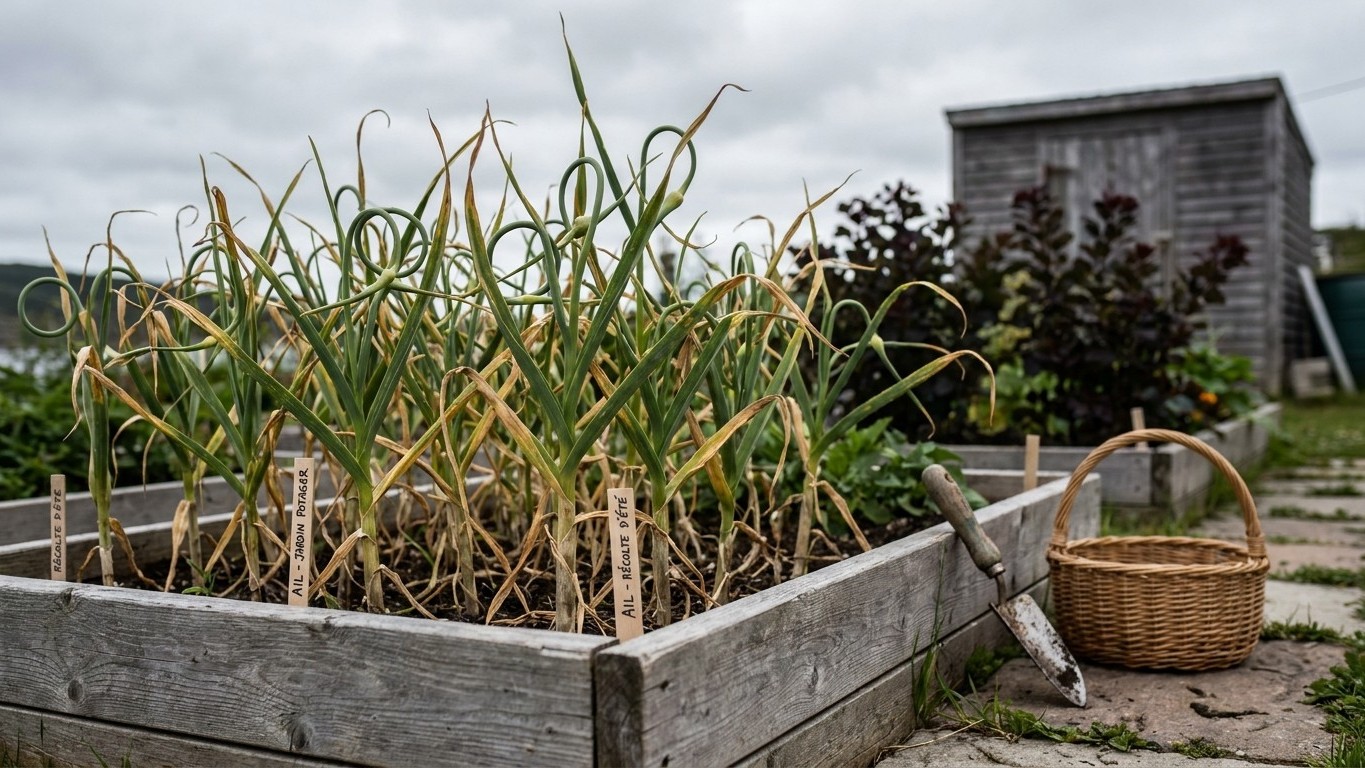
Garlic tells a grower when it’s ready far more reliably than any date on a calendar does. Watch the leaves, not the month: lift the crop when roughly the lower half of the leaves have died back and yellowed while the upper leaves are still green. Pulling too early leaves a bulb with thin, underdeveloped wrapper skins that won’t store, and waiting until every leaf has gone brown risks the bulb splitting open underground, which ruins its keeping quality even though the cloves themselves are fine to eat right away.
Curing in a cool, humid climate
Curing is where a lot of an otherwise good crop gets lost, and a cool, damp coastal climate makes it slower and less forgiving than a hot, dry one. Hang or lay bulbs in a single layer with airflow moving freely around every bulb, out of direct sun, and give the crop more time than a dry-climate guide suggests before assuming it’s cured. A small fan running continuously in the curing space makes a real difference in a humid summer, since still, damp air around the bulbs is what invites mold on the outer wrapper before the inner cloves have finished drying down. Don’t trim roots or tops, or wash off field soil, until the bulbs feel genuinely papery and the neck has tightened down hard, which in this climate can take noticeably longer than the three to four weeks often quoted for drier regions.
Local help
County-level frost dates, soil testing and variety performance notes are best confirmed locally before committing a whole bed to one plan. The Newfoundland and Labrador Department of Fisheries, Forestry and Agriculture runs the province’s extension service, reachable at gov.nl.ca/ffa, and is the right first call for anything specific to a district that a provincial-level guide like this one can’t pin down precisely.
Common questions
Can I Plant Garlic in spring instead of fall here?
Spring planting is possible but it gives up most of the yield, because the clove misses the long cold spell it needs to divide properly and often bulbs up small and late. Fall planting in late September, ahead of the region’s mean first frost, is the standard approach for a reason.
My garlic sent up leaves before winter, is that a problem?
Some top growth before the ground freezes is normal and not a cause for concern on its own. What matters is whether the growth is excessive, meaning several inches of green leaf rather than a couple of thin blades, which usually points to planting too early relative to the season and is worth adjusting the following year.
Do I need to remove the scape on hardneck garlic?
Yes, cut the scape once it curls, on any hardneck variety like Duganski or German Red. Leaving it on redirects the plant’s energy into the flower stalk instead of the bulb, which reduces bulb size at harvest.
Is it too cold in Labrador to grow garlic at all?
No, but the growing season runs shorter and colder than the St. John’s figures used in this guide describe, and both the planting window and the frost dates shift meaningfully earlier the further inland and north a garden sits. Local growers and the provincial extension service are the best source for a specific district’s timing.
Why did some of my bulbs come up as a single round clove?
That’s a sign the clove didn’t get enough sustained cold after planting to divide, usually from planting too late, too shallow, or in an unusually mild pocket of the garden. Refrigerating seed cloves for four to six weeks before planting the following year, or choosing a variety with a lower cold requirement, both address it directly.