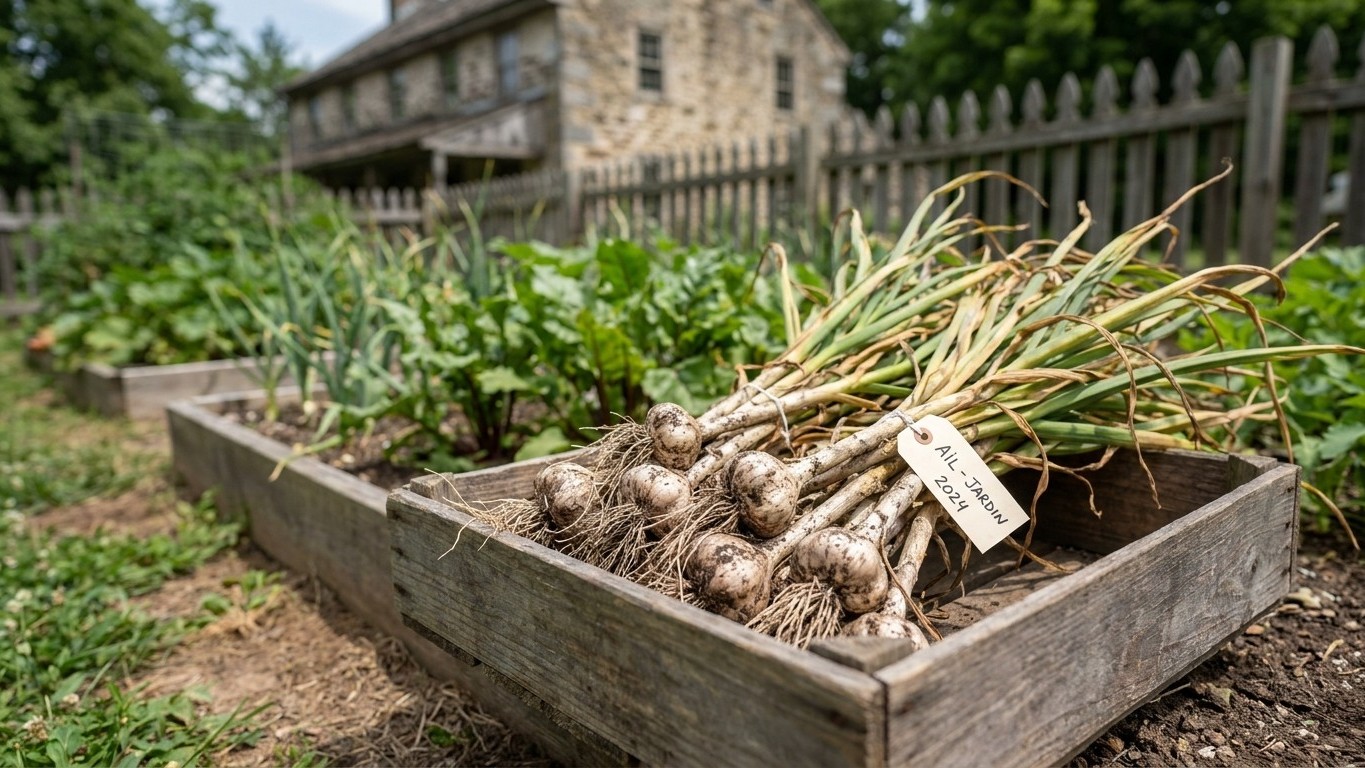

Philadelphia’s corner of Pennsylvania is the one place in the state where a grower might assume the winter runs too soft for garlic to split properly into cloves. It doesn’t. Even there, air temperatures sit below 40°F for weeks on end from December into February, and soil holds that chill longer than air does. A clove needs six to eight weeks of that cold to divide into a head instead of growing into one round, undivided bulb. Philadelphia clears it easily.
Will garlic get the cold it needs in Pennsylvania

What the six-to-eight-week rule means
Garlic clove division depends on a real stretch of cold after planting. University of Georgia Extension publication C854 puts the requirement at six to eight weeks with soil temperatures below 40°F. Skip that vernalization and the plant never splits the clove into a head of cloves. It just grows one round, undivided bulb, worthless for replanting and disappointing on the plate.
Pennsylvania is not a marginal case for this requirement, not even in its mildest corner. Philadelphia, sitting at the warm southeastern edge of the state, still runs a long stretch of weeks with air temperatures below 40°F from December into February most winters. Soil lags air by a few weeks and swings less, so the ground itself holds that chill even longer than the air does. Most Pennsylvania gardens clear the six-to-eight-week threshold with room to spare, and the northern tier and the Alleghenies, which run colder than Philadelphia, clear it even more easily.
If your site falls short
Where a grower might fall short is a warm microclimate: a sheltered urban courtyard, a south-facing wall that holds heat, or an unusually mild winter. If a bulb comes up round the following July instead of divided into cloves, that is the tell. The fix does not require moving to a colder state. Refrigerate seed cloves at 35-40°F for the four to six weeks before planting to substitute for a shortfall in field cold, or choose among the Garlic Varieties That Suit Pennsylvania Winters, including softneck types, which tolerate a lighter chill and still divide reliably.
Compare this to a genuinely cold-winter growing region such as Prince Edward Island, where growing garlic in Prince Edward Island means the cold requirement is never in doubt and the grower’s problem runs the other way, protecting cloves from a winter that is almost too severe. Pennsylvania sits comfortably in between: cold enough to skip the refrigeration step in most years, without the deep frost that forces growers further north to bury cloves under a thick blanket of mulch just to keep them alive.
When to put the cloves in
Plant by counting backward from frost, not forward from a date on the calendar, using the When to Plant Garlic in Pennsylvania guide that growers rely on. NOAA’s 1991-2020 climate normals put Philadelphia’s first fall frost between November 5 and November 16, a range rather than a single safe day. Set cloves out three to five weeks before that window, which lands most Philadelphia-area plantings in mid to late October. That gives roots time to establish in warm soil before the ground locks up, without enough time left in the season to push much leaf growth above ground.
Every cultivar on the list below carries the same recommended window for this reason. Garlic does not care what variety it is when it comes to root timing. It cares about soil temperature and day length, and both track the calendar the same way regardless of hardneck or softneck. Long-time Pennsylvania growers often treat the frost range as a deadline for finishing planting rather than a starting gun for beginning it.
What moves the date across the state
Philadelphia is the mildest corner of Pennsylvania, and NOAA’s own data flags that the northern tier and the Alleghenies run two to four weeks later for their last spring freeze. That lag has a mirror in autumn: those same higher, colder parts of the state typically see their first freeze arrive earlier than Philadelphia does. A grower in the Poconos or along the New York border should plant correspondingly earlier, not by copying the Philadelphia window verbatim. Elevation matters as much as latitude here, since a garden at higher elevation in the Alleghenies cools faster in autumn than a garden at the same latitude down in a river valley. Proximity to Lake Erie in the northwestern corner of the state has the opposite effect, holding heat late into fall and pushing the safe planting window later than inland spots at the same latitude.
The cost of planting off-window
Missing the window in either direction costs something specific. Plant too early against a warm fall and the clove sends up leaves that then get burned back by the first hard freeze, wasting stored energy the bulb needed for spring growth. Plant too late and the roots have not anchored before the ground freezes solid, and heaving through freeze-thaw cycles can push cloves up out of the soil over winter. Neither mistake is fatal on its own, but both weaken the crop before it has really started.
Which types suit Pennsylvania
Pennsylvania’s winters favor hardneck garlic over softneck, though both grow here without much trouble. Hardneck varieties are the ones that send up a curling flower stalk, called a scape, and they need a real winter to perform their best: the more marked the cold, the bigger and more evenly divided the bulb tends to be the following summer. Softneck varieties never send up a scape, braid well, and shrug off milder winters elsewhere, but they also grow perfectly well in Pennsylvania’s colder ground. The main reason to choose softneck here is storage, not survival: softneck bulbs typically keep several months longer in the pantry than hardneck bulbs do. Illinois sits in a similarly cold continental climate, and the hardneck-leaning reasoning covered in growing garlic in Illinois follows much the same logic as it does here.
Hardneck varieties worth planting
Hardneck garlic is the safer default for a Pennsylvania bed specifically because the state’s winter cold, discussed above, plays directly to its strength. German Red and German White are two of the more commonly grown hardnecks for a cold-winter garden, producing large, easy-to-peel cloves. Chesnok Red and Duganski are Purple Stripe types known for strong raw flavor and reliable division after a full winter outdoors. Bavarian Purple, Georgian Crystal, and Georgian Fire round out the hardneck options. Blue Music, Fall Festival, and Ivan fill out the list, and all of them go into the ground on the same mid-October to late-October schedule as the softnecks below, since planting timing here is set by frost date rather than variety.
Softneck varieties for longer storage
Where a Pennsylvania grower wants garlic that lasts into the following spring rather than being used up by midwinter, softneck is the better call. Inchelium Red and Lorz Italian are two Artichoke-type softnecks that store well and adapt to a wide range of soils. Early Red Italian and Italian Late round out the softneck options, and both go into the ground on the same schedule as the hardnecks above. None of these varieties requires anything different at planting time in Pennsylvania. The type decision is about the kitchen and the pantry more than the garden bed.
Soil and bed preparation
Garlic sits in the same bed for eight to nine months, through freeze, thaw, and every rain that falls between planting and the following summer’s lift. Drainage matters more than fertility for that reason. A clove that sits in saturated soil through a wet December rots before any disease organism even gets involved. Raised beds or ridged rows solve this in the heavier clay soils found across much of Pennsylvania, where flat plantings can collect standing water after a hard rain.
Work compost into the bed a few weeks before planting rather than the day of, so it has time to settle and start feeding the soil biology rather than sitting as a raw amendment around a fresh clove. Garlic is a heavy feeder over its long season in the ground, and a bed that starts rich has a real head start over one topped up later. A soil test through your county extension office, discussed further below, tells you whether phosphorus and potassium need boosting before winter, since both move slowly through soil and are best corrected before planting rather than after.
Before-planting checklist
Run through the same checklist most Pennsylvania growers use before planting day:
- Clear the bed of the previous crop’s roots and debris, especially anything in the onion or allium family
- Work in finished compost or aged manure two to three weeks ahead of planting
- Raise or ridge the bed if the soil is heavy clay or the site collects water after rain
- Break up compaction at least a shovel’s depth down, since garlic roots run deep over the winter
- Hold off on fresh nitrogen right before planting; it pushes leaf growth the plant does not need going into winter
Avoid following onions, leeks, or last year’s garlic in the same bed. All three share the same soil pathogens, and a Pennsylvania winter does nothing to sterilize a bed between crops. Rotate garlic to a new spot on at least a three-year cycle if space allows it, since some of the fungi that trouble garlic persist in soil for years without a host.
What the climate here favours, and what it does not
How to read these numbers
UC IPM’s Pest Management Guidelines for Onion and Garlic (UC ANR Publication 3453) publish temperature ranges for the fungi behind the worst garlic diseases. Measuring Philadelphia’s monthly mean air temperatures against those published ranges shows which months of the Pennsylvania growing season sit inside each disease’s window, and which do not.
Two caveats apply to every number that follows. The published ranges are soil temperatures, and the figures compared against them here are air temperatures, so a month that falls inside a range is a tendency toward risk, not a measured infection event. Soil lags air and swings less, especially at planting depth. A monthly average is also not a day-by-day forecast. A month averaging 60°F still holds days well above and below that mark, so a single point figure hides real daily variation. And one weather station, even a well-kept one, describes its own corner of the state better than it describes all of Pennsylvania.
Where Pennsylvania’s climate lines up
With those limits stated, the pattern for Philadelphia’s climate runs like this. White rot, caused by the fungus Sclerotium cepivorum, has a published range of 50-75°F, and Philadelphia’s mean air temperature falls inside that range in five months of the growing season: September, October, April, May, and June, with one of those months landing at the fungus’s published optimum. That is the widest window of any disease checked here, and it lines up with exactly the weeks garlic spends rooting in fall and pushing growth in spring. Fusarium basal rot, caused by Fusarium oxysporum f. sp. cepae, has a published range of 59-90°F, and falls inside that range in four months here: September, May, June, and July, again including one month at its optimum. Pink root, caused by Setophoma terrestris, has a narrower 75-85°F optimum that Philadelphia’s climate touches in just one month, July, right around harvest time. Southern blight, caused by Sclerotium rolfsii, needs an 86-95°F optimum that no month here reaches on average, meaning that disease runs at reduced activity through a typical Pennsylvania season rather than being shut out of it entirely.
None of this means a garlic bed here is doomed to white rot or Fusarium. It means the climate does not actively work against those fungi the way it works against southern blight. Clean, certified seed stock and the crop rotation covered above do more to keep these diseases out of a bed than the weather does, since infected planting material carries every one of these pathogens regardless of what the thermometer reads.
Getting it through the winter
Mulch timing
Mulch is not optional in Pennsylvania the way it might be in a milder growing region. Lay four to six inches of straw or shredded leaves right after planting, not weeks later, so the ground never gets the chance to freeze bare before insulation is in place. That timing matters more here than the exact material used. Straw, chopped leaves, or even a thin layer of compost topped with leaves all do the job of buffering the soil against the freeze-thaw swings that do the real damage over a Pennsylvania winter.
Freeze-thaw cycling, not deep cold itself, is what pushes cloves up and out of the ground. A clove planted at the standard two-inch depth has very little soil holding it down if the ground repeatedly freezes solid and then thaws over a warm stretch in January or February, which happens most winters somewhere in the state. Mulch slows that cycling by keeping the soil temperature more even, so the ground freezes once in early winter and stays that way rather than thawing and refreezing every time a warm front comes through. A heaved clove that ends up sitting on top of the soil, roots exposed to the air, rarely survives to spring.
Spring removal
Leave the mulch in place through winter and well into spring. Pull it back gradually once new green shoots are pushing up reliably and the hardest freezes have passed, rather than stripping the bed bare at the first mild week. Pulling mulch too early exposes new growth to a late frost that a covered bed would have shrugged off, and Pennsylvania’s spring, especially away from Philadelphia in the colder northern and mountain counties, is prone to exactly that kind of late setback. Thin the mulch rather than removing it completely, leaving an inch or two down as the soil warms, and finish removing it only once shoots are several inches tall and clearly established.
Harvest and curing here
Reading the leaves
Lift garlic by reading the plant, not the date on a calendar. The signal to dig is the lower leaves browning while four to six upper leaves are still green, since each green leaf corresponds to an intact wrapper layer around the bulb. Wait for every leaf to brown and those wrapper layers have already started to degrade underground, leaving bulbs that look fine at harvest but do not store well.
- Lower third to half of leaves have browned and dried
- Four to six leaves at the top are still green
- Scapes, on hardneck varieties, were cut a few weeks earlier
- A test bulb, dug up early, shows cloves clearly separated and wrappers still intact
Dig rather than pull. Loosen the soil a few inches out from the stalk with a fork first, since pulling a bulb straight up out of Pennsylvania’s clay-heavy soils tears the wrapper leaves and leaves that bulb exposed to rot in storage within weeks.
Curing in a Pennsylvania summer
Curing is where a Pennsylvania summer works against the grower more than the growing season does. A humid July or August, common across much of the state, slows the drying that curing depends on, and bulbs left in damp air too long can mold from the outside in before they ever fully cure. Cure in a spot with real airflow, a covered porch, a garage with a fan running, or a shed with the doors cracked, out of direct sun, for three to four weeks. Do not cure in a closed, humid space even if it is shaded, since still, damp air does more damage in a Pennsylvania summer than a few hours of morning sun ever would. Bulbs are ready to trim and store once the outer wrappers are fully dry and papery and the necks have tightened down hard.
Local help
County-level planting dates, frost timing, and soil test results vary across Pennsylvania more than any statewide guide can capture. PSU Extension runs county offices that provide exactly that local detail, along with soil testing services that catch phosphorus or potassium deficiencies before they become a problem in the ground over winter. Find your county office through Penn State Extension before you finalize a planting date, especially if you garden outside the Philadelphia area this guide leans on.
Common questions
Can I Plant Garlic in spring in Pennsylvania instead of fall?
Spring-planted garlic in Pennsylvania rarely forms a proper divided head, because it misses the fall-to-winter cold period the clove needs to split, covered above. Fall planting, anchored on the first fall frost, is the standard method for every variety on this list. A grower can force a spring planting by refrigerating cloves for several weeks beforehand to mimic that missed cold, but a fall planting date is simpler and more reliable.
What happens if I plant garlic too late in the fall?
Late-planted cloves do not root deeply before the ground freezes, and Pennsylvania’s freeze-thaw cycles over the following winter tend to heave a poorly rooted clove up and out of the soil. Heavy mulch put down immediately after a late planting reduces but does not eliminate that risk. If you miss the window entirely, holding the cloves in the refrigerator and planting them the following fall usually beats putting them in the ground very late.
Do I need to cut the scapes off my hardneck garlic?
Cutting scapes is optional but worth doing on hardneck varieties like German Red or Chesnok Red, since leaving the scape in place diverts energy away from bulb size. Softneck varieties never produce a scape, so the question does not apply to Inchelium Red, Lorz Italian, or the other softnecks on this list.
Can I use garlic from the grocery store as seed stock?
Grocery store garlic can grow, but much of it is treated with a sprout inhibitor and is often grown in climates very different from Pennsylvania, so it can perform poorly or fail to divide properly. Certified seed stock from a garlic supplier costs more per pound but avoids introducing soil-borne diseases like white rot into a bed that then carries the problem for years.
How do I know if my garlic has white rot?
White rot shows up as yellowing, wilting leaves and a white, fluffy fungal growth on the bulb and roots when you dig it up, often with small black sclerotia embedded in that growth. There is no cure once it is established in a bed, since the fungus survives in soil for years regardless of what is planted there next, so the real defense is certified clean seed stock and avoiding ground with a known history of the disease.