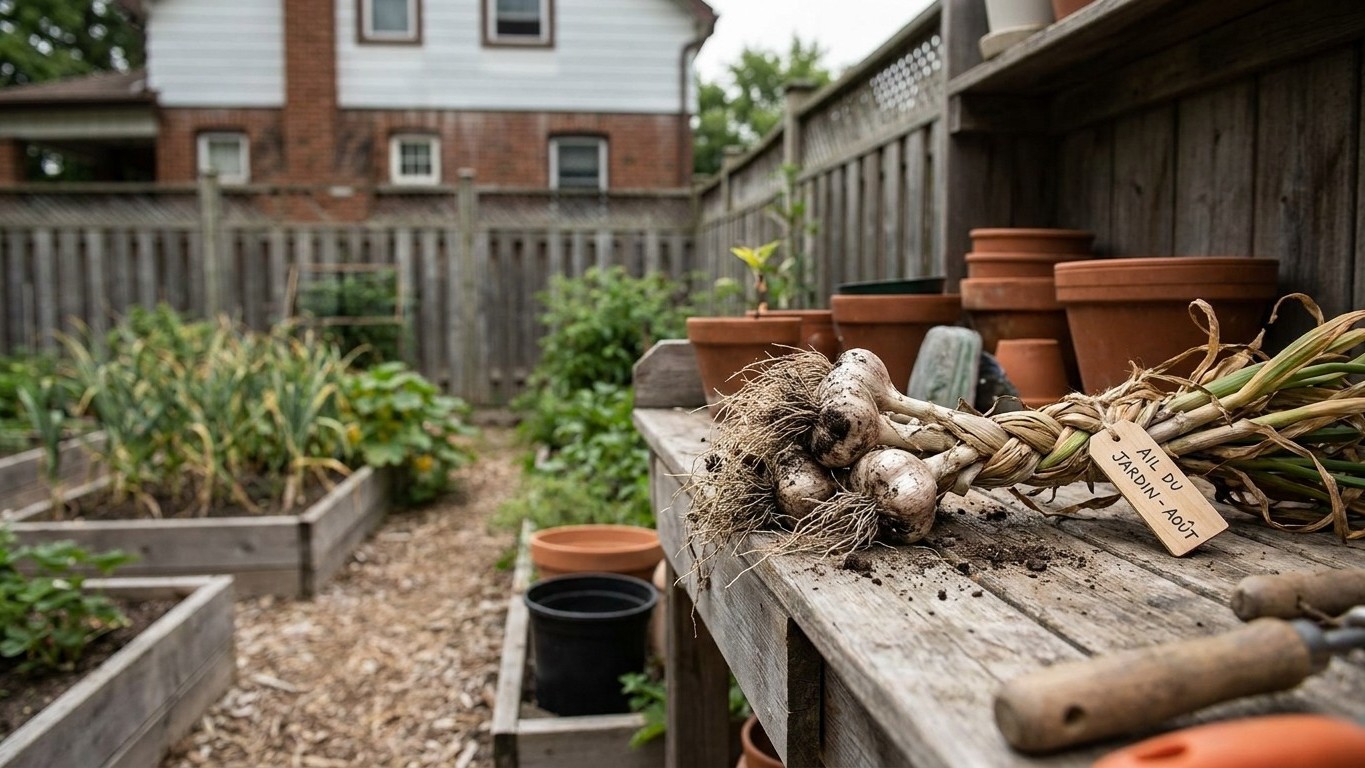

Ontario’s winters are cold enough for nearly any garlic on the market, hardneck or softneck. Environment and Climate Change Canada’s 1981-2010 Canadian Climate Normals, recorded at the Toronto Lester B. Pearson International Airport station, put the mean first fall frost at October 16. Plant your cloves in late September, working backward from that date, and pick your varieties by how you plan to use the crop rather than by worrying whether the winter will be cold enough.
The short answer for Ontario

Garlic planted in Ontario in late September gets enough winter cold to develop properly, whatever type you choose. Environment and Climate Change Canada’s 1981-2010 Canadian Climate Normals, measured at the Toronto Lester B. Pearson International Airport station, place the mean first fall frost at October 16. That date is a midpoint from thirty years of records, not a safety line. In roughly one year out of two the first frost lands after October 16, and in the other half it lands before, so treat it as the center of a window rather than a deadline you can plan against exactly.
Planting in late September gives cloves several weeks of cooling, still-workable soil to root into before the ground turns cold, which matters more than top growth at this stage. Once in the ground, cloves need a run of roughly six to eight weeks of cold to split into the multiple cloves you expect at harvest, a threshold set out by the University of Georgia Extension (publication C854). The Toronto station clears that bar with room to spare: it averages 30.4 weeks a year with mean temperatures below 40°F, so the six-to-eight-week requirement is not a close call anywhere in the province, only a floor that Ontario’s winter passes easily.
Because the cold is abundant rather than marginal, the choice among these fourteen catalogue varieties comes down to flavor, storage life and scapes rather than survival.
| Variety | Type | Wrapper appearance |
|---|---|---|
| Early Red Italian | Softneck | White, streaked pink to red |
| Inchelium Red | Softneck | White to tan, pink blush |
| Italian Late | Softneck | White to off-white |
| Lorz Italian | Softneck | Bright white |
| Bavarian Purple | Hardneck | White with purple streaks |
| Blue Music | Hardneck | Porcelain white, blue-purple blotches |
| Chesnok Red | Hardneck | Purple and white stripes |
| Duganski | Hardneck | Brownish-purple stripes |
| Fall Festival | Hardneck | Tan, marbled with purple |
| Georgian Crystal | Hardneck | Pure white |
| Georgian Fire | Hardneck | White |
| German Red | Hardneck | Reddish-brown to purple stripes |
| German White | Hardneck | Pure white |
| Ivan | Hardneck | Purple-streaked |
Working it out for your own garden
The Toronto figure is a starting point for the whole province, not a verdict on your own yard. Redoing the arithmetic yourself, with your own conditions plugged in, matters more than memorizing the October 16 date.
Counting from late September to frost
Late September to October 16 spans roughly two to four weeks, depending on where in late September you actually get cloves in the ground. That stretch is the rooting window before the soil turns properly cold. If you’re still mapping out beds and haven’t worked through the earlier steps of site selection and soil prep, Growing Garlic in Ontario covers that groundwork. For the week-by-week version of this same countdown, tailored to the planting date rather than the frost date, When to Plant Garlic in Ontario: Counting Back From the First Frost walks through it in more detail than a single average date can.
Why the mean date can mislead
Because October 16 is a mean and not a probability band, a grower who plants right on that date in a year when frost actually arrives in early November gets an extra two or three weeks of rooting they didn’t plan for, and one who plants the same week in a year when frost comes early loses that same margin. Neither outcome is a failure. Garlic tolerates a range of planting dates far wider than a single date suggests, which is exactly why the window is described in weeks rather than as one day on a calendar.
Elevation, a large lake nearby, and how exposed the site is to wind all shift the effective date further, sometimes by two weeks in either direction from what a single airport station records. A garden in a low frost pocket with no lake nearby will see its own first frost run ahead of the regional average, while a garden close to a large lake, warmed by the water through fall, often runs behind it.
What changes across Ontario
The Toronto station describes the climate around Lake Ontario’s western end, and other parts of the province run measurably different. The Niagara Peninsula and the Essex County shoreline near Windsor sit close to large bodies of water that hold summer heat into fall, which typically pushes the first hard frost later than the Toronto average and gives growers there a longer rooting window before the ground firms up.
Move inland and north and the pattern reverses. The Ottawa Valley and eastern Ontario lose the lake-moderating effect and see frost arrive earlier than the Toronto figure most years. Further north again, around Thunder Bay, Timiskaming, and the districts along Highway 11 and Highway 17, winters start earlier and run colder for longer, which means the same late-September planting guideline needs to shift earlier for growers in those districts rather than later.
Elevation matters on a smaller scale too. Higher ground in Muskoka and Haliburton cools faster on clear autumn nights than nearby valley bottoms, so frost tends to settle there first even within a single county. None of this changes what garlic needs to grow well. It only changes when a given garden crosses the threshold that triggers the fall planting window, which is why a single provincial date can only ever be a starting estimate.
The mistakes this climate punishes
Ontario’s winter cold is generous enough that undershooting the six-to-eight-week chilling requirement almost never happens by accident. The mistakes that actually cost a crop here are about timing, depth, and seed stock quality, not about whether the winter itself is cold enough.
Timing and depth errors
- Planting into November instead of late September, so cloves go dormant before rooting in, which leaves them more exposed to frost heave over winter.
- Planting too shallow, which lets freeze-thaw cycles push cloves partway out of the soil where they dry out or get frost-damaged.
- Skipping a mulch layer over the bed, which matters less for cold tolerance than for keeping soil temperature stable through the freeze-thaw swings common in a Great Lakes winter.
- Harvesting too early the following summer, before the lower leaves have started to brown, which produces bulbs with underdeveloped wrappers that store poorly.
Seed stock and disease pressure
The UC IPM Pest Management Guidelines for Onion and Garlic (UC ANR Publication 3453) publish the temperature ranges in which two soilborne pathogens are most active: white rot, caused by Sclerotium cepivorum, in the 50-75°F range, and Fusarium basal rot, caused by Fusarium oxysporum f. sp. cepae, in the 59-90°F range. Measured against mean air temperatures for the Toronto area, white rot’s range overlaps four months of the garlic growing season, September through the following May, June and July, and Fusarium basal rot’s range overlaps three, September, June and July. Those are air-temperature months compared against soil thresholds, and a monthly average hides plenty of day-to-day swing, so the count is a measure of opportunity, not a forecast of infection. It also does not mean the reverse is safe. Southern blight and pink root show no month in their optimum range at this station, but outside the optimum a pathogen is only less active, never absent, and infected seed garlic will find its own foothold regardless of the weather. The single mistake that actually invites these problems is planting saved cloves or grocery-store bulbs of unknown origin instead of certified, disease-tested seed garlic.
Checking this against your county
The October 16 frost mean and the 30.4-week cold count both come from one station near Toronto, and a province this size holds a much wider range of local conditions than one airport can describe. Before you lock in a planting date, check current recommendations and any local frost data through Ontario’s provincial agriculture ministry at ontario.ca/page/agriculture-and-food, which can point you toward county-level extension resources closer to your own garden than a single reference station ever will be.
Common questions
Is it too late to plant garlic if I miss late September?
Not automatically, but the margin shrinks fast. Cloves planted into October can still root before hard freeze in a mild year, but you lose the buffer that protects against an early frost, and hardneck types in particular seem to size down when rooting time is cut short.
Can I plant garlic in spring instead of fall in Ontario?
You can, but expect smaller bulbs. Garlic needs a sustained cold period to split into cloves, and a spring planting misses most of that chilling, so bulbs often come up as a single round instead of a properly divided head.
Does hardneck garlic actually need Ontario’s cold, or would softneck do just as well?
Both do well here. Hardneck types such as German Red and Chesnok Red are the ones traditionally associated with cold-winter regions and tend to produce scapes, while softnecks like Inchelium Red and Lorz Italian generally store longer into the following year. Ontario’s winter comfortably supports either group.
Is it safe to plant garlic from the grocery store?
It’s risky. Grocery garlic is often treated to slow sprouting, isn’t tested for soilborne diseases like white rot or Fusarium basal rot, and may not even be a variety suited to a fall-planted, cold-winter climate. Certified seed garlic from a known source costs more but avoids introducing problems that can persist in a bed for years.