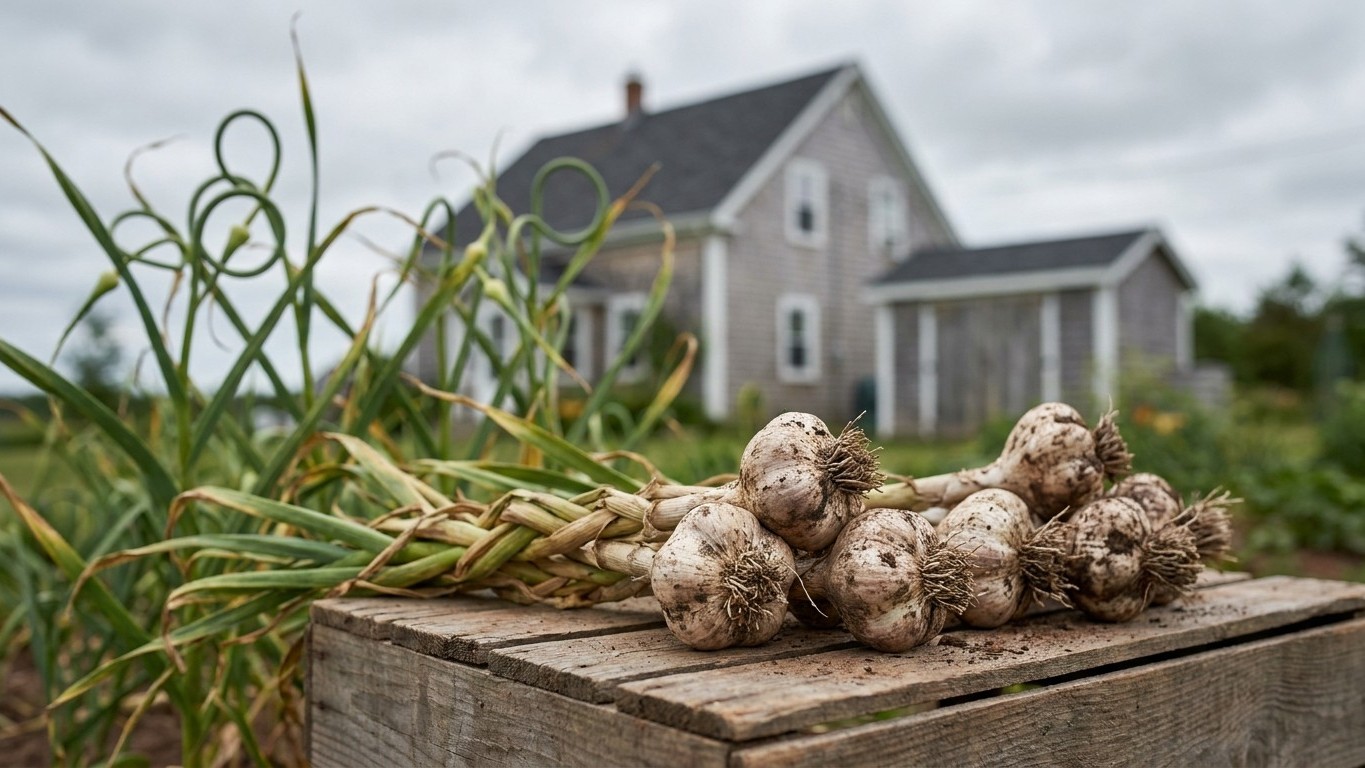

Garlic goes into Prince Edward Island soil in late September, timed against the average first fall frost of October 17 recorded at station Charlottetown A in Environment and Climate Change Canada’s 1981-2010 climate normals. That figure is a 30-year average, not a guarantee: in roughly half of those years, frost actually arrived after October 17. Get cloves separated and beds ready by mid-September so you’re not scrambling to plant into cold, wet soil during the last days of the month.
The short answer for Prince Edward Island

Plant garlic cloves in late September across most of Prince Edward Island. That single window covers hardneck types such as German Red, Chesnok Red and Duganski as well as softnecks like Inchelium Red and Lorz Italian, because none of them ask for a different calendar once you’re working from the same frost data.
The anchor point is Environment and Climate Change Canada’s 1981-2010 climate normals for station Charlottetown A, which put the average first fall frost at October 17. Late September lands roughly three weeks ahead of that average, giving cloves time to push roots into cooling soil before the ground itself starts to shut down for winter.
Treat October 17 as a midpoint, not a deadline. In about half of the thirty years behind that normal, frost arrived after October 17, sometimes considerably later. A planting plan that treats the frost date as a fixed line on the calendar is already off by weeks in half the seasons on record.
Counting back from frost makes sense for garlic in a way it doesn’t for a spring vegetable dodging a late freeze. You’re not trying to avoid the cold here, you’re using the weeks before hard freeze-up to get roots established while the soil is still workable. None of this is a question of whether the Island gets cold enough overall. University of Georgia Extension publication C854 lists six to eight weeks of post-planting cold as what garlic needs to split a clove into a full bulb, and Charlottetown’s winters run an average of 34.8 weeks with air temperatures below 40°F, far beyond what the crop requires. On PEI the real question is whether your cloves get enough weeks of root growth before the ground locks up, not whether winter shows up.
Working it out for your own garden
The three-week gap between late-September planting and Charlottetown’s October 17 average frost isn’t an arbitrary cushion. It’s what’s left after two things are accounted for: the week or so cloves need to grow their first roots in cooling soil, and the extra weeks after that when top growth keeps developing through light frosts, since a frost nips exposed leaves without touching the clove sitting below the surface.
The arithmetic, shown
Start from the Charlottetown A average of October 17. Move back roughly three weeks and you land in the last week of September, which is where every cultivar on the Island’s list sits, from softnecks like Italian Late and Early Red Italian to hardnecks like Bavarian Purple and Blue Music. The table below lines up a sample of both types side by side. None needs an earlier or later slot than the others, because clove type doesn’t change how fast roots form.
| Cultivar | Type | Recommended set-out |
|---|---|---|
| Inchelium Red | Softneck | Late September |
| Lorz Italian | Softneck | Late September |
| German Red | Hardneck | Late September |
| Chesnok Red | Hardneck | Late September |
| Georgian Crystal | Hardneck | Late September |
| Duganski | Hardneck | Late September |
If your own garden runs warmer or colder than Charlottetown in the fall, adjust the count, not the target week count. A garden that reliably stays a bit milder into October can lean toward the first days of October instead of the last days of September and still give cloves the same rooting window. A garden that reliably turns cold earlier should move into mid-September rather than wait for a calendar date that doesn’t match local conditions.
Large bodies of water are the biggest local variable on an island this size. Proximity to the Northumberland Strait or the Gulf of St. Lawrence coastline moderates fall air temperature, which can push the practical frost date later by a week or two compared with inland fields at the same latitude. Elevation plays a smaller role here than it would in a mountainous state. Prince Edward Island’s highest ground barely tops 140 metres, so elevation-driven temperature swings are modest next to what the coastline does.
What changes across Prince Edward Island
Charlottetown A is the only station behind the official 1981-2010 frost normal, but growing conditions are far from uniform across the Island’s three counties.
The north shore facing the Gulf of St. Lawrence, around communities like Cavendish and Brackley, sits close to open water that holds its summer warmth into fall. That moderating effect tends to push the first real frost later than it lands at Charlottetown, so gardens right along that coast can often afford to plant a few days later than the Island-wide late-September window without losing rooting time.
Inland low ground and river valleys work the other way. Cold air is heavier than warm air and drains into low spots overnight, so fields around the Hunter River and Kinkora areas can see a first light frost earlier than the coastal pattern, even sitting only a short drive from the water. A garden in one of these frost pockets should treat late September as the outer edge of the window, not the middle of it.
The far ends of the Island, Tignish in western Prince County and Souris in eastern Kings County, are both surrounded by water on multiple sides, which tends to keep their fall temperatures closer to the coastal pattern than to the inland one. None of this changes the underlying calculation, only where on the September-to-October calendar a particular garden should sit within it. Soil texture adds another layer: the Island’s well-drained red sandy loam warms and cools faster than the heavier clay pockets found in parts of central Queens County, which changes how long a given bed stays workable into fall.
The mistakes this climate punishes
Prince Edward Island’s fall and winter pattern turns a few common garlic mistakes into real crop losses rather than minor setbacks.
Planting too late
Waiting until frost has already hit before getting cloves in the ground is the most damaging habit here. Once soil temperature drops hard, roots barely form before the ground locks up, and a clove that heads into winter without roots is far more likely to heave out of the soil during freeze-thaw cycles than to survive and grow. Choosing between planting into slightly-too-warm soil in mid-September or waiting past the last week of the month, plant early.
Planting too shallow
The Island’s freeze-thaw pattern through late fall and early spring works cloves upward out of loose soil if they aren’t set deep enough. A shallow-planted clove is a heaved clove by March, sitting exposed on the surface instead of rooted below it.
Skipping the mulch
A mulch layer does two different jobs depending on when you look at it. In November it slows how fast the ground freezes, buying roots a few more days of growth. In March it keeps soil from swinging through repeated freeze and thaw as the season turns, which is when heaving does the most damage.
Assuming variety choice fixes timing
Because Prince Edward Island’s winter comfortably clears the cold requirement for splitting cloves into bulbs, growers sometimes assume a hardneck like Bavarian Purple needs an earlier planting date than a softneck to “get enough cold.” It doesn’t. Every cultivar on the Island’s list uses the same late-September window, because the difference between hardneck and softneck garlic is stem structure and clove count, not chill requirement.
- Planting after the first hard frost instead of ahead of it
- Setting cloves shallow enough that spring heaving pulls them loose
- Leaving beds unmulched through the freeze-thaw stretch in November and March
- Delaying hardneck varieties on the assumption they need extra cold exposure
Checking this against your county
Charlottetown A is one weather station covering a small fraction of a province with three distinct coastlines. Before locking in a planting date, check current conditions and any local guidance through Prince Edward Island’s Department of Agriculture page, which tracks conditions for Island growers beyond what a single Charlottetown normal can show.
If you’re still deciding what to plant rather than when, the variety guide for Prince Edward Island covers which hardnecks and softnecks suit Island winters before you settle on a planting date. And if beds aren’t ready yet, the overview on growing garlic in Prince Edward Island covers site selection and soil prep that should happen before cloves go in the ground.
Common questions
What happens if I miss the late September window?
Plant anyway, as soon as you can, rather than waiting for spring. Cloves set in during the first half of October can still root before the ground freezes hard, especially in a mild year, though you’re spending down the safety margin the late-September window is built on.
Can I Plant Garlic in spring instead in Prince Edward Island?
You can, but expect smaller bulbs. Spring planting skips most of the cold exposure that triggers a clove to split into a full head, and on the Island that cold period is exactly what fall planting is designed to capture.
Does a light frost right after planting kill the cloves?
No. A frost damages exposed leaf tissue, not the clove sitting below the soil surface. That’s part of why the planting window is built around weeks rather than a single date. A few frosty nights in early October don’t undo a late-September planting.
Do I need to remove mulch in spring or leave it on?
Pull the heaviest layer back once new shoots push through and the hardest freeze-thaw stretch has passed, but don’t strip beds bare the moment snow melts. Prince Edward Island’s spring freeze-thaw cycle can still heave shallow-rooted cloves well after the calendar says winter is over.
If you follow the almanac, here is when to plant garlic by the moon. It is a tradition, not a proven method.