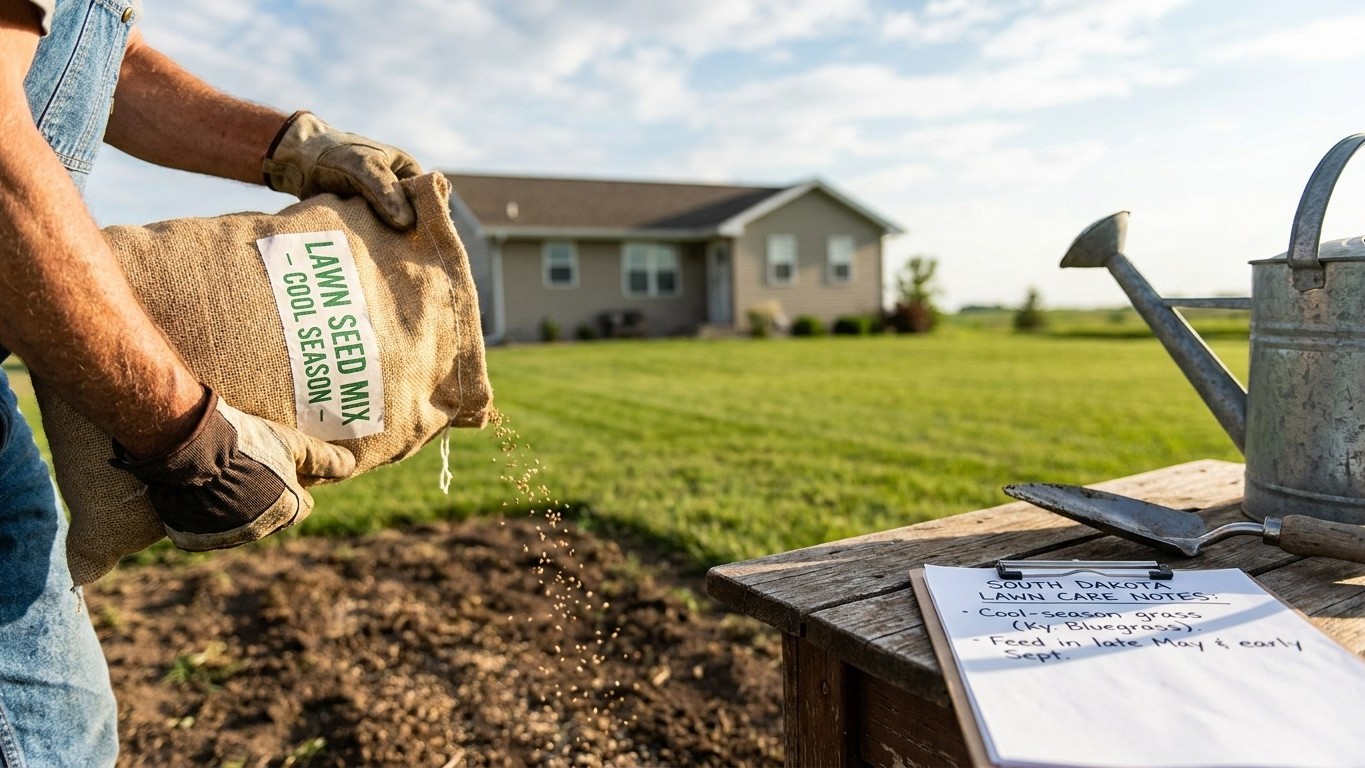

Winter is what decides your lawn, and 6.9°F for a coldest-month average means warm-season grass never had a chance here — Kentucky bluegrass, tall fescue, fine fescue and perennial ryegrass are the ones built to take it. So the choice comes down to matching one of those four to how much sun, shade, and foot traffic your own yard actually gets. Start there: walk your lawn, note which spots stay shaded and which get hammered by kids or dogs, and consult The Best Grass Seed for South Dakota Lawns to pick the grass suited to that spot rather than whatever bag is cheapest at the store. Once it’s in the ground, The South Dakota Lawn Care Calendar, Month by Month lays out what that grass needs done each month to actually establish and thrive.
Which grass belongs in South Dakota

Why cool-season grass wins here
The two numbers that matter for grass selection are how many days a year get hot and how cold the coldest month runs. NOAA’s 1991-2020 climate normals for Sioux Falls report only 13.8 days a year at or above 90°F, which is a thin summer heat load compared to what a bermudagrass or zoysia lawn needs to thrive. The same normals put the coldest month’s mean daily minimum at 6.9°F, well below what any warm-season species survives without dying back to bare dirt. Together those two figures point in one direction: this is cool-season turf country, the way Clemson Cooperative Extension’s HGIC 1214 defines the split between cool, warm and transition zones nationally.
Which species to actually plant
Clemson Cooperative Extension’s HGIC 1214, working with Penn State Extension’s species descriptions, lists five grasses suited to this pattern: Kentucky Bluegrass, Tall Fescue, Fine Fescue, Perennial Ryegrass and Rough Bluegrass. They differ enough in habit that picking one without thinking about the site is a waste of seed money.
| Grass | Shade tolerance | Drought tolerance | Best use |
|---|---|---|---|
| Kentucky Bluegrass | Low to moderate | Low, but recovers well after rain | Full-sun lawns that get regular water |
| Tall Fescue | Moderate | High, deep roots | General-purpose, high-traffic lawns |
| Fine Fescue | High | Moderate | Shade under trees, low-input areas |
| Perennial Ryegrass | Low | Low | Quick cover, overseeding, seed mixes |
| Rough Bluegrass | High | Very low, needs constant moisture | Damp, shaded spots, not a general lawn |
This is not a transition zone the way Kentucky’s lawns are, where Kentucky Lawn Care: What to Plant and When to Feed It has to weigh cool-season and warm-season options against each other. Sioux Falls winters settle the question outright for the reference city. That said, a state is not a single climate: the Black Hills sit colder at elevation, and counties along the Nebraska border see a few more warm days than Sioux Falls does. Check your own county’s normals through the extension service before assuming the reference-city figures apply exactly where you garden.
When to seed or sod here
Clemson Cooperative Extension’s HGIC 1203 sets the general cool-season seeding window at mid to late September, timed to warm-season grass’s opposite window of around May so each species gets its establishment period during its own growing season, not the other’s. For South Dakota’s cool-season lawns, that September window is the one that applies. Seeding in spring is possible but riskier, since young grass then has to survive summer heat and competition from crabgrass before it has a real root system.
Anchor that window against your own frost date rather than the calendar month alone. NOAA’s 1991-2020 climate normals put the first fall freeze at the Sioux Falls airport station in the September 24 to October 4 range, based on the 30 to 70 percent freeze-probability band. Seeding toward the earlier half of Clemson’s mid-to-late-September window gives new grass a few extra weeks of mild soil temperatures to root before that freeze arrives. Suburban and rural yards away from the airport station commonly see frost arrive a week or two earlier than the reference figure, and gardens at higher elevation see it earlier still, so anyone north of Sioux Falls or up in higher ground should lean toward the early edge of that window rather than the late one.
Gardeners just across the border in Wisconsin work from a nearly identical calendar, since Wisconsin Lawn Care: What to Plant and When to Feed It points to the same cool-season species and the same fall seeding logic. Sod can go down over a longer stretch than seed, since it arrives with an established root mat, but it still knits into the soil faster and needs less babying if it’s laid before the ground cools past the point of active root growth.
The feeding calendar that fits this climate
Nitrogen should follow the grass’s own growing season, not the calendar year. Cool-season turf does most of its rooting and carbohydrate storage in early fall, after summer heat breaks and before the ground freezes, so the heaviest feeding of the year belongs in September, not June or July. A spring-heavy feeding schedule pushes soft leaf growth right before the stress of summer, which is exactly the wrong time to ask the plant to spend energy on top growth.
Rates for the species you actually have
For tall fescue specifically, Clemson Cooperative Extension’s maintenance calendar, HGIC 1219, lays out roughly one pound of actual nitrogen per 1,000 square feet at each fall application, split across two or three feedings between September and November rather than applied all at once. Splitting the total avoids a surge of soft growth that then has to survive winter.
Kentucky bluegrass, fine fescue, perennial ryegrass and rough bluegrass follow the same broad September-through-November feeding logic, since they share the same cool-season growth pattern as tall fescue, though Clemson publishes a full month-by-month calendar only for tall fescue among the five. For an exact rate and timing on those other species, a soil test through the SDSU Extension service will tell you what your particular yard actually needs rather than a generic number.
Mowing height and watering here
Mowing height by species
Tall fescue holds up best mowed at roughly 3 to 4 inches, and Kentucky bluegrass and fine fescue at around 2.5 to 3.5 inches, all well above the close-cropped height a warm-season lawn would need. Taller cool-season grass shades its own root zone and competes harder against weeds. Whatever the target height, follow the one-third rule: never remove more than a third of the blade at a single mowing, or you stress the plant and encourage shallow rooting.
Watering through the summer
An inch of water a week, from rain or irrigation combined, is the commonly cited baseline for cool-season turf. What moves that number here is the short but real stretch of heat NOAA’s Sioux Falls normals record, an average of 13.8 days a year at or above 90°F. During those spells, water loses to evaporation faster and a lawn on sandy soil dries out well before a full week is up, while heavier clay soil holds moisture longer and can go without water a bit past that mark. Watering deeply and less often, rather than a light daily sprinkle, pushes roots down instead of keeping them shallow near the surface.
What goes wrong on lawns in South Dakota

The failures worth watching for here follow directly from the climate pattern above, not a generic list of turf problems.
Brown patch in humid summers

A stretch of warm, humid weather on tall fescue or perennial ryegrass can bring on brown patch, showing up as roughly circular tan patches, sometimes with a darker ring visible in early morning dew. It’s a fungal disease favored by wet grass sitting overnight, so watering in the morning rather than the evening cuts the risk more than any spray does.
Drought dormancy mistaken for death

A hot, dry stretch pushes cool-season grass into dormancy, and the whole lawn turns a uniform tan or straw color rather than staying green and wilted. That is not the same as dead: the crowns at soil level stay alive and the lawn typically greens back up once rain returns, sometimes over several weeks. Digging up a section to check the crown color before reseeding saves money and effort.
Weeds that don’t stop in a mild winter

In a winter that runs mild for the region, cool-season weeds like dandelion and henbit keep growing in low rosettes right through the dormant season instead of dying back with the lawn around them. A fall application of nitrogen that thickens the turf before winter is one of the better defenses against that gap, since a denser lawn leaves less bare ground for weed seedlings to establish in.
Local help
A soil test is the fastest way to turn general guidance into a specific feeding and liming plan for your own yard, and county-level advice on top of it accounts for local soil and microclimate that no state-wide article can. South Dakota State University Extension, at extension.sdstate.edu, runs soil testing and can connect you with an agent for your county.
Common questions
Can I grow zoysia or bermudagrass in South Dakota?
Not reliably. NOAA’s 1991-2020 normals put the Sioux Falls coldest-month average minimum at 6.9°F, well below what those warm-season grasses tolerate, and they would die back over winter rather than simply go dormant.
My lawn turned brown in July, is it dead?
Almost certainly not. That’s drought dormancy, a survival response in cool-season grass during hot, dry stretches, and it typically greens back up once rain returns. Pull up a patch and check the crown at soil level before you decide to reseed anything.
What’s the best grass for a shady yard here?
Fine fescue handles shade better than the other four cool-season species listed by Clemson Cooperative Extension’s HGIC 1214, and rough bluegrass tolerates shade too but needs steadier moisture than most lawns get.
Should I fertilize in spring to green things up faster?
A light spring feeding won’t ruin the lawn, but the bulk of the year’s nitrogen belongs in fall, when cool-season grass is actually building roots. Heavy spring feeding just pushes soft top growth ahead of summer stress.
Do I need to dethatch every year?
Not automatically. Check first by pulling back the turf to see how much thatch has built up at soil level, and only dethatch if it’s thick enough to keep water and fertilizer from reaching the roots, which is not an annual event on most cool-season lawns here.