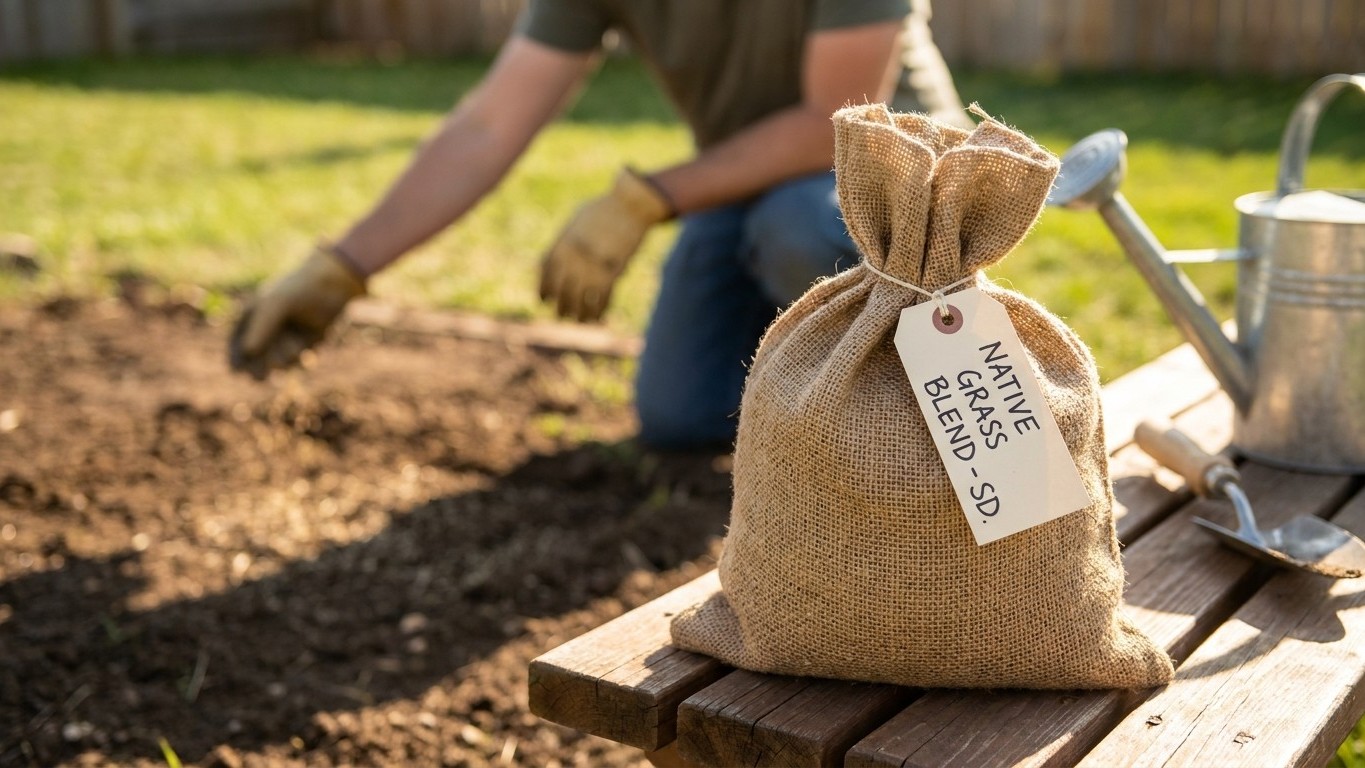

Kentucky bluegrass is your best bet for most South Dakota yards, with tall fescue a close second if you want to water less. Both are cool-season grasses built to shut down for winter instead of dying in it, which is the opposite of what happens if you plant something like bermudagrass here. Check how much sun and foot traffic your lawn actually gets, then match that against the seeding window running six to eight weeks back from the first fall freeze — that timing decides whether the roots you plant this year survive to next spring.
The short answer for South Dakota
The grasses that hold up here are the same five cool-season species named above, and none of the warm-season turfgrasses used farther south will make it through a South Dakota winter. Bermudagrass, zoysia, and centipede green up only after soil warms well past what a normal Sioux Falls spring delivers, and they don’t just go dormant at the first hard freeze the way cool-season turf does. They die outright most winters this far north, and a lawn seeded with one shows almost nothing green the following spring.
Sioux Falls falls into the cool-season zone under the thresholds The Homestead Post applies to NOAA’s climate normals, weighing summer heat days and winter lows against the tolerances Clemson publishes in HGIC 1214. That places the reference city, and most of the state along with it, in cool-season territory, though the far west runs drier and colder in ways that change which of the five species performs best, covered below.
Which of the five actually suits your yard depends on sun exposure, foot traffic, and how much you’re willing to water. The table below lays out the tradeoffs by species, using the general characteristics Clemson and Penn State publish for each.
| Species | Shade tolerance | Drought tolerance | Wear tolerance | Germination from seed |
|---|---|---|---|---|
| Kentucky bluegrass | Low to moderate | Moderate, goes dormant rather than dying | High, spreads by rhizome to self-repair | Slow, 21 to 28 days |
| Tall fescue | Moderate | High, deep root system | Moderate, a bunchgrass so it repairs slowly | Fast, 7 to 14 days |
| Perennial ryegrass | Low | Low | High at first, wears out over a few seasons | Fastest, 5 to 10 days |
| Fine fescue | High | High | Low, poor under heavy traffic | Moderate, 10 to 14 days |
| Rough bluegrass | High | Low, needs consistent moisture | Low | Moderate, 10 to 14 days |
Working through the year

Once you’ve handled the basics in South Dakota Lawn Care, the seed choice comes down to what each species costs you in exchange for what it gives back.
Ranking the five for a typical South Dakota yard
Kentucky bluegrass is the default choice for a full-sun, heavily used lawn because it spreads by rhizome and fills in its own bare spots. The cost is time: germination runs 21 to 28 days, so it needs a full fall season to root before frost, and it drinks more water through a dry August than tall fescue does.
Tall fescue establishes faster and roots deeper, which makes it the better bet if you’d rather water less. It doesn’t spread the way bluegrass does, so it’s a bunchgrass that leaves bare patches where it thins instead of filling them in on its own. For anyone growing a tall fescue lawn, Clemson’s HGIC 1219 Tall Fescue Maintenance Calendar lays out the working rhythm: mow in the 2.5 to 3.5 inch range, put the bulk of the year’s nitrogen down in fall rather than spring or summer, and aerate in fall as well, since that’s when the roots are actively growing and can use the disturbance. The calendar’s dates are written for Clemson’s home region, so use its sequence of tasks, spring pre-emergent, fall feeding, fall aeration, but set your own dates against the Sioux Falls frost window rather than the Carolina one.
Perennial ryegrass germinates fastest of the five, 5 to 10 days, which makes it useful as a nurse grass to hold soil while slower species establish, or for patching a bare spot fast. It has the shortest functional life of the group and the lowest drought tolerance, so a lawn seeded with ryegrass alone tends to need reseeding again within a few years.
Fine fescue is the pick for a shaded yard under mature trees, where bluegrass and ryegrass both thin out. It needs the least fertilizer of the five but won’t hold up to a swing set or a dog run.
Rough bluegrass is a narrow-use grass for consistently damp, shaded ground, under a downspout or in a low spot that never fully dries. It struggles anywhere the soil dries out for more than a few days.
For timing, count backward six to eight weeks from the fall frost window NOAA’s 1991-2020 normals give for Sioux Falls, September 24 to October 4, and that puts the ideal seeding stretch in late summer for most of the eastern part of the state. Spring seeding works too, but seedlings then have to survive the first hot stretch of summer before they’re established, which is a harder test than going dormant into a mild fall. For the full month-by-month sequence around that seeding window, see The South Dakota Lawn Care Calendar, Month by Month.
What changes across South Dakota
The frost window and cool-season classification above come from NOAA’s 1991-2020 normals at the Sioux Falls airport station, and they describe the eastern part of the state best. West of the Missouri River, the climate turns drier and more continental, and the same cool-season species Clemson and Penn State recommend need noticeably more supplemental water to get through a dry July and August without going fully dormant.
Elevation matters more in the west. The Black Hills rise well above the rolling prairie around Sioux Falls, and a lawn at that elevation typically sees its first fall frost earlier than the Sioux Falls date and its last spring frost later, which shortens the whole window available for seeding and establishment. A homeowner around Rapid City or in the surrounding hills should treat the Sioux Falls frost dates as a rough guide only, and lean toward the early edge of any seeding recommendation rather than the late one.
The eastern part of the state, closer to the Sioux Falls reference point, tends to hold more soil moisture and see more summer rainfall, part of why Kentucky bluegrass performs well there without heavy irrigation. Farther west, gardeners lean harder on tall fescue and fine fescue for their deeper rooting and lower water demand. No single grass or seeding date applies to the whole state, and the safest approach is to treat every figure here as a Sioux Falls-area estimate, adjusting earlier the farther west or higher up you garden.
The mistakes this climate punishes
Most lawn failures in South Dakota trace back to a handful of timing errors, and each one shows its damage on a different schedule.
- Planting a warm-season grass at all. It may look fine through summer, but it won’t green up the following spring, and the failure isn’t visible until it’s a full year too late to fix cheaply.
- Seeding cool-season grass in the heat of early summer. Germination is weak in hot soil, and any seedlings that do sprout often wilt and die within weeks once August heat sets in.
- Pushing nitrogen in July and August. Heavy summer feeding forces soft new growth right when the plant is under heat stress, which invites fungal disease that can show up as brown patches within days of a hot, humid stretch.
- Mowing short during a dry summer week. Scalping exposes bare soil to sun and heat, and a lawn cut too short during a dry spell can brown and thin within a week.
- Waiting too long into fall to seed. Seed put down after the Sioux Falls area’s typical frost window, September 24 to October 4 per NOAA, doesn’t have time to root before the ground cools, and the result is a thin, patchy lawn the following spring rather than the full stand you paid for.
None of these mistakes kill a lawn instantly. That’s part of what makes them easy to repeat: the damage from a July feeding or a late seeding date doesn’t show up until weeks later, by which point it looks like bad luck instead of bad timing.
Checking this against your county
Everything above is anchored to the Sioux Falls airport station and to national turf guidance from Clemson and Penn State, not to your specific yard. For county-level planting dates, soil test results, and species performance actually measured in South Dakota conditions, check with South Dakota State University Extension before you buy seed or put down fertilizer this fall. Their county offices are the right place to confirm how far your local frost dates run from the Sioux Falls figures used throughout this page.
Common questions
Can I plant grass seed in South Dakota in the spring instead of fall?
Yes, but it’s the harder route. Spring-seeded cool-season grass has to survive its first hot, dry stretch of summer before it’s fully established, while fall-seeded grass gets to root through mild weather and simply goes dormant for winter. If you do seed in spring, expect to water more often through the first summer than a fall seeding would need.
Should I mix Kentucky bluegrass and tall fescue in the same lawn?
It’s not usually recommended. The two have different leaf textures and growth habits, bluegrass spreads by rhizome while tall fescue grows in clumps, so a mixed stand tends to look patchy rather than uniform as one species outcompetes the other in different spots. Pick one as the dominant species and use the other only as a small percentage if you’re blending for a specific reason, like shade tolerance in part of the yard.
Will zoysia or bermuda grass survive a South Dakota winter?
No, not reliably. Both are warm-season grasses bred for climates with mild winters, and South Dakota’s cool-season classification means they typically die out over winter rather than simply going dormant and recovering. If a nursery or catalog is selling either for a South Dakota lawn, treat it as a mismatch for this climate rather than a shortcut.
How do I fix bare or thin spots without reseeding the whole yard?
Overseed just the bare patch with the same species already growing there, using loosened soil and light, frequent watering to get the new seed to germinate. Perennial ryegrass is often used as a quick patch grass because it germinates in 5 to 10 days, faster than bluegrass or fine fescue, though if the rest of your lawn is bluegrass you’ll want to blend a small amount of that in too so the patch eventually matches.