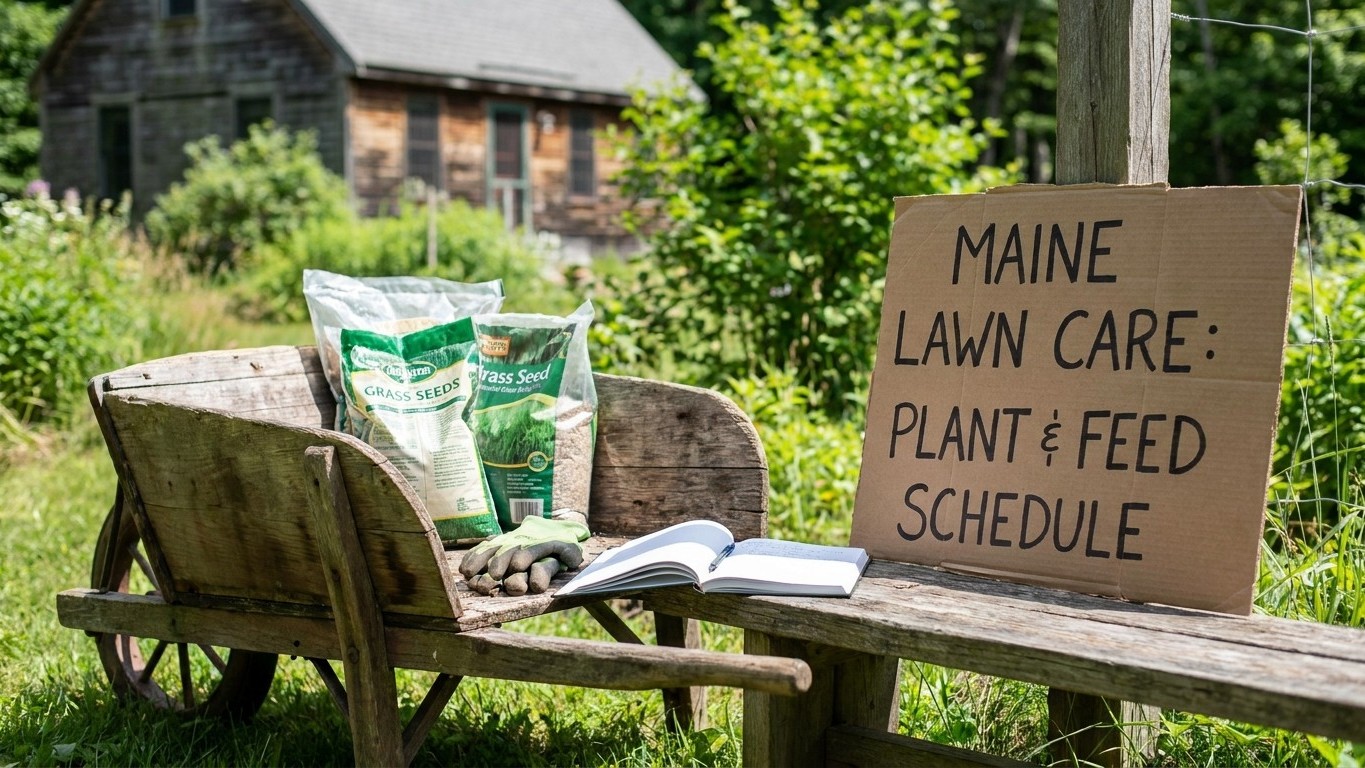

Bermudagrass seed sown in a hopeful Maine May looks green through August, spreads nicely, and then simply isn’t there come April — killed by a winter low no warm-season grass was built to survive. That’s the real cost of planting on faith instead of on climate: a summer of water and fertilizer spent on turf that never had a chance. Portland’s own weather record settles the question before seed ever hits soil, and it points toward a short, specific list of grasses that actually hold up here — the subject of The Best Grass Seed for Maine Lawns.
Which grass belongs in Maine

Portland’s climate normals settle the question before you even look at a seed tag. NOAA’s NCEI 1991-2020 climate normals put the reference station at just 3.8 days a year reaching 90°F or higher, and a coldest-month mean minimum of 13.4°F. That combination rules out warm-season turf outright: Bermudagrass, zoysia and centipede need real summer heat to spread and won’t survive a Maine winter at all. It also confirms Maine sits solidly in cool-season turf territory, where growth flushes in spring and fall rather than mid-summer — a rhythm laid out in detail in The Maine Lawn Care Calendar, Month by Month.
Comparing the five species
The species that actually work here are the ones Clemson Cooperative Extension lists for cool-season lawns in HGIC 1214, backed by Penn State Extension for the specific cultivars: Kentucky bluegrass, tall fescue, perennial ryegrass, fine fescues and rough bluegrass. Kentucky bluegrass forms the densest, most self-repairing sod of the group but wants more water and more nitrogen than the others. Tall fescue tolerates drought and shade better and needs less fertilizer, which is why it turns up so often in low-maintenance seed mixes. Fine fescues take the deepest shade of any of the five and need the least nitrogen of all, but they thin out fast under heavy foot traffic. Perennial ryegrass germinates within days and is mostly used to nurse a new Kentucky bluegrass stand along while the slower grass fills in. Rough bluegrass tolerates wet, shaded ground that would rot the others, useful on a low corner or under a downspout.
| Species | Shade tolerance | Nitrogen need | Best fit |
|---|---|---|---|
| Kentucky Bluegrass | Low | High | Dense, self-repairing lawn in full sun |
| Tall Fescue | Moderate | Low to moderate | Low-maintenance, drought-tolerant lawn |
| Fine Fescues | High | Low | Shaded yards, low-traffic areas |
| Perennial Ryegrass | Low | Moderate | Fast nurse grass in seed mixes |
| Rough Bluegrass | High, tolerates wet shade | Moderate | Damp, shaded low spots |
None of the warm-season species belong in a Maine yard, full stop. They will not survive the winter Portland actually experiences, let alone the colder ground farther north and inland. A homeowner in York County or along the coast has an easier season than one in Aroostook County, where the frost-free window runs shorter and the winter minimum drops further, but the species recommendation does not change with that difference. What changes is how forgiving the calendar is for seeding and feeding, covered below.
Growers well south of Maine face the opposite problem entirely. In Mississippi, summer heat and humidity push the choice toward Bermudagrass, St. Augustine or centipede, species that would not survive a single Maine winter. See Mississippi Lawn Care: What to Plant and When to Feed It for that end of the country’s grass palette.
When to seed or sod here
Cool-season grass goes into the ground in late summer to early fall, not spring, according to Clemson Cooperative Extension’s seeding guidance in HGIC 1203, which times warm-season lawns for around May and cool-season lawns for mid to late September. Since Maine grows the cool-season species, September is the month that matters, and it can be anchored to something more useful than a generic month: the first fall frost itself.
Anchoring the window to frost dates
NOAA’s NCEI 1991-2020 climate normals put Portland’s first fall freeze, the 30 to 70 percent probability band for 32°F, between October 9 and October 21. Extension guidance generally calls for seeding a cool-season lawn six to eight weeks ahead of that first freeze, so the seedlings have time to root before growth stops for winter. Counting back six to eight weeks from Portland’s October 9-21 window lands somewhere in mid-August to early September, which is the safe seeding stretch for anyone near the coast. That’s a range built from two ranges, not a fixed date, so treat it as a target window rather than a single Saturday to mark on the calendar.
Move inland or north and that window shifts earlier. Inland and northern Maine see their first frost arrive earlier and their growing season end sooner, which pulls the safe seeding window back by as much as several weeks compared to the coast. A grower in Aroostook County should not use the Portland-derived window without adjusting for a shorter season, and a local UMaine Extension county office is the way to pin that down for a specific address, covered further down.
Spring seeding is possible but riskier for cool-season grass in Maine. The seedlings compete with weed pressure right as summer heat arrives, and they haven’t built the root system fall-seeded grass gets before winter. Sod avoids the germination gap entirely and can go down anytime the ground isn’t frozen, but it still establishes fastest in that same late-summer window when growth is picking up rather than shutting down.
The feeding calendar that fits this climate
A cool-season lawn’s nitrogen budget follows its own growing season, and that season runs opposite to a lawn in the Deep South. Growth peaks in spring and again in fall, with a slowdown through summer heat, so the heaviest feeding goes down when the grass is actually growing hardest: September, not July.
Rates and the fall split
Penn State Extension figures a cool-season lawn’s yearly nitrogen budget at roughly 2 to 4 pounds of actual nitrogen per 1,000 square feet, with the bulk of it split across one or two fall applications of around 1 pound per 1,000 square feet each. A light spring application is optional and easy to overdo. Too much nitrogen too early pushes soft, disease-prone top growth right before the wet weeks of early summer, which is exactly the setup that invites the fungal problems covered in the next section.
Splitting the fall feeding into two lighter doses, one in early September and one in October before growth stops, spreads the nitrogen over the two flushes of fall growth instead of forcing it into one shot the grass can’t use all at once. That matters more near the coast, where the September-to-frost stretch runs longer than it does inland. A shorter fall window farther north or inland may only leave room for one solid application before the ground cools.
Tall fescue lawns have a fully mapped-out version of this schedule. Clemson Cooperative Extension’s Tall Fescue Maintenance Calendar (HGIC 1219) lays out feeding, mowing and weed control month by month for that species specifically. It’s written for a warmer state than Maine, so treat the calendar’s sequence as the useful part and slide the actual dates later to match Portland’s shorter season, or later still farther inland.
Kentucky bluegrass, being the most nitrogen-hungry of the group, sits at the upper end of that 2 to 4 pound range and shows yellowing fastest if a fall feeding gets skipped. Fine fescues sit at the lower end and can be scorched by a rate meant for bluegrass, so a lawn seeded as a fescue-heavy blend needs less product than the bag’s default rate suggests, not more, if it starts thinning. Check the seed tag or a soil test before adding nitrogen on a guess.
Mowing height and watering here
Cut a cool-season lawn taller than most people expect. Kentucky bluegrass and tall fescue both do best kept between 2.5 and 3.5 inches through the growing season, and fine fescues can run a touch shorter, closer to 2 to 3 inches, without losing density. A taller blade shades the soil, holds moisture longer between waterings and crowds out the crabgrass and other weeds that need bare, sunlit ground to germinate.
The one-third rule and deep watering
The rule that matters more than any single height number is the one-third rule: never cut off more than a third of the blade length in a single pass. Mowing a 4-inch lawn down to 2 inches in one go stresses the grass right when it needs its leaf area to keep feeding the roots, and it’s the single most common mowing mistake on a home lawn. If growth gets ahead of the schedule after a rainy stretch, mow twice, a few days apart, rather than scalping it back in one session.
Watering follows the same logic as feeding: match it to the grass’s actual growing season rather than a fixed weekly habit. An inch of water a week, delivered in one or two deep sessions rather than daily light sprinkles, is the commonly cited baseline for a cool-season lawn during active growth. What changes that figure locally is soil and site, not the calendar: sandy, fast-draining soil found on parts of the coast needs water more often in smaller amounts, while heavier inland clay holds moisture longer and can go without for stretches. Portland’s climate rarely produces sustained heat that forces daily watering, since NOAA’s 1991-2020 normals put the reference station at only 3.8 days a year above 90°F, but a dry stretch in July or August still stresses a shallow-rooted lawn faster than most people expect.
Deep, infrequent watering also trains roots to grow down rather than sideways, which is what gets a lawn through the short dry spells this climate does produce without turning brown before it needs to.
What goes wrong on lawns in Maine

The problems that show up on a Maine lawn are shaped by this specific climate, not lawn trouble in general. A humid stretch in July or August, especially after a run of warm, wet nights, is brown patch weather. It hits Kentucky bluegrass and tall fescue hardest when nitrogen has been pushed too heavy going into summer, which is one more reason the fall-weighted feeding schedule above matters.
- Roughly circular patches of collapsed, brown grass
- A darker, water-soaked “smoke ring” edge visible in early morning dew
- Worse after warm, humid nights and heavy overnight leaf wetness
Dormancy, and winter weeds that never quit
A hot, dry stretch produces the opposite-looking problem with the opposite cause: cool-season grass goes dormant and turns brown as a survival response, not because it’s dying. Dormant is not dead, and the test is simple: tug a few blades, and living dormant grass holds firm at the crown while dead grass pulls free easily with the roots attached. Portland’s climate rarely produces the kind of extended heat that turns dormancy into real dieback, since NOAA’s normals log under four days a year above 90°F at the reference station, but an unusually dry August can still push a shallow-rooted lawn further than expected.
A mild winter, or one with a thin, patchy snow cover instead of a solid blanket, lets certain cool-season weeds keep growing through stretches that would normally shut them down. Chickweed and annual bluegrass in particular can stay active on bare, exposed ground through a mild December or a January thaw, getting a head start on spring rather than resetting with the rest of the lawn. That head start is easiest to blunt with a healthy, dense stand of grass going into winter, which loops back to getting the fall feeding and the fall seeding window right in the first place.
Farther south, the same brown patch pressure that hits Maine in a humid week runs for a much longer stretch of the year. See Massachusetts Lawn Care: What to Plant and When to Feed It for how that plays out against a longer, hotter summer working on the same cool-season species.
Local help
A soil test is the fastest way to stop guessing at nitrogen and lime rates, and UMaine Extension runs that testing along with county-level advice tuned to conditions well beyond what a Portland-anchored figure can cover. Frost dates, soil type and disease pressure all shift county to county across a state this long, from the coast to Aroostook County, and the county office is where those local specifics actually get answered rather than estimated from a reference station two hundred miles away.
Common questions
Can I grow a cold-hardy Bermuda variety in Maine if I baby it?
No. NOAA’s 1991-2020 climate normals put Portland’s coldest-month mean minimum at 13.4°F, and that’s the mild end of the state. Even cold-tolerant warm-season cultivars are bred for winters far short of what a Maine yard experiences, and the grass will not persist past its first real winter.
My lawn turned brown in a July dry spell, is it dead?
Probably not. Cool-season grass in Maine commonly goes dormant rather than dies during a dry stretch, and the tug test described above is the quickest way to check. If the crown pulls free with the roots, that patch is dead and needs reseeding, not just water.
Is it too late to seed if it’s already the second week of October?
Near Portland, that’s cutting it close. NOAA’s normals put the first fall freeze there between October 9 and October 21, and seed sown that late may not root deeply enough before growth shuts down for winter. Waiting for the next window in late summer, rather than pushing seed into cold soil now, gives it a better shot.
Should I bag or leave my grass clippings?
Leaving clippings on the lawn is generally fine as long as you’re following the one-third rule and not leaving thick, wet clumps sitting on the grass. Bag only after a rain-delayed mow produces heavier clippings than usual, or when the lawn has visible disease and you don’t want to spread spores with the mower.
Does a Maine lawn need lime every year?
That depends on the soil, and there’s no single figure that applies statewide. A soil test through UMaine Extension is the only reliable way to know whether a given yard’s pH needs correcting, rather than applying lime on a routine schedule without checking first.