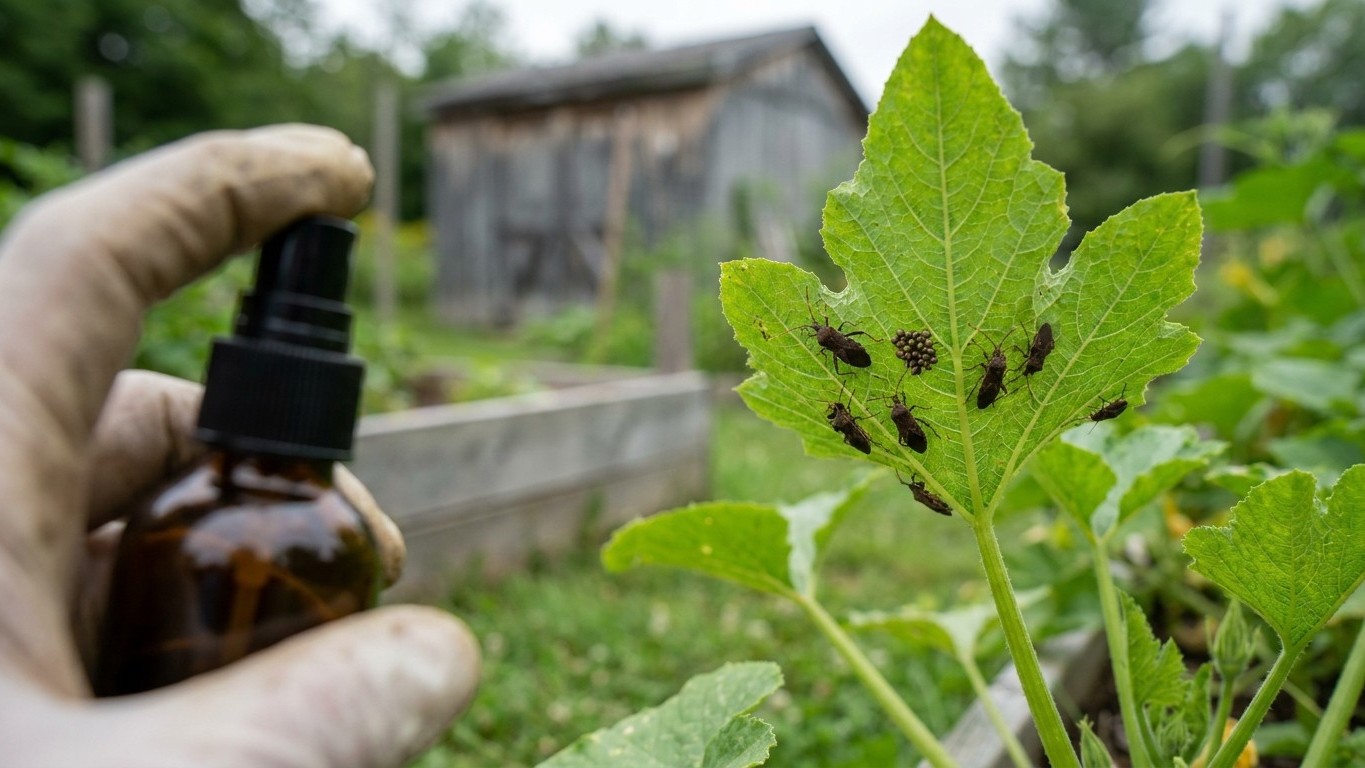

UVM Extension’s list of the pests it fields the most calls about in home gardens runs to eleven: white grubs, leek moth, Swede midge in Vermont, Spotted wing drosophila in Vermont, Colorado potato beetle, flea beetles, Green stink bug Vermont, European chafer Vermont, Asian jumping worms in Vermont, Boxelder bug in Vermont, Dark-winged fungus gnats Vermont, and Spongy moth Vermont. Before you spray anything, get the pest identified by sight against the list below, since several of these cause damage that looks alike but calls for a completely different fix.
What Vermont gardens actually deal with

Flea beetles in Vermont arrive on a different clock than the seed catalogs assume. Most planting guides are written for longer, warmer seasons where row cover can go on “sometime in spring” — here, the beetles are already moving in from field edges the moment soil temperatures tick up, often before transplants are even hardened off. That compressed window is the real story behind every pest on this list: less season to react, and less margin for guessing wrong about when trouble starts.
Flea beetles

Recognize them by the jump: disturb a seedling and the tiny, shiny black or bronze beetles hop away instead of flying. They leave a shotgun-hole pattern of small round perforations across brassica, eggplant, and potato leaves. The adults do the visible chewing, while the larvae feed underground on roots without much outward sign. Flea beetle populations respond well to floating row cover installed at transplant, before the first adults show up, since they fly in from field edges as soon as it warms.
Colorado potato beetle

The adult is unmistakable: oval, about 3/8 inch, yellow-orange with ten black stripes down its back. The larvae, humpbacked and orange-red with black spots along the sides, do the heaviest feeding and can strip a potato or eggplant plant to bare stems. Bright orange egg clusters on the leaf undersides are easy to crush by hand before they hatch. The Colorado potato beetle populations in Vermont follow the same biology that shapes pest management in potato-growing states like Idaho, where the pressure is heavier; the Idaho pest guide covers how growers there handle larger-scale infestations.
Spongy moth

The caterpillar is the damaging stage: dark, hairy, up to 2 inches long, with distinctive pairs of blue and red spots running down its back. In outbreak years it can defoliate oaks and other hardwoods near the garden. The flightless white female moth lays a tan, fuzzy egg mass directly on bark, which is easy to scrape off and destroy before the caterpillars hatch in spring.
Swede midge

The adult fly is almost too small to see. The damage is the real identifier: broccoli, cabbage, and other brassicas develop crumpled, swollen growing points and multiple small distorted heads instead of one clean one. The larvae inside that distorted tissue cause the damage. Because the midge overwinters in soil, rotating brassica beds well away from last year’s spot, and sealing row cover tight at the soil line, matters more here than any spray.
Leek moth

Look for a small, mottled brown-gray moth about 3/4 inch across, and pale green caterpillars mining inside onion, garlic, and leek leaves. Feeding shows up as thin, translucent “window-pane” patches on leaves, with larvae eventually tunneling into the bulb itself, opening the door to rot. There are multiple generations through the season, so a garden clear in June can still get hit in August.
White grubs

Three different adult beetles produce the same larval problem: Japanese beetle (metallic green body, copper-bronze wing covers), European chafer (plain tan-brown), and oriental beetle (mottled brown and black). All three lay eggs that become a C-shaped, cream-white grub with a brown head living in turf and garden soil. Adults skeletonize leaves and flowers on roses, beans, and grapes, while the grub stage chews roots and can leave patchy, wilting turf. Hand-picking adults into soapy water in early morning works. Pheromone traps do not, since they draw in more beetles from beyond your yard than they catch.
Asian jumping worms
These are earthworms, not insects, and they behave differently from the earthworms most gardeners are used to. The body is gray-brown and glossy, with a pale band (the clitellum) that wraps all the way around rather than sitting like a saddle. Handle one and it thrashes violently, sometimes hard enough to escape your grip. They strip soil of organic matter fast, leaving a loose, grainy texture that looks like used coffee grounds and no longer holds moisture the way healthy soil should. There’s no approved pesticide for them. The only real control is preventing spread, by not moving soil, mulch, or plants from an infested area to a clean one.
Green stink bug
Adults are shield-shaped, bright green, about 5/8 inch long. Nymphs are rounder and green with black markings, and both stages pierce fruit rather than chew leaves. On tomatoes and beans that shows up as cloudy, sunken spots at the feeding site. Row cover during fruit set and hand removal keep populations down without a spray.
Spotted wing drosophila
This fruit fly is a fraction of the size of a housefly, tan-bodied with red eyes, and the males carry a single dark spot near the tip of each wing. Unlike most fruit flies, it lays eggs in fruit that’s still ripening rather than waiting for it to rot, so raspberries, blueberries, and grapes can carry maggots before you’d ever suspect a problem. Harvesting frequently and refrigerating fruit right away limits the damage. This pest is also a major concern for berry growers in Pacific Northwest states, and the Oregon pest guide covers how growers there manage it across a longer, warmer season.
Boxelder bug
Adults are flat, black, about 1/2 inch, with red-orange lines outlining the wings. Nymphs are bright solid red. Feeding damage to fruit is minor. The real issue is the fall habit of congregating on sunny walls and slipping indoors in large numbers. Sealing entry points and vacuuming up stragglers handles it. Chemical treatment is rarely worth the trouble for what is mostly a nuisance pest.
Dark-winged fungus gnats
The adult is a small, dark gray to black fly that looks like a tiny mosquito, hovering weakly around pots rather than biting anyone. The larvae are the actual problem: thin, white, worm-like grubs with a black head that feed on root hairs and organic matter in consistently wet potting soil, especially in seedling trays. Letting the surface of the soil dry between waterings does more to control them than anything you’d spray.
Telling damage apart

Reading the pattern before reaching for anything
The shape of the damage narrows down the cause faster than trying to spot the pest itself. Uniform round or irregular holes chewed through a leaf point to a chewing insect, something with mandibles working the edge or the middle of the blade. Fine speckled stippling, a pale dusty look across the leaf surface, usually means a sucking pest working the underside, or sometimes leaf scorch from heat and dry soil rather than an insect at all. Sticky residue on leaves or nearby surfaces, often followed later by a black sooty film, signals a honeydew-producing insect feeding on plant sap.
Wilting is the trickiest symptom because it has three unrelated causes. A plant wilting despite consistently moist soil often points to a vascular disease or to root-feeding larvae like white grubs cutting off water uptake underground. A plant wilting with visibly dry soil is a watering problem, not a pest problem, and no amount of scouting the leaves will fix it. Match the symptom to the pattern before treating, since spraying an insecticide on a watering fault wastes the product and leaves the actual cause untouched.
- Clean-edged holes or notches: chewing insect, check leaf undersides and soil for larvae
- Fine stippling or bronzing: sucking insect or heat stress, check for fine webbing or dust
- Sticky residue or black film: honeydew from aphids or scale, check stems and new growth
- Wilting with wet soil: root damage or disease, check for grubs or discoloration at the stem base
- Wilting with dry soil: irrigation problem, not a pest issue
What actually works
Prevention comes first
Rotating vegetable families away from where they grew the previous year breaks the life cycle of soil-dwelling pests like swede midge and white grub larvae, since many of them can’t travel far to find a new host. Timing matters just as much: getting row cover on brassicas and alliums before the first adults of the season arrive, rather than after damage shows up, keeps flea beetles, swede midge, and leek moth off the crop entirely. Row cover only works if it’s sealed at the edges, since a gap at the soil line lets adults walk or crawl underneath just as easily as if the cover weren’t there. Encouraging ground beetles, birds, and parasitic wasps by leaving some undisturbed edges and skipping broad-spectrum sprays keeps natural predation working in the background all season.
Targeted intervention, and what doesn’t help
Once a pest is established, hand-picking works well for anything large and slow enough to catch: Colorado potato beetle egg masses and larvae, Japanese beetle adults, green stink bug adults and nymphs. Spinosad controls Colorado potato beetle larvae and is less disruptive to pollinators than a broad-spectrum insecticide. Bt (Bacillus thuringiensis) kills caterpillars, which makes it useful against spongy moth and leek moth larvae, but it does nothing against beetles, midges, or true bugs, since it only affects caterpillar digestive systems. Beneficial nematodes applied to soil target white grub larvae directly.
Some popular remedies simply don’t do what people expect. Pheromone traps marketed for Japanese beetles attract more beetles into the yard than they capture, often making the problem worse near the trap itself. There’s no pesticide that controls Asian jumping worms once they’re established in a bed, so anything sold for that purpose is not worth buying. Ultrasonic pest repellers have no demonstrated effect on any of the insects covered here.
What control costs
Hand-picking costs nothing but time, and that time adds up fast if the population is large, since most hand-picked pests need checking every few days through their active season. Row cover and physical barriers cost more upfront but are reusable for several seasons if stored properly, and once installed correctly they need almost no repeat attention beyond checking the seal after wind or heavy rain. Biological controls like Bt, spinosad, and beneficial nematodes sit in the middle: a single application breaks down in sunlight or rain within days to a couple of weeks, so they need reapplication through the pest’s active window rather than a one-time fix. Broad-spectrum sprays are the most expensive option to use correctly over a season, both in product cost and in the follow-up applications most labels require, and they carry the added cost of killing the predator insects that would otherwise be doing some of the work for free.
| Method | Money cost | Time cost | Repeat frequency |
|---|---|---|---|
| Hand-picking | None | High, ongoing checks | Every few days during active season |
| Row cover / barriers | Moderate upfront, reusable | Low after install | Reused season to season |
| Biological controls (Bt, spinosad, nematodes) | Moderate per application | Moderate | Every one to two weeks while active |
| Broad-spectrum sprays | Highest over a season | Moderate | Per label, often weekly |
For a typical home garden, hand-picking and barriers are the cheapest combination that also does the least collateral damage to pollinators and predator insects. Sprays make sense mainly for a heavy, established infestation where the other methods have already failed to keep pace.
Local help
UVM Extension identifies specimens and tracks outbreak reports across the state, and its Master Gardener program is the right first call when a pest doesn’t match anything described here. Reach it through UVM Extension, and note that its pest reports draw heavily from the Burlington area, so pressure and timing can run differently in the Northeast Kingdom or southern counties. For other seasonal tasks around the state, the Vermont guides section covers planting and care beyond pest control.
More Vermont Pests Worth Watching For
Soil temperature, not the calendar, decides when most of these show up, so it helps to know what’s coming next. In lawns and garden beds, Asian jumping worms become active once soil temperatures climb past the point where their cocoons hatch, usually not far behind the last spring frost, and there’s no pesticide that reaches them once they’re established. Around the same window, dark-winged fungus gnats move into moist, organic-rich soil and seedling trays as ground temperatures climb past the mid-50s. Lawns take the hit from European chafer grubs, which start chewing through roots in early summer and get blamed on other causes. Vegetable growers should watch for green stink bugs piercing beans, tomatoes, and sweet corn all summer, and for leek moth, which arrives once the soil warms enough for adults to fly and lay eggs a few weeks after last frost. Up in the trees, spongy moth caterpillars start feeding right as hardwoods leaf out in spring.
Common questions
Are Japanese beetles the same thing as the grubs in my lawn?
Yes, in the sense that the adult Japanese beetle you see on roses in summer is the same insect whose larvae live in your lawn as white grubs the rest of the year. European chafer and oriental beetle produce grubs that look nearly identical, so a grub in the soil doesn’t tell you which adult beetle it will become.
Will Bt kill Colorado potato beetle?
No, standard Bt products target caterpillars and have no effect on beetle larvae or adults. Colorado potato beetle larvae respond to spinosad, and hand-picking the adults and orange egg clusters works well for smaller plantings.
I found one jumping worm, do I have an infestation?
Not necessarily, but it’s worth checking further before assuming it’s a one-off. Dig through the top few inches of soil nearby for more, and check whether the soil already has that loose, grainy texture the worms leave behind, since a single worm found early is a very different situation from an established population.
Can I just spray everything once a week to be safe?
That approach usually backfires. Broad-spectrum sprays kill the predator insects and parasitic wasps that would otherwise be controlling several of these pests for free, and repeated use on the same pest encourages resistance over a season. Identify the pest first and match the treatment to it.