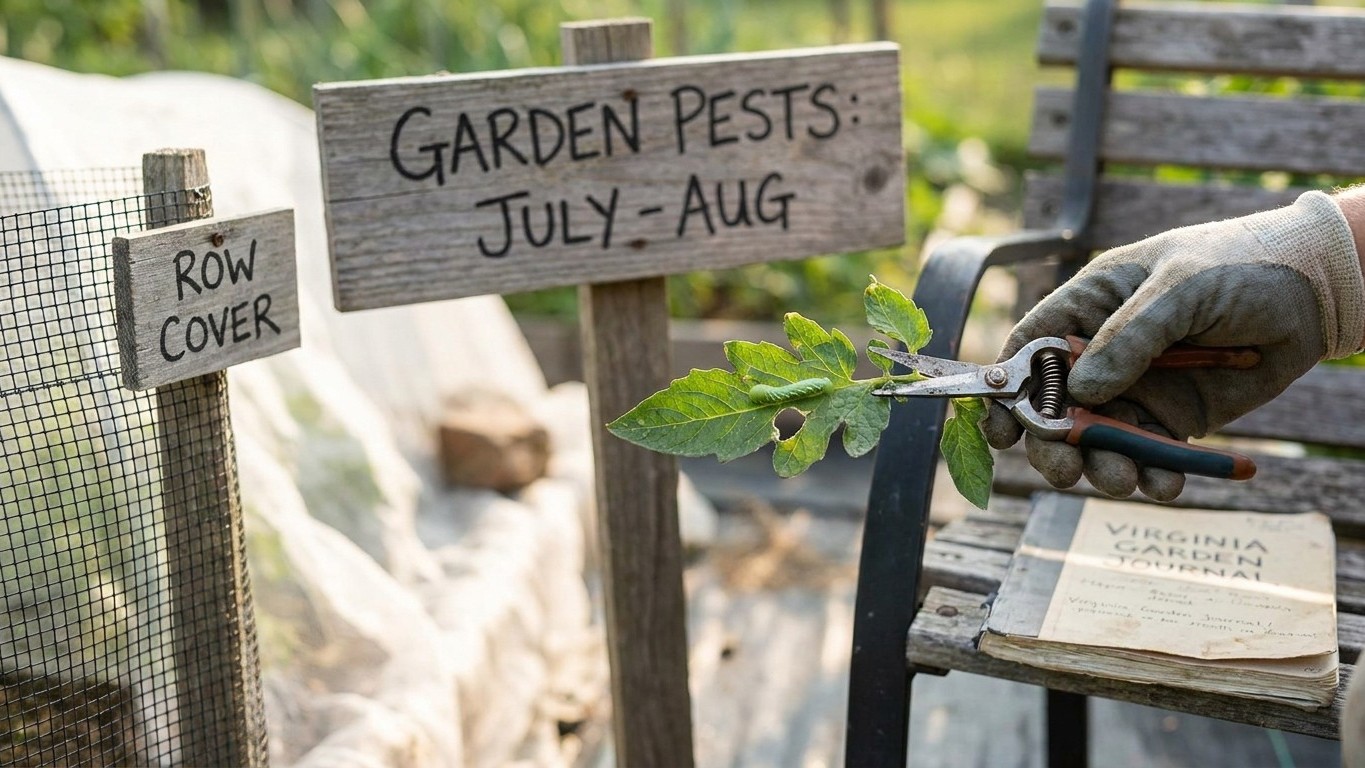

Virginia Cooperative Extension’s guide to insects commonly found on vegetable gardens, put together by an entomologist at Virginia Tech’s Eastern Shore Agricultural Research and Extension Center, names fourteen pest groups that show up on home vegetable plots across the state. Pressure from any one of them varies by county and by season, so treat the list as a starting point, not a forecast. Check your plants weekly starting at transplant, and get an unfamiliar insect identified before you spray anything.
What Virginia gardens actually deal with

Flea beetles arrive in Virginia gardens before the seed packets say they should — our mild, wet springs wake soil pests two or three weeks ahead of the schedule most national gardening advice assumes. That gap matters more than any generic pest list, because timing, not identification, is what saves a crop here. Row covers, collars and sprays all work on a calendar, and Virginia’s calendar runs early. Know that difference first, and the rest is just naming names.
Flea beetles

Flea beetles in Virginia show up as soon as the first tender leaves of eggplant, radish or brassica seedlings appear. Damage looks like a shotgun blast of tiny round holes across the leaf surface. Row cover installed at planting keeps them off young transplants, since older plants tolerate the feeding far better than seedlings do.
Black cutworm

Cutworms feed at night and hide in the soil by day, so the first sign is usually a transplant sheared off at ground level with no caterpillar in sight. A cardboard collar pushed an inch into the soil around each stem stops them cold, and it costs nothing but a few minutes per plant.
Imported cabbageworm, cabbage looper, diamondback moth and cross-striped cabbageworm

This caterpillar complex arrives on cabbage, broccoli, kale and other brassicas from the first cool-season planting onward. Look for ragged holes and dark green droppings on the leaves. Floating row cover excludes the egg-laying moths entirely, and Bacillus thuringiensis kurstaki sprays knock back caterpillars already feeding without harming the bees working nearby flowers.
Colorado potato beetle

Adults appear on potato and eggplant foliage as soon as it emerges, and the orange, humpbacked larvae do the bulk of the defoliation a few weeks later. Hand-picking adults each morning, before they’ve had a chance to lay eggs, is the single most effective non-chemical step for a small planting.
Aphids

Aphid colonies build through spring and can spike again anytime growth is soft and lush. Curled, yellowing leaves and a sticky film on the foliage below are the giveaway. A strong water spray dislodges light infestations, and lady beetles and lacewings usually catch up if you haven’t already sprayed them off the menu.
Harlequin bug

These show up on brassicas alongside the caterpillar complex, feeding in tight clusters that leave pale, blotchy patches on the leaves. Hand-picking the brightly marked adults and nymphs works well because they don’t scatter the way most insects do when disturbed.
Mexican bean beetle
Adults and their spiny yellow larvae skeletonize bean leaves from the underside, leaving a lacy pattern of veins behind. Checking leaf undersides for the orange egg clusters every few days, and crushing them, heads off the worst of a generation before it hatches.
Japanese beetle
Adults chew leaves into a lace of veins, favoring beans, roses and grape leaves through early and midsummer. Beetle traps often make the problem worse, since the lure draws in more beetles than the trap actually catches. Hand-picking into a bucket of soapy water in the morning, when they’re sluggish, works better.
Squash bug and squash vine borer
Squash bugs cluster at the base of the vine and suck sap, causing sudden wilting of individual leaves. The vine borer moth lays eggs at the stem base, and its larva tunnels inside, causing a whole vine to collapse seemingly overnight. Checking the stem base weekly for the sawdust-like frass the borer leaves behind catches it before the vine is a total loss.
Striped and spotted cucumber beetles
Both feed on leaves, flowers and young fruit of cucumbers, squash and melons, and both can spread bacterial wilt as they feed. Row cover over young plants, removed once flowering starts to let pollinators in, is the most reliable prevention.
Stink bugs and tarnished plant bug
Both pierce fruit and pods to feed, leaving sunken, discolored spots that show up on tomatoes and beans well after the insect has moved on. Weeds around the garden edge often host them before they move onto crops, so keeping that border mowed reduces the population that arrives.
Thrips and spider mites
Both thrive in hot, dry stretches of summer. Thrips leave a silvery, papery streaking on leaves and petals, while spider mites cause fine stippling and, in bad infestations, visible webbing. Regular overhead watering during dry spells knocks mite populations down, since they favor dusty, moisture-stressed foliage.
Tomato and tobacco hornworms
These large caterpillars strip tomato and pepper foliage fast and leave dark green droppings on the leaves below as the first clue, since the caterpillar itself blends in well. Hand-picking works, and leaving any hornworm covered in small white cocoons alone lets a parasitic wasp finish the job for you.
Corn earworm and European corn borer
Corn earworm larvae feed inside the ear tip, entering through the silk, while European corn borer larvae tunnel into the stalk itself. A few drops of vegetable oil applied to the silk tip just after pollination smothers earworm eggs before they hatch, without harming the ear.
Telling damage apart

The shape of the damage tells you more than the insect ever will, especially if the culprit has already moved on by the time you notice. Chewed leaf edges and ragged holes point to a chewing insect like a caterpillar or beetle. Stippling, a fine speckled or bronzed look to the leaf surface, points to something that pierces and sucks, like thrips, aphids or spider mites, rather than something that bites off tissue.
Wilting is the trickiest call. A plant that wilts despite moist soil usually has a vascular problem, either a boring insect like the squash vine borer working inside the stem, or a soilborne disease clogging the plant’s plumbing. A plant that wilts because the soil is actually dry is a watering fault, not a pest problem at all, and the fix is the hose, not a spray. Sticky residue on leaves, often followed by a black sooty film, is honeydew left by aphids or whiteflies feeding above, not a fungus growing on its own.
A quick reference
| Damage pattern | Likely cause | Example |
|---|---|---|
| Ragged holes, edges chewed away | Chewing insect | Cabbageworms, Japanese beetle |
| Fine stippling or bronzed leaf surface | Piercing-sucking insect or mite | Thrips, spider mites, aphids |
| Sudden wilting, soil still moist | Stem borer or vascular disease | Squash vine borer |
| Sticky sheen, sooty black film | Honeydew from sap-feeders | Aphids |
| Seedling clipped at soil line overnight | Cutworm | Black cutworm |
| Water-soaked spots, fuzzy or powdery growth | Fungal or bacterial disease, not an insect | Leaf spot, blight |
What actually works
Prevention beats intervention on every pest in this list, mostly because it doesn’t depend on catching the problem at the right hour of the right day. Rotating crop families each season keeps soil-dwelling stages like cutworms and Colorado potato beetle from building up where the host plant was last year. Row cover installed at transplant, before the first pest arrives, physically excludes flea beetles, cabbage moths and cucumber beetles without a single spray, and it’s the one tool that works against almost everything on this list at once.
- Rotate brassicas, potatoes and squash-family crops to a different bed each year
- Time brassica and potato plantings so the crop is past its most vulnerable stage before peak beetle activity
- Install row cover at transplant and remove it once flowering starts if pollination is needed
- Leave a strip of flowering plants nearby to support lady beetles, lacewings and parasitic wasps
- Check leaf undersides weekly, since most of these pests lay eggs there before you ever see a larva
When prevention isn’t enough, hand-picking is still the most reliable next step for Colorado potato beetle, Mexican bean beetle, harlequin bug and hornworms, since all four are large enough to see and slow enough to catch. For soft-bodied sap feeders like aphids and mites, a strong water spray or insecticidal soap disrupts the colony without touching the beneficial insects that would otherwise clean it up.
Two popular remedies do essentially nothing. Ultrasonic pest repellers have no measurable effect on insects, which don’t rely on the sound frequencies these devices claim to disrupt. Japanese beetle traps, as noted above, tend to draw in more beetles from the surrounding area than they remove, so a trap placed near the vegetable bed usually increases damage nearby rather than reducing it. Gardeners dealing with a similar caterpillar and beetle mix in a shorter, cooler season, like the one further north in West Virginia, use the same row cover and hand-picking approach, just compressed into fewer weeks.
What control costs
Hand-picking costs nothing but time, and for beetles and caterpillars big enough to see, that time is well spent since it also lets you catch a problem before it spreads. Expect to spend a few minutes per bed, a few times a week, through the pest’s active weeks.
Row cover and other barriers cost more upfront, since the material and the hoops or stakes to hold it are a real purchase, but the same cover is reusable for several seasons if it’s stored out of the sun. Once it’s installed, it needs almost no ongoing attention beyond removing it for pollination.
Biological controls, meaning purchased beneficial insects or a Bt spray, sit in the middle. Bt needs reapplying every week or two while caterpillars are actively feeding, since it breaks down in sunlight, and it only works on the caterpillar stage, not the adult moth.
Sprays, whether an insecticidal soap or a broader-spectrum product, tend to need the most frequent repeat applications, often weekly through an infestation, and each application risks knocking back the same predator insects that would otherwise be doing some of the work for free.
| Approach | Cost | Repeat frequency |
|---|---|---|
| Hand-picking | Free, time only | Several times weekly during active feeding |
| Row cover / barriers | Upfront purchase, reusable | Install once, minimal upkeep |
| Biological controls (Bt, purchased predators) | Moderate | Every one to two weeks while pests are active |
| Sprays (soap, broader products) | Ongoing purchase | Weekly, sometimes more |
Hand-picking and barriers are the cheapest options for a home garden, and together they cover most of the pests on the extension’s list without a single purchase repeated season after season.
Local help
Virginia Cooperative Extension identifies insect specimens and tracks local outbreaks through its network of county offices, and that’s the right first call for anything on this list that you can’t confidently name. Find your county’s office and current pest advisories through the extension service directory. Gardeners well outside Virginia’s climate, including those working a shorter season in a place like South Dakota, should check their own state’s extension list rather than assume this one applies directly.
Pest-by-Pest Guides
Once you know a pest is active, it helps to see its full season laid out. Start in early spring, when aphids arrive in two waves, hitting hard in April and May before tapering off and returning in a smaller rebound come September and October. Around the same time, Colorado potato beetles emerge as soon as soil warms into the low 50s, and cucumber beetles show up right as cucurbit seedlings break ground. Warmer regions see harlequin bugs as early as mid-April, while imported cabbageworm larvae start chewing through brassicas around the same time and keep going into fall. Mexican bean beetle follows close behind, crawling out of leaf litter in late April and May to attack young bean plants. By early summer, Japanese beetles take over, peaking through July, and tomato hornworms show up from mid-June through early September as the state’s two generations overlap. Each guide breaks down exactly when to watch and what actually stops the damage.
Common questions
Why do I keep finding the same pest year after year in the same bed?
Several of these pests overwinter in soil or plant debris right where they fed the previous season, including Colorado potato beetle and squash vine borer. Rotating that crop family to a different bed, and clearing old plant debris in fall, breaks the cycle better than any spray applied the following spring.
Is it too late to use row cover if I already see damage?
Row cover works by excluding egg-laying adults, so once larvae are already feeding inside the cover, it traps the problem rather than solving it. Remove the cover, hand-pick or treat what’s there, then reinstall it once the plant is clean if more generations are still likely.
Do ladybugs actually eat garden pests or is that a myth?
Lady beetles genuinely eat large numbers of aphids at both the adult and larval stage, and the larvae, which look like small spiny gray and orange alligators, are easy to mistake for a pest and kill by accident. Leave them alone if you find them near an aphid colony.
My tomato leaves have holes but I never see a caterpillar. What’s going on?
Hornworms feed mostly at night and their green coloring blends in almost perfectly with tomato foliage during the day. Look for dark green droppings on the leaves below the damage, then run a flashlight over the plant after dark, which is when they’re easiest to spot.