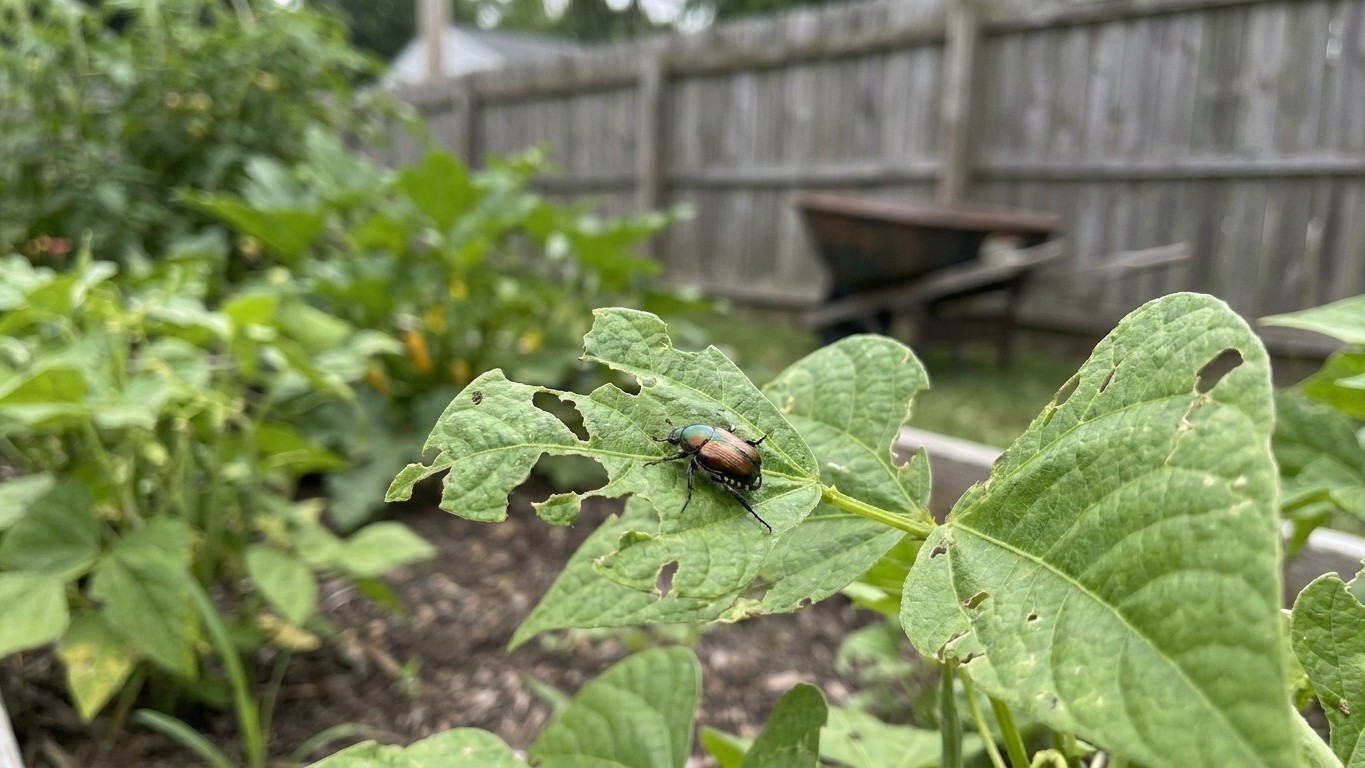

OSU Extension names ten pests as the ones most likely to show up in an Ohio food garden: slugs and snails, Twospotted spider mite Ohio populations, European earwig populations, fourlined and tarnished plant bugs, aphids gardeners frequently battle, Japanese beetle populations, cutworms, squash vine borer growers watch for closely, and striped cucumber beetle and spotted cucumber beetle gardeners often report. Check the base of stems and the undersides of leaves weekly, starting as soon as transplants go in the ground, because most of these problems are far easier to stop early than to undo.
What Ohio gardens actually deal with

Ohio’s mix of clay soils, humid summers, and wet shoulder seasons gives soft-bodied pests and beetles plenty of cover, and OSU Extension’s home garden list reflects that. These ten are not the only insects a gardener will meet, but they are the ones the extension service flags often enough to name individually.
Cutworms

Cutworms in Ohio are the caterpillar stage of several moth species, and they do their damage at night, chewing through tender stems right at soil level. A transplant that was upright yesterday and lying flat this morning, with a clean-cut stem, is the classic sign. Curl a suspect caterpillar in your palm: if it rolls into a tight C-shape, it’s a cutworm. A paper or foil collar pushed an inch into the soil around each new transplant stops them cold, and it costs almost nothing.
Slugs and snails

These show up as ragged, irregular holes in leaves, often starting at the edges, with a telltale slime trail nearby. They feed at night and hide under mulch or boards during the day, so checking after dark with a flashlight confirms the culprit faster than daytime leaf inspection ever will. Reducing damp hiding spots and hand-picking after rain does more than most commercial baits, and gardeners dealing with slug populations often find this two-step approach enough on its own.
European earwig

Earwigs chew irregular holes in leaves and flower petals, and in large numbers can shred seedlings overnight. The pincers look alarming but rarely break skin. They shelter in mulch, under pots, and in rolled leaves, so a rolled damp newspaper trap set out overnight and shaken into soapy water in the morning is a low-cost way to knock numbers down.
Striped cucumber beetle

These feed on cucumber, squash, and melon seedlings, chewing holes in leaves and, more seriously, spreading bacterial wilt as they feed. Seedlings that wilt suddenly despite adequate water, with beetles visible on the leaves, point to this pest rather than a watering problem. Floating row cover over young plants until flowering, removed for pollination, is the most reliable non-chemical fix.
Spotted cucumber beetle

Similar habits and similar damage to the striped species, though it feeds on a broader range of plants including beans and corn seedlings. The spotted pattern rather than stripes is the quickest way to tell them apart in the field. Control measures overlap with the striped beetle: row cover early, then hand removal once flowers open.
Fourlined plant bug and tarnished plant bug

Both leave small, sunken, round spots on leaves, sometimes called “shot holes,” most visible on mint family herbs and many perennials. Damage appears fast, often overnight, as both bugs feed by piercing tissue and sucking sap rather than chewing. They’re fast and drop off plants when approached, so a jar held underneath while brushing the foliage catches more than a direct grab.
Aphids
Aphids cluster on new growth and leaf undersides, and their feeding causes curled, distorted leaves along with a sticky residue called honeydew that later grows sooty mold. A strong water spray dislodges light infestations, and lady beetles and lacewings, both natural predators, usually catch up if broad-spectrum sprays haven’t wiped them out first.
Squash vine borer
The larva tunnels inside squash and pumpkin stems, and the first sign is often a suddenly wilting vine with sawdust-like frass near the base, long after the borer is already inside. By the time wilting shows, the caterpillar has done its damage, which is why prevention has to happen before that point. Wrapping the base of young stems in foil or covering with row cover through early stem growth blocks the egg-laying adult from ever reaching the plant.
Twospotted spider mite
Look for a fine, dry stippling or bronzing across leaves, plus faint webbing on the undersides in heavier infestations. Mites thrive in dry, dusty conditions, so a strong spray of water on leaf undersides every few days often keeps numbers down without any product at all.
Japanese beetle
Adults skeletonize leaves, eating the tissue between veins and leaving a lacy pattern behind, and they feed in groups, so damage appears fast once they arrive. Hand-picking into a jar of soapy water in the cooler morning hours, when beetles are sluggish, is more effective than most people expect.
Telling damage apart

The shape of the damage tells you more than the plant does. Chewed, ragged edges point to a beetle, caterpillar, or slug feeding with mouthparts built for tearing tissue. Fine stippling or a dusty bronze cast points to a piercing-sucking pest like spider mites or plant bugs, which drain cells rather than remove them. Sudden wilting with no chewing visible is the pattern to take seriously, since it can mean a borer working inside the stem, a root problem, or simply underwatering, and those three need completely different responses.
Reading the secondary clues
Sticky residue on leaves or the ground beneath a plant is almost always honeydew from aphids or another sap-feeder, and it often shows up before the insects themselves are obvious. A slime trail with no visible insect nearby means slugs or snails fed overnight and are hiding now. Holes with smooth, even edges usually mean disease, a leaf spot fungus for instance, rather than an insect, since insect chewing leaves irregular tears.
Watering faults mimic pest damage more often than gardeners expect. Leaves that yellow evenly from the bottom of the plant upward, with no stippling, holes, or sticky film, usually point to overwatering or poor drainage rather than an insect. A plant that wilts in afternoon heat but recovers by morning is under water stress, not attack. Only wilting that doesn’t recover overnight, paired with visible tunneling or frass at the stem base, should send you looking for a borer. Getting this distinction right before reaching for any treatment saves both money and the plant.
When each one shows up
Pest timing in Ohio tracks temperature and plant growth stage more closely than the calendar. Cutworms and slugs are earliest, active while transplants are small and soil stays cool and damp, and OSU Extension notes that slugs reach pest status specifically in wet springs and falls, near Columbus and generally across the state, with drier stretches giving plants a break. Earwigs and plant bugs follow as growth picks up, with plant bug damage concentrated in late spring and early summer per OSU Extension, right when new leaf and flower tissue is tender.
Cucumber beetles arrive as soon as cucurbit seedlings or transplants emerge, since they’re drawn to the young leaves before the plant has much size to spare. Aphids build steadily through spring and summer wherever soft new growth keeps coming, with numbers often spiking after a flush of fertilizer or rain pushes fresh leaves out.
Squash vine borer has one generation a year in Ohio, and OSU Extension ties the adult’s emergence to accumulated heat, roughly 1,000 degree days at a base of 50°F, which typically lands the flight period in early to mid summer near Columbus. Gardeners farther south see this and other warm-season pests arrive earlier in the year, a shift covered in Garden Pests in Tennessee: What Shows Up, When, and How to Stop It, where longer warm stretches speed up the same degree-day math.
Twospotted spider mite and Japanese beetle are the pests of high summer. OSU Extension notes spider mites are worst during summer heat, when hot, dry conditions favor rapid reproduction, while Japanese beetles emerge in late June and remain active into early fall. That gives Ohio gardeners a long window to watch roses, beans, and grapevines rather than a single narrow date to circle.
What actually works
Prevention beats intervention for nearly every pest on this list, and it costs less over a season. Crop rotation breaks the cycle for soil-dwelling stages like cutworm pupae and cucumber beetle larvae, since moving cucurbits and other host plants to a different bed each year means overwintering adults emerge somewhere with nothing to eat. Floating row cover, put on at planting and removed once flowers need pollinators, physically blocks cucumber beetles, squash vine borer adults, and many plant bugs from ever reaching the plant, and it’s reusable for several seasons.
Encouraging what already eats these pests
Lady beetles, lacewings, and parasitic wasps handle a meaningful share of aphid and caterpillar pressure on their own, provided broad-spectrum insecticides haven’t already killed them off. Letting a few dill, fennel, or alyssum plants flower nearby gives these predators and parasitoids a place to feed as adults, which keeps them working the rest of the garden.
Hand removal still beats most sprays for Japanese beetle and slugs, since both are large enough to see and slow enough to catch, and neither has a spray with a great track record in home gardens. For aphids and spider mites, a hard water spray on the undersides of leaves every few days knocks numbers down without any product cost at all.
A few popular remedies do little. Ultrasonic pest repellers have no meaningful effect on insects or slugs. Beer traps for slugs catch some, but they also draw slugs in from outside the immediate area, often creating a net increase near the trap. Diatomaceous earth loses its effect the moment it gets wet, which makes it a poor match for Ohio’s damp spring and fall stretches when slugs are worst. When a spray is genuinely warranted, targeted products, applied directly to the pest and timed to its active stage, work far better than a general cover spray applied on a schedule.
What control costs
Hand-picking is the cheapest option in dollars and the most demanding in time. Slugs, Japanese beetles, and cucumber beetles are all large enough to remove by hand, and doing it two or three times a week through the pest’s active window controls most home garden populations without spending anything beyond your own time.
Physical barriers cost more upfront but less over the season. Row cover, collars, and copper tape are a one-time purchase that can be reused for several years if stored dry, and once installed they need almost no repeat attention beyond removing cover for pollination when required. This makes barriers the best value for a gardener who can’t check plants daily.
Biological controls sit in the middle. Encouraging predator insects costs nothing but a few flowering plants and patience, while purchased beneficial insects or nematodes add a real cost and often need reapplying if conditions aren’t right for them to establish.
Where sprays fit
Sprays, whether an insecticidal soap, a horticultural oil, or a targeted insecticide, usually cost the least per application but need repeating every week or two through the pest’s active period to hold a population down, since most break down quickly in sunlight and rain. Over a full season that repeat cost, in both product and labor, often exceeds what a one-time barrier would have run. For most home vegetable gardens, hand-picking and barriers together handle the bulk of this list for less money and fewer applications than a spray program.
Local help
For pest identification you’re not sure of, or an outbreak that seems worse than usual, OSU Extension maintains county offices across the state that identify specimens and track local pest pressure. Since the figures above are measured at or near Columbus, a county office elsewhere in Ohio, from the Lake Erie shore to the Ohio River valley, can tell you how local timing shifts. For more on gardening across the state, our Ohio guides cover related topics season by season.
One Pest Worth Watching Closely
Not every garden problem in Ohio follows the calendar you’d expect. Most people brace for pest trouble in spring, when everything else in the garden is waking up too, but that timing doesn’t hold for every insect or mite that can wreck a season’s growth. Take the twospotted spider mite, for example: it waits until the hottest, driest stretches of summer to become a real threat, long after the early-season pests have come and gone. That gap matters, because if you’re only watching your plants closely in April and May, you can miss the window when this particular pest is doing its damage. Ohio State University Extension backs this up directly, pointing to summer heat as the peak period for this mite’s activity, not the cooler months most gardeners associate with pest pressure. If your leaves start looking stippled or bronzed in the middle of a heat wave, this is the page that explains what’s likely going on and what to do about it before the damage spreads further across the bed.
Common questions
Why do I keep finding holes in my squash leaves but no bugs anywhere?
Most cucumber beetles and slugs feed at night or in early morning and drop off or hide the moment a plant is disturbed. Check with a flashlight after dark, or look under mulch and boards near the damaged plant, before assuming nothing’s there.
Is it too late to save a plant once I see squash vine borer frass?
Sometimes. If the vine hasn’t collapsed, slitting the stem lengthwise near the frass, removing the borer, and mounding moist soil over the wound can let the plant root in and recover. Once the main stem is fully wilted and hollow, it’s usually done.
Do ladybugs actually eat enough aphids to matter?
Yes, a single lady beetle larva can eat a large number of aphids over its lifespan, and a healthy population often keeps light infestations from ever needing a spray. They just need time to build up, so early-season aphid spikes may need a hard water spray to buy that time.
Why does everyone say to check for pests weekly instead of just spraying on a schedule?
Most of these pests have a short window where they’re actually vulnerable, either a young larval stage or a specific feeding period, and a fixed spray schedule misses that window as often as it hits it. Checking weekly lets you catch the stage that’s actually easy to control, and skip the spray entirely when nothing’s there yet.