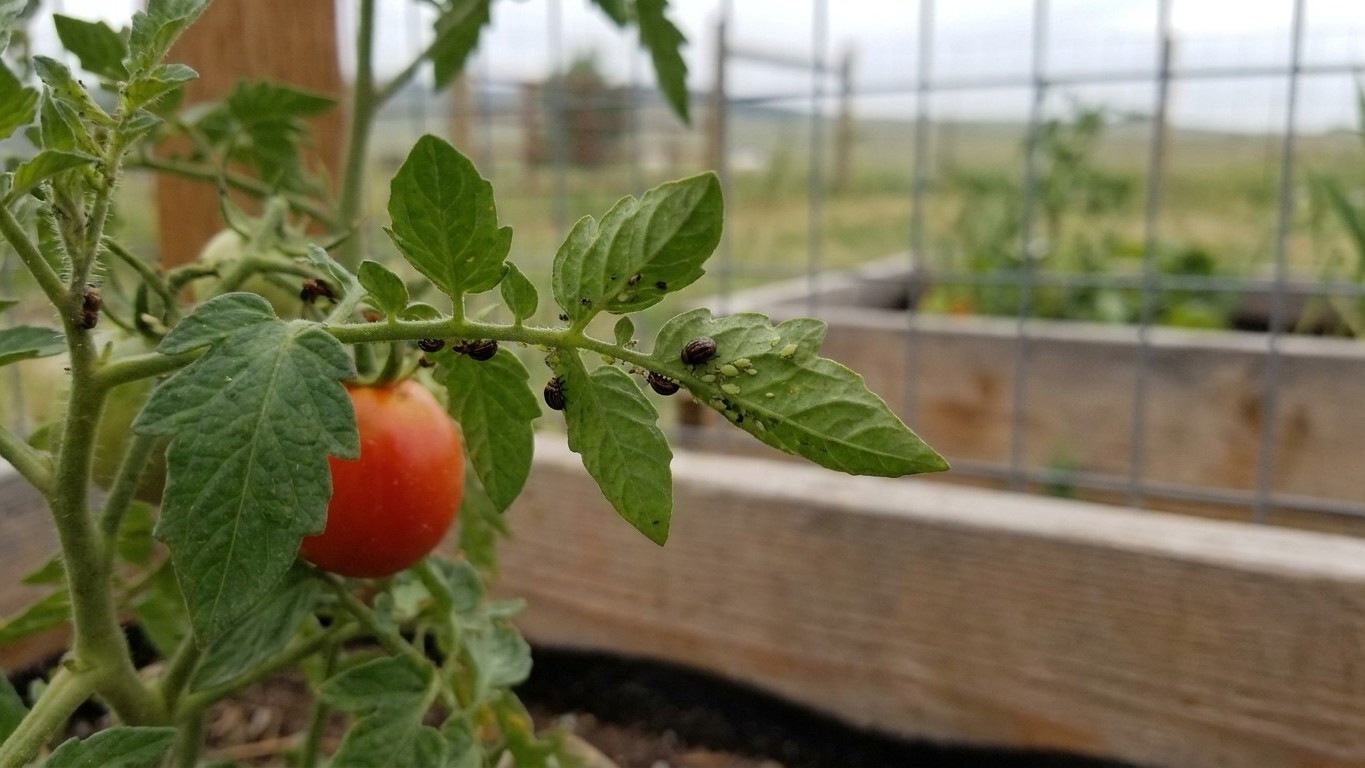

Only a handful of tomato pests show up with any regularity in Wyoming: cutworms, flea beetles, aphids, spider mites, tomato hornworms and blister beetles, in roughly that order across a growing season that NOAA’s 1991-2020 climate normals put at a last spring freeze of May 7 to May 18 and a first fall freeze of September 24 to October 5 near Cheyenne. That short window keeps a lot of pests that plague longer, warmer seasons from ever building up real numbers here. Walk your rows for cutworm damage the first week after transplant, since that’s the earliest threat your plants will face.
What this comes down to in Wyoming

Tomato hornworms get all the worry — gardeners scan for that fat green caterpillar all summer and miss what actually takes plants down here. In Wyoming, the damage usually happens weeks earlier and lower to the ground. Cutworms sever transplants at the soil line their first nights out, and flea beetles riddle young leaves before a hornworm would even have hatched. By the time anyone’s checking for hornworms, the real trouble already happened.
Cutworms

These are dull gray to brown caterpillars, up to two inches long, that curl into a tight C shape when you disturb the soil around them. They feed at night in the first weeks after transplant, chewing through a seedling’s stem right at the soil line and toppling the whole plant by morning. A cardboard collar pushed an inch into the soil around each transplant stops them cold, and it costs nothing but a few cereal boxes.
Flea beetles

Flea beetles are shiny black beetles barely a sixteenth of an inch long that jump like fleas when you brush the leaves. They show up on young transplants and chew a scatter of small round holes through the foliage, sometimes shredding a seedling’s first true leaves before it has a chance to establish. Floating row cover over the bed until plants are past the seedling stage keeps them off without spraying anything.
Aphids

Aphids are small, soft-bodied insects, usually green but sometimes black, that cluster in tight groups on the undersides of leaves and along new growth. They pierce the plant to feed on sap, curling leaves and leaving a sticky honeydew residue that can grow sooty mold. A strong jet of water knocks most colonies off, and a soap spray handles the rest; aphids build up steadily through the cooler weeks of early and mid summer.
Two-spotted spider mites

Spider mites are almost too small to see without a hand lens, pale yellow-green with two darker spots on the back, and they announce themselves with fine webbing on leaf undersides and a stippled, dusty yellow look to the foliage. They thrive in hot, dry conditions, which makes mid to late summer their peak in a climate this dry. Regular overhead watering in the evening and a miticide labeled for tomatoes if the population is heavy are the two real options.
Tomato hornworm

The tomato hornworm is hard to miss once it’s grown: a thick green caterpillar up to four inches long, with white diagonal stripes down its sides and a curved horn on its back end. It feeds on foliage and green fruit in mid to late summer and can strip a plant of leaves in a couple of days. Hand-picking works fine on a home garden scale since the caterpillar is large and slow.
Blister beetles

Blister beetles are elongated, soft-bodied beetles about three-quarters of an inch to an inch long, often striped black and yellow or solid gray, and they tend to show up in groups rather than one at a time. They chew ragged holes through leaves from mid-summer on, and they’re worth handling with gloves rather than bare hands, since their body fluid can raise a blister on skin. Knock them into a jar of soapy water rather than crushing them for that reason.
Working it out for your own garden
The fastest way to know which pest you’re dealing with is to work backward from what you actually see, not to guess from a photo online. A toppled seedling with a stem chewed clean at the soil line, and nothing else touched, is almost always a cutworm; check by feeling through the top inch of soil next to the plant, since that’s where it hides during the day. Small round shot-holes scattered through young leaves point to flea beetles instead. Sticky residue, curling new growth and a cluster of tiny insects on the leaf underside is aphids, not mites. Fine webbing and a dusty, stippled look, especially once the weather has turned hot and dry, is spider mites. A big caterpillar or a bare, stripped branch is a hornworm, and a mid-summer gathering of striped or gray beetles chewing ragged patches is blister beetles.
A quick field checklist
- Stem cut clean at soil line, plant toppled overnight: cutworm.
- Small round holes scattered through young leaves: flea beetle.
- Sticky leaves, curled new growth, cluster of tiny insects: aphids.
- Fine webbing, dusty stippled leaves in hot dry weather: spider mites.
- Large green caterpillar, stripped foliage: tomato hornworm.
- Group of striped or gray beetles chewing ragged holes: blister beetles.
The other half of working this out for your own garden is timing it against your own frost window, the same one that governs when a tomato plant is even outside for a pest to attack in the first place. If you haven’t nailed down your own transplant date yet, that’s worth doing before you worry about bugs; see Tomato Planting Dates in Wyoming: Counting Back From Your Frost Window for how to count backward from Cheyenne’s frost window to a transplant date at your own elevation. Once you know roughly when your plants go in the ground, you know roughly when to start watching for cutworms and flea beetles, and roughly how many weeks of hot weather remain before frost ends the season, and the spider mite and hornworm pressure with it.
What changes across the state
Every figure in this piece is measured at or near Cheyenne, and Wyoming’s elevation swings from under 4,000 feet along the eastern plains to well over 7,000 feet in mountain valleys, which changes both the growing season and the pest pressure inside it. Higher, colder gardens get a shorter frost-free window than Cheyenne’s, which means less time for aphids and spider mites to build the large colonies that come from several generations stacked in a row; a garden at higher elevation may see a pest arrive later and never reach the numbers a lower, warmer garden does. Southeastern Wyoming’s high plains, closer to rangeland and alfalfa acreage, tend to see heavier blister beetle pressure than gardens tucked well away from grazing land. Wind exposure matters too: a sheltered garden holds humidity longer after watering, which favors aphids, while an exposed, breezy plot dries out faster and tends to favor the pests that prefer it dry, like spider mites.
None of this changes which pests are on the list, only how much of each one you’re likely to see and how early. The USDA’s hardiness zone map puts the state anywhere from zone 3a to 6a depending on elevation and location, and that same spread is a reasonable stand-in for how the pest calendar shifts across the state: expect a colder zone to compress and delay pest pressure, and a warmer one to stretch it out over more weeks of the season.
The mistakes this state punishes

The single most common mistake is treating pest control like a summer-long chore instead of a set of narrow windows. Cutworms only matter in the first two or three weeks after transplant; skip the collar because the seedling looks fine one week in, and there’s no fixing a plant that’s already down by morning. The opposite mistake is ignoring blister beetles because they show up later, in the mid-summer stretch when gardeners are focused on watering and ripening fruit rather than scouting foliage; a cluster of them can strip a section of a plant in a day or two if nobody’s looking.
The other mistake specific to this climate is confusing spider mite damage with plain drought stress, since both show up as dusty, off-color leaves during the hottest, driest weeks of summer. Watering more without checking for the fine webbing underneath the leaves just keeps the plant limping along while the mite population keeps growing. Check the underside of a struggling leaf before you assume it just needs water. And because Wyoming’s whole growing season is short to begin with, bounded by the frost window NOAA’s 1991-2020 normals put around Cheyenne, any week lost to unmanaged pest damage is a week the plant doesn’t have to spare before fall frost ends things regardless of what you do. That’s a different calculation than in a state with a long season to recover in, and it’s the reason to lean on quick physical fixes like collars, row cover and hand-picking rather than waiting to see if a problem gets worse on its own.
Checking this against your county
Cheyenne’s frost dates and pest calendar are a starting point, not an instruction for your particular yard, especially in a state with as much elevation range as Wyoming has. Your county extension office will have a better read on which of these pests are actually active nearby this year, and how heavy the aphid or blister beetle pressure has been running. Start with the University of Wyoming Extension, and while you’re there, it’s worth reviewing the broader guidance on growing tomatoes in Wyoming, since pest timing only makes sense in the context of when your plants are actually in the ground.
Common questions
Do I need to spray for pests every week in Wyoming?
No. Most of the pests that Actually Show Up Here are manageable with physical controls like collars, row cover and hand-picking, and spraying on a fixed calendar rather than in response to an actual sighting usually does more harm to beneficial insects than good.
Why don’t I see the tomato pests people in other states complain about?
Wyoming’s short, cool, dry season doesn’t give many warm-climate pests enough generations to build up a noticeable population, so pests that are a real problem in longer, more humid growing seasons often just don’t get established here in numbers worth worrying about.
Are blister beetles dangerous to me, not just the plant?
Handle them with gloves rather than bare hands. Their body fluid can cause a skin blister on contact, which is where the name comes from, so knock or brush them into a container instead of crushing them with your fingers.
My leaves look dusty and yellow but I don’t see any bugs. What is it?
Check the undersides of the leaves with a hand lens before assuming it’s just drought stress, since two-spotted spider mites are tiny enough to miss with the naked eye and their fine webbing is often the first real clue. If you genuinely find nothing there, look at your watering consistency instead, and consider whether the variety you planted was ever going to finish before frost in the first place, which is a separate question covered in Tomato Varieties That Ripen in Time in Wyoming.