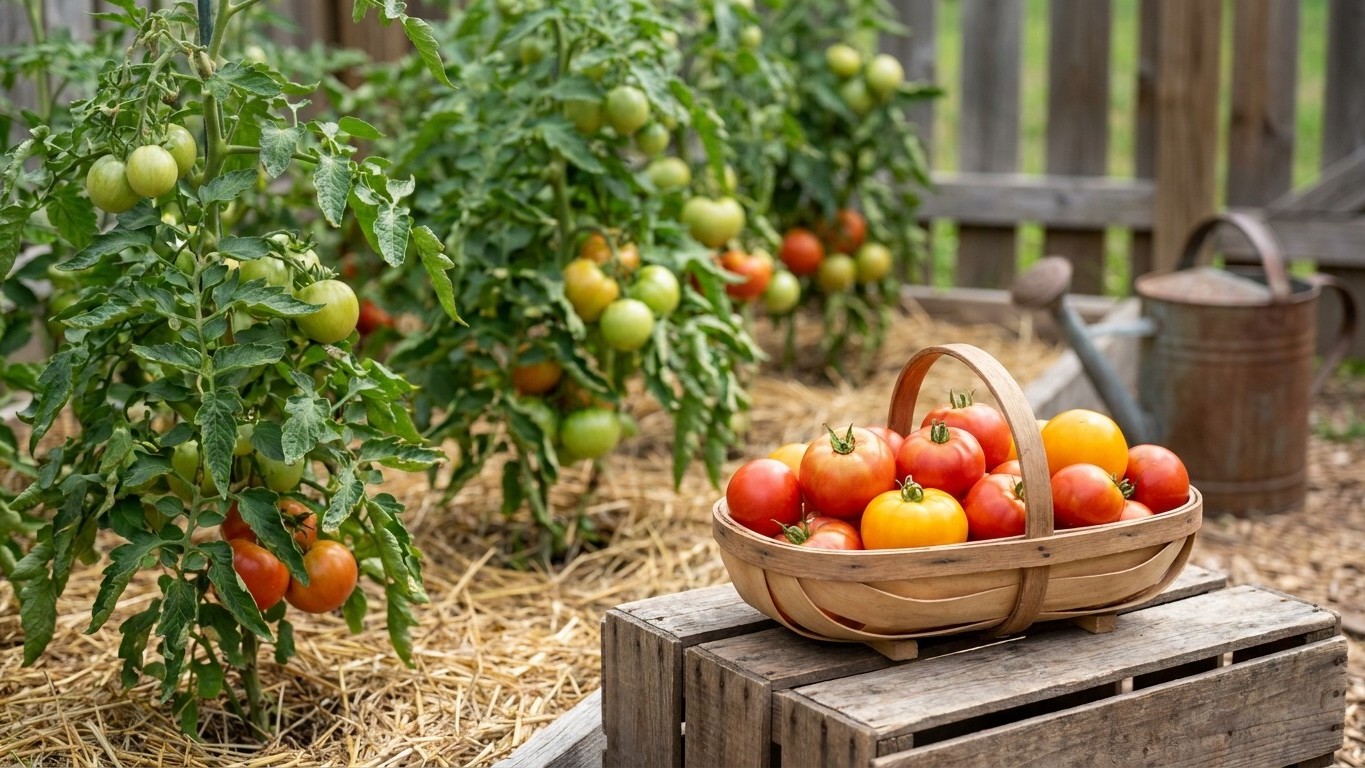

Several tomato varieties ripen with real room to spare in Kansas, even in a cool year. NOAA’s 1991-2020 climate normals put the last spring freeze at Wichita between April 4 and April 18, and the first fall freeze between October 23 and November 2, which leaves roughly six months of growing season in most years. Check your own county’s frost history before you commit to anything running past about 78 days from transplant.
What this comes down to in Kansas

Sakura’s fifty-five days looks like a promise printed right on the packet, but that clock starts the day the transplant goes into the ground, not the day the seed goes into the tray. Set it out mid April to early May, Kansas’s usual window, and it ripens by late June with roughly four months to spare before the Wichita-area fall freeze. Other varieties on this list stretch that math further, some barely clearing frost, some with weeks to burn.
The varieties below are ordered from shortest season to longest, using the days-to-maturity figure printed on the seed packet, counted from the day of transplant rather than from seed. Setting transplants out mid April to early May, the window this state’s frost dates allow, gives each one a calculated first-ripe date and a calculated margin before the Wichita-area fall freeze. Catalogue figures shift by a week or two depending on the season, so treat these as a planning range rather than a fixed calendar.
Sakura

Sakura reaches first ripe fruit around 55 days from transplant, the shortest season on this list. Set out mid April to early May, that puts first ripe fruit in late June, with about 119 days of margin before the fall frost window opens. It carries intermediate resistance to nematodes and high resistance to Tomato Mosaic Virus and two races of Fusarium Wilt, useful in a bed that has grown tomatoes for several years running.
Sun Gold

Sun Gold needs about 57 days from transplant, close behind Sakura. The same mid April to early May transplant window puts first ripe fruit in late June, with roughly 117 days of margin before frost. It resists Tobacco Mosaic Virus and one race of Fusarium Wilt, both of which show up in Kansas garden soil over time.
Supersweet 100

Supersweet 100 runs about 60 days from transplant, putting first ripe fruit in early July with roughly 114 days of margin before frost. It resists Verticillium Wilt and Fusarium Wilt race 1, two soil-borne diseases that persist for years once established in a bed. The vines keep setting new clusters right up until frost actually arrives.
Jasper

Jasper also finishes around 60 days from transplant, first ripe fruit in early July, about 114 days of margin. It carries high resistance to Late Blight, a fungal disease that spreads fast in a wet Kansas August, plus intermediate resistance to Early Blight. That combination makes it a sturdier cherry choice than most for a humid summer.
Amalfi

Amalfi takes about 68 days from transplant, ripening in early July with about 106 days of margin before frost. It is a determinate paste tomato bred for sauce, and it carries intermediate resistance to Late Blight, Early Blight and nematodes. Because it is determinate, most of the fruit sets in a shorter window, which suits a gardener aiming for one big canning batch rather than a slow trickle all season.
Cherokee Purple

Cherokee Purple needs about 72 days from transplant, putting first ripe fruit in mid July with about 102 days of margin. It is an heirloom slicer with no listed disease resistance, so it leans on the length of the season itself rather than genetics to get across the finish line. That margin is comfortable at Wichita, but a gardener whose local frost tends to arrive on the early side of the county’s range should watch it closely in a cool spring.
Big Beef Plus
Big Beef Plus also runs about 72 days from transplant, first ripe fruit in mid July, about 102 days of margin. It resists nematodes, Gray Leaf Spot and Tomato Mosaic Virus, a broader package than the heirlooms carry. That makes it a dependable main-season slicer in a bed where soil-borne pressure has built up from several years of tomatoes in the same spot.
Celebrity Plus
Celebrity Plus takes about 78 days from transplant, ripening mid July with about 96 days of margin, the tightest cushion among the mid-season slicers on this list. It is determinate, resists nematodes, Gray Leaf Spot and Tomato Mosaic Virus, and its fruit arrives in a more concentrated window than an indeterminate vine, useful if you want most of the harvest ready for canning at once.
Amish Paste
Amish Paste is the longest-season variety here at about 85 days from transplant, putting first ripe fruit in late July with about 89 days of margin, still comfortably inside the Wichita frost window in a normal year. It carries no listed disease resistance, so a cool wet spring that delays transplanting eats directly into that margin. This is the one to skip if a late spring or a slow start has already cost you a week or two.
| Variety | Days to maturity | Type | First ripe | Margin before frost |
|---|---|---|---|---|
| Sakura | 55 | Indeterminate | Late June | ~119 days |
| Sun Gold | 57 | Indeterminate | Late June | ~117 days |
| Supersweet 100 | 60 | Indeterminate | Early July | ~114 days |
| Jasper | 60 | Indeterminate | Early July | ~114 days |
| Amalfi | 68 | Determinate | Early July | ~106 days |
| Cherokee Purple | 72 | Indeterminate | Mid July | ~102 days |
| Big Beef Plus | 72 | Indeterminate | Mid July | ~102 days |
| Celebrity Plus | 78 | Determinate | Mid July | ~96 days |
| Amish Paste | 85 | Indeterminate | Late July | ~89 days |
Working it out for your own garden
Start from your county’s own last spring frost date, not Wichita’s, since the airport station’s figures used above run one to two weeks earlier than what many suburban and rural gardens actually see. From there, work forward.
A worked example
Take Sun Gold, at 57 days from transplant. Setting it out mid April to early May, the standard window this state’s frost dates allow, adding 57 days lands first ripe fruit in late June. Wichita’s fall frost window, per NOAA’s normals, opens October 23 to November 2. That leaves roughly 117 days of open season after the first tomato ripens, more than three times what the plant needs to keep producing until frost actually shuts it down.
Now take a hypothetical paste tomato needing around 100 days from transplant, longer than anything on the list above. The same mid April to early May transplant window pushes first ripe fruit into late July or even August, and the margin before frost shrinks to somewhere around 75 to 85 days rather than the 89 to 119 days the varieties above carry. That is still workable at Wichita in a normal year, but it leaves almost no room for a delayed transplant, a cool June, or a county where the growing season runs shorter than the reference city’s. This is the line a long-season variety walks in Kansas: not whether it can ripen, but how much slack is left if anything goes wrong.
- Find your own county’s frost dates rather than relying on Wichita’s alone.
- Count forward from your realistic transplant date using the variety’s days-to-maturity figure.
- Subtract that first-ripe estimate from your county’s typical first fall frost to see the true margin.
- Treat catalogue day counts as a range, not a fixed number, since a cool spring adds a week or more.
The full method for pinning down your own transplant window, county by county, is worked through in Tomato Planting Dates in Kansas: Counting Back From Your Frost Window.
What changes across the state
Kansas is not one climate, and the Wichita figures above are a starting point, not a state-wide promise. Elevation rises steadily from east to west across the state, and higher ground tends to see a shorter frost-free window than lower elevation river valleys, since cold air pools and cools faster at altitude. A gardener in the western part of the state should generally expect the season to run tighter on both ends than what the Wichita normals show, while parts of the eastern third, closer to the Missouri border and at lower elevation, often see a somewhat longer window.
North versus south
The northern tier of the state, along the Nebraska border, typically sees its last spring frost later and its first fall frost earlier than the southern tier near Oklahoma, simply because it sits farther from the equator and cools faster in autumn. That difference compounds with elevation, so a garden in the northwest corner of the state faces the tightest season of any region, while the south-central and southeast corners tend to have the most room to work with.
None of this changes which cultivars are on the market or their published days-to-maturity, since those figures are fixed at the seed company. What it changes is the margin each variety actually gets once it’s planted in your specific county rather than at the Wichita airport station used for the statewide normals. A variety that finishes with 89 days of margin at Wichita might finish with meaningfully less in a colder northwestern county, which is exactly the kind of buffer a longer-season paste tomato like Amish Paste can’t easily spare.
The mistakes this state punishes

The most common error is planting into soil that is still cold underneath a warm stretch of April weather. Kansas often throws a run of 70-degree days well before the last frost has actually passed, and tomato roots set into cold soil sit stalled for two to three weeks even if no frost ever touches the leaves, which erases exactly the margin you have been calculating. Wait for the soil itself to warm, not just the air, before transplanting.
Choosing on flavor before checking the calendar
The second mistake is picking a variety for its reputation rather than its days-to-maturity. Brandywine and Amish Paste are prized for flavor and for canning, but at 78 and 85 days from transplant they carry the thinnest margins, and a gardener who plants them a week late because the soil was still cold has given away most of that cushion before the season even starts. If your county’s spring runs cooler than Wichita’s, lean toward the 55 to 68 day varieties instead and treat anything past 75 days as a calculated risk rather than a safe default.
The third mistake is ignoring the disease pressure that builds through a long Kansas summer, since a plant that survives to ripen its first fruit can still lose the rest of the season to a fungal disease it was never bred to resist. Checking which pests and diseases actually show up in this state, and when, is covered in Tomato Pests in Kansas: Which Ones Actually Show Up Here, and it’s worth reading before you finalize a variety list rather than after something shows up on the leaves.
Checking this against your county
Everything above is anchored to Wichita’s airport weather station, and NOAA itself notes that suburban and rural gardens typically see later spring frosts and earlier fall frosts than that single point, often by one to two weeks. Before locking in a variety list, check your own county’s extension office and the state’s tomato guidance through Kansas State Research and Extension, which can point you to more localized frost data than a single reference city can provide. The broader steps for planning a tomato crop in this state, from soil prep through harvest, are covered in growing tomatoes in Kansas.
Common questions
Can I still grow a 90-day tomato in Kansas?
Yes, in most years, but the margin gets thin. At Wichita’s frost dates, a 90-day variety would ripen in early to mid August with maybe 75 to 85 days of buffer left, less than half what a 55-day cherry tomato carries, so a cold spring or a late transplant leaves very little room for error.
Do I need to pick a disease-resistant variety?
Not strictly, but it helps in a bed that has grown tomatoes for several years. Heirlooms like Cherokee Purple, Brandywine and Amish Paste carry no listed resistance, while hybrids like Big Beef Plus and Celebrity Plus resist several common soil-borne diseases, which matters more the longer you’ve used the same garden spot.
Why does my catalogue say a different days-to-maturity than what’s listed here?
Catalogue figures are counted from the day of transplant, not from seed, and they shift by a week or two depending on the season and how the plant was hardened off. Treat any days-to-maturity number as a planning range rather than an exact count.
Should I start seeds early to get ahead of the frost date?
Starting seeds early only helps if you also have somewhere warm enough to hold the transplants until the soil outside has actually warmed. Setting a young plant out into cold soil, even weeks after the frost has passed, stalls its roots and can cost more time than starting seed a little later would have.