
Los Angeles freezes exactly zero days a year on average, three decades of records confirm it, and that single fact does more to shape which bugs find your tomatoes than any spray schedule ever will. No hard frost means aphids, whiteflies and mites never really die off — they just idle through winter and climb back onto transplants weeks before a cold-state gardener would think to check for them. Inland and up north, actual freezes hold that line instead, so the same pests arrive later and thinner. Where you garden decides the calendar more than the calendar does.
What this comes down to in California

Frost is not what shapes a tomato pest season near Los Angeles, because NOAA’s 1991-2020 climate normals show zero days at or below 32°F in thirty years of records there. Without a hard freeze to knock back overwintering populations, aphids, whiteflies and mites can carry over from one season into the next in coastal and southern California, arriving on transplants earlier and building up faster than a gardener used to a cold-winter state would expect. Inland and in the north, actual freezes do the job frost normally does elsewhere, so the same pests show up later and in smaller numbers there.
Once you’ve handled the basics of growing tomatoes in California, pest pressure is the next variable that decides whether a planting makes it to harvest. The pests below are ordered by when they typically turn up over the course of a season, from the seedling stage through fruit set. Not every pest shows up in every garden, and coastal fog, Central Valley heat and mountain elevation all shift the timing and severity, covered further down.
Cutworms
Cutworms are the caterpillar stage of several night-flying moths, and they do their damage in the first two or three weeks after you set out transplants. The larvae hide in the soil during the day and come out at night to chew clean through a young stem at the soil line, dropping the whole seedling overnight with no warning. A cardboard collar pushed an inch into the soil around each stem blocks them completely, and it costs less time than replacing a lost transplant.
Flea Beetles
Flea beetles show up around the same time as cutworms, while leaves are still small and tender. They chew hundreds of tiny round holes that make a leaf look like it took a hit of fine buckshot. Established plants usually outgrow the damage on their own, but a heavy hit on seedlings can stunt them for weeks. Floating row cover over the bed until plants are established keeps adults off without a single spray.
Aphids
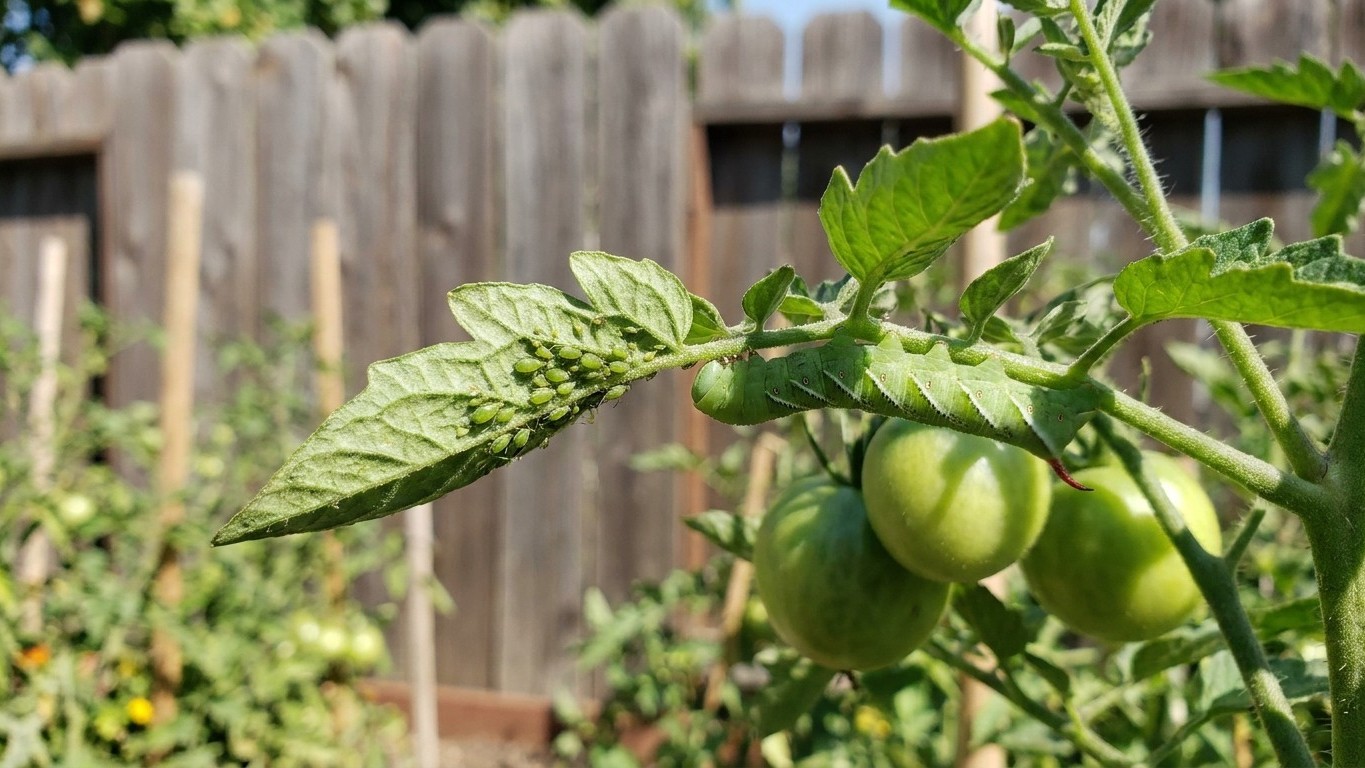
Aphids move in once new growth is soft and plentiful, clustering on stem tips and the undersides of leaves where they go unnoticed until the leaves start to curl. They excrete a sticky honeydew that sooty mold grows on, which is often the first sign a gardener actually notices. A strong jet of water knocks most colonies down, and lady beetles and lacewings usually clean up what is left if nothing has been sprayed to kill them off along with the aphids.
Tomato/Potato Psyllid
The tomato and potato psyllid is a small, cicada-shaped insect that feeds on the underside of leaves and injects a toxin as it does, causing the whole plant to yellow, curl and stall in a pattern growers call psyllid yellows. It is worse in some years than others and worse in some parts of the state than others, so a sudden, unexplained yellowing that does not match a watering or nutrient problem is worth checking under the leaves with a hand lens before you assume it is something else.
Whiteflies
Whiteflies flutter up in a small pale cloud when a leaf is brushed, which is usually how a gardener first notices them. Both the adults and the flat, scale-like nymphs feed on plant sap and can spread viruses between plants as they move around a planting. Yellow sticky traps near the plants catch adults and give an early warning before numbers get out of hand, and a heavy infestation is far easier to knock back at that stage than after it has spread through the whole bed.
Twospotted Spider Mites
Spider mites are barely visible without a hand lens, but the damage is not: leaves take on a fine yellow-bronze stippling and, in a bad case, fine webbing shows up between leaves and stems. They thrive in hot, dry conditions and on dusty foliage, which makes them a bigger problem in the hottest part of a California summer than earlier in the season. A weekly rinse of the foliage with plain water does more to prevent an outbreak than most sprays do to fix one already underway.
Tomato Hornworm
Hornworms are hard to spot despite their size, up to about four inches long, because their green coloring and white diagonal stripes match tomato foliage almost exactly. The first clue is usually stripped stems and dark green droppings on the leaves below, not the caterpillar itself. Hand-picking at dusk, when they start moving, is still the most reliable control for a home garden.
Tomato Fruitworm
Fruitworms show up as fruit starts to ripen, boring a single clean hole into the fruit, usually near the stem end, and hollowing out the inside from there. Checking green and ripening fruit for that entry hole a couple of times a week catches an infestation before an entire cluster is lost. Removing and destroying affected fruit keeps the caterpillar from finishing its life cycle in your bed.
Working it out for your own garden
Matching a symptom to the right pest matters more than memorizing the full list, because treating a spider mite problem like an aphid problem, or the reverse, wastes a week you don’t get back once fruit is on the vine. Start by asking where on the plant the damage shows and how the plant’s stage lines up with the season, since most of these pests have a narrow window when they actually do harm.
Match the symptom to the pest
| Pest | Where the damage shows | When it is most active |
|---|---|---|
| Cutworms | Stem severed at the soil line | First weeks after transplant |
| Flea beetles | Small round holes across young leaves | Early in the season, on small plants |
| Aphids | Curled new growth, sticky honeydew | Spring through most of the season |
| Tomato/potato psyllid | Yellowing, curling, stunted growth | Spring into summer |
| Whiteflies | Cloud of tiny insects when leaves are disturbed | Warm weather, mid-season on |
| Spider mites | Stippled, bronzed leaves, fine webbing | Hottest, driest stretch of summer |
| Hornworm | Stripped stems, chewed green fruit | Mid to late summer |
| Fruitworm | Bored hole in ripening fruit | Late summer, as fruit ripens |
When the symptoms overlap
Once you’ve narrowed it to two or three candidates, a hand lens settles most arguments. Aphids and psyllid nymphs are both small and pale, but aphids are soft, round-bodied and move when you touch them, while psyllid nymphs are flat, scale-like and stay put. Spider mites show up as a faint moving dot if you tap a damaged leaf over a sheet of white paper. If a photo and a description still don’t get you a confident answer, the state’s land-grant extension service, UC ANR, publishes pest identification pages that cover the insects most gardeners in the state actually run into.
The transplant date you settle on also shapes how much pest pressure your plants meet while they’re still small and vulnerable. If you haven’t nailed that date down yet, working backward from your local frost window the way our Tomato Planting Dates in California: Counting Back From Your Frost Window guide lays out puts seedlings into the ground with the least overlap with cutworms and flea beetles, both of which taper off once plants are past the tender seedling stage.
What changes across the state
The frost-free figure NOAA records near Los Angeles describes the coast and the southern part of the state, not California as a whole. The Central Valley and the foothills see real winter cold, and the Sierra sees hard freezes that most of the pests above cannot survive outdoors. That single difference resets the pest calendar: a garden in a colder inland pocket starts each spring with a much smaller carryover population of aphids, whiteflies and psyllids than one on the immediate coast, even though both fall somewhere within the USDA hardiness zones 5a-11a the state spans overall.
Coast, valley and mountain differences
Distance from the ocean changes which pest gets the upper hand, too. Coastal fog keeps humidity up and daytime highs down, which slows spider mites, since they favor hot, dry, dusty conditions. Move inland into the Central Valley, where summer heat runs much higher and the air is drier, and mites become the dominant problem by midsummer while psyllid and whitefly pressure can ease off during the hottest stretches. Elevation works in the gardener’s favor for most of these pests, since cooler nights in the foothills and mountains slow insect reproduction across the board, and a garden at higher elevation typically sees a shorter, lighter pest season than one at sea level a short drive away.
None of this changes which pests are possible in the state, only how early they arrive and how much damage they do before something, frost, heat or a natural predator, checks them. A gardener moving from the coast to the Central Valley should expect the same list of pests but a different order of urgency, and two gardens forty miles apart can report very different pest years depending on how their local winter and summer played out.
The mistakes this state punishes

The biggest mistake is treating a frost-free winter as if it means nothing carries over, then being caught off guard by an aphid or whitefly population that never actually died back. Scout in late winter, before you even transplant, especially if you grew tomatoes, peppers or eggplant in the same bed the year before, since those pests can be sitting on volunteer plants or nearby weeds the whole time.
Prevention beats a rescue spray
Reaching for a broad-spectrum insecticide at the first sign of aphids or mites is another one that backfires here. It kills off the lady beetles, lacewings and predatory mites that would otherwise keep both pests in check, and because the growing season runs so long in most of the state, a population that bounces back after a spray has months left to do damage rather than weeks.
Letting foliage stay dusty through a long, dry Central Valley summer is a third one. Dust buildup is exactly what lets spider mite populations explode, and a plant already stressed by heat and inconsistent watering has less capacity to outgrow the damage. A weekly rinse of the leaves costs nothing and heads off the worst of it before webbing ever shows up.
Finally, waiting for visible fruit damage before checking for hornworms or fruitworms means losing fruit that was already ripening. Checking the undersides of leaves and the fruit itself a couple of times a week from midsummer on catches both while there is still something worth saving.
Checking this against your county
Everything above is anchored to conditions measured near Los Angeles, and a garden in Redding, Fresno or up in the Sierra foothills will see a different mix of these pests on a different timeline. Before committing to a control plan, check with your county’s University of California ANR extension office, since staff there track which pests are actually active locally in a given year and can confirm an identification you’re unsure of. A quick email with a photo attached is usually enough to get a confirmed answer.
Once pests are under control, matching the right variety to the season you actually have matters just as much. See our guide to Tomato Varieties That Ripen in Time in California for cultivars that fit different length seasons across the state.
Common questions
Do tomato pests die off over winter in California?
Not on the coast or in Southern California, where NOAA’s climate normals for Los Angeles show no freeze in an average year, so several pests simply keep reproducing at a reduced rate through winter. In the Central Valley and northern California, real winter cold does knock populations back the way it does in most other states.
Why do my tomato leaves look yellow and curled but I can’t find any bugs?
Check the underside of the leaves with a hand lens before ruling pests out, since both aphids and tomato/potato psyllid nymphs are small enough to miss with a quick glance from above. If nothing turns up there, a watering problem or a nutrient deficiency is worth checking next, since several of those produce similar yellowing.
Is it worth spraying for pests I haven’t actually seen yet?
Spraying on a fixed schedule rather than in response to an actual sighting usually does more harm than good, because it kills off the lady beetles and other predators that keep aphid and mite numbers down on their own. Scouting weekly and treating only what you actually find works better in a state with a long growing season, since a population that survives a preventive spray still has months left to rebuild.
Can I compost tomato plants that had hornworms or fruitworms on them?
Removing the caterpillars and any damaged fruit before composting the rest of the plant is the safer approach, since a home compost pile doesn’t reliably kill every pupa in the soil around the roots. Pupae from both pests can overwinter in the ground, so shaking roots free of dirt before adding them to the pile cuts down on how many make it through to the next season.