
Minnesota’s tomato pest list is short and it repeats every year: cutworms, flea beetles, Colorado potato beetles, aphids, tomato hornworms and tomato fruitworms. Minneapolis sees its last spring freeze between April 17 and April 30 and its first fall freeze between October 11 and October 23, according to NOAA’s 1991-2020 climate normals, and that window decides when each pest shows up. Check transplant stems at the soil line for the first two weeks after you set plants out. That’s when the earliest of these six does its damage, and it’s the one most gardeners miss.
What this comes down to in Minnesota

A transplant’s stem, chewed clean through overnight, is what tells you cutworms got there before you did — the top looks fine, the root ball looks fine, and the seedling is still dead. Growers lose whole flats this way in late May because they scouted for chewed leaves instead of checking soil level, and by the time the damage shows, the collar you should’ve pushed into the dirt a week earlier won’t help anymore. Minnesota’s pest list isn’t long, but timing wrong on this one costs you the whole planting.
Cutworms

Cutworms are the first threat a new transplant faces. The larva is dull gray-brown to black, plump, and curls into a tight C-shape if you disturb it while turning soil. It feeds at night and chews clean through a seedling stem right at the soil line, so you find a healthy-looking top lying next to an intact root ball in the morning. A paper or foil collar pushed an inch into the soil around each stem stops it, since the caterpillar cannot climb over or reach around the barrier.
Flea Beetles

Flea beetles show up around the same time, riddling young leaves with small round holes that look like they were made with a hole punch. The adults are tiny, shiny black beetles that jump when disturbed, which is where the name comes from. They rarely do enough damage to slow down an established plant, but a heavy flea beetle attack on week-old transplants can stunt growth. A floating row cover kept on until plants are a foot tall keeps them off without any spray.
Colorado Potato Beetle

Adults overwinter in the soil and climb onto tomato and potato foliage as it emerges, oval and about 3/8 inch long, yellow-orange with five black stripes running down each wing cover. The larvae do the real damage: humpbacked, brick-red to orange, with two rows of black spots, and capable of stripping a young plant’s leaves in a matter of days if left unchecked. Handpicking both stages works well at home-garden scale, since the beetle is slow-moving and easy to spot against green foliage.
Aphids

Aphids build through midsummer rather than arriving all at once. They are small, pear-shaped, soft-bodied insects clustered on the undersides of leaves and on new stem tips, usually pale green but sometimes pink or black. Heavy colonies leave a sticky honeydew residue that molds black on lower leaves. A strong jet of water or insecticidal soap knocks a colony back, and ladybird beetles usually keep light infestations from ever becoming a problem worth treating.
Tomato Hornworm

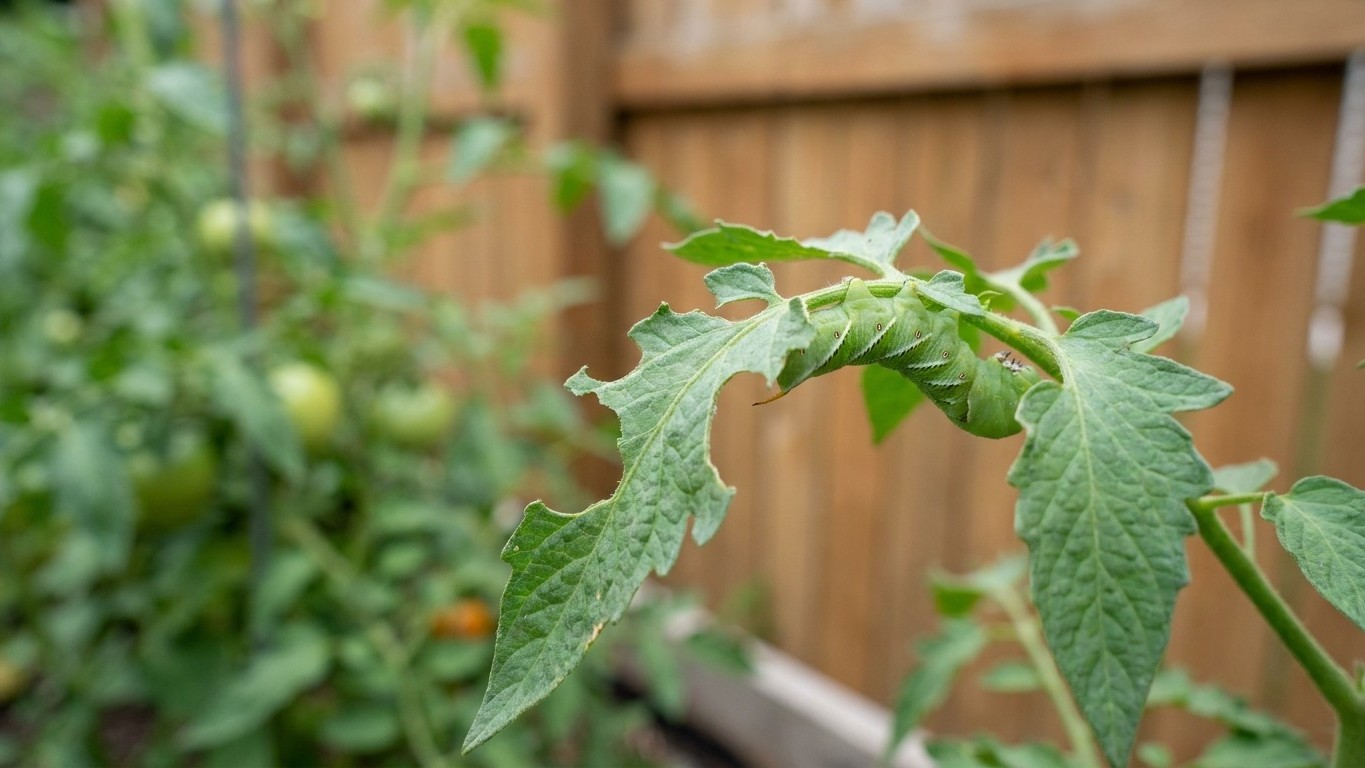
Hornworms feed through late summer once nights are reliably warm. The caterpillar is large, bright green, up to 4 inches long, with pale diagonal stripes down each side and a curved horn near the tail end. One hornworm can strip a branch bare in a single night, but the damage, once you know the silhouette, is easy to trace back to a caterpillar sitting in plain sight against a bare stem.
Tomato Fruitworm

Fruitworms arrive latest, boring directly into ripening fruit from late summer on. The caterpillar varies from green to brown to pink with pale side stripes and reaches about 1.5 inches long. Damage shows as a clean entry hole near the stem end with rot spreading behind it. Pull and destroy infested fruit right away, since the caterpillar abandons a spent fruit and moves to the next one on the same plant.
Working it out for your own garden
Identifying which of these six you have comes down to matching timing to damage location, not just matching a photo. A caterpillar that severs a stem at ground level in the first two weeks after transplant is a cutworm. Shot-holes in young leaves during that same early window point to flea beetles instead. Leaf-stripping that starts in June, with a humpbacked red larva doing the eating, is Colorado potato beetle. Sticky, curling leaves in midsummer mean aphids. A missing branch of foliage in August, with a caterpillar the size of your finger sitting on the stem, is a hornworm. A hole bored straight into a ripe fruit late in the season is a fruitworm.
A quick reference
| Pest | When it shows up | Where the damage is |
|---|---|---|
| Cutworms | First 2 weeks after transplant | Stem severed at soil line |
| Flea beetles | Right after transplant | Shot-holes in young leaves |
| Colorado potato beetle | Late spring into June | Leaves stripped, larvae visible |
| Aphids | Building through midsummer | Sticky, curled leaves and stem tips |
| Tomato hornworm | Late summer | Whole branches of foliage missing |
| Tomato fruitworm | Late summer onward | Bored holes in ripening fruit |
Run through this checklist before reaching for any treatment:
- Note the date and the plant’s growth stage, since three of these pests only appear on young transplants
- Turn suspect leaves over to look for the insect itself, not just the damage
- Check the soil line at the base of any severed stem before assuming disease
- Separate insect damage from disease. A resistance code printed on a seed packet, like the Tomato Mosaic Virus resistance bred into Big Beef Plus or Celebrity Plus, protects against a pathogen and does nothing against any of these six insects
If cutworms keep taking out replacement transplants no matter when you set them, moving your planting date within the range described in Tomato Planting Dates in Minnesota: Counting Back From Your Frost Window will not fix it. Cutworm risk tracks soil moisture and grass or weed cover from the previous season, not the calendar.
What changes across the state
Every figure above is anchored to Minneapolis, and Minneapolis sits in the mild south of a state that runs from USDA hardiness zone 3a in the north to zone 5a in the metro area, per the USDA Plant Hardiness Zone Map. NOAA’s own normals note that northern Minnesota’s frost window runs two to three weeks tighter at both ends than the Twin Cities. That compressed season pushes back when soil warms enough for Colorado potato beetle to become active and shortens the stretch aphids and hornworms have to build up numbers.
Large bodies of water change things locally too. Areas near Lake Superior and along the Mississippi River bluffs hold heat longer into fall than open prairie land at the same latitude, which can stretch the window fruitworms have to keep feeding on ripening fruit. A garden on an exposed, elevated site with no windbreak will generally run a few days colder at both ends of the season than a sheltered spot in the same county, which matters more for frost timing than for any single pest’s arrival.
The practical upshot is that a gardener in Duluth or International Falls should expect every pest on this list to arrive later and build up in smaller numbers over a shorter window than a gardener in the Twin Cities metro, while someone gardening in the warmer southeast corner of the state, near Rochester, may see the opposite: an earlier start and slightly more time for a second generation of aphids or a later fruitworm flight.
The mistakes this state punishes

The single costliest mistake is losing transplants to cutworms early and then having to replant. Minnesota’s frost-to-frost window is not generous to begin with, and a two-week delay from a lost first planting can push a long-season cultivar past its margin. A tomato like Amish Paste, at 85 days from transplant and roughly 65 days of margin before the Minneapolis fall frost window even under normal timing, has almost no room to absorb a setback. A shorter cultivar such as Sun Gold or Sakura, both around 55 to 57 days, tolerates a replant far better simply because it has more days of margin to spend.
The second mistake is treating every leaf hole as the same problem. Spraying a broad insecticide for what turns out to be flea beetle damage on an established plant, when the beetle mostly threatens seedlings, kills off the ladybird beetles that would otherwise be quietly controlling an aphid colony. Match the treatment to the pest and the plant’s age, not just to the visible damage.
The third mistake is pulling row covers too early or leaving them on too long. Take them off before flowers need pollinator access, but not so early that flea beetles get a clean run at fresh transplants. Both errors are common in a state where the safe window for cover removal is short and easy to misjudge.
Checking this against your county
Every number and every pest description here reflects conditions measured at or near Minneapolis. A county in the Red River Valley, the Arrowhead region, or the far southeast corner of the state will see these same six pests on a shifted schedule. Confirm the current picture for your county through UMN Extension, which maintains county offices and pest updates specific to local conditions, before deciding when to start scouting or when to stop worrying about a given pest for the season. For the crop overview, see growing tomatoes in Minnesota.
Common questions
My tomato leaves have small round holes but I can’t find any bugs on them, what’s doing that?
That pattern usually points to flea beetles, which feed at dawn and dusk and hide in soil or nearby plant debris during the heat of the day. Check the plant early in the morning or right before dusk and you will likely find them.
Should I spray for tomato hornworms or just pick them off?
Handpicking works fine at garden scale since hornworms are large and, once you know the silhouette, easy to spot against bare stems. Leave any hornworm covered in small white cocoons alone, since those are a parasitic wasp’s eggs and the caterpillar is already dying and will stop feeding soon.
Do floating row covers keep cutworms out too?
No. Cutworms live in the soil and are usually already present in the bed before you cover it, so a cover does nothing against them. A physical collar pushed into the soil around each stem is the control that actually works for cutworms.
When can I stop watching for pests for the season?
Most insect activity drops off once nights turn consistently cold heading into the first fall frost window, October 11 to October 23 at Minneapolis per NOAA’s normals. A warm, extended fall can keep fruitworms active a bit longer than usual, so it pays to keep checking ripening fruit even after the days start feeling like fall.