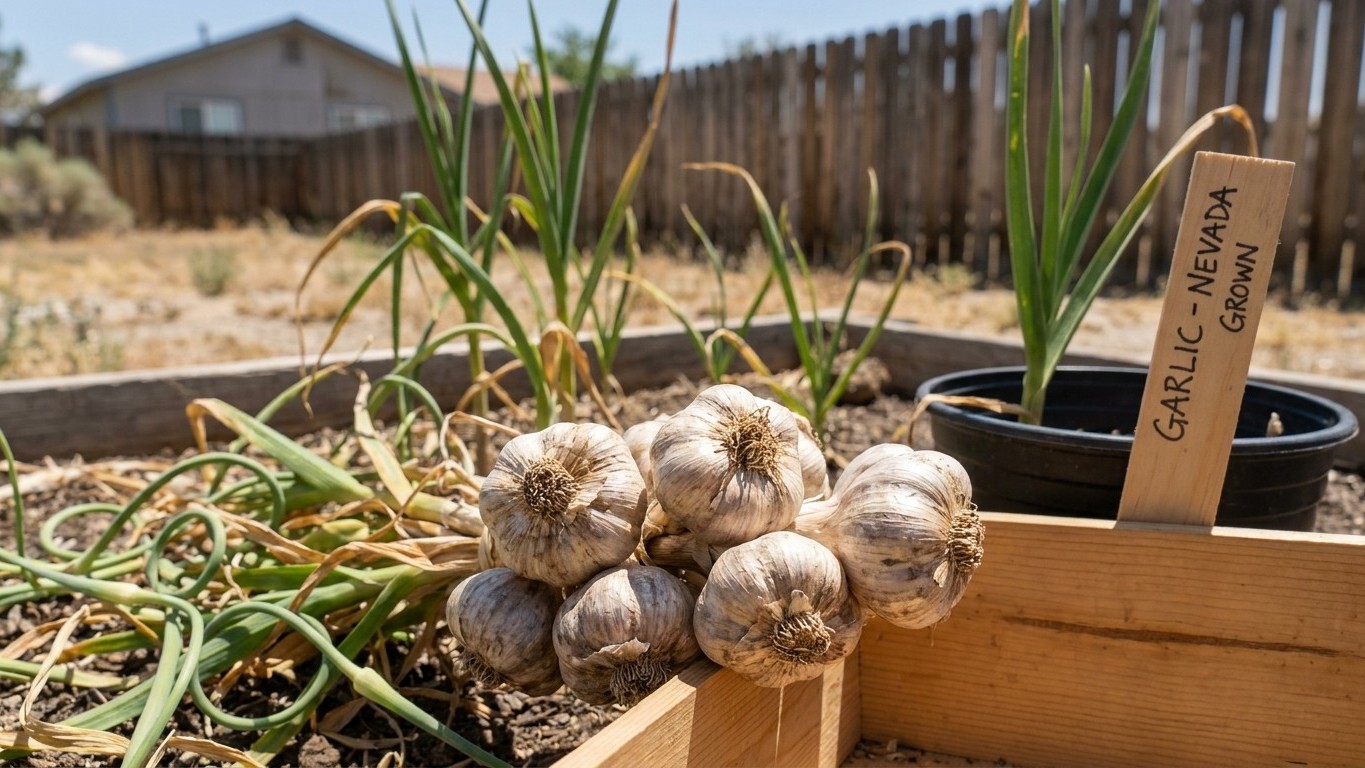

Every one of the fourteen garlic varieties worth growing in Nevada gets more winter chill than it needs here, so cold isn’t what decides whether your crop works — timing the planting is. The right move is to set cloves out sometime between mid-November and early December, no matter which softneck or hardneck type you’ve picked. Before you settle on an exact date, check when your ground typically sees its first fall freeze, since that date shifts by weeks or even months depending on your elevation, and everything else about your planting window builds backward from it.
The short answer for Nevada

The short answer is a window, not a single date: set cloves out from mid-November to early December for any of the fourteen cultivars worth growing here, softneck (Inchelium Red, Early Red Italian, Italian Late, Lorz Italian) or hardneck (German Red, German White, Chesnok Red, Duganski, Bavarian Purple, Blue Music, Fall Festival, Georgian Crystal, Georgian Fire, Ivan). That window works statewide because Nevada’s cold season, wherever you garden, hands garlic more chilling than it needs to split into cloves.
The window is anchored on the first fall freeze, but not on any single day. At the Las Vegas airport station, NOAA’s 1991-2020 climate normals put the first fall freeze between December 8 and December 23, a fifteen-day spread. Even that spread is only a midpoint: in roughly half the years behind that normal, frost at the station arrived later than December 23, not earlier, so no single day inside the window is ever a safe date to lean on. The Las Vegas figure also comes with a specific catch. It’s measured at a desert airport with a strong urban heat island, and it runs weeks to months behind the freeze dates at higher, cooler ground elsewhere in the state. That’s why mid-November to early December works as a statewide planting window rather than a Las Vegas-specific calculation: it’s built to clear the earliest freezes in the state, not just the latest one.
| Variety | Neck type | Set-out window |
|---|---|---|
| Early Red Italian | Softneck | Mid-November to early December |
| Inchelium Red | Softneck | Mid-November to early December |
| Italian Late | Softneck | Mid-November to early December |
| Lorz Italian | Softneck | Mid-November to early December |
| Bavarian Purple | Hardneck | Mid-November to early December |
| Blue Music | Hardneck | Mid-November to early December |
| Chesnok Red | Hardneck | Mid-November to early December |
| Duganski | Hardneck | Mid-November to early December |
| Fall Festival | Hardneck | Mid-November to early December |
| Georgian Crystal | Hardneck | Mid-November to early December |
| Georgian Fire | Hardneck | Mid-November to early December |
| German Red | Hardneck | Mid-November to early December |
| German White | Hardneck | Mid-November to early December |
| Ivan | Hardneck | Mid-November to early December |
Working it out for your own garden
If you haven’t already worked through the basics of Growing Garlic in Nevada, that’s worth doing before you lock in a set-out week, since bed prep and clove selection both happen ahead of planting. Once that’s sorted, the arithmetic behind the window above is worth redoing for your own address, because a state this size is not one climate.
Start from the freeze, not the calendar
Garlic wants to go into the ground about three to five weeks before the soil locks up for winter: early enough that roots grow before the top goes dormant, late enough that it doesn’t push green growth a hard freeze can damage. At the Las Vegas station, NOAA’s 1991-2020 normals put that freeze between December 8 and December 23. Counting back three to five weeks from the early end of that range lands in mid-November. Counting back from the late end lands in early December. That’s the whole calculation, and it’s also why the answer is a window instead of a date. The freeze itself is a fifteen-day range, and the planting lead time is a two-week range, so stacking the two produces a window nearly a month wide.
Now move it for your own ground
That calculation only holds at a station shaped like the Las Vegas airport: low elevation, a lot of pavement, minimal cold-air drainage. Add elevation and the freeze moves earlier in the fall, sometimes by months rather than weeks, which pulls the whole planting window earlier with it. A large body of water nearby moderates swings in either direction, holding warmth into the evening and delaying the first hard freeze, though there is no NOAA figure available here to put a number on that effect for any specific Nevada valley. Cloves planted on the early end of the window, in mid-November, have the whole cold season ahead of them to send down roots before top growth stalls. Erring early costs little in a Nevada garden. Erring late risks a stand of shallow-rooted garlic that heaves out of the ground over winter.
What changes across Nevada
Three parts of the state pull the calendar in different directions, and none of them are interchangeable with a single statewide recommendation.
The low desert around Las Vegas is the mildest and the latest. NOAA’s 1991-2020 normals put its first fall freeze at December 8 to December 23, the latest window discussed here, and even that date is inflated by the airport’s urban heat island, so a garden a few miles into the surrounding desert can turn colder sooner than the station suggests.
Reno and Carson City sit at real elevation, and both see their first freeze arrive earlier in the fall than the Las Vegas figure by a wide margin, sometimes months rather than weeks. A grower there working from the Las Vegas date alone would plant weeks too late and hand the cloves too little time to root before the ground locks up for the season.
The rest of the state, the high valleys and mountain-adjacent ground scattered across rural Nevada, falls somewhere between those two extremes, and NOAA does not publish a normals station for most of it. That’s not a gap to paper over with a guess. None of this changes which cultivars will vernalize: every variety gets enough cold whether it’s grown in the Las Vegas valley or a Carson City backyard, since the cold-season surplus holds even at the state’s mildest station. What elevation changes is the deadline for getting the cloves rooted, not whether they’ll split.
The mistakes this climate punishes
Planting shallow where the ground actually freezes and thaws
In the Las Vegas valley, a freeze that stays close to the surface rarely heaves a bed. At elevation, in Reno, Carson City and the mountain valleys between them, real freeze-thaw cycles work a shallow-planted clove loose over the course of a winter, and by spring it can be sitting half out of the soil with a damaged root system. Plant cloves root-down and at least two inches deep anywhere the ground genuinely freezes, and add a mulch layer once the soil has cooled, since mulch is what keeps a freeze-thaw cycle from reaching the clove at all.
Buying seed garlic without asking where it grew
The second mistake has nothing to do with cold. It’s planting cloves from an unknown source, because garlic diseases travel in planting stock, not in weather. White rot, caused by the fungus Sclerotium cepivorum, survives in soil for years once established, and there is no in-season treatment that removes it from a bed. According to UC ANR’s Pest Management Guidelines for Onion and Garlic (Publication 3453), the fungus is active across a published 50 to 75°F soil-temperature range, and Nevada’s growing-season air temperature falls inside that range in five months: October, November, February, March and April. Air temperature is not soil temperature, soil lags behind it and swings less, and one reference station doesn’t describe the whole state, so treat that count as a sign the risk exists here, not a forecast of when it will strike. It also doesn’t mean white rot is absent the other seven months. It means infected seed stock can start a problem in a Nevada garden whenever it finds a host, cold season or not.
Fusarium basal rot, caused by Fusarium oxysporum f. sp. cepae, runs a wider published range of 59 to 90°F according to the same UC ANR guidelines, and Nevada’s growing-season mean falls inside it across six months: September, October, March, April, May and June, with one of those landing at the range’s own optimum. Southern blight and pink root both prefer hotter conditions, in the 75 to 95°F band, and show up in the state’s air-temperature averages for two months each, in the shoulder seasons and at the height of summer respectively. None of these counts tell you a disease will appear in your garden. They tell you the climate does not rule any of them out, which is one more reason to buy seed garlic from a grower who can name the field it came from.
- Ask the grower which field, county or state the seed garlic came from
- Reject any bulb with a fluffy white fungal mat around the base
- Skip bulbs that feel soft or discolored where the roots attach
- Favor stock sold as certified or disease-tested where it’s available
Checking this against your county
Everything above is a state-level approximation built around a single Las Vegas airport station. Your own county almost certainly has a different first-freeze date, and UNR Extension is the place to get it: the university runs county-level offices across Nevada with staff who track local conditions rather than a single statewide normal. Visit the UNR Extension office for your county before committing to a set-out week, especially if you garden above the low desert floor. For the exact week to count back from once you have that local freeze date, see When to Plant Garlic in Nevada: Counting Back From the First Frost.
Common questions
Can I plant garlic in spring instead of fall in Nevada?
You can, but expect smaller bulbs. Spring planting misses most of the cold period that triggers clove division, and it also loses growing time before summer heat shuts bulbing down. Fall planting in the mid-November to early December window is what lets Nevada’s own winter do that vernalizing work for you.
What if I miss the early December cutoff?
Get the cloves in the ground as soon as you can rather than waiting for spring. Garlic planted later than the usual window can still root and vernalize through a Nevada winter, but the plant has less time to establish before dormancy, and that usually shows up as a smaller bulb at harvest.
Do I need to buy different garlic for Reno versus Las Vegas?
No, the same fourteen cultivars work in both, since the cold-season surplus covers even the state’s mildest station. What changes is the calendar, not the variety. A Reno garden should plant toward the earlier end of the window or earlier still, and a Las Vegas garden can lean toward the later end.
How do I know if my garlic has white rot?
Look for a fluffy white fungal growth at the base of the bulb, often with small black specks embedded in it, and a root plate that’s gone soft and spongy. Since the fungus survives in soil for years once introduced, according to UC ANR’s guidelines, prevention has to happen before planting, not after symptoms show up in a growing crop.