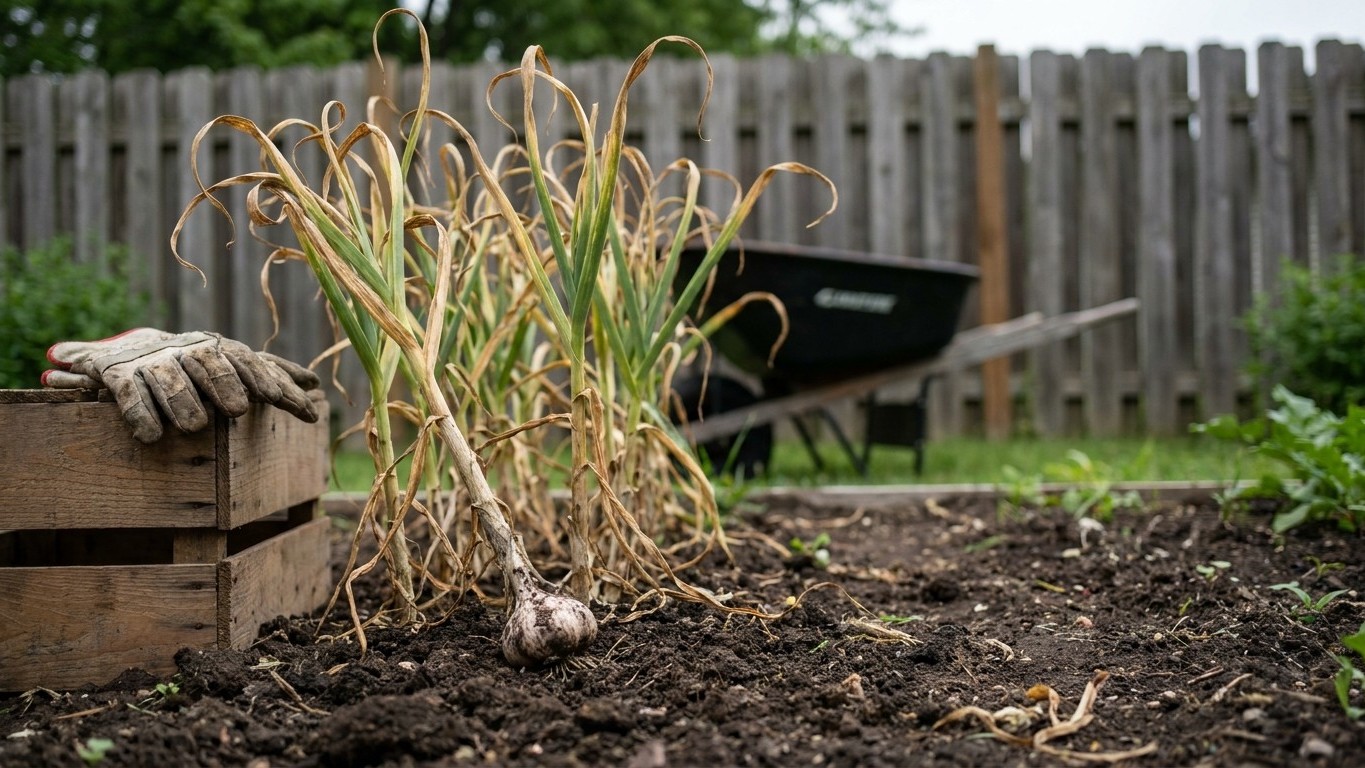

Garlic does fine in Wisconsin winters, no question, and honestly the state gives it more cold than a clove even needs to form a proper head. What matters right now is timing: get your cloves into the ground in late September to early October, before that first hard freeze locks the soil up, so the roots have a few weeks to settle in first. Check your local frost date, count back three to four weeks from it, and plant, or see the garlic planting dates guide for a fuller breakdown by region.
Will garlic get the cold it needs in Wisconsin

Garlic does not just sit in the ground over winter, it works. A planted clove needs a real stretch of cold to trigger the split into separate cloves inside the papery wrapper. Skip that cold, or cut it short, and the plant sends up a single round bulb instead of a head, the same mistake gardeners in the Deep South run into every year.
How much cold Wisconsin provides
Wisconsin’s winters run cold for about 26.1 weeks below 40°F near Milwaukee. University of Georgia Extension publication C854 puts garlic’s minimum chilling need at six to eight weeks after planting for the clove to divide properly. Twenty-six weeks is more than three times that minimum, so this territory clears the chilling requirement with room to spare, and that holds whether the grower is in Madison, the Fox Valley, or up near Lake Superior, since none of those places run milder than Milwaukee for an entire winter. Growers comparing states side by side will find the same margin in places with genuinely severe winters, like Wyoming, where the chilling threshold is never in real question either.
If your site runs milder than the rest
The one place this margin can narrow is a sheltered dooryard bed close to Lake Michigan, where the lake moderates both the fall freeze and the coldest weeks of winter. Even there, the shortfall would have to be dramatic to matter, and there is no local data suggesting it is. Two real fixes exist for a grower who is still unsure: refrigerate seed cloves for four to six weeks before planting at 40°F or below to guarantee the vernalization by hand, or plant a softneck type, which needs less cold to perform and tolerates a mild pocket without complaint. Checking the Garlic Varieties That Suit Wisconsin Winters guide can help narrow down which type suits a milder pocket. Neither move is required here based on the numbers, but both are worth knowing if garlic planted a year ago came up as single round bulbs instead of full heads.
When to put the cloves in
Garlic planted in autumn needs enough time to grow roots before the ground freezes solid, but not so much time that it pushes tall green shoots into the first hard freeze. NOAA’s 1991-2020 climate normals put Milwaukee’s average first fall freeze between October 17 and October 29, a two-week band rather than a single date. The midpoint of that range, around October 23, is the reference point growers count back from, not a date to circle on the calendar as a deadline.
Counting Back From the frost
Wisconsin garlic growers generally count back three to four weeks from that midpoint to let cloves root without much top growth showing above ground before winter. Counted from around October 23, that arithmetic lands the planting window in late September to early October, which is also the window used for every catalogue variety named in this guide. Planting earlier than that risks green shoots emerging before a hard freeze, which the plant usually survives but at some cost to vigor. Planting later gives roots too little time to establish before the soil locks up for the season.
What shifts the window earlier or later
Milwaukee’s frost date is measured at one station on Lake Michigan’s shore, and the lake itself is the reason that date runs later than most of the state’s interior. NOAA’s data notes this delay directly: inland southern Wisconsin typically freezes in early October, a week or more ahead of the lakeshore, and the northern third of the state earlier still. A grower in Eau Claire or Wausau should treat the late-September end of the window as the safer target, while a grower right on the Milwaukee or Kenosha lakefront has a little more room to plant into the first week of October.
Soil temperature is a more honest signal than the calendar in a year that runs warmer or colder than average. Garlic roots best once the soil at planting depth has cooled from summer’s heat, which most years follows the first real cool snap of late September. A soil thermometer pushed a few inches down gives a truer read of readiness than counting days on a page.
Which types suit Wisconsin
Hardneck and softneck garlic are not interchangeable, and Wisconsin’s winters make the choice for most growers before they even open a catalog. Hardneck garlic needs sustained cold to perform well, and repays it with a stiff central stalk called a scape and larger, easier-to-peel cloves. Softneck garlic tolerates a much milder winter, which is why it dominates the mesh bags in grocery stores, but its main advantage in a cold state like this one is simply that it stores longer through the pantry months.
Why hardneck is the safer default here
With the winter cold covered several times over, as established above, hardneck garlic is the more reliable choice across most of the state, not because softneck fails here but because hardneck’s flavor and clove size reward the cold Wisconsin already supplies for free. The closed list of hardneck varieties suited to this kind of planting includes:
- German Red, a strongly cold-hardy hardneck often grown at the northern edge of garlic country.
- German White, a hardneck with a reputation for large, easy-to-peel cloves.
- Duganski, a purple-streaked hardneck grown for a strong, lingering flavor.
- Chesnok Red, a hardneck bred in the Republic of Georgia and popular for baking whole.
- Georgian Crystal and Georgian Fire, two more hardnecks from the same region, the second notably hotter in flavor.
- Bavarian Purple and Blue Music, both hardnecks grown as much for striking bulb color as for flavor.
All of these go into the ground on the same late September to early October schedule as the softnecks below, since planting timing here is set by the fall frost window rather than by variety.
Where softneck still earns a place
Softneck varieties are not ruled out. Inchelium Red and Lorz Italian are both softnecks that handle a Wisconsin winter without trouble once mulched, and both store considerably longer in a kitchen than any hardneck listed above. Early Red Italian and Italian Late are two more softneck options worth growing specifically for that storage life, for a grower who wants garlic to last into the following spring rather than eating the crop by midwinter. Growing both a hardneck for flavor and a softneck for storage covers both jobs without asking one variety to do work it was not bred for.
Growers weighing this decision in a genuinely harsher climate, such as Montana, often find hardneck is close to the only sensible option because the winters there leave softneck struggling. Wisconsin’s winters are cold enough to favor hardneck without eliminating softneck as a real choice.
Soil and bed preparation
Garlic spends eight or nine months in the same patch of ground, through freeze, thaw, and spring mud, so the bed has to handle water before it has to handle fertility. Drainage comes first: a clove sitting in saturated soil through a Wisconsin winter rots long before any fungus or frost gets the credit. Raised rows or beds four to six inches above the surrounding grade solve most drainage problems in the state’s heavier clay soils, and they also warm and dry out a little earlier the following summer, which matters at curing time.
Working the bed before planting
Test soil pH before amending anything. Garlic does best in soil in the slightly acidic to neutral range, and a county extension office is worth using here since it can also flag nutrient issues specific to that plot. Work in a couple of inches of finished compost or well-rotted manure a few weeks before planting, not fresh manure, which can burn cloves and feed rot organisms right where the clove needs to root. Skip a heavy nitrogen feed at planting entirely. Garlic wants nitrogen in spring when it is building leaves, not in fall when it should be building roots.
Planting depth and spacing
Break bulbs into individual cloves right before planting, not weeks ahead, since a broken clove dries out fast. Push each clove pointed end up, about two inches deep, into loosened soil, spacing cloves four to six inches apart in rows a foot or more apart. That depth matters more in a cold state than a mild one: a clove set too shallow is the one most likely to heave out of the ground when the soil freezes and thaws in late fall, a problem covered in more detail below.
What the climate here favours, and what it does not
UC IPM’s Pest Management Guidelines for onion and garlic, UC ANR Publication 3453, publish the temperature ranges several soilborne diseases need to become active. Matching those published ranges against the average air temperature for each month of Wisconsin’s growing season, from planting in September through harvest the following July, shows where the climate leans and where it does not.
Where the risk sits
| Disease | Pathogen | Months in range | Note |
|---|---|---|---|
| White rot | Sclerotium cepivorum | 5 of 9 (Sept, Oct, May, June, July) | 1 month lands at the published optimum |
| Fusarium basal rot | Fusarium oxysporum f. sp. cepae | 3 of 9 (Sept, June, July) | within occurrence range, not optimum |
| Southern blight | Sclerotium rolfsii | 0 of 9 | no month reaches the 86-95°F optimum |
| Pink root | Setophoma terrestris | 0 of 9 | no month reaches the 75-85°F optimum |
White rot is the disease this climate spends the most time inside the range for, with five months of the growing season, spring and both ends of fall, falling inside its published 50 to 75°F window, including one month at the pathogen’s optimum. Fusarium basal rot has a narrower window here, three months, all of them at the warmer ends of the season rather than in the depths of it.
What stays unlikely, but is never impossible
Southern blight and pink root both need temperatures this climate essentially never averages during the growing season, with zero months landing inside either pathogen’s published optimum. That is a real difference from white rot and Fusarium, not a coin flip, but it is not a guarantee. All four of these organisms travel in infected seed stock and contaminated soil regardless of climate, and a month’s average temperature hides a lot of daily swing: a month reading 65°F on average still spends days well above and below that figure. The published thresholds are also soil temperatures, not the air temperatures compared here, and soil lags behind air and swings less through the day. Treat this table as a tendency worth planning around, buying clean certified seed and rotating out of allium beds every few years, rather than as a forecast of what will or will not show up in a given bed.
Getting it through the winter
Mulch is what turns Wisconsin’s deep cold from a threat into the exact chilling garlic needs. A three to four inch layer of straw or shredded leaves, laid once the soil surface has frozen hard for the first time, insulates the cloves from the sharp freeze-thaw cycles that do the actual damage, while still letting the accumulated cold underneath do its work on the cloves.
Timing the mulch
Mulching too early is the more common mistake. Straw laid down while the soil is still warm traps that warmth in and can encourage a clove to push soft top growth right before a hard freeze arrives, which then kills it back. Wait for the ground to freeze once, even briefly, before covering the bed. That single freeze signals the clove has already begun the dormancy it needs, and mulch from that point on only steadies the temperature instead of restarting growth.
Heaving, and what pulls a clove out of the ground
Repeated freezing and thawing of bare soil, without mulch buffering it, can physically push a shallow-planted clove up and out of the ground over the course of a winter, a problem called heaving. A clove planted at the two-inch depth described above and mulched on schedule rarely heaves. One planted too shallow, or left unmulched through a winter with several freeze-thaw swings, is the one a grower finds sitting half-exposed on the surface in March.
Pulling the mulch back in spring
Pull the mulch back, not off, once new green shoots are visible and the hardest freezes have passed. Leaving a thin layer in place suppresses spring weeds and holds soil moisture, but a thick layer left untouched can smother emerging shoots and hold the soil colder and wetter than the plant wants once it is actively growing again.
Harvest and curing here
Garlic tells a grower when it is ready far more reliably than any date on a calendar does. Lift the crop when the lower third to half of the leaves have browned and died back while the upper leaves are still green. Pulling too early leaves cloves undersized and poorly wrapped, pulling too late lets the bulb split open in the ground and lose its storage wrappers entirely.
Reading the leaves instead of the date
Each green leaf on a garlic plant corresponds roughly to a wrapper layer on the finished bulb, so a plant that still has five or six green leaves left is not ready even if a neighbor already pulled theirs. Dig one test bulb from the row and check the clove definition and wrapper condition before committing to the full harvest.
Curing in a humid summer
Curing, not harvest, is where a Wisconsin crop is most often lost after the hard part is already done. Bulbs need two to four weeks of drying in a shaded, well-ventilated spot, out of direct sun and rain, before the necks are trimmed and the crop goes into storage. A humid Wisconsin summer slows that drying considerably compared with a dry climate, so airflow matters more here than heat does. A box fan run on low in a garage or covered porch, with bulbs spread in a single layer rather than piled, cuts real risk of the neck rot and mold that show up when garlic cures too slowly in damp air.
Local help
County-level frost dates, soil test results, and disease pressure all vary across a state this size, and the closest read on any of them comes from a local office rather than a statewide guide. The University of Wisconsin-Madison Division of Extension runs county offices that handle soil testing and can speak to planting dates specific to that county.
Common questions
Can I plant garlic in spring in Wisconsin instead of fall?
Not with any real success. Garlic planted in fall gets the long cold spell it needs to divide into cloves, and a spring-planted clove misses most or all of that chilling and usually bulbs up as a small, undivided round instead of a full head. If cloves are still in hand come spring, get them in the ground anyway rather than composting them. The harvest will be smaller, but it beats losing the seed entirely.
Do I need to cut the scapes on hardneck garlic?
Cutting the scape, the curling flower stalk hardneck varieties send up in early summer, redirects the plant’s energy into the bulb instead of that stalk. It is worth doing on every hardneck variety listed above, and the cut scapes are edible on their own, chopped into a stir-fry or blended into a pesto.
What happens if I plant too early, before the window closes?
Cloves planted well ahead of the late September to early October window risk pushing green top growth before the ground freezes, and that growth can be damaged by the season’s first hard freeze even though the plant itself usually survives underground. It is a bigger risk than planting a little late, since a late-planted clove simply gets less time to root, not damaged growth.
Can I use grocery store garlic as seed stock?
It is possible, but risky. Grocery garlic is rarely labeled by variety, is sometimes treated with a sprout inhibitor that also slows root growth, and carries no guarantee against the soilborne diseases discussed above. Certified seed garlic from a known supplier costs more per clove but removes that risk from a bed the crop will sit in for nine months.
How many cloves do I need for a 10-foot row?
At the four to six inch spacing described above, a 10-foot row holds roughly 20 to 30 cloves, depending on exactly how tight the spacing runs. One full bulb of a hardneck variety typically breaks into somewhere around six to ten plantable cloves, which gives a rough sense of how many bulbs to start with.