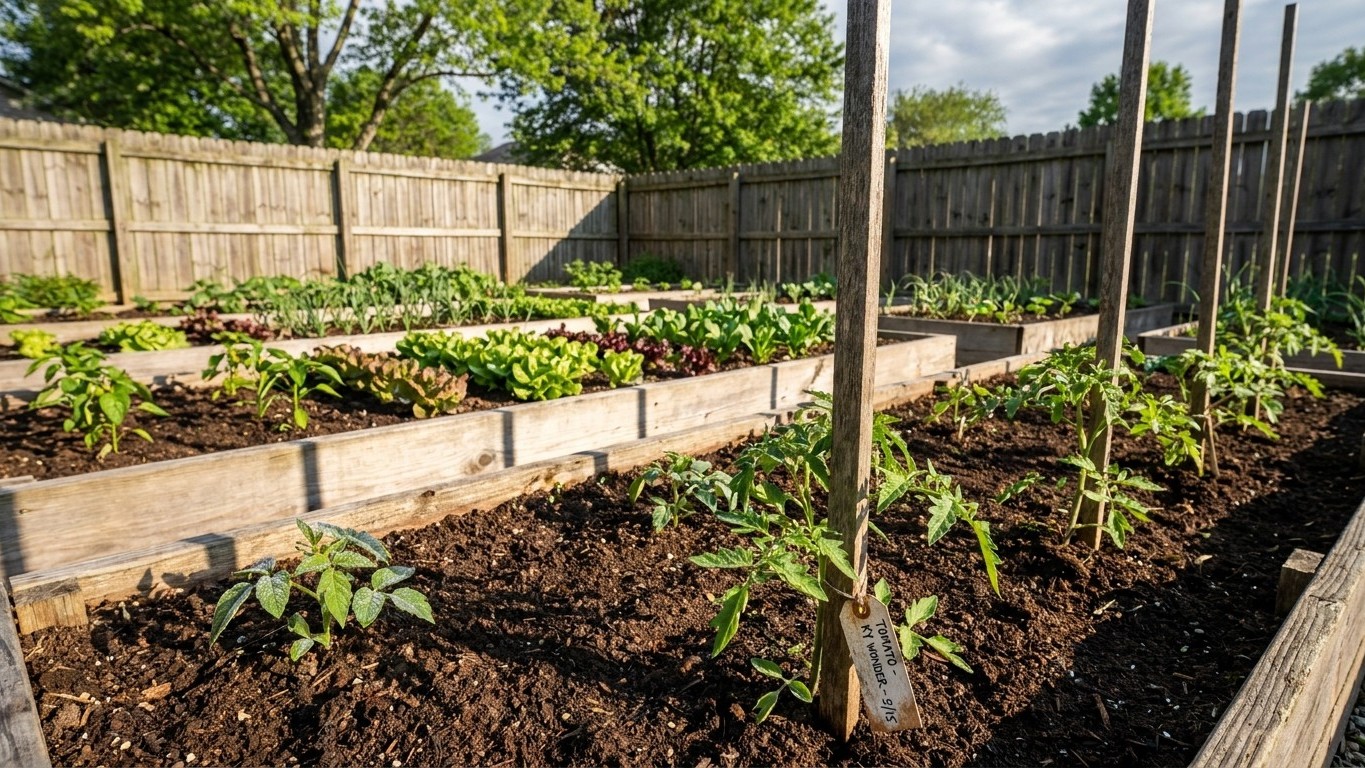

Kentucky sits in USDA hardiness zones 6a to 7a, with a frost-free window that runs roughly from early April to early November in the reference city, Louisville. That’s the frame. Everything else, from which tomato variety to try to when to sow lettuce twice, has to fit inside it or work around it.
How long your season really is

Three numbers set the boundaries of what you can grow here. The USDA Plant Hardiness Zone Map places Kentucky in zones 6a to 7a, based on average annual extreme minimum temperatures. At the Louisville reference station, NOAA’s 1991-2020 climate normals put the last spring frost between March 24 and April 4, and the first fall frost between November 2 and November 12.
Do the subtraction and you get a frost-free stretch of about seven months. That sounds generous, and for a lot of crops it is. But it’s not unlimited. Long-season crops like some heirloom tomato varieties, certain winter squash, or peanuts need every one of those weeks to mature, and a late spring or an early fall snap can wipe out the harvest before it happens. If you’re eyeing a 100-plus-day variety, you’re gambling with a margin that isn’t always there. This same timing pressure applies to fall crops grown for a specific date, so it’s worth checking When to Carve a Pumpkin in Kentucky if pumpkins are part of your plan, it’s just as relevant for a cool-season staple like Growing Potatoes in Kentucky, the same window shapes the timing behind Growing Beets in Kentucky, it applies just as much to another quick-maturing root covered in Growing Carrots in Kentucky, not to mention a slow-maturing root crop covered in Growing Parsnips in Kentucky.
That margin matters because these dates are averages, not guarantees. NOAA builds them from a 30-70% probability band, which means in roughly half of all years, frost arrives later in spring or earlier in fall than the date on the chart. Plant tender crops the week of the “average” last frost and you’re playing the odds, not following a rule. Some years you’ll get away with it. Some years you won’t. This is especially true for a perennial that goes in early and stays put for years, as explained in Growing Asparagus in Kentucky. Cool-season crops that can handle a bit of frost, like the guidance in Growing Spinach in Kentucky, give you a bit more breathing room on either side of these average dates.
There’s another wrinkle specific to this data. The National Weather Service office in Louisville has flagged that its own urban station runs warmer than the surrounding rural county, meaning spring frost lingers less and fall frost arrives later downtown than it does a few miles out. If you garden outside the city, especially in a low-lying or rural spot, treat the window as tighter than the numbers suggest. That’s not a guess, it’s what the source itself says: build in a buffer, not a shortcut.
What the summer does to a garden here
Heat isn’t just a background condition. At the Louisville reference station, the climate normals show an average of 37.2 days a year hitting 90F or higher. That’s more than five weeks of genuine heat load, and it changes what a garden can do in the middle of summer.
Once temperatures push past roughly 90F, tomato blossoms drop instead of setting fruit. Peppers, by contrast, tend to hold up better through the hottest stretch, which is part of why Growing Peppers in Kentucky is worth planning around this heat window. Lettuce and other cool-season greens bolt, turning bitter and going to seed instead of staying tender. Spinach, peas, and broccoli simply stop being viable once that heat sets in for any stretch. The result isn’t one long uninterrupted growing season. It’s two: a spring push and a fall push, with a hot, unproductive lull in between for anything that isn’t heat-tolerant.
Winter matters just as much, in the opposite direction. The mean daily minimum for the coldest month at the reference station is 27.8F. That figure, not the record low and not a seasonal average, is what actually determines whether a perennial, shrub, or overwintering crop survives here. A plant rated for warmer zones might survive an occasional cold snap but struggle against that recurring nightly minimum, year after year.
Put those two numbers together and the practical takeaway is straightforward: plan around a spring season and a fall season as two separate windows, not one continuous run, and choose perennials with winter hardiness that comfortably clears that upper-20s minimum rather than just squeaking by.
What tends to go wrong in Kentucky
The University of Kentucky Cooperative Extension Service tracks pest pressure on home gardens and landscapes through its ENTfact series, and a handful of names show up consistently enough to matter for anyone gardening in the state.
Eastern tent caterpillar shows up early, often before most vegetables are even in the ground, spinning webs in the forks of cherry and crabapple branches and stripping leaves in spring. Squash vine borer and squash bug arrive later, through the peak of summer, targeting squash and pumpkin vines from the inside out and from the base of the stem. Striped and spotted cucumber beetles follow a similar summer timeline, feeding on cucumber, squash, and melon leaves while also spreading bacterial wilt. Japanese beetle rounds out the list as a midsummer regular, skeletonizing leaves on everything from roses to beans.
This isn’t the full roster of insects a Kentucky gardener could ever encounter, and the extension service doesn’t present it that way either. It’s a short list of the pressures that recur often enough to plan for. Pest pressure isn’t uniform across the state, and the fix isn’t a calendar of treatments applied on a schedule. It’s identification first, through your county office, before you decide whether a problem needs action at all.
Where to check before you plant
Everything above is a state-level average, and Kentucky is not one climate. The state spans multiple degrees of latitude and stretches across hardiness zones 6a to 7a, which means a planting date that works in Louisville can be off by two or three weeks for a garden in the eastern mountains or the far western counties.
That’s exactly the gap the University of Kentucky’s Cooperative Extension Service exists to close. Its statewide extension site connects to county offices that track local soil conditions, regional pest pressure, and frost timing specific to your address rather than to a reference station miles away. For pest identification specifically, the entomology department’s ENTfact series, including the EF447 pest calendar, breaks down timing county agents can localize further.
None of this replaces the numbers above. It sharpens them. A frost date, a heat threshold, a pest calendar built on a state or a single reference city is a starting point for a conversation with your own county office, not a substitute for it.
Where to Go Next for Specific Crops
Everything above is about the season as a whole — the frost windows, the wet spring soil, the humidity that shapes what survives here. But once you’re ready to put something specific in the ground, the details change crop by crop. If garlic is on the list, the timing question isn’t about frost at all but about cold exposure: growing garlic in Kentucky walks through why a bulb that comes up round and undivided the next July means the cloves never got the winter chill they needed, and what fall planting dates avoid that. For the lawn itself, Kentucky’s mix of thirty-seven days a year over 90°F and winters averaging a 26.8°F low rules out a clean warm-season or cool-season choice, which is the whole problem Kentucky lawn care works through. And if tomatoes are the goal, the risk runs the other direction — set them out too early and a single calm, clear night undoes six weeks of windowsill work, so growing tomatoes in Kentucky is worth reading before you guess at a planting date.