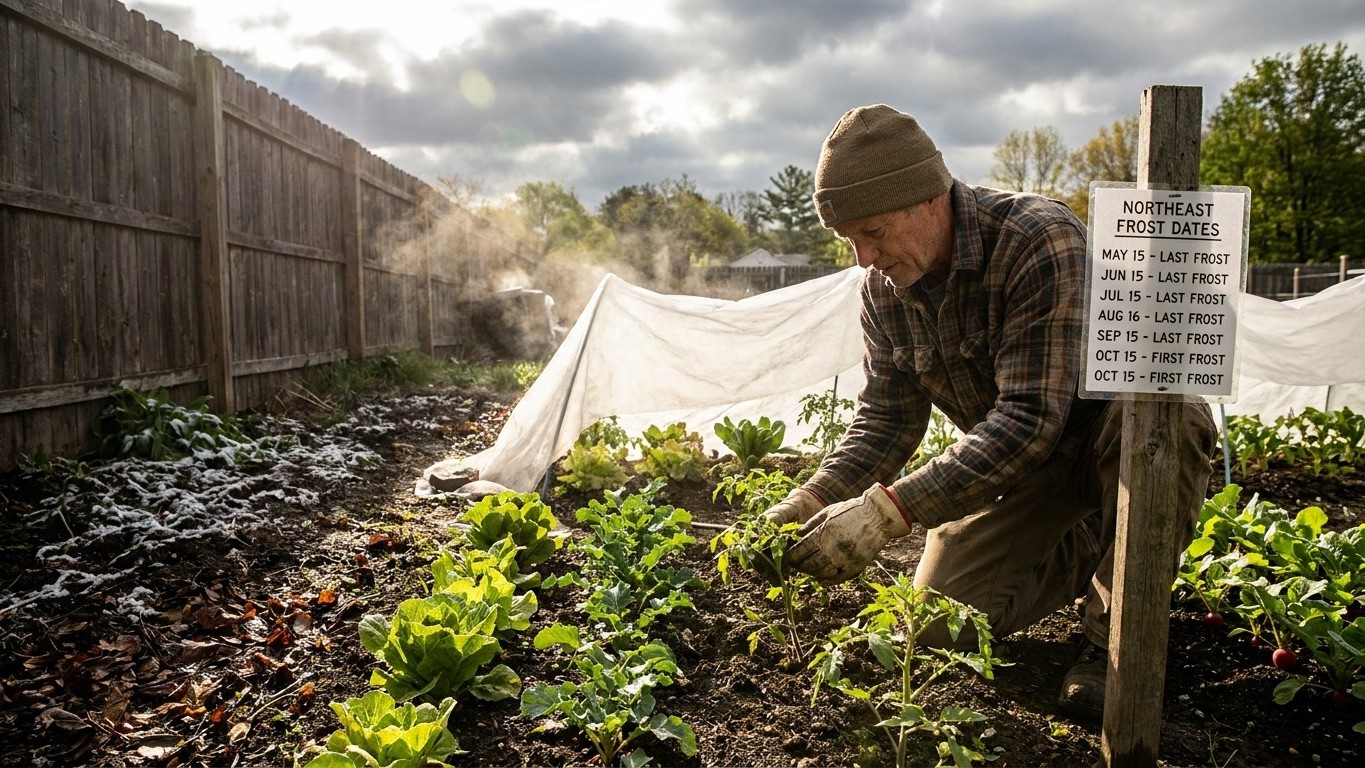

New York gardening runs on a frost-free window that’s shorter than most new gardeners assume, bookended by a spring thaw that arrives on its own schedule and a fall freeze that doesn’t wait for your tomatoes to ripen. Here’s what the numbers actually mean for what you plant, when, and how it holds up.
How long your season really is

New York spans USDA hardiness zones 3b to 7b, a range so wide it covers everything from the harsh winters near the Canadian border to milder pockets along the coast. That’s the first clue that this state doesn’t have one growing season, it has several, depending on where you’re standing. But for a baseline, look at New York City: the average last spring frost falls between March 23 and April 3, and the average first fall frost lands between November 14 and November 27, a window that also shapes When to Carve a Pumpkin in New York if you’re growing your own for Halloween.
Do the math and you get a frost-free window of roughly seven and a half months at that reference point, upstate counties and higher elevations run considerably shorter. That window is the single number that decides what’s realistic in a New York garden. It’s generous enough for most vegetables, including cool-season staples like Growing Potatoes in New York and root crops such as Growing Parsnips in New York, Growing Beets in New York, or Growing Carrots in New York, and it also leaves plenty of room for quick, cold-tolerant greens as detailed in Growing Spinach in New York, along with warm-season vines like Growing Pumpkins in New York or a full stand of Growing Sweet Corn in New York if you time the planting right, but it still rules out anything that needs a truly long, hot stretch without interruption, think of certain long-season melons or dry beans bred for southern climates. Push those crops here and you’re gambling against a calendar that may not cooperate.
Averages aren’t guarantees
Those frost dates are averages pulled from three decades of NOAA climate data, not promises. By definition, half of all years run colder or later than that average on one end or the other. A last frost date of March 23 to April 3 means some years it happens in early March, and other years a stray freeze shows up in mid-April and takes out anything planted too eagerly. Treat the window as a planning tool, not a safe date circled on the calendar.
This matters most for gardeners tempted to set out tomatoes or peppers the moment the soil feels warm, a mistake covered in more detail in Growing Peppers in New York. A week of unseasonably warm weather in late March doesn’t mean the frost risk has passed, it means you got lucky that particular week. The extension service in your county tracks local variation far better than a statewide average ever could, and that’s worth checking before you commit trays of seedlings to the ground.
What the summer does to a garden here
New York City averages 12.2 days a year at or above 90F, based on 1991-2020 climate normals. That’s not a brutal number compared to the Deep South, but it’s enough to matter. Above roughly 90F, tomato flowers drop without setting fruit, lettuce and spinach bolt to seed, and anything in the cool-season category simply stalls. Heat isn’t a background detail here, it actively shuts down parts of the garden for stretches of midsummer.
Pair that with a coldest-month daily minimum of 27.9F, and you get a state where winter hardiness and summer heat stress both matter, just in different halves of the calendar. That 27.9F figure is what decides whether a perennial or a fruit tree survives the season here at all, it’s not a record low, it’s the average nightly floor during the coldest stretch of winter.
Put those two facts together and a pattern emerges: New York doesn’t offer one uninterrupted growing season so much as two productive shoulders, a spring push and a fall push, with a midsummer stretch where cool-season crops simply won’t perform no matter how well you tend them. Gardeners who plan around that rhythm, succession-planting lettuce in spring and again in early fall rather than fighting the July heat, tend to get more out of the same plot than those who plant once and hope.
What tends to go wrong in New York
Cornell University’s Insect Diagnostic Laboratory tracks the pests that consistently show up in home gardens across the state, and a handful of them account for most of the damage reports.
- Colorado potato beetle emerges early in the season and can defoliate potato and eggplant plants fast once populations build.
- Striped cucumber beetle and squash vine borer both target cucurbits, the beetle chewing leaves and spreading bacterial wilt in spring, the borer tunneling into stems by midsummer.
- Cabbage maggot and imported cabbageworm hit brassicas from spring through fall, the maggot attacking roots early, the cabbageworm chewing leaves later in the season.
- Apple maggot shows up in home orchards in mid to late summer as fruit begins to develop.
This isn’t the full list Cornell tracks, onion maggot, asparagus beetles, fourlined plant bug, and viburnum leaf beetle all get their own factsheets too, but these are the ones a typical home gardener in New York is most likely to actually encounter. Pest pressure isn’t uniform across the state either, a garden in the Hudson Valley and one on Long Island won’t see identical timing or severity. If something’s chewing through your crop and you’re not sure what it is, your county extension office is built for exactly that kind of identification.
Where to check before you plant
Everything above is a state-level starting point, and New York is too large and too climatically varied for a single planting calendar to fit it well. A frost date calculated for New York City can be off by two or three weeks compared to the Adirondacks or the Southern Tier, and a hardiness zone range spanning 3b to 7b tells you the state has no single answer to “when is it safe to plant.”
Cornell University’s Cooperative Extension is the land-grant service for the state, and it’s worth bookmarking directly: Cornell Cooperative Extension. From there, look up your own county office. County-level agents adjust recommendations for local elevation, soil, and microclimate in ways a statewide figure simply can’t.
That local check matters most in the weeks right before planting, when a generic calendar and your actual backyard conditions are most likely to disagree. Extension staff also field pest identification questions, follow diagnostic protocols other reference pages skip, and can tell you whether that beetle in your cabbage bed is one of Cornell’s tracked culprits or a passerby you can leave alone.