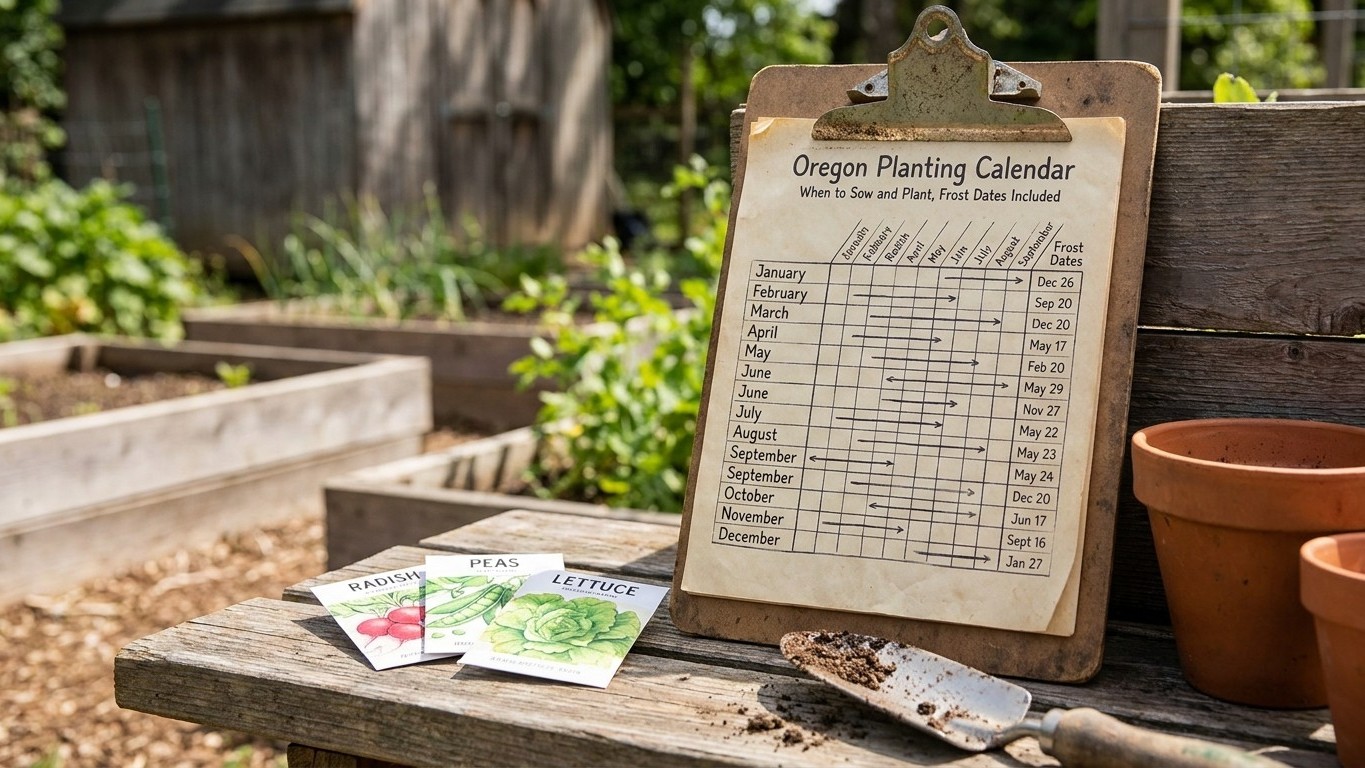

Oregon’s last spring frost falls between March 6 and March 21 in most years, and the first fall frost arrives between November 11 and November 27, according to NOAA’s National Centers for Environmental Information (NCEI) 1991-2020 climate normals for Portland. That gives the Willamette Valley roughly eight months of frost-free growing season, though the high desert east of the Cascades runs on a much shorter clock. Check your own soil, not just the calendar, before you set out warm-season transplants.
The frost window in Oregon

Oregon’s growing season hinges on one thing: when the last spring frost actually lets go of your soil, and that date moves depending on whether you’re gardening in Portland’s mild Willamette Valley or the high desert around Bend. Most years the valley clears frost between March 6 and March 21, giving you close to eight months before the first fall frost shows up in mid-to-late November. Skip the calendar guesswork and go dig a few inches into your bed right now — if it’s dry and crumbles rather than clumps cold and wet, your peas and spinach can go in today.
Run the arithmetic and the Portland-area growing season spans somewhere between roughly 235 and 267 days, depending on where in each window the actual frost lands in a given year. That is a long season by national standards, and it is the main reason the Willamette Valley supports everything from tender tomatoes to overwintered brassicas in the same yard.
None of this applies evenly across the state. Portland sits in the mild, marine-influenced Willamette Valley, and coastal areas run even milder. Move east over the Cascades into Bend, Redmond, or the Klamath Basin, and you are in high desert country with a much shorter frost-free stretch and colder nights even in midsummer. Gardeners just across the Columbia River deal with a similar maritime pattern, and our Washington Planting Calendar walks through that comparison in more detail. If you garden anywhere outside the immediate Portland metro, treat these dates as a starting reference and confirm your own local window before committing seed to soil. If you’re planning ahead for the start of the season, see What to Plant in Oregon in February, then check What to Plant in Oregon in January, once the frost window opens up see What to Plant in Oregon in March, for a month-by-month breakdown of what to get started once the soil is workable, see What to Plant in Oregon in August…, and once the season turns toward fall, see What to Plant in Oregon in September, and once the danger of frost has fully passed, check What to Plant in Oregon in May for the next wave of warm-season crops to get into the ground., and once summer heat settles in, see What to Plant in Oregon in Julyil/”>What to Plant in Oregon in April, and once the frost risk passes, see What to Plant in Oregon in December…. as fall approaches and the season winds down, see What to Plant in Oregon in October… and as that first fall frost approaches in mid-to-late November, see What to Plant in Oregon in November for what still has time to go in the ground.anting-calendar/may/”>What to Plant in Oregon in May, and What to Plant in Oregon in June for the next round of crops to get in the ground.
Cool-season crops
Cool-season vegetables go in the ground before the last spring frost, not after it, because they are built to tolerate cold soil and a light freeze while they germinate and establish. Waiting for frost-free conditions to plant peas or spinach just wastes weeks of a growing season that these crops don’t need protection from in the first place.
What goes in early
- Peas: sown directly as soon as the soil can be worked, well ahead of the last frost date
- Spinach and lettuce: direct-sown or transplanted while nights are still cold, tolerant of a hard freeze once established
- Brassica transplants: broccoli, cabbage, and kale started indoors and set out while frost risk is still present
- Root crops: carrots, beets, radishes, and turnips direct-sown into cool soil ahead of the frost window
The common thread is germination temperature, not frost tolerance alone. Peas and spinach will sprout in cold soil that would rot a bean seed outright, and once the seedlings are up, a stretch of frosty mornings barely slows them. Lettuce and the brassica family handle a light freeze on the leaf without damage, though a hard, prolonged freeze on young transplants can still set them back or kill them outright, so watch the forecast in the days right after transplanting rather than assuming the crop is bulletproof.
Root crops are the most patient of the group. Carrots and beets can sit in cold soil for a couple of extra weeks without harm if a late storm keeps you out of the garden, which makes them a forgiving choice for a first cool-season planting. Radishes are the fastest of the bunch and a good way to test whether a bed has warmed and drained enough to work, since they germinate in days and tell you quickly whether the soil is ready for the rest of the cool-season lineup.
Warm-season crops

Tomatoes, peppers, squash, beans, and corn all need warm soil to germinate and grow, and soil temperature matters more than the calendar date of the last frost. A garden bed can sit well past the frost window and still be too cold underground for a bean seed to do anything but rot. Wait for the soil itself to warm, not just for the frost risk to pass, and hold transplants indoors a little longer if a cold, wet spring is dragging the soil temperature down.
Starting seeds indoors: the count-back math
Tomato seed packets typically call for starting seeds indoors six to eight weeks before the transplant date. With a Portland-area transplant window of mid March to early April, counting back six to eight weeks lands indoor sowing somewhere around mid January to late February, depending on which end of the transplant window you’re aiming for. That’s a wide range on purpose: a cold, wet March pushes the safe transplant date later, so it’s worth holding seedlings under lights a little longer rather than rushing a leggy transplant outside.
Matching the variety to the season
Every catalogue tomato lists its days to maturity counted from transplant, not from seed, and that number lets you work out how much of the frost-free season a given variety actually needs. For a Portland-area transplant window of mid March to early April and a first fall frost of November 11 to November 27, even a slower-maturing tomato leaves a wide margin of frost-free days behind it once it starts ripening.
| Variety | Days to Maturity | Type | Set Out | First Ripe | Frost Margin |
|---|---|---|---|---|---|
| Sakura | 55 | Indeterminate | Mid March-early April | Late May | 166 days |
| Edox | 55 | Indeterminate | Mid March-early April | Late May | 166 days |
| Valentine | 55 | Indeterminate | Mid March-early April | Late May | 166 days |
| Glacier | 55 | Determinate | Mid March-early April | Late May | 166 days |
| Sun Gold | 57 | Indeterminate | Mid March-early April | Late May | 164 days |
| Juliet | 60 | Indeterminate | Mid March-early April | Early June | 161 days |
| Supersweet 100 | 60 | Indeterminate | Mid March-early April | Early June | 161 days |
| Amalfi | 68 | Determinate | Mid March-early April | Mid June | 153 days |
| Cherokee Purple | 72 | Indeterminate | Mid March-early April | Mid June | 149 days |
| Big Beef Plus | 72 | Indeterminate | Mid March-early April | Mid June | 149 days |
| Tiren | 75 | Indeterminate | Mid March-early April | Mid June | 146 days |
| Granadero | 75 | Indeterminate | Mid March-early April | Mid June | 146 days |
| San Marzano II | 78 | Indeterminate | Mid March-early April | Late June | 143 days |
| Celebrity Plus | 78 | Determinate | Mid March-early April | Late June | 143 days |
Disease resistance matters more in a wet spring than a dry one, and the Willamette Valley gets a wet one most years. Sakura, Edox, and Sun Gold all carry high resistance to Tomato Mosaic Virus, and Big Beef Plus and Celebrity Plus add resistance to Gray Leaf Spot on top of that, which is worth weighing if your garden has had disease trouble in past seasons. Peppers, squash, and beans don’t have catalogue days-to-maturity figures in the list above, but the same principle holds: check the packet, count from your local transplant window, and confirm the number of frost-free days left before you commit a slow-maturing variety to the ground.
The fall planting window
Fall planting works backward from the first frost instead of forward from the last one. Take a crop’s days-to-maturity figure, add it to your intended sowing date, and check whether harvest lands comfortably before the first fall frost of November 11 to November 27 at the Portland reference point. Crops that mature in 60 days or fewer generally still fit a fall sowing started in mid to late summer; anything slower needs to go in earlier in the season to have any margin left.
Build in extra time for shorter days
The days-to-maturity number on a seed packet assumes the steady warmth and long daylight of late spring and summer. A crop sown in August is growing into shortening days and cooling soil, and it will take noticeably longer to reach the same size than the packet number suggests. Add a real margin beyond the printed days-to-maturity figure for anything sown after midsummer, rather than counting on the packet number to hold.
Some crops actually improve after a light frost rather than being hurt by it. Kale, Brussels sprouts, and collards sweeten once cold weather converts some of their stored starches to sugars, which is why many gardeners leave them in the ground deliberately through the first few frosty nights instead of harvesting early. Carrots and parsnips left in the ground do something similar underground, and a well-mulched bed can often be harvested well into the cold season in the milder parts of the Willamette Valley.
Spinach and lettuce sown for a fall crop tend to hold in the garden far longer than a spring planting of the same crop would, since falling temperatures slow bolting rather than triggering it. That makes fall a good second chance at crops that bolted too fast in a hot spring, provided the sowing goes in with enough lead time to size up before growth slows for the season.
Reading a planting calendar properly
A statewide planting calendar, this one included, is built on data from a single reference point, in this case Portland. It is a starting point, not an instruction, and treating it as gospel for a garden thirty miles away, three hundred feet higher, or on the far side of the Cascades will lead you astray more often than it helps.
What actually shifts the numbers
Elevation is the biggest factor within western Oregon. Gain a few hundred feet climbing out of the valley floor and the last frost date routinely pushes later, sometimes by weeks rather than days. Urban areas hold heat and often run measurably milder than surrounding open ground, which is part of why a backyard in central Portland can push frost risk earlier or later than a rural garden nearby using the same reference dataset. Low-lying spots collect cold air on clear nights and frost first and hardest, while a slope or a spot near a large body of water often stays a few degrees warmer.
None of that shows up in a NOAA climate normal, because the normal is an average built from decades of data at one weather station. It cannot know about the cold pocket at the bottom of your yard or the wall that radiates heat onto your tomato bed after sunset. Keep a simple log of your own frost dates for a few seasons, noting which parts of the yard frost first and which stay clear, and you will end up with a more useful calendar than any statewide table, this one included, can give you. A gardener in a state like Oklahoma works with an entirely different pattern of spring swings and summer heat, which is exactly why our Oklahoma Planting Calendar reads nothing like this one despite following the same method.
Local help
For county-level frost dates, soil testing, and crop timing specific to your part of the state, contact your local Oregon State University Extension office. Extension staff can also help diagnose disease pressure and recommend soil amendments based on a local test, which matters more than any statewide guess once you’re past the general planting window. For more state-specific guidance beyond frost dates, our full set of Oregon guides covers soil, pests, and season extension topics county calendars don’t get into.
Common questions
What zone is Oregon for planting?
Oregon spans several USDA hardiness zones because of the huge difference between the mild, marine-influenced west side and the high desert east of the Cascades. There is no single zone number that applies to the whole state, so check your specific county through OSU Extension rather than relying on a statewide figure.
Can I plant tomatoes before the last frost date in Oregon?
You can, but only under cover, and it’s risky without it. Tomatoes are killed outright by frost, so setting them out before the last frost window has passed at your location means gambling on a cold snap unless you’re using row cover, cloches, or a greenhouse to buy a few extra weeks.
How much shorter is the growing season in central and eastern Oregon?
Meaningfully shorter, though the exact figure depends on the specific town and elevation. The frost dates in this article are measured at Portland and don’t apply east of the Cascades; check with your local OSU Extension office for the frost window at your own location before planning around these numbers.
Do I need to wait for soil to warm even if the frost date has passed?
Yes, for warm-season crops. A bean or squash seed can sit in cold, wet soil for weeks without germinating even after all frost risk is gone, and it’s often better to wait a bit longer for the soil to warm than to rush seed into ground that’s still cold from a wet spring.
Why does my neighbor’s garden frost later than mine?
Microclimate differences within the same neighborhood are common and usually come down to elevation, slope, and how cold air drains at night. A yard at the bottom of a slope collects cold air and frosts first, while a spot on a rise or near a heat-holding wall often stays several degrees warmer on the same night.
Some gardeners layer an older custom on top of frost dates: planting by the moon, which we explain as almanac tradition, not fact.
Related guides
- Washington Planting Calendar: When to Sow and Plant, Frost Dates Included
- Idaho Planting Calendar: When to Sow and Plant, Frost Dates Included
- Alberta Planting Calendar: When to Sow and Plant, Frost Dates Included