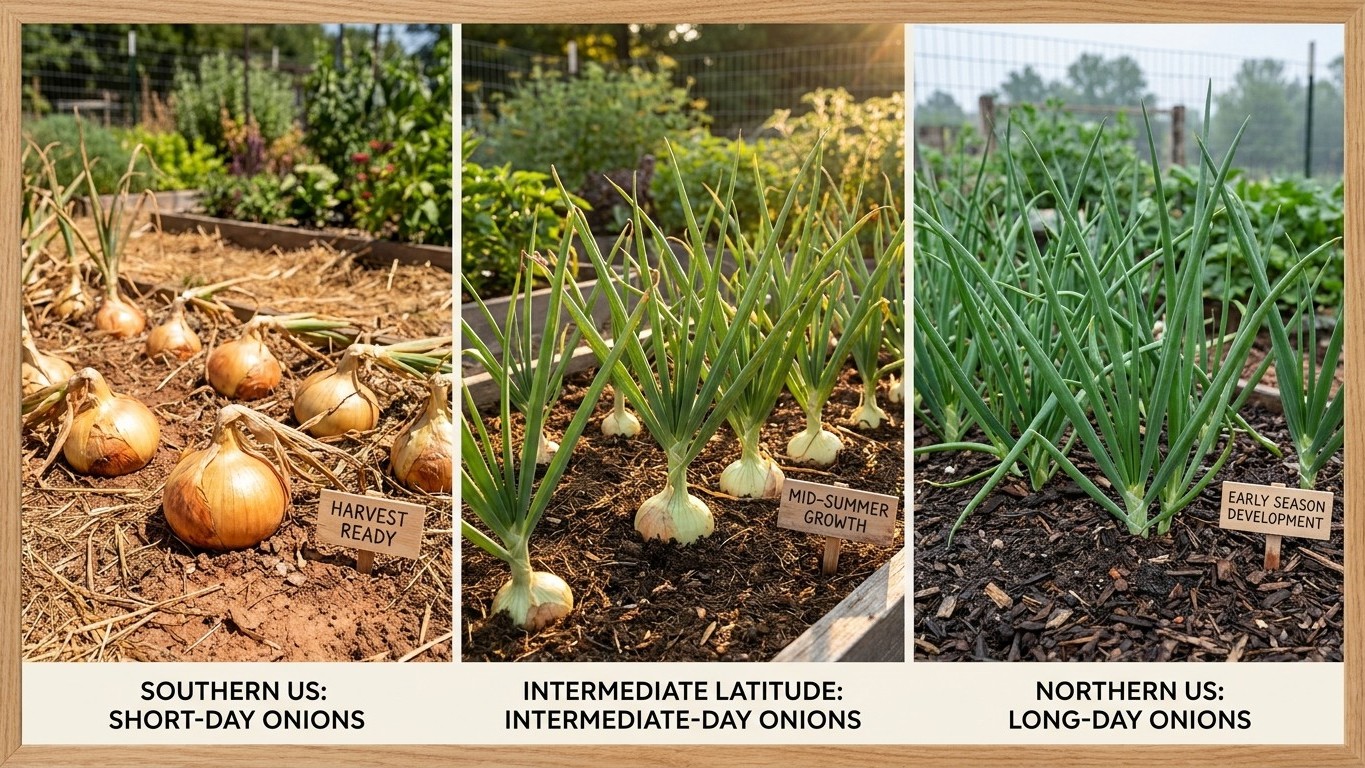

The daylight hours in your zip code determine whether an onion forms a bulb at all, not just how big it grows. Onions are grouped by “day-length” needs: short-day, intermediate-day, and long-day. Match the group to your latitude and you get bulbs. Ignore it and you get a bed of green tops that never swell, no matter how good your soil is or how much you fertilize.
Onion Varieties

Here’s the mechanism most seed racks never explain clearly: an onion plant checks the length of daylight, not the calendar, before it decides to stop growing leaves and start building a bulb. Once daylight hits a certain threshold, the plant redirects its energy downward. Miss that threshold and the plant just keeps making leaves. A short-day variety planted in Minnesota will still be pushing green tops in August, long past when it should have bulbed, because the summer days up there never drop into the 10-to-12-hour range it’s waiting for. A long-day variety like the Ailsa Craig Onion planted in south Texas hits its 14-to-16-hour trigger so early in the season, while the plant is still small, that it bulbs prematurely into something the size of a golf ball, or rots trying.
That’s the part worth repeating: a variety planted outside its range doesn’t just underperform. It gives no bulb at all. Leaves, then eventual rot, is the actual outcome, not a smaller onion. The Elsye Onion: Where It Bulbs and How Long It Keeps is a useful case study in just how tightly bulbing success is tied to matching a variety with its correct day-length zone, much like the Expression Onion, the Patterson Onion, the Rossadi Milano Onion, the Safrane Onion, the Candy Onion: Where It Bulbs and How Long It Keeps, the Powell Onion, and the Walla Walla Sweet Onion, which show the same sensitivity to their zone.
The three groups break down by latitude, using daylight hours as the trigger point rather than a hard calendar date. These ranges reflect long-standing horticultural convention rather than a single measured data point, but they’re reliable enough to plan a garden around, as seen with intermediate-day varieties like the Bridger Onion that depend on hitting the right daylight window to bulb properly.
| Day-length group | Trigger (hours of daylight) | Rough latitude band |
|---|---|---|
| Short-day | 10 to 12 hours | 20 to 38 degrees north (Gulf Coast, Deep South, Southwest) |
| Intermediate-day | 12 to 14 hours | 32 to 50 degrees north (mid-Atlantic, Midwest, transition zones) |
| Long-day | 14 to 16 hours | 35 to 65 degrees north (Upper Midwest, Northeast, Pacific Northwest, Canada) |
Notice the overlap between 32 and 38 degrees, and again between 35 and 50. That band is where a lot of home gardeners live, and it’s why intermediate-day types get marketed as the “safe middle choice.” They tolerate a wider swing in daylight before bulbing goes wrong, which matters if your county happens to sit right on one of those seams. The Cabernet Onion, a popular intermediate-day variety prized for its deep red color, is a good example of a type bred to handle that daylight flexibility without sacrificing bulb formation, much like the short-day Talon Onion: Where It Bulbs and How Long It Keepsmesteadpost.com/garden/onions/varieties/sierra-blanca/”>Sierra Blanca Onion, or the Red Longof Tropea Onion, another red-skinned variety gardeners often compare when weighing day-length tolerance, or the Red Carpet Oniont.com/garden/onions/varieties/bridger/”>Bridger Onion, another intermediate-day option gardeners in those overlap zones often turn to, much like the Blush Onion: Where It Bulbs and How Long It Keeps, and much like the Monastrell Oniont.com/garden/onions/varieties/walla-walla-sweet/”>Walla Walla Sweet Onion, which is grown furthert.com/garden/onions/varieties/safrane/”>Safrane Onion, which shows the same tolerance within the intermediate-day range, or the Redwing Onion, another intermediate-day cultivar known for reliable bulbing across that overlapping latitude band, or the Frontier Onion, another intermediate-day option gardeners in that overlap zone often turn to.
There’s a second layer to variety selection that has nothing to do with geography: the tradeoff between sweetness and shelf life. The sulfur compounds responsible for a sharp, eye-watering bite are the same compounds that act as a natural preservative in storage. A mild, sweet onion has less of that sulfur, which is exactly why it tastes better raw and also why it turns to mush in the pantry within a few weeks. A pungent storage onion holds through winter precisely because it’s loaded with the chemistry that makes you cry when you slice it. Neither trait is an accident, and neither can be bred out without losing the other. Choosing a variety, then, really means answering two questions at once: what daylight band do I live in, and am I planting for the table this month or for the shelf next February?
Among short-day types, two stand out for gardeners in that 25-to-35-degree band. Red Sensation is a grano-type onion that’s red all the way through the bulb, not just at the edges, which makes it worth growing for looks alone. It’s best treated as an eat-it-now onion: that color and flavor are at their peak fresh out of the garden, sliced raw into salads or layered on a sandwich, rather than tucked away for later. Vidora, by contrast, is yellow and delivers the classic sweet Granex flavor gardeners associate with short-day onions generally. That sweetness comes at the usual cost outlined above: less sulfur means less natural preservative, so Vidora belongs in the same eat-it-in-season category as Red Sensation. Neither of these is a storage onion, and trying to hold either past its window just means watching that mildness turn soft in the pantry.
Within the intermediate-day group, the varieties on offer split along the usual sweet-versus-keeper line. Candy (33-40°N) and Sierra Blanca (32-45°N) are sweet yellow onions, best eaten soon after harvest rather than stored. Elsye, Expression, and Scout, all bulbing across roughly 32-46°N, are pungent yellow onions built for curing and winter storage. Calibra (35-45°N) is another sharp, keepable yellow, holding well into spring. On the red side, Cabernet and Monastrell (35-45°N and 35-46°N) are sharp, deep-colored onions best used raw while firm, since red onions don’t store as long as yellow ones. Red Long of Florence (38-50°N) and Red Long of Tropea (35-48°N) are sweet reds, low in the sulfur compounds that preserve an onion, so they’re an eat-it-now choice rather than a pantry one. Match the latitude band first, then pick sweetness or keeping quality.
Among long-day varieties, the range of bulbing latitudes stretches wide. Bridger (35-50°N) and Redwing (43-65°N) sit at the broad ends, while Powell (43-47°N) and Red Carpet (40-45°N) occupy narrower bands further north. Frontier and Talon both bulb around 40-50°N, and Safrane matches Talon’s 42-50°N window. Barolo, Blush, and Patterson share the widest common band at 38-55°N, alongside Walla Walla Sweet’s 35-55°N range. New York Early and Rossa di Milano both bulb between 38 and 50°N. Nearly all of these are sharp, sulfur-heavy onions built for the pantry, holding into spring precisely because of the chemistry that makes them bite. The exceptions are New York Early and Walla Walla Sweet, both mild and low in sulfur, best eaten in season rather than stored, since the compounds that would protect them through winter are the same ones bred out for sweetness.
How to do it
Getting the right onion into the right ground follows a specific order. Skipping ahead, like buying seed before checking your latitude, is how mismatched varieties end up in gardens every spring.
- Find your latitude band first. A quick check of your county’s approximate latitude (any online mapping tool will show it) tells you whether you’re in short-day, intermediate-day, or long-day territory before you look at a single seed packet.
- Check your extension office’s variety list. Land-grant university extension services publish regionally tested onion variety recommendations for exactly this reason. They’ve already filtered out the mismatches for your state.
- Decide your priority: eating fresh or storing. If you know you’re planting for salads and burgers this summer, lean toward a milder type within your day-length group. If you want onions in the root cellar come January, lean toward the more pungent option in that same group.
- Buy sets, transplants, or seed based on your timeline. Sets bulb fastest but offer the fewest variety choices. Transplants split the difference. Seed started indoors gives access to the widest range of named varieties but needs 8 to 10 weeks of lead time before your last frost.
- Plant according to your day-length group’s calendar, not a generic date. Short-day types generally go in the ground in fall or very early winter across the South. Long-day and intermediate types go in as early as the soil can be worked in spring, since they need a long runway of leaf growth before the daylight trigger arrives.
- Track daylight, not just the thermometer, as bulbing season approaches. Once you notice the tops starting to swell at the base, that’s the day-length trigger firing. It’s a visual cue that your variety and your location are actually in sync.
What goes wrong
- No bulb ever forms, just thick green tops. This is a short-day variety planted too far north, or a long-day variety planted too far south, and the plant never received its daylight cue. Once you’ve spotted this mid-season, there’s no fix for that year’s crop. Harvest the tops as scallions or green onions instead of waiting for a bulb that isn’t coming, and switch groups next season.
- Bulbs form early and small. A long-day variety grown too far south hits its trigger while the plant is still young and undersized, producing tiny bulbs. If you catch this happening, pull and use them as you would a young onion rather than letting them sit and rot in the ground. Next time, choose a variety one band lower for your latitude.
- Bulbs split into doubles or grow oddly shaped necks. This usually traces back to a stress event, often a cold snap after the plant was already actively growing, which confuses the bulbing signal. Once split, those onions won’t store well; use them first and set them aside from anything you’re planning to keep long-term.
- Bulbs rot in storage within a few weeks. A sweet, mild variety was likely stored expecting the shelf life of a pungent type. Once rot starts, sort through the batch immediately, use any softening bulbs right away, and store the rest in a cooler, drier spot with better airflow. For next harvest, plan to eat mild varieties within a month or two and reserve long-term storage for the sharper, sulfur-heavy types.
- Green tops fall over weeks before you expected harvest. That’s often not a problem at all, it’s the plant signaling the bulb is mature. If it happens unusually early, though, it can mean drought stress forced an early shutdown. Once the tops have fallen, pull the bulbs within a few days rather than leaving them in wet soil, where they’ll start rotting from the neck down.