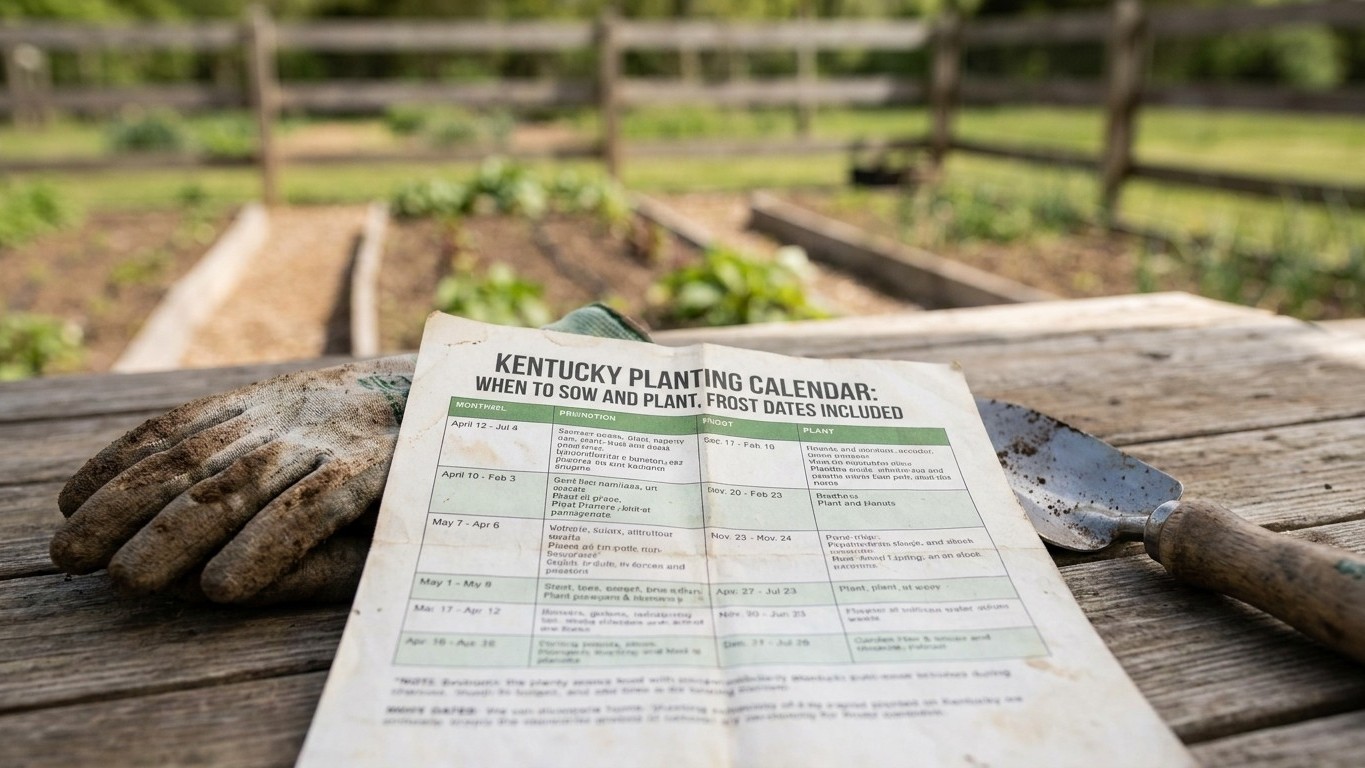

Your last frost lands somewhere between March 24 and April 4, and that single date is the one number that matters right now. Everything else about your garden this year hangs off it — when the peas go in, when the tomatoes wait, how long your season actually runs. Before you plant anything, walk your own yard and think about how it sits: low ground, open field, close to town, tucked in trees. That’s where the real date lives, not on a calendar.
The frost window in Kentucky

NOAA’s 1991-2020 climate normals put the last spring freeze near Louisville between March 24 and April 4, and the first fall freeze between November 2 and November 12. Those two dates come from the National Centers for Environmental Information’s station data for the Louisville area, and they mark the 30 to 70 percent freeze probability band, not a hard guarantee either way. A freeze can still land before or after that window in a given year.
The National Weather Service office in Louisville has flagged something worth repeating here: the airport station behind these numbers sits inside an urban heat pocket, and it runs measurably later in spring and earlier in fall than the rural county around it. If you garden outside the city itself, plan for a tighter frost-free window than the Louisville numbers show, since your own last frost likely comes earlier and your first fall frost likely comes sooner.
Season length by the numbers
Stack the two dates against each other and the growing season runs roughly 212 to 233 days, depending on where in each range your particular year lands. Take the latest last-frost date, April 4, against the earliest first-frost date, November 2, and you get 212 frost-free days. Take the earliest last frost, March 24, against the latest first frost, November 12, and you get 233. Most years fall somewhere between those two figures, which is why a planting calendar for the whole state has to work in ranges instead of single dates.
How the rest of the state compares
None of this is uniform across Kentucky. Louisville sits in a warmer, lower-elevation stretch of the state’s climate. Gardeners further north toward the Ohio River, and those at higher elevation in the eastern mountains, should expect their own last frost to run later and their first fall frost to arrive sooner, shrinking the season from both ends. For comparison, gardeners just across the river work with a noticeably shorter season, laid out in our Ohio Planting Calendar, while growers further south push tomatoes into the ground weeks earlier, the subject of our Louisiana Planting Calendar. If you’re mapping out the whole year ahead, start with What to Plant in Kentucky in March, it’s worth planning for the season’s close too, and our guide on What to Plant in Kentucky in November covers exactly that, don’t overlook the back end of the season either — see What to Plant in Kentucky in September for what goes in as the first frost approaches, our guide to What to Plant in Kentucky in May covers the month when most of the state’s frost risk has fully passed, it’s also worth looking further into the season at What to Plant in Kentucky in June, including the height of summer, see What to Plant in Kentucky in July, start with What to Plant in Kentucky in February, including the quieter months, see What to Plant in Kentucky in December, start with What to Plant in Kentucky in April, start with What to Plant in Kentucky in January. And once the season winds down, check out What to Plant in Kentucky in October What to Plant in Kentucky in August to keep your beds productive through the late-summer stretch.
Cool-season crops
Cool-season vegetables tolerate a light frost and actually mature best before Kentucky’s early summer heat sets in, so they go into the ground well ahead of the March 24 to April 4 last-frost window, not after it. The trigger for most of these crops is soil condition, not the calendar: once the ground is workable and no longer frozen solid, peas, spinach, and lettuce can go in.
Peas, spinach, and lettuce
Sow peas and spinach directly outdoors in the weeks leading up to the last-frost window. Both germinate in cold soil and shrug off a frost once they’ve sprouted. Loose-leaf lettuce follows the same logic, though a floating row cover helps if a hard freeze is forecast after the seedlings emerge. None of these three needs to wait for warm soil, and starting them late costs flavor, since all three bolt and turn bitter once summer heat arrives.
Brassicas
Broccoli, cabbage, and kale transplants go outside a few weeks before the last frost date, since young brassica plants tolerate a light freeze far better than their warm-season neighbors do. Direct-sown kale can go in even earlier than transplants. Hardening off the transplants over several days before setting them out reduces the shock if a late cold snap follows a warm stretch, something that happens more than once most Kentucky springs.
Root crops
Carrots, beets, radishes, and turnips are direct sown in the weeks before the last frost, since their seeds germinate at cool soil temperatures and the young roots aren’t bothered by a light freeze. Sow radishes in short successive batches through this window rather than all at once, since a single sowing matures within days of itself and you’ll want more spread than that at the table.
- Peas and spinach: direct sow ahead of the last-frost window, tolerate freezing once sprouted
- Lettuce: direct sow or transplant ahead of last frost, bolts once summer heat arrives
- Broccoli, cabbage, kale: transplant a few weeks before last frost, hardened off first
- Carrots, beets, radishes, turnips: direct sow ahead of last frost, unaffected by a light freeze
Warm-season crops

Tomatoes, peppers, squash, beans, and corn have no frost tolerance at all, so the last-frost window is a floor, not a target. What actually decides when they go in the ground is soil temperature, not the date on the calendar. Cold, wet soil rots seed and stalls transplant roots even after the air itself has cleared frost risk, so wait for a settled run of warm weather rather than moving plants outside the moment the frost window closes.
Tomatoes: matching variety to the season
Every tomato variety lists its days to maturity from transplant, not from seed, and that figure is printed the same way on the seed packet no matter what state you garden in. What changes by location is how much season you have left to spend it in. Setting transplants out early April to mid April, once the worst of the frost risk near Louisville has passed, a fast variety like Sakura needs just 55 days to first ripe fruit, putting harvest around mid June and leaving roughly 143 days of margin before the earliest fall frost. A slower paste tomato like San Marzano II, at 78 days to maturity, pushes first ripe fruit to early July and still leaves about 120 days of margin, comfortably inside even Louisville’s earliest fall frost date of November 2.
| Variety | Days to maturity | Type | Set out | First ripe | Margin to fall frost |
|---|---|---|---|---|---|
| Sakura | 55 | Indeterminate | Early-mid April | Mid June | ~143 days |
| Edox | 55 | Indeterminate | Early-mid April | Mid June | ~143 days |
| Valentine | 55 | Indeterminate | Early-mid April | Mid June | ~143 days |
| Glacier | 55 | Determinate | Early-mid April | Mid June | ~143 days |
| Sun Gold | 57 | Indeterminate | Early-mid April | Mid June | ~141 days |
| Supersweet 100 | 60 | Indeterminate | Early-mid April | Mid June | ~138 days |
| Juliet | 60 | Indeterminate | Early-mid April | Mid June | ~138 days |
| Amalfi | 68 | Determinate | Early-mid April | Late June | ~130 days |
| Cherokee Purple | 72 | Indeterminate | Early-mid April | Late June | ~126 days |
| Big Beef Plus | 72 | Indeterminate | Early-mid April | Late June | ~126 days |
| Tiren | 75 | Indeterminate | Early-mid April | Early July | ~123 days |
| Granadero | 75 | Indeterminate | Early-mid April | Early July | ~123 days |
| San Marzano II | 78 | Indeterminate | Early-mid April | Early July | ~120 days |
| Celebrity Plus | 78 | Determinate | Early-mid April | Early July | ~120 days |
All fourteen carry enough margin to finish well before Louisville’s frost window closes, which tells you Kentucky’s growing season handles slow-maturing paste and beefsteak types, not just quick cherry tomatoes. Several also carry disease resistance worth knowing before buying seed: Sakura, Edox, Valentine, and Glacier all resist Fusarium wilt races 1 and 2, and Celebrity Plus adds resistance to gray leaf spot and tomato mosaic virus on top of nematode tolerance, useful in a garden with a history of root-knot nematode trouble.
Starting seed indoors, and everything else warm-season
Tomato and pepper transplants generally need six to eight weeks of indoor growth before they’re ready for the garden, so counting backward from the early-April-to-mid-April set-out window puts seed-starting in mid February to early March. Peppers often run a bit longer, eight to ten weeks, so starting them at the earlier edge of that same window gives them more time to size up before transplant.
Squash, beans, and corn skip the indoor stage entirely and go straight into the ground as seed, but only once the soil has warmed and dried out well past the last-frost date itself. Beans in particular rot in cold, wet soil before they even germinate, so a week or two of buffer after the frost window closes is worth more than rushing the calendar.
The fall planting window
Kentucky’s first fall frost lands between November 2 and November 12, according to NOAA’s 1991-2020 climate normals for the Louisville area, and that date is where a fall planting calendar starts, working backward rather than forward. Take the days to maturity listed for a fall crop, add roughly two weeks to account for the slower growth of shortening, cooling days, and count back from the earlier end of that frost range to build in a safety margin.
What goes in for fall
Fast-maturing greens and roots handle a compressed fall window well. Spinach, lettuce, and radishes can be direct sown in late summer with enough time to mature before the November frost window opens, especially if you count back from the earlier end of the range rather than the later one. Bush beans and quick summer squash can also fit a fall slot if sown early enough, though both lose their frost tolerance entirely and need to finish before the first freeze, not after it.
Crops that improve after a light frost
Several fall crops actually taste better once a light freeze has touched them, because the plant converts stored starches into sugars as a cold-stress response. Kale, collards, and Brussels sprouts all sweeten this way, and a light frost can be left to do that work instead of being treated as a deadline to beat. Carrots and turnips left in the ground through a light frost do the same thing underground.
- Kale, collards, Brussels sprouts: sweeten after a light frost, no rush to harvest before it
- Carrots, turnips: left in soil through frost develop more sugar
- Spinach, lettuce, radishes: fast enough to finish before frost if sown with margin
- Bush beans, summer squash: need to finish before frost entirely, no frost tolerance
The narrower the gap between your sowing date and the frost window, the less room there is for a slow, cloudy stretch of September weather to push a crop past its maturity date. That extra two weeks of buffer matters more for fall crops than spring ones, since fall growth only slows as the days shorten. It doesn’t speed back up the way a warming spring does.
Reading a planting calendar properly
A state-wide planting calendar, including this one, is built from a single weather station’s climate normals, and Kentucky’s terrain guarantees that no single station represents the whole state. The NOAA figures used throughout this page come from the Louisville area, and NWS Louisville itself warns that its airport station runs later in spring and earlier in fall than the rural county around it, purely because of the heat held in pavement and buildings. If your garden sits outside a city, treat the Louisville dates as a starting estimate, not a fixed rule.
What shifts the dates in your own yard
Elevation is the biggest factor across Kentucky’s landscape: higher ground in the eastern part of the state cools faster in fall and warms slower in spring than the river valleys and lower plains do. A low spot in your own yard where cold air pools overnight, sometimes called a frost pocket, can run several degrees colder than a slope twenty feet away. Suburban plots surrounded by pavement and buildings, similar to the Louisville airport station itself, often run warmer than open countryside nearby.
A late cold snap after a warm stretch is the risk no calendar range fully protects against. Kentucky springs regularly deliver a run of warm days that pulls buds and blossoms out early, followed by a hard freeze that a calendar based on averages never flagged. Watching your own garden, rather than trusting the printed date alone, catches this: track your own frost history year to year, note which corners of your yard freeze first and which stay open latest, and keep a simple log of bud break on your fruit trees, since that’s a better real-time signal than any date on a page.
Local help
County-level frost dates, soil testing, and variety recommendations specific to your part of Kentucky are available through the University of Kentucky Cooperative Extension Service. Every county has its own extension office, and a soil test through your local office tells you far more about your actual planting timeline than any statewide calendar can, since it accounts for your specific soil temperature and drainage. For more on gardening across the state, browse our Kentucky guides.
Common questions
Can I plant tomatoes as soon as the last frost passes in Kentucky?
Technically yes, but soil that’s still cold and wet right after frost season will stall or rot tomato roots even without any freeze risk. Wait for a stretch of settled, warm weather after the frost window closes rather than moving transplants out the moment the calculated date arrives.
What USDA hardiness zone is Kentucky in?
That figure isn’t something this page can state precisely, since it varies by county and the source data here covers frost dates, not the USDA zone map. Check the USDA hardiness zone lookup or your county office of the University of Kentucky Cooperative Extension Service for your specific zone.
How many weeks before transplant should I start pepper seeds indoors?
Peppers generally need eight to ten weeks of indoor growth before they’re ready to move outside, a bit longer than the six to eight weeks tomatoes need. Counting back from an early-April-to-mid-April transplant date puts pepper seed-starting in mid to late February.
Is there enough season left in August to start a fall garden?
For fast crops like radishes, lettuce, and spinach, yes, since they can finish well within the gap between a late-summer sowing and the November frost window. Slower fall crops need to go in earlier, counted back from the November 2 to November 12 frost range with extra time added for slowing fall growth.
Does the Louisville frost date apply everywhere in Kentucky?
No. The NOAA figures on this page come from a single station near Louisville, and NWS Louisville itself notes that the airport site runs later in spring and earlier in fall than the rural county around it. Higher elevation and areas farther from the Ohio River valley should expect a shorter frost-free window than the Louisville numbers show.
Related guides
- Indiana Planting Calendar: When to Sow and Plant, Frost Dates Included
- Louisiana Planting Calendar: When to Sow and Plant, Frost Dates Included