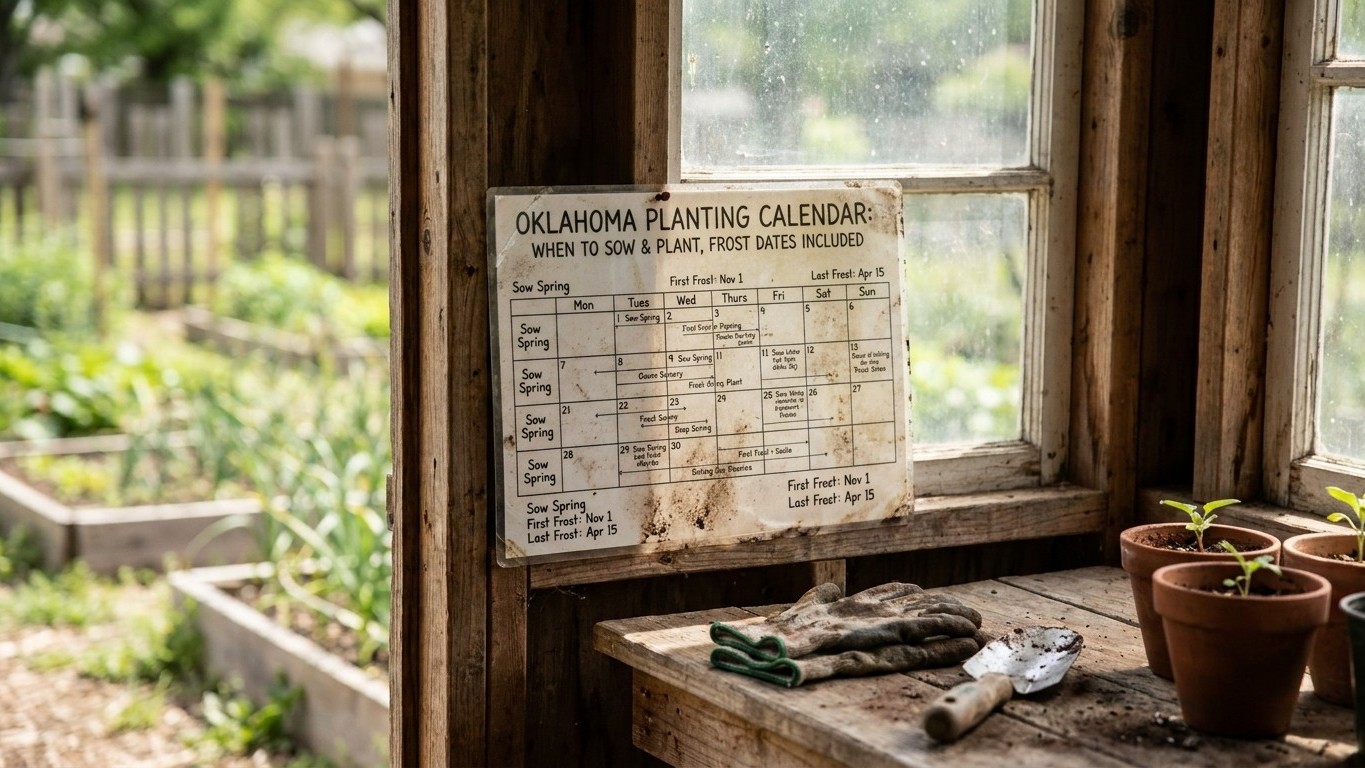

Oklahoma’s growing season hangs on two dates: the last spring freeze at Oklahoma City runs March 28 to April 10, and the first fall freeze arrives October 29 to November 8. That’s your whole calendar right there, roughly seven months to work with if you’re near the metro, less if you’re farther north or higher up. Pull your own county’s frost history before you commit a single seed to the ground, then use the Oklahoma City window below as your starting point, check What to Plant in Oklahoma in January as you map out the year ahead, check What to Plant in Oklahoma in April as you kick off your spring planting, check What to Plant in Oklahoma in August as the summer heat peaks, check What to Plant in Oklahoma in September as you plan your fall crops, check What to Plant in Oklahoma in October as harvest season ramps up, check What to Plant in Oklahoma in November when you’re planning that final stretch before the freeze hits, and check What to Plant in Oklahoma in December as you close out the growing year.
The frost window in Oklahoma

Two dates decide almost everything else on this page: the last hard freeze in spring and the first hard freeze in fall. At the Oklahoma City airport station, NOAA’s 1991-2020 climate normals put the last spring freeze at March 28 to April 10, and the first fall freeze at October 29 to November 8. Everything below, from when to start pepper seed indoors to when to pull the last squash off the vine, works backward or forward from those two ranges.
That reading comes from Oklahoma City itself, and the state spans a long distance east to west, with elevation climbing steadily toward the panhandle. NOAA’s own caution on this data applies directly here: readings from an airport weather station tend to run warmer than a garden a few miles out of town, especially one sitting in a low spot where cold air pools overnight. A garden in the northern part of the state, or one at higher elevation, should expect the last spring frost to land later than the Oklahoma City range and the first fall frost to arrive earlier, sometimes by a week or two. If you garden outside the metro, treat these dates as a starting point and adjust toward caution rather than assuming they apply exactly.
If you’re comparing notes with family gardening elsewhere, the same NOAA methodology sits behind the Texas Planting Calendar to the south and the Vermont Planting Calendar to the north. Lining the three up shows how much a long stretch of latitude changes a sowing calendar, and it’s a useful check if you’re new to Oklahoma and still thinking in terms of wherever you gardened before.
What the window means for season length
Subtract the early edge of the spring range from the early edge of the fall range and Oklahoma City gets a frost-free season of a bit over six months, stretching closer to seven months in years when both dates land late. That’s enough time to run a full succession: a cool-season crop ahead of the last frost, following the guidance in What to Plant in Oklahoma in March, then a warm-season crop that gets underway with What to Plant in Oklahoma in May, then a warm-season crop that gets underway with What to Plant in Oklahoma in June and runs through summer, peaking with What to Plant in Oklahoma in July, and in many years a second cool-season planting in fall before the ground freezes for good. Gardeners further north or at higher elevation should plan on a shorter window than that and lean toward shorter-season varieties, a theme that returns in both the warm-season and fall sections below.
Cool-season crops
Cool-season vegetables don’t wait for the last frost, they work around it. Peas, spinach, lettuce, and most root crops tolerate a light frost and actually germinate poorly once the soil warms up, so the early edge of Oklahoma City’s spring frost window is a target to sow toward rather than a date to avoid.
- Peas and spinach: direct-sow four to six weeks before the last frost, as soon as the soil can be worked.
- Lettuce and leafy greens: direct-sow two to three weeks before the last frost.
- Carrots, beets, radishes, and turnips: direct-sow two to three weeks before the last frost, since germination slows once soil warms.
- Broccoli, cabbage, and cauliflower transplants: set out around the last frost date itself, not well ahead of it.
Working the early window
Counting back from the March 28 to April 10 range at Oklahoma City puts the earliest pea and spinach sowing in mid to late February for gardens where the soil dries out fast, and into early March for heavier or slower-draining ground. Lettuce and root crops follow two to three weeks behind that, landing in the second half of March for most Oklahoma City gardens. None of these are calendar dates so much as soil conditions: if the ground is workable and not waterlogged, that’s the signal, not the day on a wall calendar.
Root crops and the bolting limit
Radishes are the fastest of the root crops and can be resown every couple of weeks through the cool part of spring for a rolling harvest rather than one big flush. Brassica transplants, started indoors several weeks earlier, have less cold tolerance as seedlings than direct-sown seed does, which is why they go out closer to the frost date rather than ahead of it. All of these crops share the same upper limit: once summer heat arrives in earnest, lettuce and spinach bolt and turn bitter, so the cool-season window closes fast once the warm-season crops start going in.
Warm-season crops

Tomatoes, peppers, squash, beans, and corn all care more about soil temperature than about the calendar date of the last frost. A frost-free night doesn’t help a tomato transplant if the soil underneath it is still cold enough to stall root growth, and cold, wet soil is exactly what rots bean and squash seed before it has a chance to germinate. That’s why the transplant windows below sit a couple of weeks after Oklahoma City’s last frost date rather than right on top of it.
Counting back from transplant to seed-starting
Work backward from the transplant date to know when to start seed indoors. Tomatoes and peppers generally need five to seven weeks of indoor growth before they’re sturdy enough to go in the ground, so with transplants going out mid to late April, seed-starting falls in early to mid March. That’s a planning range to adjust once you know your own garden’s actual frost pattern, not a fixed calendar day.
Matching a variety to the season
Catalogue days-to-maturity are counted from the transplant date, not from seed, and they shift by a week or so depending on the weather in a given year. Setting transplants out in the mid to late April window and counting forward against Oklahoma City’s fall frost range shows how much room each variety actually has before the first freeze.
| Variety | Type | Days from transplant | Set out | First ripe | Margin before fall frost |
|---|---|---|---|---|---|
| Sakura | Indeterminate | 55 | Mid to late April | Mid June | 133 days |
| Edox | Indeterminate | 55 | Mid to late April | Mid June | 133 days |
| Valentine | Indeterminate | 55 | Mid to late April | Mid June | 133 days |
| Glacier | Determinate | 55 | Mid to late April | Mid June | 133 days |
| Sun Gold | Indeterminate | 57 | Mid to late April | Mid June | 131 days |
| Supersweet 100 | Indeterminate | 60 | Mid to late April | Late June | 128 days |
| Juliet | Indeterminate | 60 | Mid to late April | Late June | 128 days |
| Amalfi | Determinate | 68 | Mid to late April | Early July | 120 days |
| Cherokee Purple | Indeterminate | 72 | Mid to late April | Early July | 116 days |
| Big Beef Plus | Indeterminate | 72 | Mid to late April | Early July | 116 days |
| Tiren | Indeterminate | 75 | Mid to late April | Early July | 113 days |
| Granadero | Indeterminate | 75 | Mid to late April | Early July | 113 days |
| San Marzano II | Indeterminate | 78 | Mid to late April | Mid July | 110 days |
| Celebrity Plus | Determinate | 78 | Mid to late April | Mid July | 110 days |
Disease resistance matters as much as days to maturity in a state where humid summers push early blight and fusarium wilt hard. Sakura, Edox, and Valentine all carry high resistance to Fusarium Wilt races 1 and 2, and Sakura and Edox add tomato mosaic virus resistance and intermediate nematode resistance on top of that. Big Beef Plus and Celebrity Plus both carry the same three-part package of nematode, gray leaf spot, and tomato mosaic virus resistance, which is worth knowing if a previous season’s plants came down with any of those. If your soil already has a known fusarium problem, that’s the trait to check on the seed packet before days-to-maturity.
Peppers follow the same schedule as tomatoes, going out in the same mid to late April window once nights no longer dip toward freezing. Squash, cucumbers, and beans are usually direct-seeded rather than transplanted, and they germinate best once the soil has warmed well past the chilly range that spinach and peas tolerate, so most gardeners hold off seeding them until a week or two after the tomato transplant date. Corn is more sensitive to cold at the seedling stage than at germination, and a stand that gets nipped by a late cold snap right after emergence usually needs to be reseeded rather than nursed along.
The fall planting window
Fall planting means counting backward from the first frost instead of forward from the last one. Using Oklahoma City’s NOAA fall frost range of October 29 to November 8, take a crop’s days to maturity, add one to two weeks for the slower growth that comes with shortening daylight in September, and count back from the early end of that range to get a safe sowing date.
Working the arithmetic
A crop listed at 60 days to maturity effectively needs closer to 70 to 75 real days once you build in that fall slowdown. Counting back from October 29, the earlier edge of the frost range, lands the sowing date in the second half of August for that crop. A 45-day crop, like most radishes or fast leafy greens, has more room and can go in through most of September and still finish before the frost range arrives.
Crops that improve after a light frost
Not every crop needs protecting from that first frost. Kale, collards, and Brussels sprouts sweeten after a light touch of cold because the plant converts stored starches to sugars as a natural antifreeze response. Carrots and parsnips left in the ground through the first frosts do the same thing underground, which is why many gardeners leave root crops in place under a layer of mulch rather than pulling them the moment the forecast turns cold. Broccoli and cabbage hold up to a light frost but don’t particularly improve from it, so timing those to finish just before the frost range, rather than counting on them to ride it out, is the safer bet.
Gardeners outside the Oklahoma City area should shift these fall dates earlier rather than later. NOAA’s caution on this data runs in reverse for autumn: a garden in a low-lying spot, at higher elevation, or further north in the state typically sees its first frost arrive before the October 29 to November 8 range, sometimes by a week or two. Using the same August or September sowing dates that work near Oklahoma City in a colder pocket of the state risks losing the last fall succession to an early cold snap, so treat the early edge of the range as the one to plan around if you’re not gardening in the metro itself.
Reading a planting calendar properly
A state planting calendar built on one weather station is a starting point, not an instruction. Oklahoma is a big state, and factors NOAA’s airport-based normals don’t capture, elevation, proximity to a lake, how built up the surrounding land is, can all shift the actual frost date at a given garden by days or weeks in either direction.
What actually moves the date at your garden
- Elevation: higher ground generally sees a later last frost and an earlier first frost than the valley floor nearby.
- Urban heat: a garden close to pavement and buildings, like the Oklahoma City airport station itself, often runs a few degrees warmer overnight than an open rural yard a few miles out.
- Cold air drainage: cold air sinks, so a garden at the bottom of a slope can frost when higher ground nearby stays clear.
- A late cold snap: even after the statistical frost window has passed, an occasional freeze arrives outside it, since NOAA’s range describes typical probability, not a guarantee.
The more reliable approach, once you’ve gardened a spot for a season or two, is to keep your own log. Note the date of the last frost you actually saw last spring and the first one you saw last fall, and compare it against the Oklahoma City range. If your garden consistently runs a week behind or ahead of the metro figure, adjust every date on this page by that same margin instead of recalculating from scratch each season.
Soil temperature is a better trigger than a date on the calendar for anything in the warm-season group. A soil thermometer pushed a few inches into the bed tells you directly whether the ground is ready for tomato roots or bean seed, regardless of what the date is supposed to mean. Two gardens ten miles apart can differ noticeably in soil temperature on the same morning depending on whether the bed is raised, mulched, or sitting in full sun.
Local help
Oklahoma State University Extension keeps county-level frost data, soil testing services, and planting guidance that goes well beyond what one Oklahoma City weather station can tell you. Reach your county office through the OSU Extension directory before you finalize a planting date, especially if you garden outside the metro area. A soil test through that same office is one of the most useful steps before spring planting, since it tells you what your ground actually needs rather than leaving you to guess. For more on gardening across the state’s varied conditions, browse our Oklahoma guides.
Common questions
Is it too late to plant a fall garden if it’s already August?
It depends on the crop. Fast-maturing crops like radishes and many leafy greens can still go in through most of September near Oklahoma City and finish before the first fall frost, while a 70-plus day crop started in August is cutting it close against the October 29 to November 8 frost range.
Do I need to cover my tomatoes if a late frost is forecast after I’ve already transplanted?
Yes, cover them. Even inside the statistical frost window, a forecast freeze after transplant can still happen, and a sheet, row cover, or overturned bucket overnight is cheap insurance against losing plants you’ve already hardened off and set out.
Why did my seeds planted right on the last frost date fail to come up?
Most likely the soil was still too cold for that particular crop, not the air. Frost date and soil temperature are related but not the same thing, and beans, squash, and corn in particular will simply sit and rot in cold soil rather than germinate, regardless of what the calendar says.
Can I use this same calendar for the whole state of Oklahoma?
Treat it as a reference point rather than a guarantee. The dates here come from the Oklahoma City area specifically, and NOAA’s own data shows gardens further north or at higher elevation typically get a later spring frost and an earlier fall frost, so shift the ranges accordingly.
How do I find my exact last frost date instead of a range?
There isn’t a single exact date, since frost timing varies year to year even at one location, which is why NOAA reports it as a probability range rather than a fixed day. Your county extension office can help you interpret local frost records if you want data closer to your specific garden than the Oklahoma City station provides.
Related guides
- Kansas Planting Calendar: When to Sow and Plant, Frost Dates Included
- Missouri Planting Calendar: When to Sow and Plant, Frost Dates Included
- Texas Planting Calendar: When to Sow and Plant, Frost Dates Included