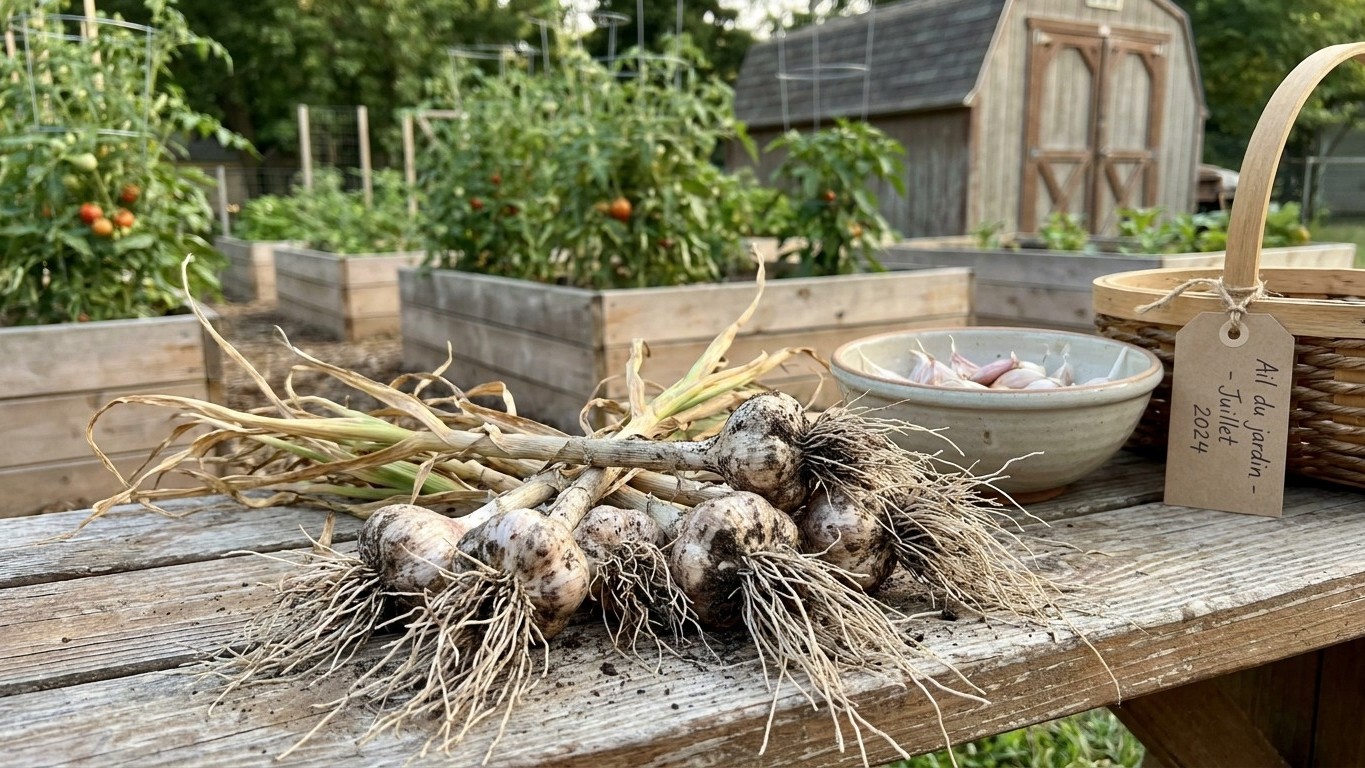

Kansas winters run cold enough, and long enough, for garlic to divide properly into cloves. NOAA’s 1991-2020 climate normals put Wichita’s first fall frost between October 23 and November 2, and the cold that follows comfortably clears the six to eight weeks below 40°F that garlic needs to bulb. Set cloves out in early to mid October, one to four weeks ahead of that frost window, so roots establish before the ground locks up.
Will garlic get the cold it needs in Kansas

The vernalization requirement
Wichita’s first hard frost lands between October 23 and November 2, and that’s really all the answer a Kansas grower needs: plant garlic in fall, and the winter that follows will chill it plenty. December through February run cold statewide, not just at the reference station, so cloves sit well past the eight weeks below 40°F they need to divide into bulbs. The only real exception is a sheltered microclimate mild enough to dodge that cold outright.
Kansas winters clear that bar without much drama. NOAA’s 1991-2020 climate normals put Wichita’s first hard frost between October 23 and November 2, and the months that follow, December through February, run cold across the whole state, not just at the reference station. A Kansas garden planted in fall sits through far more than eight weeks below 40°F before spring, so vernalization is not the risk here the way it is further south. Elevation and latitude shift this some: the higher ground in the northwest tends to turn cold sooner than the Wichita figure suggests, while the southeast corner near the Ozark foothills often runs a touch milder. Either way, the season’s total cold accumulation still clears the threshold across the state.
If your site runs mild
The risk runs the other way on an unusually sheltered site, a south-facing bed against a heated foundation wall, a protected urban courtyard. If a spot never seems to get properly cold, two fixes work. Refrigerate cloves for six to eight weeks at about 40°F before planting, breaking the bulb apart first, or grow a softneck type, which needs less chill to divide reliably; consulting Garlic Varieties That Suit Kansas Winters can help narrow down which softneck performs best locally. Growers in far colder places have the opposite problem, keeping cloves alive through the cold rather than getting enough of it. Growing Garlic in Quebec: Planting Dates, Varieties and Winter Cold covers that end of the spectrum.
Don’t skip planting because you’re worried about cold in Kansas. The state’s winter climate is on garlic’s side. The more common mistake here is planting too late, not worrying about too little cold.
When to put the cloves in
Anchoring on the frost window
Garlic wants to go in while soil is still workable but cool enough that it roots without pushing much leaf growth before frost. NOAA’s 1991-2020 climate normals put Wichita’s average first fall frost between October 23 and November 2, and that window anchors the guidance on When to Plant Garlic in Kansas that growers rely on. Counting back from that window, the early to mid October planting range used for the varieties below lands roughly one to four weeks ahead of frost, enough time for a clove to send down roots and settle in without racing to put up a shoot that then gets nipped.
That frost window comes from the Wichita airport station, and NOAA notes conditions elsewhere in the state differ, often by a week or two in either direction. Higher ground in the northwest, toward the High Plains, tends to see its first freeze earlier than the Wichita figure. The southeast corner of the state, lower and closer to the Ozarks, often runs a week or so milder. A large reservoir nearby can push the very first light frost back a few days on its downwind shore, though it rarely shifts the planting window much. Treat October 23 to November 2 as a midpoint for south-central Kansas, not a hard deadline for the whole state, and adjust a few days earlier or later based on your own county’s frost history.
Getting the timing wrong either direction
Planting too early is the more common error. Garlic set out in September, while soil is still warm, often pushes several inches of green top growth before winter, and that growth gets damaged by the first hard freeze even though the clove underneath survives fine. Planting too late, after the ground has gone properly cold, leaves too little time for root development, and a clove that hasn’t rooted well by freeze-up is more prone to heaving out of the ground over winter, covered in more detail further down. Aim for the early to mid October range, and lean toward the earlier end of it in a colder part of the state and the later end where your own site tends to stay open longer into fall.
Which types suit Kansas
Hardneck or softneck
Kansas winters put this territory solidly on the hardneck side of the choice. Hardneck garlic needs a real cold season to divide well and to produce the central scape that hardneck growers cut in early summer. Given how reliably Kansas clears the vernalization threshold discussed above, hardneck varieties perform consistently here and reward the gardener with the biggest, easiest to peel cloves.
Softneck garlic still grows fine in Kansas and has two advantages worth knowing. It stores longer in a home pantry, often months past when a hardneck bulb starts sprouting, and it tolerates a mild or inconsistent winter better than hardneck does, useful if your particular site runs warmer than the surrounding county. Growers in milder states lean harder toward softneck for exactly that tolerance. See Growing Garlic in Kentucky: Planting Dates, Varieties and Winter Cold for that comparison.
From the varieties carried for this territory, hardneck options include Bavarian Purple, Blue Music, Chesnok Red, Duganski, Fall Festival, Georgian Crystal, Georgian Fire, German Red, German White, and Ivan. Softneck options on this list include Early Red Italian, Inchelium Red, Italian Late, and Lorz Italian.
| Variety | Type | Set out (this territory) |
|---|---|---|
| Duganski | Hardneck | Early to mid October |
| German White | Hardneck | Early to mid October |
| Chesnok Red | Hardneck | Early to mid October |
| Inchelium Red | Softneck | Early to mid October |
| Lorz Italian | Softneck | Early to mid October |
All the cultivars on this list share the same early to mid October planting window here. What differs is what comes out of the ground come summer. Hardneck bulbs like Duganski and German White run fewer, larger cloves and a stronger flavor, while a softneck like Inchelium Red packs more, smaller cloves per bulb and keeps well into winter storage. Planting one of each hedges against a winter that runs milder than usual, since softneck tolerates that better, while still giving you the scapes and size hardneck offers in a normal Kansas winter.
Soil and bed preparation
Drainage matters more than fertility for garlic going into a Kansas winter. A clove sits in the same spot of ground for eight or nine months, through freeze, thaw, and whatever rain or snowmelt the season brings, and standing water rots a clove long before any soil-borne disease gets the chance. If a bed holds a puddle for more than a few hours after a heavy rain, raise it. A few inches of loose soil above grade is usually enough to keep roots out of saturated ground.
Kansas gardens run a wide range of native soil, from sandy river-bottom ground in places to heavy clay elsewhere, and clay holds water long after a rain has passed. Work in a couple of inches of finished compost or well-rotted manure before planting, turned into the top eight to ten inches of soil. That organic matter opens up clay enough to drain, and it holds moisture in sandier soil through a dry fall.
Skip a heavy dose of nitrogen at planting time. Garlic uses very little nitrogen in fall, and pushing lush top growth right before winter is the same mistake as planting too early: tender green tissue that a hard freeze then damages. Save nitrogen feeding for when growth resumes and lengthens in spring. A soil test before planting tells you where pH and phosphorus actually stand rather than guessing, and the state extension service handles that testing by county.
Once the bed is amended and reasonably level, let it settle for a week or two before planting if you can. Freshly turned soil drains fast right after amendment but can leave air pockets around a newly set clove, and firming the bed slightly before planting gives roots better contact with the soil around them.
What the climate here favours, and what it does not
UC IPM’s Pest Management Guidelines for Onion and Garlic (UC ANR Publication 3453) publish temperature ranges for the main soil-borne diseases that affect garlic, and those ranges say something about which pathogens find a Kansas growing season hospitable. One caveat before the numbers: the published thresholds are soil temperatures, and the figures used here are air temperatures, which lag behind air and swing less. Treat what follows as a tendency the climate leans toward, not a diagnosis of what will happen in any one garden.
- White rot (Sclerotium cepivorum): published range 50-75°F, and Kansas air temperatures sit inside it for four months of the growing season, September, October, April, and May.
- Fusarium basal rot (Fusarium oxysporum f. sp. cepae): published range 59-90°F, inside it for four months, September, May, June, and July, including one month at the pathogen’s published optimum.
- Pink root (Setophoma terrestris): published optimum 75-85°F, and Kansas sits inside that optimum for two months, June and July, both at the optimum itself.
- Southern blight (Sclerotium rolfsii): published optimum 86-95°F, and no month of the Kansas growing season averages a mean air temperature inside that band.
The white rot window overlaps exactly with planting and spring green-up, so clean planting stock matters more than any soil treatment, since the pathogen survives in soil for years once introduced. Fusarium basal rot and pink root both peak right around harvest, when bulbs are sizing up and curing conditions start to matter for storage. Southern blight is the one piece of good news: no month here averages into its optimum range, which means the disease is less active in Kansas than further south, not that it cannot occur. Sclerotium rolfsii survives on infected stock and debris regardless of temperature, so starting clean still matters even where the climate leans against it.
Getting it through the winter
A layer of mulch does two jobs over a Kansas winter. It insulates the soil enough to buffer the freeze-thaw cycles that heave a shallow-planted clove partway out of the ground, and it holds soil moisture through a dry winter when snow cover is thin or absent. Straw, shredded leaves, or spoiled hay all work. Lay it on once the ground has cooled and the top inch or two of soil has started to firm up, rather than right at planting while soil is still warm enough to trap heat and moisture against the clove.
Heaving is the real winter risk here, more than the cold itself. A clove planted too shallow, or one that never rooted well because it went in too late, gets pushed upward as the soil freezes and thaws through winter, sometimes far enough that the top of the clove sits exposed at the surface by February. An exposed clove dries out or gets caught by a late hard freeze with no soil insulation left around it. Planting at a proper depth, with the clove’s base a few inches under the surface, and mulching before the first deep freeze, are the two defenses against it.
Come spring, pull the mulch back gradually rather than stripping it off in one go, and only once new green growth is clearly pushing through it. Leaving mulch too thick too long into spring can trap excess moisture right where disease pressure, discussed above, starts climbing anyway. Growers further north handle winter cover differently again, since ground that stays frozen solid for months longer is a different problem than the freeze-thaw cycling that defines a Kansas winter.
Harvest and curing here
Read the leaves, not the calendar. Garlic is ready to lift once the lower third to half of the leaves have browned and died back while the upper leaves are still green. Pull a test bulb a few days before harvesting the rest, and check that the cloves have filled out and the skins have started to separate into distinct wrappers rather than looking like one undivided mass.
Kansas summer heat makes curing timing tighter than it looks. A bulb pulled a bit early cures down to a smaller, thinner-skinned head, but one left too long past that half-brown leaf stage risks the wrapper splitting open, which ruins storage life even though the cloves are still fine to eat right away. Once pulled, get bulbs out of direct sun within an hour or two. Kansas summer sun on a wet bulb straight out of the ground scalds the outer wrapper fast enough to show as soft, sunken patches within a day.
Cure in a spot with good airflow and shade, a covered porch, an open garage, or a shed with the doors cracked, rather than a sealed space. A humid stretch of summer weather slows curing and raises the risk of mold starting on the neck before the outer layers dry, so add a fan if the air feels heavy and still. A dry, hot spell does the opposite, and bulbs can finish curing faster in genuinely dry heat than in a humid stretch. Bulbs are ready for long storage once the outer wrapper is fully dry and papery and the neck has tightened down hard, not just once the leaves look brown.
Local help
County-level frost dates, soil test results, and current disease reports vary enough across Kansas that one reference station can’t answer everything. The Kansas State University Research and Extension service runs county offices that handle soil testing and can tell you how your local frost pattern compares to the Wichita figures. A soil test before planting is worth the small fee, especially in a bed you haven’t grown garlic in before.
Common questions
Can I Plant Garlic in spring in Kansas instead of fall?
You can, but expect small bulbs. Garlic planted in fall gets the full cold period to vernalize and a long root system established before top growth starts, and a spring-planted clove skips most of that, usually bulbing weak and undersized by comparison. If you missed the fall window, refrigerating cloves for six to eight weeks before a very early spring planting is the closest workaround, though results still tend to run smaller than a proper fall crop.
What happens if I plant garlic too late in the fall?
A clove that goes in after the ground has gone hard and cold often fails to root before winter sets in fully, and a poorly rooted clove is far more likely to heave out of the ground during freeze-thaw cycles. It may still survive, but expect a weaker start in spring and a smaller bulb at harvest.
Do I need to buy seed garlic every year or can I replant my own?
Save your largest, healthiest bulbs from this year’s harvest and replant the biggest cloves from them. Garlic grown this way adapts somewhat to your specific soil and climate over a few seasons, though bringing in fresh certified stock every few years helps avoid gradually building up soil-borne disease on saved cloves.
Should I cut the scapes on my hardneck garlic?
Yes, cut hardneck scapes once they curl, typically a few weeks before bulb harvest. Leaving the scape on diverts energy into the flower stalk rather than the bulb, and cutting it gives you an edible bonus crop, since scapes are good eating on their own.
Why did my garlic come up as one round bulb instead of separate cloves?
That’s a vernalization failure, almost always from too little sustained cold before planting or an unusually mild winter. It’s uncommon in Kansas given how reliably the state’s winter clears the cold requirement, so check first whether the cloves were pre-chilled or stored somewhere warm before you planted them.