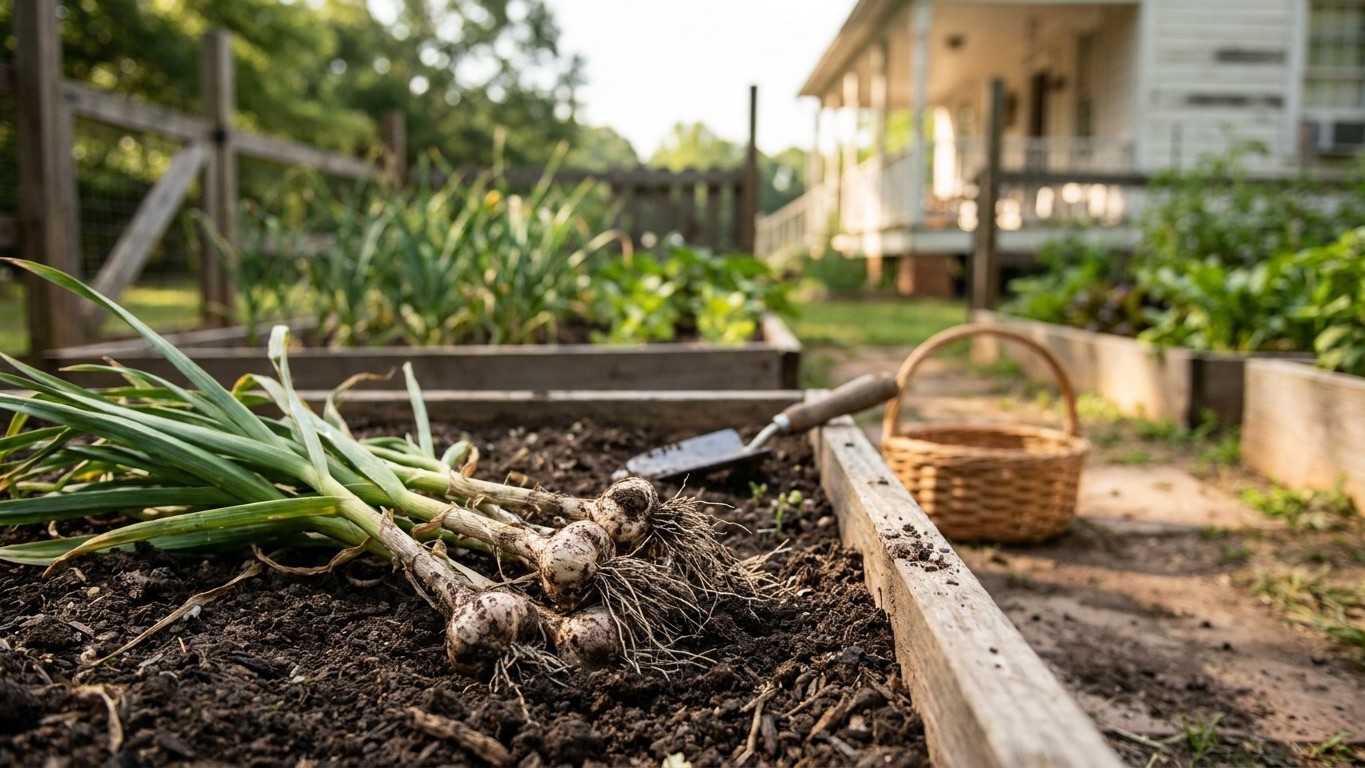

Late October to early November is when garlic goes into Georgia soil, hardneck or softneck, no matter where you garden. That window isn’t tied to one frost date — it’s built to give cloves several weeks of root growth before the ground turns cold and wet, which is what actually determines whether you get big bulbs next summer or small, sad ones. So look at your bed today: if it’s worked and ready, pick a date inside that window and get cloves in, pointed end up, about two inches deep, before you second-guess yourself waiting for a “perfect” day that isn’t coming.
The short answer for Georgia

For most of Georgia, garlic goes into the ground between late October and early November. That window comes from the planting dates published for the cultivars grown in southern gardens, not from a single frost date treated as a hard deadline. The target is root establishment before serious cold arrives, not the frost date itself.
NOAA’s 1991-2020 Climate Normals for the Atlanta station (USW00013874) put the first fall freeze, a 32°F reading, somewhere between November 13 and December 1. That’s an 18-day span, and it exists because freeze timing genuinely shifts from one year to the next, not because the data is loose. A grower near Atlanta planting in late October to early November gives cloves several weeks of soil contact before that freeze window opens, enough time to grow roots without pushing the kind of tender top growth that a hard freeze punishes.
This date is a midpoint, not a guarantee. In roughly half of the years on record at this station, the first freeze falls later than November 13, sometimes not until December 1 or after. In the other half it arrives earlier than that. Treat the November window as the center of a spread of outcomes, not a line you can plant right up against and expect to be safe every year.
Garlic planted in this window spends the winter building roots before shoots push up as days lengthen in late winter, then sizes up through spring. Plant too early and hardneck types especially can put up lush growth going into winter that a sudden freeze scorches back. Plant too late and the crop gets less root time before dormancy, which tends to show up as smaller bulbs the following summer.
Working it out for your own garden
The Atlanta figures are a starting point, not a rule for the whole state. NOAA’s station data comes from one location, and Georgia runs from ridge-and-valley terrain in the north to flat coastal plain in the south, a spread that shifts first-frost timing by weeks in either direction. If you haven’t picked a site or worked the bed yet, that groundwork belongs in Growing Garlic in Georgia; once you’re ready to set cloves in the soil, start here.
The arithmetic, shown
Start from the local first-frost window rather than a fixed date, because that’s the number that actually varies by place. At the Atlanta station, NOAA’s 1991-2020 normals put that window at November 13 to December 1. Garlic needs roughly three to five weeks of cool, workable soil to grow a root system before winter dormancy sets in fully, so counting back from that window lands you in mid-October through mid-November, which is why the catalogue planting dates for cultivars like Inchelium Red and Duganski both read “late October to early November.” That range is wide on purpose. It gives you room to plant on a week when the soil is dry enough to work rather than forcing a specific day.
Elevation moves the math more than anything else in Georgia. Land that sits several hundred feet higher than the Atlanta station tends to see its first freeze arrive earlier, sometimes by two weeks or more, because cold air is denser and settles into higher, more exposed ground faster than it does over a warm valley floor. A large lake nearby has the opposite effect, holding warmth into fall and pushing the first freeze back. Nearness to the coast does the same thing on a bigger scale, since large bodies of water release stored summer heat slowly through autumn. Either factor can shift your effective planting window by up to two weeks against the Atlanta figure, so use the Atlanta window as a reference point and adjust toward earlier or later depending on which of these applies to your ground.
What changes across Georgia
Georgia isn’t one climate, and NOAA’s Atlanta figures describe the Atlanta area specifically, not the state. North Georgia and the mountains freeze several weeks earlier in fall than the Atlanta normals suggest, which means growers in that part of the state should plan on setting cloves earlier within, or even ahead of, the late-October-to-early-November window. The coastal plain in the south runs milder for longer, pushing the safe planting window later. Atlanta itself sits inside an urban heat island effect tied to its airport location, so the immediate metro area can lag slightly behind its own suburbs and the surrounding countryside in when the first real cold arrives.
Cultivar choice tracks these regional differences almost as closely as planting date does. Hardneck garlic needs a real, sustained cold period to divide properly into cloves and form a scape, which makes it a better match for the mountains and the northern piedmont. Softneck garlic tolerates a milder, shorter winter and is the safer pick toward the coastal plain and the southern half of the state. For a full rundown of which types suit which region, see Garlic Varieties That Suit Georgia Winters.
| Type | Varieties | Where it fits best in Georgia |
|---|---|---|
| Softneck | Early Red Italian, Inchelium Red, Italian Late, Lorz Italian | Coastal plain and south Georgia, where winters stay mild |
| Hardneck | Bavarian Purple, Blue Music, Chesnok Red, Duganski, Fall Festival, Georgian Crystal, Georgian Fire, German Red, German White, Ivan | North Georgia and the mountains, where a longer, colder winter builds cloves properly |
The mistakes this climate punishes
Planting the wrong type for a mild winter
The most common failure in the warmer half of Georgia is planting a hardneck variety that never gets the sustained cold it needs to divide into a proper ring of cloves. In a mild winter, hardnecks like German White or Ivan can come up looking fine and still bulb poorly, producing one round clove instead of a full head. South of the piedmont, softneck types are the safer default unless you know your winters run cold enough to satisfy a hardneck’s chilling needs.
Planting too shallow or too late where winters bite harder
In north Georgia and the mountains, the opposite mistake causes the damage. Cloves set too shallow, or set late enough that they haven’t rooted before the ground locks up, get heaved out of the soil by freeze-thaw cycles over winter. A clove sitting on top of frozen ground by February has lost its whole head start. Plant to the depth appropriate for the cultivar and get it done on the early side of the window in colder districts, then mulch to buffer the soil temperature swings that cause heaving in the first place.
Ignoring seed stock health
Georgia’s fall planting months also carry real disease pressure that has nothing to do with your planting date and everything to do with where your seed garlic came from. UC IPM’s Pest Management Guidelines for Onion and Garlic (UC ANR Publication 3453) list white rot, caused by the fungus Sclerotium cepivorum, as active across a 50 to 75°F range. Mean air temperatures in September, October, November, March, and April fall inside that band at a reference station, including two months at the pathogen’s published optimum. Fusarium basal rot, caused by Fusarium oxysporum f. sp. cepae, shows a similar overlap across six months of the growing season, with its own two months at optimum.
Those comparisons use air temperature against thresholds that UC IPM published as soil temperature, and soil lags air by weeks and swings less than air does, so treat this as a rough indication of risk rather than a forecast. One reference station also can’t describe conditions on your specific piece of ground. None of this means these diseases are guaranteed here, and a low month count doesn’t mean they’re absent either: both pathogens travel in infected bulbs and cloves regardless of the weather. Pink root and Southern blight follow the same logic in the other direction, favoring warmer months than fall planting brings, which points to reduced activity in a Georgia fall, not zero risk.
- Buy certified disease-free seed garlic from a known source
- Skip any clove with soft spots, discoloration at the base, or a sour smell
- Never replant bulbs pulled from a bed that had stunted or yellowing plants the year before
Planting saved cloves of unknown health is the single mistake that causes more failed garlic beds in the Southeast than any date on a calendar.
Checking this against your county
The Atlanta figures in this article come from one NOAA station and describe that area specifically. Your county can run a week or two earlier or later depending on elevation, water nearby, and how exposed the site is to cold air drainage. For a county-level read on local conditions and planting guidance, contact the UGA Extension office in your county before you finalize a date. A five-minute call beats guessing if your ground sits well above or below the Atlanta reference elevation.
Common questions
Can I still plant garlic in Georgia in December?
You can, and it will likely still grow, but you’re giving up root-establishment time. Cloves set after the first freeze window has passed spend less time rooting before dormancy, which usually means smaller bulbs at harvest. If December is your only option, plant as early in the month as the ground allows and mulch heavily right away.
What happens if I plant garlic too early in Georgia?
Early planting, especially into a warm October, can push top growth before winter that a later hard freeze then damages. Hardneck types tend to show this more than softnecks. It doesn’t usually kill the plant outright, but it sets bulb development back.
Do I need to vernalize garlic before planting in Georgia?
No, not if you’re planting in fall. Vernalization happens naturally in the ground over winter, which is the whole reason for planting in October and November rather than spring. Cold-treating cloves in a refrigerator only matters if you’re forced into a spring planting.
Is it too late to Plant Garlic if I missed the late-October window?
Not necessarily. The window described here is a target, not a cutoff, and gardeners plant successfully into November across much of Georgia. Push later than that and weigh the tradeoff: a bulb that’s smaller but still usable against one that never gets in the ground at all.
The Moon calendar is a separate, older custom: see when to plant garlic by the moon, written as tradition rather than fact.