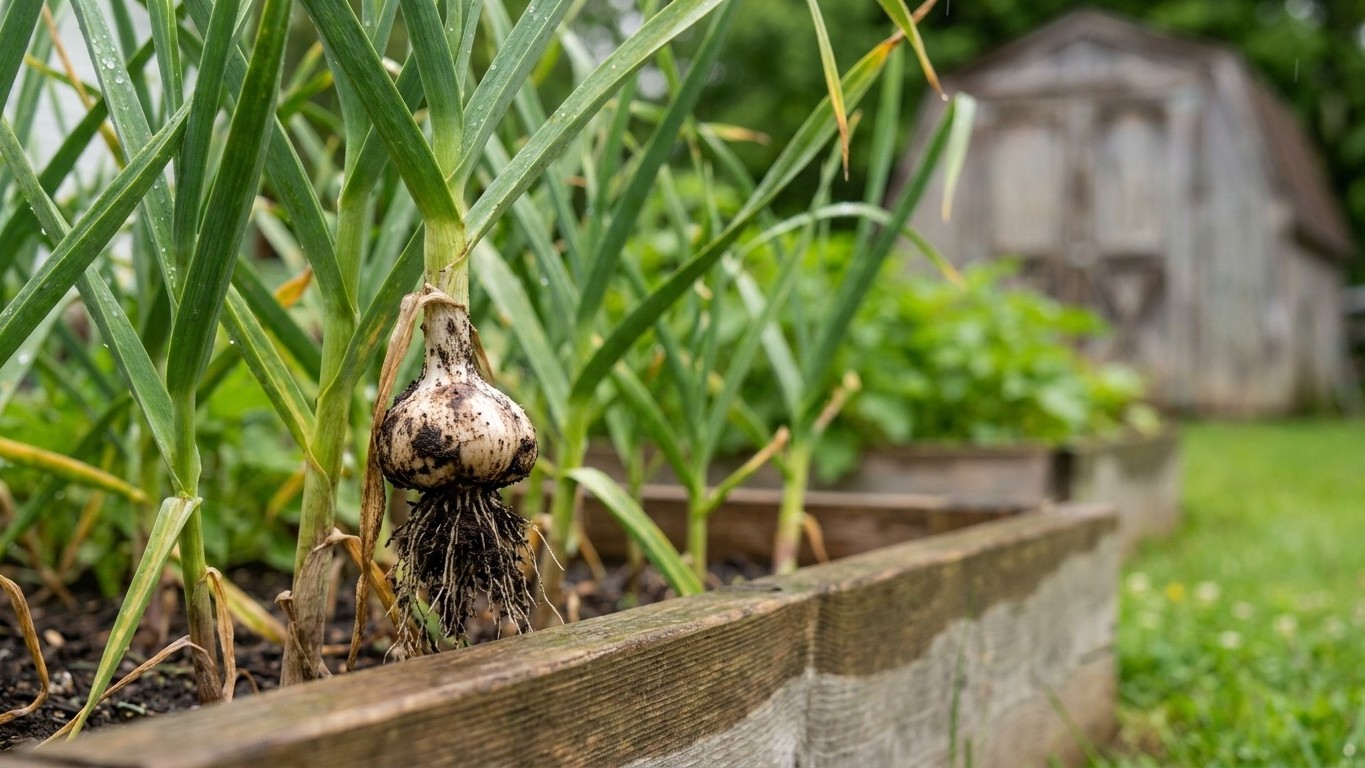

Illinois’s best garlic picks are cold-hardy hardnecks like German White, German Red, Chesnok Red and Duganski, plus dependable softnecks such as Inchelium Red and Lorz Italian. That answer is anchored on NOAA’s 1991-2020 climate normals for the Chicago-area station, which put the first fall freeze at October 24 to November 3, a midpoint that shifts earlier or later depending on where in the state you garden. Set cloves out in the early-to-mid-October window the catalogue lists for these varieties, rather than waiting for a frost to actually show up before you plant.
The short answer for Illinois

For most of Illinois, favor the varieties bred to shrug off a hard freeze. Hardnecks like German White, German Red, Chesnok Red and Duganski handle a deep freeze better than softnecks do, and all four go into the ground in the same early-October to mid-October window the catalogue lists for them. If you want a milder crop that keeps longer in the kitchen, Inchelium Red and Lorz Italian, both softnecks, share that identical window.
That window is set against NOAA’s 1991-2020 climate normals for the Chicago-area station, which put the first fall freeze at October 24 to November 3. That figure is a midpoint, not a promise. In roughly one year out of two, the actual first freeze at that station lands later than November 3, sometimes by a good stretch. Garlic planted early to mid October has time to push roots before the ground shuts down for real, whichever way a given year breaks.
Other named cultivars on this list, including Bavarian Purple, Blue Music, Georgian Crystal and Georgian Fire, along with Early Red Italian, Italian Late, Fall Festival and Ivan, all carry that same catalogue planting window. The window doesn’t vary by variety. What varies is how well each one tolerates the winter that follows, and how it stores once it’s cured next summer.
Working it out for your own garden
The early-October to mid-October window isn’t arbitrary. It’s built by counting backward from the freeze date, the same way you’d count backward from any known endpoint to figure out how much runway you have.
Counting from the freeze window backward
NOAA’s 1991-2020 normals put the Chicago-area station’s first freeze at October 24 on the early end and November 3 on the late end. Count from an early-October planting to the earliest freeze date and you get roughly three weeks of soil time before that freeze window even opens. Count from a mid-October planting to the latest freeze date in the range and you still land close to three weeks. That’s the logic behind the window: enough time for roots to establish, not so much time that the plant pushes green top growth into a hard freeze.
Your own garden almost certainly doesn’t sit on top of the Chicago airport station NOAA measured. If you garden in a low-lying river valley, near open farmland, or well outside the city’s heat, expect your first fall frost to arrive earlier than the reference figure, often by a week or two, and more at elevation. That argues for planting on the early side of the window rather than the late side if you know your site runs cold. If you’re deep in an urban heat pocket close to Lake Michigan itself, the opposite can be true, and you may have a bit more room before the ground firms up.
The safest way to use this arithmetic is to treat the catalogue window as a starting point and adjust it against what you actually know about your own site’s history: does frost tend to show up early on your low ground, does your soil stay workable into November most years, has garlic you’ve planted before rooted well or heaved out over winter. If you’re still deciding when in that window to plant, our planting calendar for Illinois garlic walks through the same backward count in more detail against the frost figure.
What changes across Illinois
Illinois runs roughly 400 miles north to south, and garlic doesn’t experience that distance as one climate. Counties near the Lake Michigan shoreline, including much of Cook County, get a moderating effect from the lake that keeps fall air a bit milder there than at inland counties sitting at the same latitude but away from the water. That can buy a shoreline garden a little extra time before the ground firms up compared to a farm field forty miles inland.
Southern Illinois, down toward Cairo, sits in a warmer band overall than the counties near the Wisconsin border, with a longer stretch of fall before the ground locks up hard. Northern Illinois counties, by contrast, typically see the soil cool and freeze sooner in the season than southern ones do. None of this changes which cultivars from this list will grow. It changes how much margin you have on either side of the planting window, and how much winter protection matters once the crop is in.
Low-lying river valleys and open farmland away from any city tend to run colder overnight than a built-up urban lot, simply because cold air drains downhill and pools there, and pavement and buildings hold heat that farmland doesn’t. A frost pocket in a river-bottom garden can freeze noticeably earlier than a lot a few miles away on higher, more open ground. If your site fits that description, lean toward the earlier half of the planting window regardless of which variety you’ve chosen.
The mistakes this climate punishes
Illinois’s growing-season air temperatures overlap the published range for two garlic diseases enough to matter. According to the UC IPM Pest Management Guidelines for Onion and Garlic (UC ANR Publication 3453), white rot, caused by the fungus Sclerotium cepivorum, is active in a 50-75°F range, and Illinois’s growing-season air temperatures fall inside that range in five months, September, October, May, June and July, with one of those months landing right at the pathogen’s optimum. Fusarium basal rot, caused by Fusarium oxysporum f. sp. cepae, is active from 59-90°F, a range Illinois’s air temperatures overlap in four months: September, May, June and July.
Those are soil-temperature thresholds compared against air averages, and a monthly mean hides plenty of daily swing, a month averaging in range can still include days well outside it. Southern blight and pink root show zero months at their published optimum in this count, but that never means those diseases can’t occur here. Infected seed stock carries any of these pathogens into a garden regardless of climate. The practical mistake is buying ungraded, uncertified cloves, including grocery-store garlic, since you can’t see white rot sclerotia sitting dormant in the soil or on a clove before you plant it.
Cold-specific mistakes
- Planting a hardneck expecting softneck storage life, or the reverse, without checking which type you actually bought
- Setting cloves too shallow, which lets a hard freeze heave them out of loosened fall soil before roots anchor them
- Waiting past the catalogue’s mid-October end date “to be safe,” which shortens root time rather than lengthening it
- Skipping mulch on a site that already runs colder than the county average, such as a low field or a river-bottom lot
The mulch point matters most in a colder-than-average winter. In a mild one, an unmulched hardneck usually pulls through fine because the ground never truly locks up. In a genuinely cold winter, the same bed without mulch can lose cloves to heaving, particularly on the early side of the range if roots haven’t had their full three weeks or so to establish before that hard freeze arrives.
| Variety | Type | Cold tolerance note |
|---|---|---|
| German White | Hardneck | Consistently reported as one of the more cold-tolerant hardnecks in the catalogue trade |
| Duganski | Hardneck | Purple-streaked hardneck bred from cold-climate stock, handles hard freezes well |
| Chesnok Red | Hardneck | Porcelain-type hardneck, reliable in northern climates when mulched |
| Inchelium Red | Softneck | Less cold-hardy than the hardnecks above, but a strong keeper once cured |
| Lorz Italian | Softneck | Softneck type; benefits from mulch in a harsh winter more than the hardnecks do |
Checking this against your county
Every figure above comes from one Chicago-area weather station and one national temperature dataset, and Illinois is a big state. Before you commit to a planting date, check your county-level guidance through Illinois Extension, which can point you to local frost records and any garlic-specific advice for your part of the state. If you haven’t yet worked out the rest of your bed prep and site choice, our broader guide to growing garlic in Illinois covers what comes before this step.
Common questions
Is it too late to Plant Garlic in November in Illinois?
It depends on how far into November and how cold your specific site already runs. NOAA’s 1991-2020 normals put the Chicago-area first freeze at October 24 to November 3, so planting in early November at a site that matches that station is cutting it close on root time, and later than that is a real gamble on most Illinois ground.
Can I plant grocery store garlic instead of one of these named varieties?
You can, but it carries more disease risk. Grocery garlic isn’t certified disease-free, and Illinois’s growing-season temperatures overlap the published range for white rot and fusarium basal rot for several months of the year, so uninspected cloves are a worse bet here than certified seed stock of a named variety.
Do I need to mulch garlic over an Illinois winter?
Most growers in this state mulch, especially on sites that run colder than average or sit in a low frost pocket. Straw laid down the same day you plant protects against the freeze-thaw heaving that pulls shallow cloves loose, and your county Extension office can confirm what depth local growers typically use.
Will hardneck garlic survive without any winter protection?
Often, yes, in a mild winter on well-drained soil, since hardnecks like German White and Duganski are bred from cold-climate stock. In a harder winter, or on a site with poor drainage or heavy heaving, an unmulched bed is more likely to lose cloves than a mulched one.