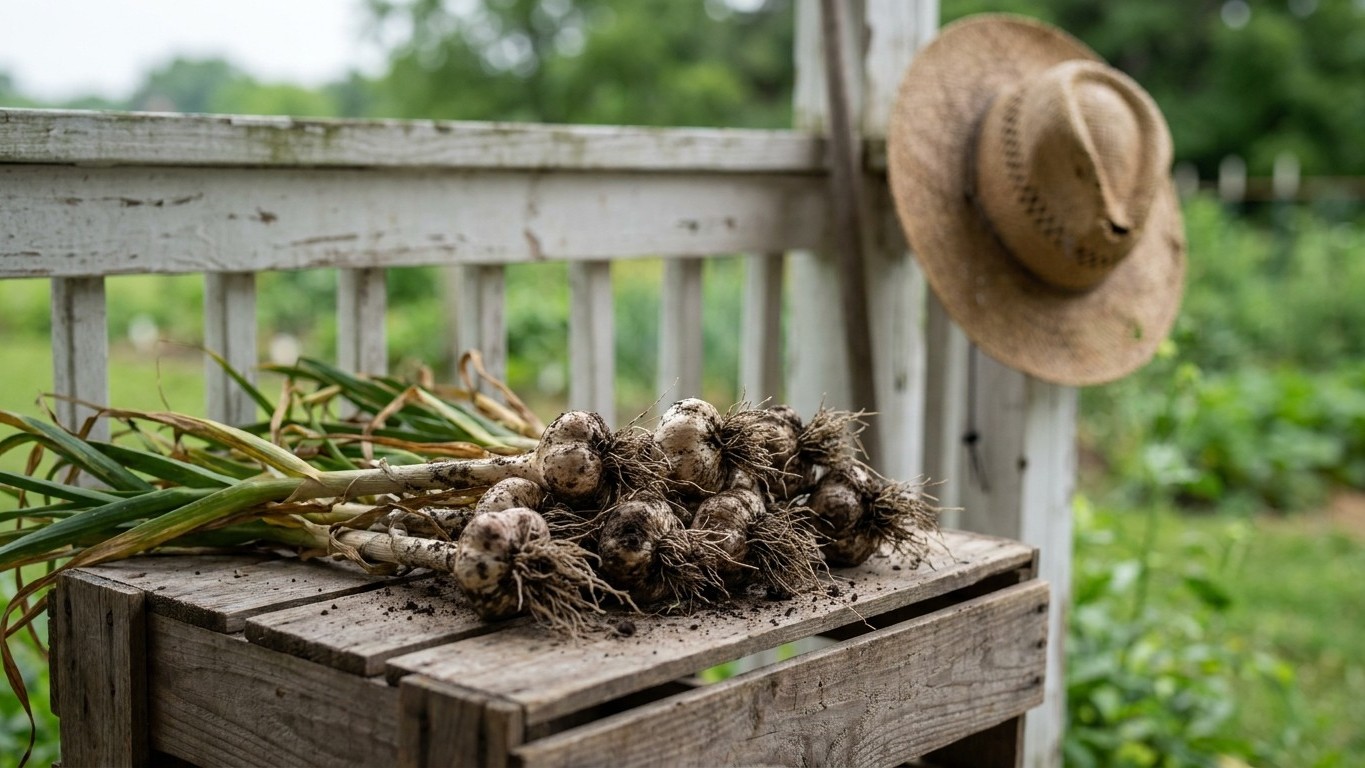

Garlic grown in Ohio gets all the cold it needs almost everywhere in the state, since a zone 6a winter runs well past the six to eight weeks below 40°F that University of Georgia Extension publication C854 sets as the minimum for clove division. Get seed garlic in the ground in the mid-September to late September window this garlic planting dates guide lays out below, timed against OSU Extension’s Columbus-area first fall frost of October 5 to October 15. Order your seed garlic now: local suppliers of the better hardneck varieties sell out before the planting window opens.
Will garlic get the cold it needs in Ohio

Zone 6a winters settle over most of Ohio, and that’s a sustained run of sub-40°F weather from December through February — well past the six to eight weeks garlic needs to break dormancy properly. Cold is not something Ohio growers need to manage or worry about clearing; the whole state gets there easily, lake-effect counties included. What actually costs Ohio gardeners their crop is shallow planting or softneck varieties bred for milder climates, not a shortage of winter chill.
Ohio clears that bar almost everywhere in the state. Most of Ohio sits in USDA hardiness zone 6a, and a zone 6a winter delivers a sustained run of sub-40°F weather from roughly December through February that runs longer, not shorter, than the six to eight weeks UGA sets as the floor. Cold is not the limiting factor for garlic anywhere in Ohio, unlike a state such as Oklahoma, where winters run milder and growers have to plan for whether a given year clears the threshold at all.
Ohio still has internal variation worth knowing about. The interior and the hill country of southeastern Ohio cool down earlier and harder than the strip of land near Lake Erie, where the lake’s stored warmth slows the arrival of sustained cold. None of that changes whether the state as a whole clears the chilling requirement, but it does mean a grower near the lake shouldn’t assume their winter behaves like one further inland.
Where growers actually lose the crop to cold
Where Ohio gardeners lose garlic to winter, it is rarely from too little cold. It’s from planting shallow going into a hard winter, or from choosing a softneck variety bred for a mild climate and expecting hardneck-scale bulbs out of it. If you’re planting stock of uncertain origin, or unsure whether it was grown somewhere with a much milder winter, the two standard fixes apply: refrigerate the cloves for several weeks before planting to force the chilling artificially, or choose a softneck variety that divides reliably on less cold than a hardneck needs. Consulting this guide to Garlic Varieties That Suit Ohio Winters can help match the right type to your local conditions. Neither is usually necessary for garlic grown and planted within Ohio, but both matter if the seed garlic itself came from somewhere warmer.
When to put the cloves in
Anchor garlic planting on the first fall frost, not on a date fixed weeks in advance. OSU Extension’s Ohio Gardening Calendar puts the first fall frost in the Columbus area at October 5 to October 15, and that window is the reference point for the whole state, even though other parts of Ohio run earlier or later around it.
Working backward from frost
Garlic wants four to six weeks of root growth before the ground freezes hard, without so much time that it pushes tall green top growth heading into winter. Counted back from Columbus’s October 5 to October 15 frost window, that lands planting in the mid-September to early October range, which is why every variety in this guide is listed for a mid-to-late September set-out. Treat the frost window as the middle of normal year-to-year swing, not as a safe deadline. Some years bring the first hard frost days ahead of it, others push it back into late October, and garlic planted with that buffer in mind tolerates either outcome.
Elevation and lake effect move that window in both directions. Higher ground in southeastern Ohio’s hill country tends to cool earlier than the Columbus reference point, which argues for planting toward the earlier end of the range there. The strip of land near Lake Erie holds warmth longer into fall, which can push practical planting a little later without added risk, since the lake delays the first hard freeze right along the shoreline.
Watch the clove, not just the date, once you’re inside the target window. Cloves planted while soil is still warm from summer can put up a green shoot before the ground freezes. That shoot usually survives fine under mulch, but it spends reserves the plant would rather put into root growth first. Waiting until night temperatures have dropped consistently, even ahead of the first freeze, is a better planting cue than a fixed day of the month.
Which types suit Ohio
Ohio’s winters put this decision firmly on the side of hardneck garlic. Hardneck types need a real cold season to trigger scape formation and divide the bulb properly, and a zone 6a Ohio winter provides exactly that across most of the state. Softneck garlic evolved for milder winters and survives in Ohio fine with mulch, but a grower this far north is asking it to do something it wasn’t bred for. Compare that to Florida, where winters barely reach hardneck territory and softneck is close to the only workable choice.
Within hardnecks, Ohio growers have a wide field to pick from, and all of them go in on the same mid-September to late September schedule this territory’s frost window sets:
- Bavarian Purple
- Blue Music
- Chesnok Red
- Duganski
- Fall Festival
- Georgian Crystal
- Georgian Fire
- German Red
- German White
- Ivan
Softnecks still earn a place in an Ohio garden, mainly for the reason hardnecks can’t match: storage life. Softneck bulbs braid well and keep for months longer in a pantry than most hardnecks do, which is worth the tradeoff in a state where cold is not scarce. Inchelium Red, Lorz Italian, Italian Late, and Early Red Italian are all softnecks that go in on the same mid-to-late September schedule as the hardnecks above. Growing one softneck bed alongside a hardneck bed gets you both the flavor and clove size hardnecks are known for and a portion of the harvest that keeps well into winter.
Soil and bed preparation
Garlic sits in the same bed for eight to nine months, through freeze, thaw, and spring rain, so drainage is the first thing to fix, not an afterthought addressed after planting. A clove sitting in saturated soil over winter rots before any disease organism gets involved. If your planting site holds standing water after a heavy rain, raised beds or ridged rows solve that more reliably than any soil amendment will.
Work compost or aged manure into the bed a few weeks ahead of planting, giving it time to settle rather than sitting loose right around the cloves. Garlic is a heavy feeder over its long season in the ground, and a bed built up with organic matter in fall carries it through the nutrient demands of spring growth without needing early fertilizer applications while the ground is still cold.
Check soil pH before you plant if that bed hasn’t been tested recently. Garlic performs best in soil that isn’t strongly acidic, and a bed that’s grown acid-loving plants for years can benefit from lime worked in ahead of fall planting, based on an actual soil test rather than a guess. Your county extension office can run that test and return both a pH reading and amendment recommendations specific to your soil, which is cheaper insurance than losing part of a bed to a pH problem never diagnosed.
What the climate here favours, and what it does not
The temperature thresholds behind this section come from the University of California’s IPM Pest Management Guidelines for Onion and Garlic, UC ANR Publication 3453, and they’re published as soil temperature ranges, while the figures below are Ohio’s average air temperatures. Soil lags air by weeks and swings far less than air does, so read this as a tendency the climate leans toward, not a threshold the garden crosses on any given day.
By that measure, Ohio’s growing season spends real time in the range that favors white rot (Sclerotium cepivorum). The pathogen’s published 50-75°F range overlaps five months of Ohio’s growing season: September, October, April, May and June, including one month at the fungus’s published optimum. White rot is rated critical for a reason, since infected soil stays infectious for years and there is no in-season cure, only exclusion through clean seed stock.
Fusarium basal rot (Fusarium oxysporum f. sp. cepae) has a wider published range, 59-90°F, and Ohio’s average air temperature falls inside it across four months: September, May, June and July. Pink root (Setophoma terrestris) only reaches its 75-85°F optimum in July here, one month out of the growing season, which limits its relevance without removing it.
Southern blight (Sclerotium rolfsii) is the one piece of good news in this list. No month of Ohio’s growing season carries a mean air temperature inside its 86-95°F optimum. That doesn’t mean the disease can’t occur here, since infected planting stock brings its own pathogens along regardless of climate, but Ohio’s temperatures don’t push this one the way they push white rot.
None of this is a reason to avoid garlic in Ohio. It’s a reason to buy seed garlic from a supplier who guarantees it disease-free, rather than planting bulbs of unknown origin, and to rotate away from any bed that has grown onions, garlic, or other alliums in the past three to four years. White rot sclerotia persist in soil for years once introduced, so keeping clean stock out of clean ground matters here more than any treatment applied after symptoms show up.
Getting it through the winter
Mulch is what separates a bed of garlic that survives an Ohio winter from one that heaves out of the ground. Lay four to six inches of loose straw over the bed once the ground has had its first hard cold snap, not right after planting, since mulching too early traps warmth the cloves don’t need and can encourage the same early shoot growth a grower is trying to avoid.
Heaving, not cold itself, is the real winter threat here. Repeated freeze-thaw cycles through an Ohio winter push shallow-planted cloves upward out of the soil, exposing them to desiccation and cold injury they’d otherwise be insulated from. Planting cloves a full two inches deep, combined with a solid mulch layer, holds soil temperature steadier through those freeze-thaw swings and keeps the clove anchored where it was planted.
Straw is the standard mulch material because it stays loose and insulating through winter. Whole leaves raked straight off the lawn compact under rain and snow into a wet mat that holds too much moisture against the clove and invites rot rather than preventing it. Shredded leaves work as a substitute if straw isn’t available, but whole leaves do not.
Pull mulch back gradually in spring once hardneck shoots start pushing through, rather than stripping the bed all at once. Leaving a thin layer in place a while longer still suppresses spring weeds without smothering the emerging shoot, and the rest can come off once growth is clearly underway and the risk of a hard late freeze has passed.
Harvest and curing here
Lift garlic by what the leaves are doing, not by a date on the calendar. A bulb is ready when the lower third to half of its leaves have browned and dried back while the upper leaves are still green, since each leaf corresponds to a wrapper layer around the bulb. Pulling too early or too late costs either bulb size or storage quality.
Curing is where Ohio’s humid summer weather causes more losses than the harvest itself does. Curing needs airflow and shade, not sun. Hang or lay bulbs somewhere dry and ventilated, out of direct light, for several weeks until the outer wrappers turn papery and the necks dry fully. In a humid stretch, that means running a fan in the curing space rather than relying on open air alone, since Ohio summers routinely bring enough ambient humidity to slow drying to the point where bulbs start molding before they finish curing.
Don’t wash bulbs before curing and don’t cut the tops off green. Both open a route for moisture and rot organisms into a bulb that would otherwise cure cleanly, and a bulb that molds during curing was a good bulb lost to a step with nothing to do with how the season grew.
Once cured, trim roots and cut stems to an inch or two above the bulb on hardnecks, or braid softneck tops if you want them for storage or display. Hardneck bulbs from Ohio gardens typically hold for a few months in storage. Softnecks like Inchelium Red and Lorz Italian keep noticeably longer, which is the main reason to grow a few even in a state where hardnecks otherwise have the advantage.
Local help
Ohio spans several frost patterns from the Lake Erie shore to the hills along the Ohio River, so treat the Columbus figures in this guide as a reference point, not a substitute for local numbers. OSU Extension maintains county offices that can give you a frost date specific to your area and run a soil test on your garlic bed, both worth doing before committing to a planting date from this page alone.
Common questions
Can I Plant Garlic in spring in Ohio instead of fall?
Not with any expectation of a normal bulb. Garlic needs the cold period fall planting provides to trigger clove division, and a spring-planted clove that misses that chilling period usually grows a single round bulb rather than splitting into cloves.
I missed the September planting window. Is it too late?
Get cloves in the ground as soon as you can rather than waiting until spring. Planting continues to work right up until the ground actually freezes, though a later planting gives roots less time to establish and increases the risk of the clove heaving out of the soil over winter, so add extra mulch depth if you’re planting later than the mid-to-late September target.
Can I plant garlic from the grocery store?
You can, but it carries more risk than seed garlic from a supplier that guarantees disease-free stock. Grocery store garlic is often treated to inhibit sprouting, and its disease history is unknown, which matters given how long white rot sclerotia persist in soil once introduced.
Do I need to cut the scapes on my hardneck garlic?
Yes, once they curl. Cutting the scape redirects the plant’s energy into bulb growth instead of the flower stalk, and the scape itself is a harvestable, edible byproduct rather than something you leave to pollinate, since garlic is grown from cloves, not seed.
Will a milder-than-usual winter hurt my garlic in Ohio?
Unlikely. Ohio’s winters run well past the six to eight weeks below 40°F that garlic needs for clove division, so a winter that’s milder than average by Ohio standards still typically clears that threshold. The exception is a garden at unusually low elevation with poor cold air drainage, which is worth checking with your county extension office if you’ve had trouble with small, undivided bulbs in the past.