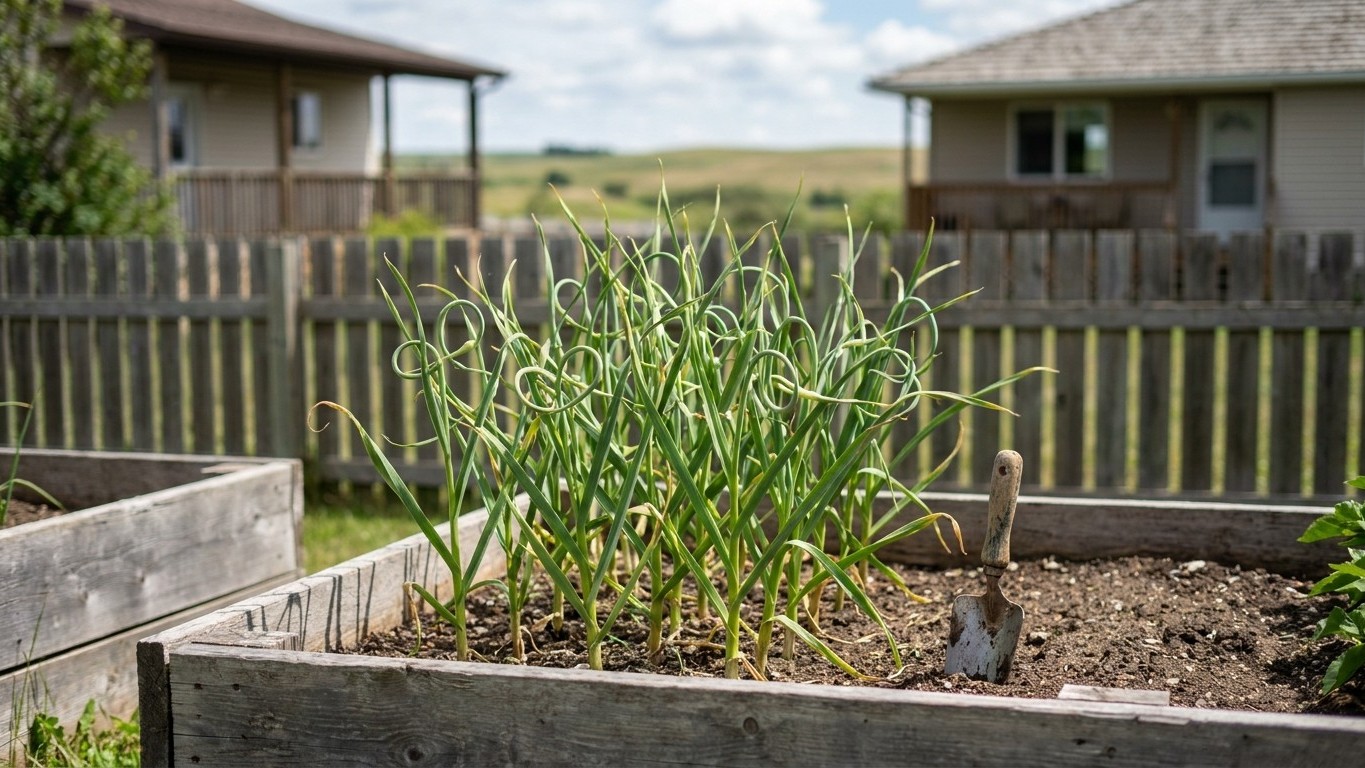

34.8 weeks a year — that’s how long Saskatoon sits below 40°F, against the six to eight weeks a garlic clove actually needs to split into cloves instead of coming up as one useless round bulb. Fall-planted garlic here isn’t gambling on cold; it’s swimming in it, four and a half times over. Compare that to Kentucky, where growers sweat the margin. In Saskatchewan the only real question left is which variety and which week in fall to get it in the ground.
Will garlic get the cold it needs in Saskatchewan

A garlic clove planted in fall is not just overwintering. It is going through a cold-driven process that splits one round clove into the several cloves that make up next summer’s bulb. Skip that process, or cut it short, and the plant comes up as a single round bulb with no seams, useless for replanting and disappointing on a cutting board. University of Georgia Extension’s publication C854 sets the bar at six to eight weeks of soil temperatures below 40°F after planting for that split to happen reliably.
What the numbers say for this territory
Saskatchewan does not come close to falling short of that bar. Environment and Climate Change Canada’s 1981-2010 normals for the Saskatoon SRC station record 34.8 weeks a year with mean air temperatures below 40°F, roughly four and a half times the minimum garlic needs. Even allowing for the gap between air and soil readings, and for the fact that one station cannot speak for the whole province, no reasonable planting date here leaves a clove short on chill. With that much margin to spare, choosing Garlic Varieties That Suit Saskatchewan Winters matters more than the timing itself. A grower comparing notes with someone in Growing Garlic in Kentucky: Planting Dates, Varieties and Winter Cold, where the winter runs milder and the chill margin is narrower, will find Saskatchewan is the easier climate on this one point, if nothing else.
Where the shortfall risk actually lives
The real risk in this province is not a winter too short. It is a clove that never gets a proper start because it went into a warm, sheltered spot late in the season, or because it sat in cold storage before planting and lost time it needed in the ground. If a site runs warmer than the surrounding area, a heat-holding raised bed against a south wall, for instance, two fixes work. Refrigerate the cloves at close to 40°F for several weeks before planting to bank chill hours artificially, or plant a softneck type, which tolerates a shorter or milder cold period than hardneck garlic does. Neither is usually necessary here, but both exist for the year or the site that runs unusually warm.
When to put the cloves in
Anchor the planting date on the season’s end, not on a page from a calendar. The average first fall frost at the Saskatoon SRC station, per Environment and Climate Change Canada’s 1981-2010 normals, is September 18, a useful starting point for figuring out When to Plant Garlic in Saskatchewan. That figure is a mean, which means in roughly one year out of two the actual frost lands later than that, sometimes well later. Treat it as the middle of a window, never as a date you can plant right up against and still be safe.
How the window shifts across the province
Saskatoon’s reading will not match every county. Low-lying land and frost pockets in river valleys tend to see their first freeze arrive earlier than the Saskatoon average, while a large body of water nearby moderates the swing and can push the first frost later. Elevation works the same way in reverse, higher ground cools faster. None of that changes the planting logic, only the exact week you should treat as your own local frost midpoint.
Work back three to four weeks from that midpoint and you land in late August for planting, which is why every variety in the cultivar list below is marked for a late August set-out here. That timing gives cloves enough weeks to grow roots and settle into the soil before hard freeze, without pushing enough top growth to be vulnerable to a hard early frost. Roots first, leaves later, is the goal.
Planting too early risks green shoots poking through before winter, which then get burned back by the first real cold snap and cost the plant stored energy it needed for spring. Planting too late risks the opposite problem: cloves that go in with no root system at all before the ground freezes solid, which weakens the plant all through the following growing season even if it survives.
Which types suit Saskatchewan
Hardneck or softneck is not a matter of preference in this climate, it is a matter of what the winter actually provides. Hardneck garlic wants a real, sustained cold season to perform well, and produces a central flower stalk (the scape, which gets cut off, not pollinated) along with strong flavor and easy peeling. Softneck garlic tolerates milder winters and stores for many more months, but generally wants less cold than hardneck to do well.
Given the winter this territory carries, hardneck is the type that fits the climate rather than merely surviving it. The cultivar list available for this region includes several hardneck options, all set out in late August:
- Bavarian Purple
- Blue Music
- Chesnok Red
- Duganski
- Fall Festival
- Georgian Crystal
- Georgian Fire
- German Red
- German White
- Ivan
Softneck’s storage tradeoff
Softneck still has a place here, mostly for growers who want a bulb that keeps into late winter without shriveling, or who braid their harvest. Inchelium Red, Lorz Italian, Early Red Italian and Italian Late are all softneck options in the same late August planting window. In a mild state like South Carolina, where Growing Garlic in South Carolina: Planting Dates, Varieties and Winter Cold explains softneck dominates almost by default because the winter rarely gives hardneck enough cold, growers do not get the choice this province offers. Here, softneck is a deliberate pick for storage life, not a fallback forced by climate.
Soil and bed preparation
Drainage comes before anything else. A garlic clove sits in the ground through the entire winter and well into the following summer, and standing water will rot it long before any disease in the soil gets the chance. On the heavier clay soils common across the prairie, a raised bed or a mounded row is worth the extra work if the planting site holds water after rain or spring melt.
Getting drainage and fertility right
Work the bed over in the weeks before planting, not the day of. Loosen the soil to a full spade’s depth so roots can push down freely once they start growing in fall, and mix in aged compost or well-rotted manure rather than anything fresh, since fresh manure can burn young roots and also tends to carry weed seed into a bed that will sit undisturbed for most of a year. A soil test through the provincial extension service, mentioned below, will tell you where phosphorus and potassium levels stand, both of which matter more to garlic’s root and bulb development than nitrogen does at planting time.
Clear the bed of perennial weeds before planting rather than after. Garlic offers almost no competition to weeds through its slow fall rooting phase, and a weedy bed going into winter is a weedy bed coming out of it in spring, at exactly the point when the crop needs full sun and undisturbed soil to bulk up its bulbs.
What the climate here favours, and what it does not
The thresholds below come from UC IPM’s Pest Management Guidelines for Onion and Garlic, UC ANR Publication 3453, and they are published as soil temperature ranges. What follows counts months where this region’s mean air temperature falls inside those ranges, which is a tendency toward disease pressure, not a measured infection and not a soil reading. A monthly average also hides a lot: a month that averages inside a pathogen’s preferred range can still swing well outside it on any given day.
| Disease | Published range | Months in range here | What that means |
|---|---|---|---|
| White rot (Sclerotium cepivorum) | 50-75°F | 4 (September, May, June, July), including one at the pathogen’s published optimum | Most of the growing season sits inside the range this pathogen favors |
| Fusarium basal rot (Fusarium oxysporum f. sp. cepae) | 59-90°F | 2 (June, July) | Only the warmest stretch of summer falls inside its occurrence range |
| Southern blight (Sclerotium rolfsii) | 86-95°F optimum | 0 | No month reaches its preferred range, so the disease runs less active, not absent |
| Pink root (Setophoma terrestris) | 75-85°F optimum | 0 | Same as above, less active outside the optimum, never impossible |
White rot is the one to watch here, since four months of the growing season, including one at the pathogen’s stated optimum, sit inside the range it favors. That does not mean it will show up. Its most common route into a garden is infected planting stock or contaminated soil carried in on tools, not the air temperature alone. Southern blight and pink root, by contrast, never see a month at their published optimum in this territory’s growing season, which lowers the odds without ever closing the door on either one, since both pathogens can persist in soil and cause disease outside their preferred range too.
Getting it through the winter
Mulch is what turns a planted clove into a surviving one through a prairie winter, and timing matters as much as depth. Lay it too early, while the ground is still warm, and you trap heat and moisture around the clove in a way that invites rot before the cold even sets in. Lay it after the ground has started to firm up with the season’s first hard cold, and it does its real job: insulating the soil against the deep freeze-thaw swings that would otherwise heave a shallow clove right out of the ground.
Mulch timing and depth
A layer of straw or shredded leaves, roughly four to six inches deep once settled, is the standard depth for a cold-winter planting. Pull part of it back in spring once green shoots appear, since a mulch layer left too thick and too long can smother new growth and hold the soil colder and wetter than the plant wants as it starts active growth again.
Planting depth matters just as much as mulch. A clove set too shallow, with only a light dusting of soil over the tip, is exactly the kind that heaving lifts partway out of the ground over a winter of repeated freeze and thaw. Plant with roughly two inches of soil above the tip of the clove, then mulch on top of that, so the clove itself sits below the depth where freeze-thaw cycling does most of its damage.
Harvest and curing here
Read the plant, not the calendar, to know when to lift. Garlic is ready when the lower third to half of the leaves have browned and dried back while the upper leaves are still green. Pull a test bulb or two before committing to the whole bed. A bulb lifted too early has thin, underdeveloped skins that won’t protect it in storage, and one left too long in the ground starts to split its wrapper and separate into loose cloves in the soil.
Curing in a dry prairie summer
Saskatchewan’s typically low summer humidity is an advantage at curing time, since garlic cures fastest and cleanest in warm, dry, moving air. Move bulbs somewhere shaded right after lifting. Direct sun on a freshly pulled bulb can scald the outer wrapper and shorten its storage life before curing even starts. Cure in a well-ventilated, shaded spot, tops and roots still attached, until the outer wrappers turn papery and the neck tightens down fully. If a wet or humid stretch hits during curing, a fan running over the bulbs keeps air moving and prevents the mold that a still, damp curing space invites.
Local help
County-level frost dates, soil test results and any updates to disease pressure in your specific district go beyond what a station reading from Saskatoon can tell you. Saskatchewan’s Ministry of Agriculture agribusiness office is the place to check for that detail before finalizing a planting date on a new site, and it is worth a call before the first year you plant garlic on unfamiliar ground.
Common questions
Can I Plant Garlic in spring instead of fall in Saskatchewan?
You can plant cold-treated cloves in spring, but expect smaller bulbs. Fall planting lets the clove use the province’s natural winter cold to split properly, and spring planting compresses or skips that process even with refrigeration beforehand.
Do I need to cut the scapes off my garlic?
Yes, on hardneck varieties. Cutting the curling flower stalk once it forms redirects the plant’s energy into the bulb instead of the stalk, and most growers get a modest but noticeable size increase in the bulb from doing it.
What if I miss the late August planting window?
Plant as soon as you can into September rather than skipping the year. The goal is roots established before the ground freezes solid, so a clove planted a couple of weeks later than ideal, ahead of the September 18 average first frost at the Saskatoon SRC station, still has a reasonable shot, just with less of a head start than an on-time planting.
Can I grow elephant garlic here?
Elephant garlic is actually a type of leek, not true garlic, and it is not on the cultivar list for this territory. Its growing needs differ enough from true garlic’s that it is worth treating as a separate crop rather than assuming the same fall planting rules apply exactly.
How many cloves will I get per bulb?
It depends on the type more than on this climate. Hardneck varieties like the ones listed above typically produce fewer, larger cloves arranged in a single ring around the woody stalk, while softneck types like Inchelium Red or Lorz Italian produce more, smaller cloves in overlapping layers with no central stalk.