
Yukon’s winters give garlic far more cold than it needs to divide into cloves. Environment and Climate Change Canada’s Whitehorse A climate normals (1981-2010) put the territory at 39.1 weeks a year below 40°F, well past the six to eight weeks University of Georgia Extension (C854) says triggers clove division. The decision that actually matters here is timing: get cloves in the ground early enough to root before freeze-up, and no earlier than that.
Will garlic get the cold it needs in Yukon

Garlic does not divide into individual cloves unless it passes through a real stretch of cold after planting. Skip that stretch and the plant never bothers to differentiate, and a grower digs up one rounded, undivided bulb the following summer instead of a head split into cloves. That requirement is the reason garlic goes into the ground in autumn almost everywhere it is grown, and never in spring.
How much cold this territory delivers
Whitehorse gets that cold in spades. Environment and Climate Change Canada’s Whitehorse A climate normals (1981-2010) put the territory at 39.1 weeks a year with a mean temperature below 40°F. University of Georgia Extension, in publication C854, sets the garlic requirement at six to eight weeks below that threshold to trigger division. Yukon’s winter clears that bar by a wide margin, and clove division is not a question a Yukon grower needs to spend any worry on.
That puts this territory in an unusual position. Most garlic guidance is written for growers trying to find enough cold, not for growers who already have too much of it. In much of Alabama, for instance, winters barely brush the six-to-eight-week floor, and growers there refrigerate cloves before planting or lean on softneck varieties bred for mild winters, a workaround covered in growing garlic in Alabama. Nevada’s high desert splits the difference, cold enough in the mountains and marginal in the valleys, a different puzzle covered in growing garlic in Nevada. Yukon has no cold-side puzzle to solve at all, which shifts the real decision toward picking the hardneck types best suited to local conditions, as covered in the Garlic Varieties That Suit Yukon Winters guide.
So the real decision here is not whether to Plant Garlic, since the cold answer is settled, but when to plant it and how to carry it through the winter that follows. A clove that gets enough cold but never got the chance to root first fails for a completely different reason, and that reason, not the cold requirement, is what actually separates a good Yukon garlic crop from a poor one.
When to put the cloves in
Anchor the planting date on the region’s average first fall frost, not on a page from a calendar, and consult a When to Plant Garlic in Yukon guide for specifics. Environment and Climate Change Canada’s Whitehorse A climate normals (1981-2010) put that average at August 25, and that figure is a midpoint, not a guarantee. In roughly half of all years the first frost arrives later than August 25, and in the other half it arrives earlier. Treat it as the center of a window, never as a safe date to plant around with any precision.
Reading the window rather than the date
Garlic wants to go into the ground while soil is still workable and warm enough to grow roots, but before the ground freezes solid. Cloves planted too early throw up green top growth that a hard frost then cuts back, wasting stored energy before winter even starts. Cloves planted too late do not have time to root before the soil locks up, and an unrooted clove sitting through a Yukon winter is one that heaves out of the ground or fails outright. The practical planting window runs from a few weeks before the average frost date through roughly the week it falls, adjusted every year to how the season is actually running rather than to what the calendar says it should be doing.
Whitehorse’s own site sits low in a river valley, and that geography matters as much as the date itself. Higher ground away from the valley floor cools faster in autumn and can see a measurably earlier first frost than the Whitehorse average, while low spots that pool cold air overnight will frost before the surrounding hillsides do. A grower gardening at elevation, or in a known frost pocket, should watch their own nights rather than assume the Whitehorse figure applies exactly to their yard.
Where a fall date genuinely cannot be pinned down for a given site, the more reliable signal is soil temperature, not the calendar. Garlic roots best while soil temperature is falling but still cool rather than cold, and long-time growers in the territory watch that drop, and the behavior of their own ground from one year to the next, more closely than they watch any single printed date.
Which types suit Yukon
Hardneck garlic sends up a stiff central stalk called a scape and needs a real cold season to perform well, and Yukon supplies more of that cold than almost any garlic-growing region in North America. Softneck garlic tolerates mild winters, braids well, and stores for months longer than hardneck once cured, but it does not need Yukon’s kind of cold to do well. Hardneck is the natural fit for this territory, though a softneck planted here does no harm and simply gives up some of the flavor range hardnecks are grown for.
Hardneck options for a cold winter
German Red and German White are two of the most widely grown cold-climate hardnecks in North America, and both are set out in early August in this territory. Duganski and Chesnok Red are Purple Stripe types bred in the cold-winter regions of the former Soviet Union, and both take the same early-August planting here. Georgian Crystal and Georgian Fire come from the same cold-adapted stock, with Georgian Fire carrying a noticeably hotter clove than most hardnecks sold in North America. Bavarian Purple and Blue Music round out the hardneck list, and Fall Festival and Ivan are two further hardnecks that take the same early-August schedule.
Softneck options where longer storage matters
Early Red Italian, Italian Late, Inchelium Red and Lorz Italian are softnecks that go into the ground on the same early-August timing as the hardnecks above. Inchelium Red is one of the most widely adapted softnecks in the North American seed trade, and a reasonable choice for a grower who wants a few heads that keep well past midwinter, something most hardnecks grown here will not do. Lorz Italian was originally selected in the Pacific Northwest but tolerates a wide range of winters and is worth naming for the same storage-length reason.
Soil and bed preparation
Garlic sits in the same patch of ground for roughly ten months in this territory, through freeze-up, the depth of winter and the spring thaw, and drainage matters more than any other single factor in bed preparation. A clove sitting in cold, saturated soil rots before any disease organism gets the chance, and a raised bed, or a bed worked with enough compost and coarse material to drain freely, is worth more than any other single amendment a Yukon grower can make.
Building fertility before the cloves go in
Work compost or well-rotted manure into the bed several weeks before planting, giving it time to settle rather than sitting freshly turned when the cloves go in. Garlic is a heavy feeder over its long season in the ground, and a bed that starts rich in organic matter carries that fertility through the winter and into the surge of spring growth that follows snowmelt.
Loosen the soil to a full spade’s depth if it has not been worked recently. Compacted subsoil holds water at exactly the depth cloves are planted, recreating the drainage problem that no amount of surface compost will fix. Raised beds four to six inches above the surrounding grade solve this cleanly, and that matters in a territory with a short window to correct a soggy bed once the ground starts to freeze.
Test soil pH if the bed has never been tested. Garlic is not especially fussy, but very acidic soil, common in parts of the territory under conifer cover, holds the crop back more than most gardeners expect. A soil test through the local extension office settles the question rather than leaving it to a guess.
Gather mulch material before the ground freezes rather than after. Straw, shredded leaves or spoiled hay staged in early autumn beats trying to find a truckload of straw once the roads are icy and suppliers have sold through their stock for the season.
What the climate here favours, and what it does not
UC IPM’s Pest Management Guidelines for Onion and Garlic (UC ANR Publication 3453) publishes temperature ranges for the four soil-borne diseases that most often trouble a garlic crop, and those ranges make a useful check against Yukon’s own growing-season temperatures, with one limit understood up front: the published thresholds are soil temperatures, and the figures below are air temperatures, which lag behind air and swing less through any given month. A month that runs warm in the air is not necessarily warm at clove depth.
| Disease | Published temperature range | Months in range, Yukon growing season |
|---|---|---|
| White rot | 50-75°F | 2 (June, July) |
| Fusarium basal rot | 59-90°F | 0 |
| Southern blight | 86-95°F (optimum) | 0 |
| Pink root | 75-85°F (optimum) | 0 |
Reading the numbers without overreading them
White rot (Sclerotium cepivorum) has a published occurrence range of 50 to 75°F, and Yukon’s growing-season mean air temperature falls inside that range in two months, June and July. That does not mean white rot will appear in a Yukon garlic bed. It means the climate does not rule it out the way it rules out the other three diseases in the table, and white rot survives for years in soil once introduced on infected sets, so the real safeguard is clean planting stock, not the weather.
Fusarium basal rot, southern blight and pink root all have published ranges or optima that no month of the Yukon growing season reaches on air-temperature figures. Outside its optimum, a disease is less active, not impossible, and none of these three organisms needs Yukon’s air to warm into its published range to survive in soil or on stored bulbs from one season to the next. Practically, this territory is a poor host for the higher-temperature diseases and only a marginal one for white rot, two months a year. The single biggest lever a grower controls either way is planting stock: buy certified or at least visibly clean seed garlic, and never replant a bulb that showed rot or discoloration at harvest.
Getting it through the winter
Mulch is not optional in this territory. Lay four to six inches of straw, shredded leaves or spoiled hay over the bed once the soil has cooled but before it freezes hard. That insulates the ground against the deep cold a Yukon winter brings and evens out the freeze-thaw cycling that does more damage to a garlic bed than steady cold ever does.
Heaving, and why planting depth prevents it
A shallow-planted clove is the one most at risk from heaving, the process by which repeated freezing and thawing at the soil surface pushes a clove up and out of the ground over a winter. Planting cloves at a full two to three times their own height in soil, then mulching heavily on top, keeps them below the zone where the worst of that freeze-thaw cycling happens.
Snow itself insulates well once it has accumulated, and a deep, early snowpack can carry a bed through a Yukon winter with less mulch than the bed would otherwise need. Snow cover is not something a grower can plan around, though. An open, cold, low-snow stretch in early winter is exactly when an unmulched bed loses the most cloves, since a hard freeze reaches down before any insulating layer has had time to build up.
Leave the mulch in place through the coldest months. Pulling it back too early, at the first mild stretch in late winter, exposes the bed to the very freeze-thaw cycling the mulch was laid down to prevent, and a late freeze after mulch has been removed can kill shoots that have already started to push through. Pull it back gradually once snow is gone and the ground has started to warm, rather than all at once, and leaving a thin layer in place through spring also suppresses the first flush of weeds that compete hardest with garlic right after thaw.
Harvest and curing here
Lift garlic by reading the plant, not the calendar. The signal to watch is the leaves: garlic is ready to dig when roughly half the leaves have gone brown or yellow while the top few stay green, not when a date on a chart says so. Pulling too early gives small, papery-skinned bulbs that do not store well, and waiting too long past that point lets the bulb wrappers split and the cloves separate in the ground, which ruins storage life just as badly.
Lift with a garden fork rather than pulling by the stalk, working under the bulb to loosen soil before drawing it clear. Yukon’s soil dries slowly compared to warmer regions, and lifting into soil that is still damp risks tearing the wrapper right where it matters most for storage.
Curing in a short, cool-summer climate
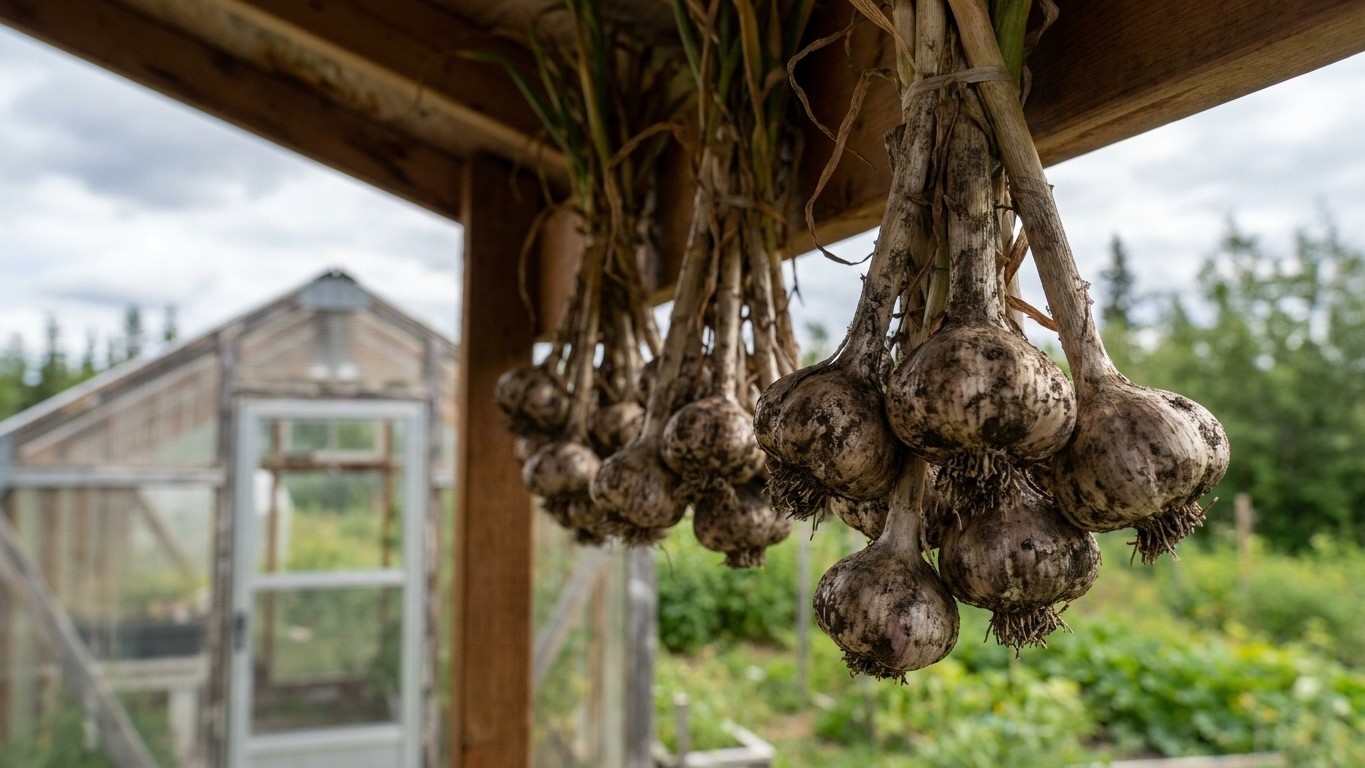
Curing takes longer in a cool, short summer than the three-to-four-week figure often quoted for warmer growing regions, because the warm, dry, moving air that drives curing is in shorter supply here. Hang bulbs in bundles or lay them in a single layer somewhere shaded, dry and well-ventilated, a covered porch or an open shed rather than direct sun, and give the crop extra time rather than rushing it onto a shelf while the necks are still soft.
A bulb is cured when the wrapper is fully dry and papery and the neck, on a hardneck, snaps rather than bends. Curing too fast in a hot, closed space cooks the cloves, and curing too slowly in damp air invites the same rot that a badly drained bed causes at the other end of the season. Trim roots and cut stalks down to an inch or two once cured, and store in a cool, dark, well-ventilated space rather than the refrigerator, which is too humid for long-term storage.
Local help
Frost dates, soil types and snow cover all vary across a territory this size, and the Whitehorse figures will not match every garden exactly. Check with Agriculture and Agri-Food Canada or the territorial agriculture branch for local planting dates and soil testing before committing a full bed to garlic, especially if gardening well outside the Whitehorse valley. Start at Agriculture and Agri-Food Canada for federal resources and links through to territorial programs.
Common questions
Can I plant garlic in spring instead of fall in the Yukon?
Not with good results. Garlic needs the fall-to-spring cold period to divide into cloves, and spring planting also forfeits the insulating snow cover a fall-planted bed gets through the coldest months. A spring-planted clove usually produces a single small, undivided bulb rather than a proper head.
What if I miss the fall planting window entirely?
Refrigerate the cloves for six to eight weeks, per University of Georgia Extension’s C854 guidance on the vernalization requirement, then plant as early as the ground can be worked. Expect a smaller crop than a properly fall-planted bed, since the plant loses growing time it would otherwise have had.
Do I need to cut the scapes on hardneck garlic here?
Yes. Cutting the curled scape off a hardneck once it appears redirects the plant’s energy into the bulb rather than the stalk, and the practice matters as much in Yukon’s short season as anywhere else garlic is grown.
Can softneck garlic actually survive Yukon winters?
Yes, with the same mulch depth described above for hardnecks, though hardneck remains the more reliable choice given how much cold this territory delivers. A softneck’s advantage here is storage length, not winter hardiness.
How do I know if my garlic has white rot?
Look for yellowing, wilting leaves and small black sclerotia, like grains of black pepper, on the base of the bulb. White rot survives in soil for years once introduced, so pull and destroy affected plants rather than composting them, and do not replant garlic or onions in that bed.