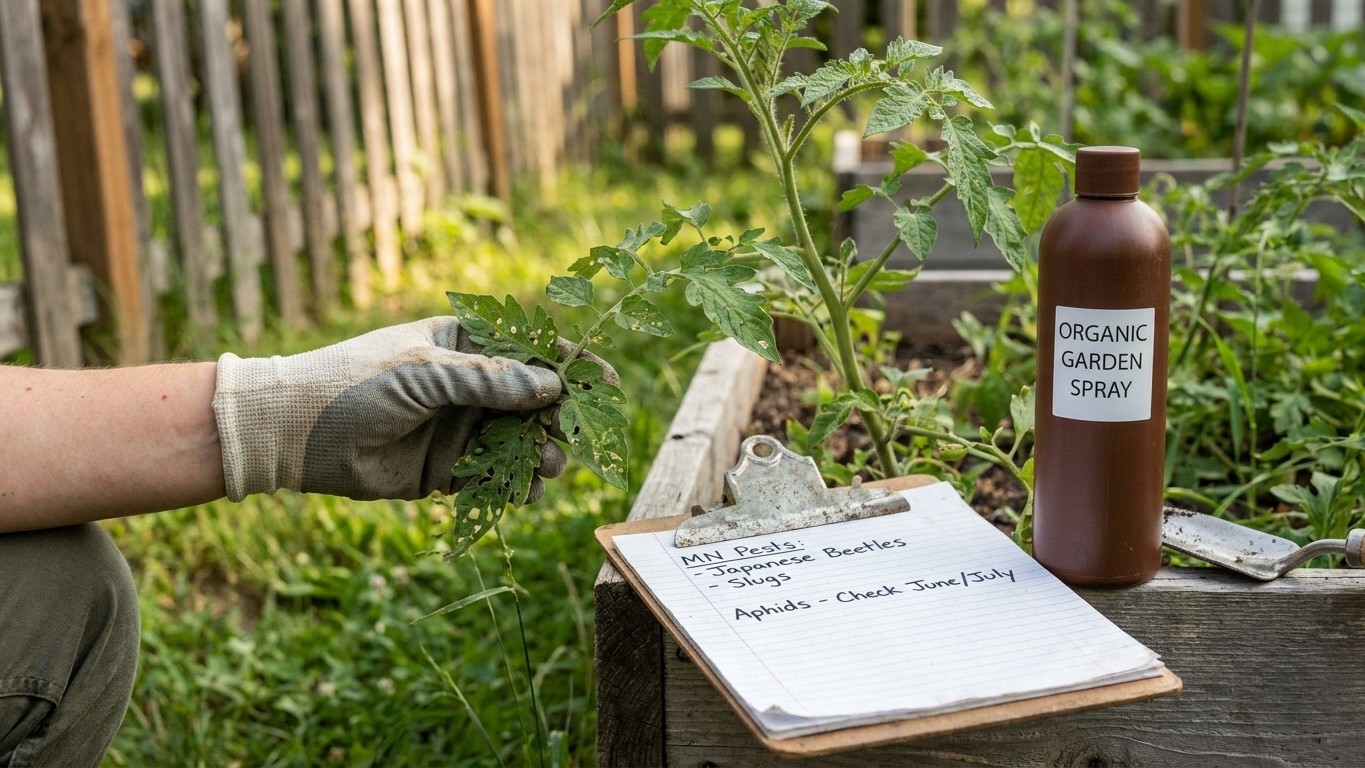

Minnesota gardens deal with a defined set of insect pests that UMN Extension flags as the ones home growers run into most, and most of them peak between June and August according to the same source. The fastest fix is to know which pest matches which crop and start scouting before damage shows, not after.
What Minnesota gardens actually deal with

What’s eating your garden probably has a name and a schedule, and once you know both, you’re not guessing anymore. Most of what shows up in Minnesota yards follows a pattern tied to the calendar and the crop it targets, so the wilted seedling, the skeletonized leaf that Japanese beetle in Minnesota leaves on roses and raspberries by midsummer, the vine that collapsed overnight from the Squash bug in Minnesota that growers battle every summer, the sudden wilt caused by Squash vine borer in Minnesota boring into stems, or the pitted, riddled leaves and collapsed seedlings left by the Striped cucumber beetle Minnesota gardeners find on young cucurbits isn’t random — it matches a pest that’s active right now. Walk your rows this week and check the plants that are struggling, especially anything in the squash, cabbage, or potato family, and look under the leaves before you decide what’s wrong.
Cabbage maggot

Look for wilting transplants and stunted, off-color seedlings in broccoli, cabbage and related crops. Pull one up and check the roots for tunneling and the white maggots doing it — the classic sign of Cabbage maggot in Minnesota that gardeners deal with each spring. Damage is worse in cool, wet springs, and floating row cover laid at transplanting is the most reliable barrier — the same cover also helps against Swede midge in Minnesota, which growers increasingly report as distorted, blackened brassica growing points, while soft, sunken spots on ripening raspberries and other soft fruit late in the season point to Spotted wing drosophila Minnesota growers keep watch for as harvest nears.
Onion maggot

Yellowing, collapsing seedlings or soft, rotting bulbs later in the season are the tell of Onion maggot in Minnesota, a pest gardeners contend with each year. Like its cabbage-feeding cousin, this fly favors cool, damp soil early on, so delaying planting slightly and rotating onion beds each year cuts down on carryover.
Colorado potato beetle

Both the striped adult and the red-orange larva of the Colorado potato beetle in Minnesota strip potato foliage down to the veins, and a heavy infestation can defoliate a young plant in days. Check the undersides of leaves for clusters of bright yellow-orange eggs and crush them before they hatch, and while you’re at it, keep an eye out for the Three-lined potato beetle in Minnesota, which gardeners also report on nightshade-family plants.
Striped cucumber beetle

Small holes in cotyledons and seedling leaves, plus a sudden wilt that spreads from one vine, point to this beetle, since it also carries bacterial wilt. UMN Extension notes it is usually not active until the first week of June in southern Minnesota, so covering seedlings before then is worth more than spraying after.
Squash bug

Yellow speckling on leaves that turns brown and crisp, followed by sudden vine collapse, is classic squash bug feeding. Check under leaves for the bronze egg clusters and gray nymphs, and hand-pick both before populations build.
Squash vine borer

A healthy-looking squash vine that wilts overnight, with a small hole and sawdust-like frass near the base of the stem, has a borer inside it. UMN Extension puts this pest active mid-June through July with one generation a year, which means the window for a barrier or a targeted spray at the stem base is short and worth marking on a calendar.
Three-lined potato beetle
Ragged holes in potato and tomato-family foliage, with a slower buildup than Colorado potato beetle, points to this striped beetle. The larva’s habit of carrying its own waste on its back is the giveaway if you’re unsure which grub you’re looking at.
Japanese beetle
Skeletonized leaves, with the green tissue eaten away between veins and only a lace of veins left, are the calling card of adult Japanese beetles feeding in groups. UMN Extension puts adult emergence at late June to early July with the heaviest feeding in July and August, so that’s the window to check roses, grapes and linden trees daily.
Spotted wing drosophila
Soft fruit that looks fine on the outside but collapses or turns mushy within a day of picking usually has larvae inside already. UMN Extension records first appearances in late June or early July with numbers peaking in August, right when raspberries and late blueberries are ripening.
Swede midge
Distorted, blackened growing points and crops that never head properly in broccoli and cabbage relatives can be swede midge, though this one is a narrower concern. UMN Extension has documented it only in Hennepin and Ramsey counties since it was first found in 2016, so gardeners outside the Twin Cities metro should look elsewhere first for that symptom.
Telling damage apart

The shape of the damage tells you more than the pest ever will if you never actually see it feeding. Chewed leaf edges and skeletonized foliage mean a chewing insect like a beetle, while a stippled, bleached, dusty-looking leaf usually means something sucking sap, not biting chunks out. Sudden wilting of a single vine or stem, especially with a hole near the base, points to a borer working inside rather than anything on the surface.
Sorting insect damage from disease and watering trouble
Insect feeding almost always leaves a visible entry point: a hole, a tunnel, a chewed margin, frass, or the insect itself if you look at the right time of day. Disease tends to spread in blotches or rings on the leaf surface, often starting on lower, older leaves and moving up, with no chewed tissue anywhere. A watering fault, whether too much or too little, shows up as uniform wilting or yellowing across the whole plant rather than isolated damage on one leaf or one stem.
A few quick checks separate the three before you reach for anything:
- Turn leaves over and check the undersides for eggs, nymphs, or the insects themselves
- Look for frass (small dark droppings) near chewed tissue, which confirms an insect and rules out disease
- Press a finger into the soil two inches down. Bone dry or waterlogged soil points to a watering problem before you blame a bug
- Note whether damage is spreading from one plant outward (often disease) or scattered randomly (often insect)
Growers who deal with a similar mix of beetles and vine borers further south have worked through the same sorting logic. It comes up in Garden Pests in Missouri: What Shows Up, When, and How to Stop It, where the pest calendar shifts earlier but the diagnostic steps are the same.
When each one shows up
Pest activity in Minnesota tracks soil and air temperature more than the calendar, so the ranges UMN Extension gives are tied to conditions, not fixed weeks. Cool, wet spring soil favors both cabbage maggot and onion maggot, and a warm, dry spring often means less pressure from either. That makes soil temperature at transplanting, not the date on a seed packet, the thing worth checking before you plant brassicas or onions.
Once soil warms into early June, striped cucumber beetle becomes active in southern Minnesota, per UMN Extension, and that is the point to start checking cucumber and squash seedlings daily rather than weekly. Squash vine borer follows soon after, active mid-June through July in a single generation, so a gardener who missed the window has essentially missed the pest for the year, since there is no second wave to catch.
The July and August crunch
Japanese beetle adults emerge late June into early July and do most of their feeding in July and August, the same stretch UMN Extension gives for spotted wing drosophila’s peak numbers. That overlap means midsummer is the busiest scouting period of the year, with two very different pests, one chewing leaves in daylight and one laying eggs inside ripening fruit, both active at once. Three-lined potato beetle and Colorado potato beetle build through this same window as their larvae mature, so potato and tomato-family beds need the same attention as fruit and roses.
Swede midge does not follow this broader pattern in the same way, since UMN Extension’s records place it only in Hennepin and Ramsey counties. A gardener there watching for distorted brassica growth is watching for something with essentially no documented range elsewhere in the state.
What actually works
Prevention beats reaction for nearly every pest on this list, and it starts before planting rather than after damage appears. Rotating brassicas, onions and squash-family crops to a different bed each year breaks the cycle for maggots and vine borers that overwinter in soil near last year’s plants. Floating row cover laid at transplanting, then removed once plants flower if the crop needs pollination, keeps cabbage maggot flies, cucumber beetles and squash vine borer moths off young plants during their most vulnerable stage.
Encouraging what already eats these pests
Ground beetles, lacewings and parasitic wasps take a real bite out of beetle and caterpillar populations in a garden that isn’t sprayed broadly. Leaving some bare or lightly mulched soil for ground beetles, and planting a few flowering herbs like dill or cilantro to bolt, gives predatory and parasitic insects a place to live and feed between pest outbreaks. This does nothing overnight, but it lowers the baseline pressure over a season.
Where a pest has already shown up, hand-picking works well for slow-moving, visible insects: Colorado potato beetle adults and egg clusters, squash bug adults and egg clusters, and Japanese beetles in the cool of early morning when they’re sluggish. For squash vine borer, a slit stem with the larva removed and the wound mounded with soil often lets the plant recover. For spotted wing drosophila, harvesting ripe soft fruit promptly and removing dropped or overripe fruit from the ground denies the larvae a place to develop.
A few popular remedies are worth naming specifically because they underperform. Garlic and pepper sprays repel almost nothing once beetles are already feeding, and yellow sticky traps for cucumber beetles catch a lot of beneficial insects along with the pest and rarely bring numbers down meaningfully in a home garden. Tilling soil in fall does help by exposing overwintering pupae of several of these pests to cold and predators, so it is worth doing where root maggots or cucumber beetles have been a repeat problem.
What control costs
Cost here is mostly a question of time rather than money, and the two trade off against each other depending on the method. Hand-picking and row cover cost almost nothing in materials but demand consistent attention, often several short checks a week through the peak season. Sprays cost more up front and need to be reapplied on a schedule, and several of the pests on this list, notably squash vine borer and root maggots, are inside the plant by the time damage shows, which makes a spray far less useful against them than a barrier applied earlier.
| Method | Money cost | Time cost | How often repeated |
|---|---|---|---|
| Hand-picking | Lowest | High, several short checks weekly | Continuous through peak season |
| Row cover / barriers | Low to moderate, one-time material cost | Low after initial install | Reused each season if stored well |
| Biological controls (predators, parasitic wasps) | Low, mostly habitat plants | Low ongoing, slow to establish | Builds over multiple seasons |
| Targeted sprays | Moderate, ongoing purchase | Moderate, timed applications | Repeated every 7 to 14 days during peak activity for many products |
For a typical home garden, hand-picking and barriers are the cheapest combination overall, since they need no ongoing purchase and work on the pests that do the most visible damage: beetles, bugs and borer moths before they lay eggs. Biological controls are close to free but take a season or more to build up enough predator numbers to matter. Sprays make the most sense as a targeted, occasional tool for a specific outbreak rather than a standing routine, both because of the repeat cost and because several of these pests spend their damaging life stage hidden inside the plant, out of reach of most sprays entirely.
Local help
UMN Extension tracks pest outbreaks across the state and offers identification help for anything you’re not sure about, through its yard and garden insects resources. That is the place to send a photo or a sample if a pest doesn’t match anything described here, since county-level pressure varies and a specimen beats a guess. For other Minnesota-specific growing questions, the broader Minnesota guides collection covers planting windows and frost timing that shape when these pests find vulnerable plants in the first place.
Two More Pests Worth Watching
If your garden runs to soft fruit or vine crops, there are two more culprits worth knowing by name before they show up uninvited. The spotted wing drosophila is the one to watch if you grow raspberries, blueberries, or other thin-skinned fruit — it typically turns up in Minnesota fields and backyard patches by early to mid-July, with numbers building through August and peaking in late summer before the first hard frost finally knocks them back. Over in the squash and cucumber patch, the striped cucumber beetle is the pest to plan around, since it emerges once soil temperatures climb into the mid-50s — usually mid-May in the southern counties, a few weeks later farther north. Both pages walk through the timing county by county and lay out what actually works, from row covers put down before the beetles ever show up to the trapping and sanitation habits that keep fruit fly populations from getting ahead of you. Worth a look if either crop is part of your garden plan this year.
Common questions
Why are there suddenly holes in my squash leaves overnight?
Sudden overnight holes usually mean striped cucumber beetle or squash bug nymphs feeding at night or in early morning before you’re out checking. Look under the leaves for the insects themselves or their eggs, since both are large enough to spot without a magnifier.
Do I need to spray every week all summer to keep Japanese beetles off my roses?
No. Weekly spraying is rarely necessary and wastes money and beneficial insects along with the pest. Hand-picking beetles into a bucket of soapy water in the cool morning hours, when they’re least active, controls most home garden infestations without repeat chemical applications.
My onions rotted from the inside, was it a pest or just too much water?
Cut one open and check for a maggot before blaming water. Onion maggot larvae leave visible tunnels and soft, rotting tissue around the tunnel, while overwatering rot tends to be more uniform and doesn’t show tunneling.
Is swede midge something I need to worry about outside the Twin Cities?
Based on current UMN Extension records, no confirmed cases exist outside Hennepin and Ramsey counties. If you garden elsewhere in the state and see distorted brassica growing points, check for cabbage maggot or another cause first, and send a sample to your county extension office if you’re unsure.