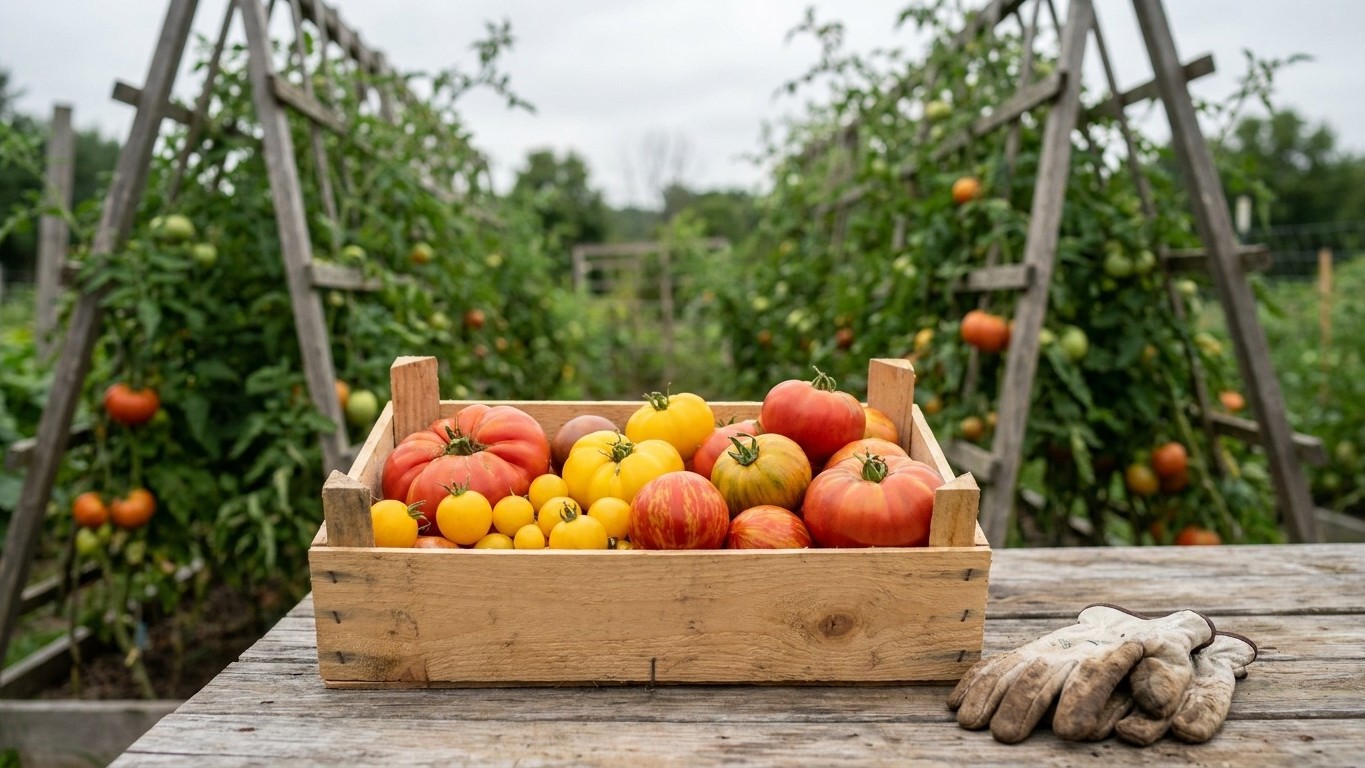

Near Philadelphia, NOAA’s 1991-2020 climate normals put the last spring freeze at March 29 to April 6 and the first fall freeze at November 5 to November 16. That gives a frost-free stretch wide enough for a cherry tomato and most paste and slicing types, provided you match the cultivar’s days-to-maturity to the window instead of guessing. Set transplants out once that spring frost risk has passed, and check the packet’s days-to-maturity against the fall date before you commit to a long-season heirloom.
What this comes down to in Pennsylvania

Once transplants go into the ground in mid-April, near Philadelphia’s frost dates, the season runs long enough that almost every named cultivar below finishes with weeks or months to spare. The catalogue days-to-maturity figures are counted from transplant, not from seed, and they shift by a week or two depending on how warm the summer runs, so treat every date here as a range built from that count, not a fixed day on the calendar. The real question isn’t whether tomatoes will ripen here at all, it’s which variety leaves the most room for a slow spring or a cool August, a step that follows on from the basics covered in growing tomatoes in Pennsylvania.
Sakura

At 55 days from transplant, Sakura is one of the fastest cherry tomatoes on this list. Set out in mid-April, it ripens by early to mid June near Philadelphia, leaving roughly 144 days before the first fall freeze. It resists nematodes, tomato mosaic virus and two races of fusarium wilt, which makes it a low-drama choice for a first-year garden.
Sun Gold

Sun Gold needs 57 days from transplant and produces a sweet, thin-skinned orange cherry tomato in long trusses. Ripening by early to mid June near Philadelphia, it carries about 142 days of margin before frost, and its resistance to tobacco mosaic virus and one race of fusarium wilt covers two of the more common early-season setbacks.
Juliet

Juliet is a 60-day grape tomato bred for the crack-resistant, disease-tolerant end of the salad-tomato category. It resists both early blight and late blight at an intermediate level, which matters in a humid Pennsylvania summer, and it still ripens by mid-June near Philadelphia with about 139 days of margin left.
Amalfi
Amalfi is a 68-day paste tomato on a compact, determinate bush, useful where space or staking is limited. It carries intermediate resistance to nematodes, late blight and early blight, three pressures that show up in a wet Pennsylvania season, and it still ripens by late June near Philadelphia with around 131 days to spare.
Cherokee Purple
Cherokee Purple takes 72 days from transplant to produce its large, dusky pink-purple beefsteak fruit. It carries no listed disease resistance, so it depends on good airflow and rotation rather than genetics to get through the season clean. Ripening by early July near Philadelphia, it still has about 127 days of margin, plenty for a heavy slicer.
Tiren
Tiren is a 75-day paste tomato built for sauce and canning, with resistance to verticillium wilt, tomato mosaic virus and one race of fusarium wilt. It ripens by early July near Philadelphia and finishes with roughly 124 days of margin before the first fall freeze, comfortable even in a slow year.
San Marzano II
San Marzano II runs 78 days, the longest figure on this list, and produces the classic narrow plum fruit used for canned sauce. It has no listed disease resistance, so it rewards mulching and pruning more than the resistant hybrids do. Ripening by early July near Philadelphia, it still closes out with about 121 days of margin, the tightest cushion of the named cultivars but still generous at that latitude.
Celebrity Plus
Celebrity Plus also needs 78 days, but on a compact determinate bush that suits a cage rather than a full trellis. It resists nematodes, gray leaf spot and tomato mosaic virus, a broader disease package than San Marzano II, and it reaches the same early-July ripening with the same 121 days of margin near Philadelphia.
| Variety | Days to maturity | Habit | Best for | Margin before Philadelphia frost |
|---|---|---|---|---|
| Sakura | 55 | Indeterminate | Fresh eating | ~144 days |
| Sun Gold | 57 | Indeterminate | Fresh eating | ~142 days |
| Juliet | 60 | Indeterminate | Salads, roasting | ~139 days |
| Amalfi | 68 | Determinate | Sauce, canning | ~131 days |
| Cherokee Purple | 72 | Indeterminate | Slicing | ~127 days |
| Tiren | 75 | Indeterminate | Sauce, canning | ~124 days |
| San Marzano II | 78 | Indeterminate | Sauce, canning | ~121 days |
| Celebrity Plus | 78 | Determinate | All-purpose slicing | ~121 days |
Working it out for your own garden
The method matters more than any single figure, because it still works if you move counties or get a cold spring. Start from the spring window: near Philadelphia, NOAA’s 1991-2020 normals put the last freeze at March 29 to April 6, so transplants normally go out a week or two after that closes, in mid-April. Add a cultivar’s days-to-maturity, counted from that transplant date, and you get a range for first ripe fruit. Then check that range against the first fall freeze, November 5 to November 16 near Philadelphia, to see how much slack is left. The full arithmetic, including what to do with soil temperature before you transplant, is worked through in Tomato Planting Dates in Pennsylvania: Counting Back From Your Frost Window.
Take Sakura as the example that clearly works. At 55 days from a mid-April transplant, it ripens by early to mid June near Philadelphia. Subtract that from the first fall freeze window and you get roughly 144 days of cushion, more than enough to absorb a cool, slow spring without losing the crop.
Now take San Marzano II as the case that starts to matter. At 78 days from the same mid-April transplant, it ripens by early July near Philadelphia, leaving about 121 days before frost there, which still finishes comfortably. But push that same 78-day paste tomato into a part of the state where spring runs two to four weeks later, as it does across the northern tier and the Alleghenies, and the transplant date slides into late April or early May while the fall freeze also arrives earlier. That combination can erase a third or more of the 121-day cushion, and in a cool, cloudy season a long-season paste tomato planted that late may not finish ripening on the vine at all.
What changes across the state
Every figure is measured near Philadelphia, which NOAA’s data and the USDA hardiness map both treat as the mildest corner of Pennsylvania. The USDA Plant Hardiness Zone Map puts the state as a whole between zones 5a and 7b, with the warmer end concentrated in the southeast and the colder end up in the Alleghenies and the northern tier, so a zone map alone tells you less than a local frost date does.
Elevation is the biggest single driver inside the state. Climb into the ridge-and-valley country or the Allegheny Plateau and the growing season shortens from both ends, with spring frost lingering later and fall frost arriving sooner than the Philadelphia figures suggest. Distance from the Great Lakes shoreline matters too. The northwestern corner of the state sits close enough to Lake Erie that the lake’s stored summer heat can push the first fall freeze later than it would otherwise run at that latitude, while inland spots at similar elevation see frost arrive sooner. None of that changes which cultivars exist or what their days-to-maturity figures are, it just changes how much margin each one has left once you apply your own local frost dates instead of Philadelphia’s.
The mistakes this state punishes

The most common error is planting into cold soil right after a warm spell fools everyone into thinking spring has arrived. Tomatoes set out into soil that hasn’t caught up will sit stalled for a week or more, and that stall quietly eats into the margin a days-to-maturity figure never accounts for. Wait for the soil itself to warm, not just the air, before any transplant goes in.
The second mistake is choosing a 78-day paste tomato or a slow heirloom for a part of the state where the frost window is already tight, rather than swapping to a 55 to 60-day cultivar with a wider cushion. San Marzano II and Cherokee Purple both finish comfortably near Philadelphia, but the same choice made in the northern tier can leave fruit ripening on the vine as frost closes in.
- Transplanting into cold, wet soil right after an early warm spell
- Picking a long-season variety where the local frost window is already narrow
- Ignoring the pest calendar and missing the early window for a problem that gets worse the longer it goes untreated
The third is timing pest control by guesswork instead of by the calendar. Pennsylvania’s tomato pests arrive on a rough schedule of their own, and missing the early window for one of them costs as much time as planting the wrong variety. Check Tomato Pests in Pennsylvania: Which Ones Actually Show Up Here for what typically shows up and when, rather than waiting until damage is visible to act.
Checking this against your county
Every date and margin comes from a single weather station near Philadelphia, and it’s a starting point, not an instruction for your own yard. Pennsylvania State University’s Cooperative Extension keeps county-level guidance that accounts for local elevation and microclimate, and it’s worth a call before you lock in a transplant date for a long-season cultivar. Find your county office through PSU Extension and confirm the local frost window there before finalizing your plan.
Common questions
What’s the fastest tomato I can grow in Pennsylvania?
Among the cultivars covered here, Sakura and Edox are the quickest at 55 days from transplant, ripening by early to mid June near Philadelphia. That leaves roughly 144 days of margin before the first fall freeze there, the widest cushion on this list.
Can I still grow Cherokee Purple if I live in northern Pennsylvania?
Yes, but check your local frost dates first rather than relying on the Philadelphia figures. Cherokee Purple’s 72-day maturity leaves a comfortable margin in the southeast, but the northern tier’s later spring and earlier fall freeze narrow that cushion, so a county extension check is worth doing before you commit garden space to it.
Do disease-resistant varieties matter more in Pennsylvania?
They help, especially in a humid summer where fungal pressure builds fast. Cultivars like Juliet and Amalfi carry intermediate resistance to early and late blight, while Cherokee Purple and San Marzano II carry none, which means they lean more heavily on spacing, mulching and rotation to stay clean through the season.
Is a 78-day tomato too long for a Pennsylvania season?
Not near Philadelphia, where San Marzano II and Celebrity Plus both still finish with around 121 days to spare before the first fall freeze. The margin gets tighter the further north or higher in elevation you garden, so in the northern tier or the Alleghenies it’s worth leaning toward a shorter cultivar instead.