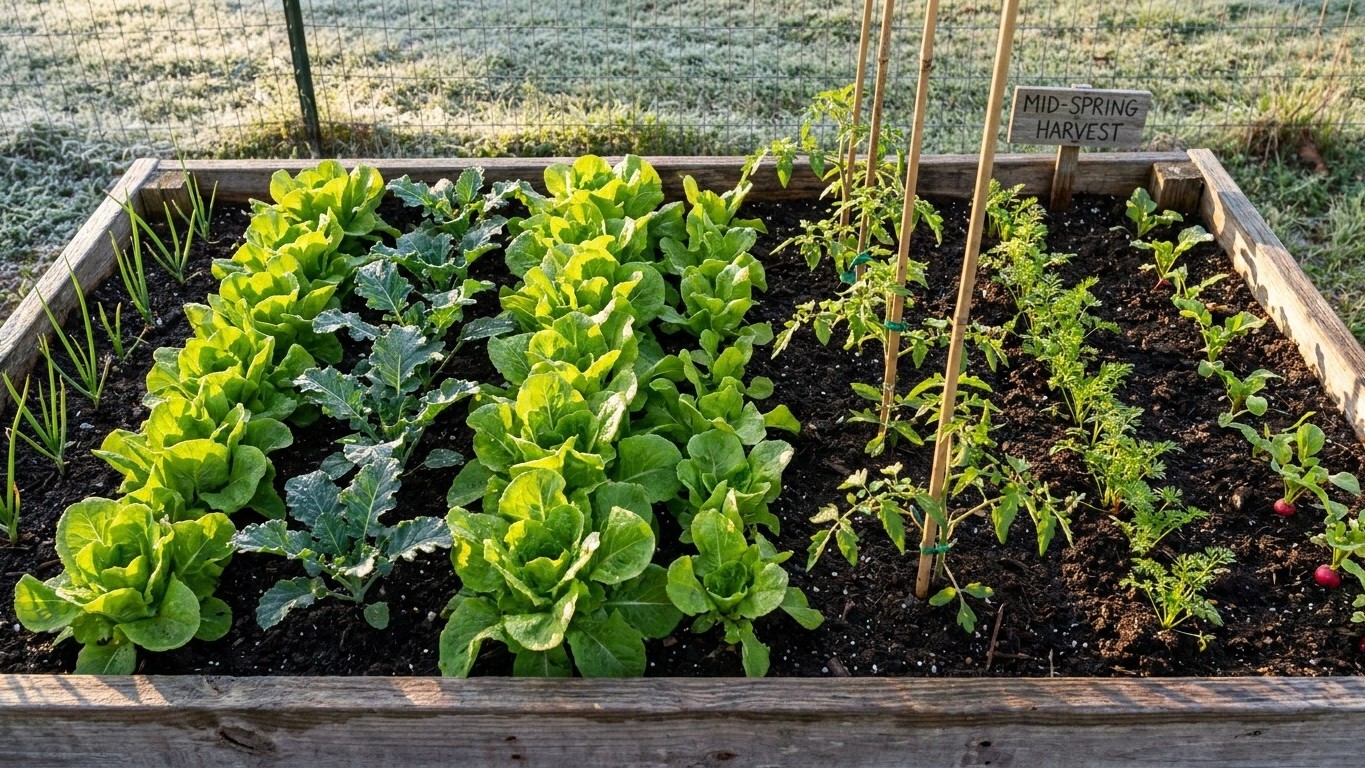

South Carolina’s growing window runs roughly eight to nine months depending on where you sit in the state, but the number that matters more than any calendar date is 90: the days each year that push past that mark and shut down half your vegetable list. Here’s what the season actually allows, and what it doesn’t.
How long your season really is

Three figures decide almost everything you can grow here. The state spans USDA hardiness zones 7a to 9a, meaning winter’s coldest nights vary a lot depending on whether you’re in the Upstate or on the coast. The average last spring frost falls somewhere between February 28 and March 17. The average first fall frost lands between November 20 and December 5. Stack those together and you get a frost-free window that can stretch close to nine months near the coast, tighter inland and shorter still in the Upstate.
| Factor | Value |
|---|---|
| USDA Hardiness Zone | 7a to 9a |
| Average last spring frost | February 28 to March 17 |
| Average first fall frost | November 20 to December 5 |
That’s a long window by national standards, and it’s why South Carolina gardeners can chase two full vegetable cycles, spring and fall, instead of squeezing everything into a short summer sprint. But long doesn’t mean unlimited. Even at eight or nine months, a 100-day pumpkin planted too late in a shorter-season pocket of the Upstate can still meet frost before it finishes.
The dates above are averages, not guarantees. By definition, roughly half of all years bring a frost earlier than “last frost” or later than “first frost” suggests. Treat the window as a planning range, not a safe date circled on the calendar. Peninsular Charleston runs noticeably milder than the airport station these figures come from, and the Upstate runs several weeks tighter at both ends. A gardener in Greenville working off a Charleston-area frost date is setting up for a bad surprise.
What this rules out is straightforward: anything needing a true 200-day-plus season without season extension is a gamble almost everywhere in the state, and doubly so upstate. That’s also why timing matters so much for a crop like pumpkins; Growing Pumpkins in South Carolina starts with getting the planting date right months before you ever think about knowing When to Carve a Pumpkin in South Carolina. The same logic applies to cool-season staples: Growing Potatoes in South Carolina means fitting the crop into that spring windo, while a long-lived perennial crop takes a different kind of planning entirely; Growing Asparagus in South Carolina means committing a bed to a plant that won’t produce a full harvest for two or three yearsw, while a warm-season crop like Growing Sweet Corn in South Carolina depends on waiting until that frost risk has truly passed.w, and it’s the same reasoning behind Growing Beets in South Carolina, another crop that rewards getting the timing right rather than working around a short summer, and it’s just as true for a quick, frost-tolerant root crop; Growing Carrots in South Carolina works best when sown early enough to mature before summer heat sets inw, and the same is true for leafy greens, where Growing Spinach in South Carolina depends on getting seeds in before the heat arrives and closes that window before summer heat sets in, and another cool-season root crop follows the same rule, as Growing Parsnips in South Carolina also depends on getting that timing right/south-carolina/garden/beets/”>Growing Beets in South Carolina/south-carolina/garden/carrots/”>Growing Carrots in South Carolina/south-carolina/garden/parsnips/”>Growing Parsnips in South Carolina also depends on getting the timing right, while a heat-loving crop needs the opposite approach, and Growing Peppers in South Carolina means waiting until the soil is reliably warm. What the season allows, done right, is a spring crop, a summer crop, and often a fall crop from the same bed in a single year, something gardeners in New England or the Upper Midwest simply don’t get to attempt.
What the summer does to a garden here
Charleston averages 55.1 days a year at 90F or hotter. That’s not a temperature, it’s a workload, and it changes what a South Carolina garden actually looks like in July.
Heat past roughly 90F isn’t simply “good growing weather turned up a notch.” Tomato flowers drop and stop setting fruit once daytime highs push consistently into the low 90s and nights stay warm. Lettuce, spinach, and other cool-season greens bolt and turn bitter. Broccoli and cauliflower give up on forming heads at all. With over 55 days a year crossing that threshold, and them arriving in a clump through midsummer, this isn’t a rare bad week. It’s a predictable dead zone in the growing calendar.
The coldest month here still averages a nightly minimum of 38.9F, well above freezing. That combination, mild winters and a brutal midsummer stretch, means the South Carolina gardening year doesn’t behave like one long growing season at all. It behaves like two seasons with a heat wall in between: a spring run for cool-season crops and early tomatoes and peppers, then a break where cool-season crops simply can’t be grown, then a second run in early fall as temperatures ease back down before the first frost.
The practical upshot: planting a fall broccoli crop isn’t optional scheduling, it’s the only way to get broccoli at all if spring’s window closed before harvest. And starting heat-tolerant crops (okra, southern peas, sweet potatoes) at the right time matters more here than in states where summer is simply “warm” rather than a 55-day stretch of 90-plus heat.
What tends to go wrong in South Carolina
Ask Clemson Cooperative Extension what actually damages home gardens in this state and the same names keep coming up. A handful of them account for most of the calls.
- Tomato fruitworm / corn earworm — the single most damaging tomato pest in South Carolina, boring into ripening fruit as it develops through summer.
- Diamondback moth and cabbage looper — the top brassica caterpillar problems, showing up on broccoli, cabbage, and collards through both the spring and fall crop windows.
- Striped and spotted cucumber beetles, and squash vine borer — arriving as cucurbits (squash, cucumbers, melons) get going in late spring and through summer, chewing foliage and boring into stems.
- Stink bugs and leaffooted bugs — building up through summer and hitting tomatoes and other fruiting crops hardest as the season peaks.
- Hornworms, silverleaf whitefly and potato aphid — summer regulars on tomatoes and a range of other vegetables, feeding through the hot months alongside the fruitworm pressure.
This isn’t every insect that exists in a South Carolina garden. It’s the short list the state’s own extension service flags because these are the ones home gardeners actually meet, season after season. If something on a plant doesn’t match one of these, or if damage is heavier than usual, that’s a job for a county extension office, not a guess.
Where to check before you plant
Everything above is a state-level average, and South Carolina is not one climate. It runs from a barrier-island coast to a mountain-edge Upstate, crossing three USDA zones along the way. A planting calendar built around Columbia can be three weeks off in Aiken and further off than that in the mountains near Walhalla.
Clemson Cooperative Extension, the state’s land-grant extension service, publishes county-specific planting guides, pest identification sheets, and soil testing programs built for actual local conditions rather than a statewide average. Your county extension office is the next step, and it’s the difference between a frost date that fits your yard and one that fits a weather station forty miles away.
Before you commit seed money or a Saturday to a planting plan, check your county’s extension guidance against the ranges here. If your ZIP code sits well outside the reference stations behind these figures, on the coast, deep in the Upstate, or somewhere in between, that local check matters more than anything a state-level page can tell you.
Where to Go Next for Specific Crops and Lawns
The general timing rules on this page only get you so far — the real decisions happen crop by crop. If you’re thinking about putting cloves in the ground this winter, planting dates and varieties for South Carolina garlic lays out why the Charleston area’s cold hours barely cover what division actually requires, and what that shortfall means for your bulbs. If your yard is the more pressing question, South Carolina lawn care guidance on grass types and feeding schedules starts from the grass you already have — Bermuda, Zoysia, Centipede, or St. Augustine — since the state’s climate rules out fescue and bluegrass from the start. And if tomatoes are the plan, tomato planting dates, varieties, and local pests for South Carolina works from the actual freeze-probability window rather than a generic last-frost rule, so you can see exactly how early is too early. Each of those pages picks up where this one leaves off, with the specifics your soil and your calendar actually need.