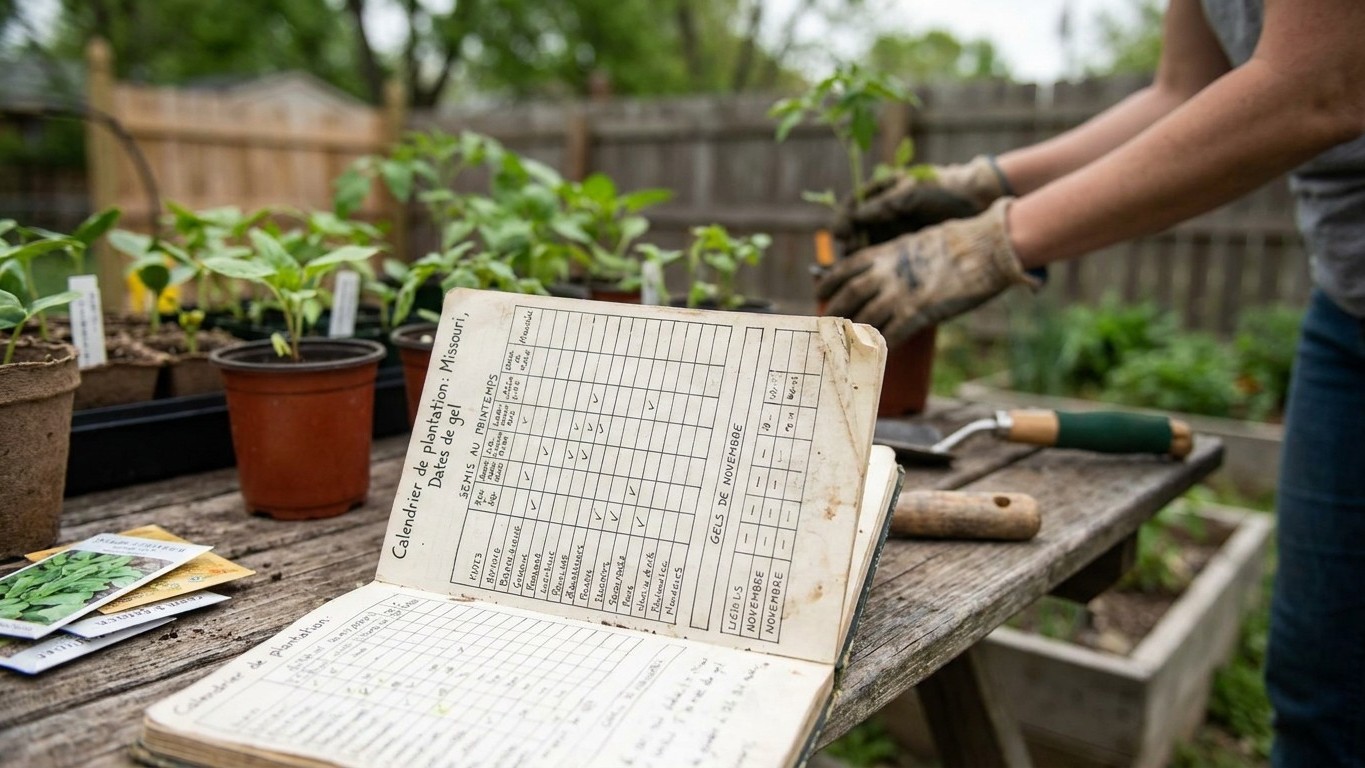

When’s it actually safe to plant in your Missouri yard? Once the soil warms and your last frost has passed, not before, and that date shifts depending on where you are in the state. Walk out and grab a handful of dirt: if it crumbles instead of packing into a mud ball, it’s dry and warm enough to start working, and that test tells you more than any date printed on a seed packet ever will.
The frost window in Missouri

NOAA’s National Centers for Environmental Information put the last spring freeze for the Kansas City area at between April 6 and April 20, based on the 1991-2020 climate normals recorded at Kansas City International Airport. The first fall freeze follows between October 18 and October 29, using that same 30-year record. Those two windows bracket the frost-free stretch that decides when it’s safe to set out tender plants and when the season winds down.
The airport station sits well north of downtown Kansas City, and NOAA’s own data show the downtown station runs about five days earlier in spring. That means gardeners closer to the urban core can often push transplants out a few days sooner than the airport figures suggest, while anyone farther north or at higher elevation should treat the later end of the range, April 20, as the safer bet.
How the last freeze date compares across Missouri
Stack the two windows against each other and the frost-free growing season across the wider Kansas City area comes out to roughly six months. Count from the earliest last-frost date, April 6, to the latest first-frost date, October 29, and the long end lands near 206 days. Pair the latest last frost, April 20, with the earliest first frost, October 18, and the short end comes to about 181 days. Most years fall somewhere between those two figures, which is why it pays to treat the frost window as a range and not a single date when you’re deciding what to risk in the ground.
North of Kansas City, conditions trend toward the shorter season described in our Nebraska Planting Calendar, especially in a year with a late cold snap. Southern Missouri runs consistently milder than the Kansas City figures suggest, closer to a spring that arrives earlier and a fall that holds off longer, and both this range and its caveats are the ones to keep in mind whenever a seed packet or nursery tag gives you a single planting date with no state attached to it, which matters just as much when you’re planning ahead with our What to Plant in Missouri in January guide, our What to Plant in Mi guide, or our What to Plant in Missouri in August guidessouri in February guide, or even our What to Plant in Missouri in December guide when mapping out the tail end of the seasonssouri in February guide, our What to Plant in Mis, our What to Plant in Missouri in May guidesouri in March guide, our What to Plant in Missouri in June guide, our What to Plant in Missouri in July guide, our What to Plant in Missouri in September guide, our What to Plant in October guide, or our What to Plant in Missouri in November guide in Missouri in October guide for the tail end of the season.
Cool-season crops (see our What to Plant in Missouri in January guide or our What to Plant in Missouri in February guide for earlier-season planting options, or our What to Plant in Missouri in November guide for later-season planting options)
Peas, spinach, and lettuce germinate in cold soil and tolerate a light frost, so they don’t wait for the last frost date the way tomatoes do. Near Kansas City, where NOAA’s 1991-2020 normals put the last spring freeze between April 6 and April 20, these crops typically go in early, and for a fuller rundown of timing, check out What to Plant in Missouri in Aprilically go into the ground several weeks ahead of that window, as soon as the soil itself allows.
What goes in first, and how
Soil that’s workable, not a date on the calendar, is the real trigger for cool-season sowing. If a handful of soil crumbles instead of forming a mud ball, it’s usually dry enough to dig and plant. Brassica transplants, like broccoli and cabbage started indoors, can go out around four to six weeks before the last-frost window closes, since young plants tolerate cold better than bare seed but still benefit from a frost cloth on the coldest nights. Kale and collards handle that same slot, and because both crops hold in the garden well past the last frost date, many Missouri gardeners let a spring planting run right into the warm season instead of pulling it early.
Root crops such as carrots, beets, and radishes are direct-sown straight into cold soil and don’t transplant well, so timing them to soil workability rather than air Temperature matters even more. Onion sets and seed potatoes go in on the early end of that same stretch and tolerate a hard frost once established.
- Peas: direct sow as soon as soil is workable, well ahead of the April 6-20 window
- Spinach and lettuce: direct sow or transplant several weeks before last frost
- Broccoli and cabbage: transplant four to six weeks before last frost, with frost cloth ready
- Carrots, beets, radishes: direct sow in cold soil, thin after germination
- Onion sets and seed potatoes: go in early, tolerate a hard frost once established
The risk with cool-season crops in Missouri isn’t the cold, it’s the heat that follows. Spinach and lettuce bolt fast once late spring days warm up, so the practical window is bounded on one end by soil temperature and on the other by how quickly the calendar moves toward the warm-season transplant window of mid-April to early May. Sowing a short row every couple of weeks through that stretch keeps a harvest coming instead of one crop that bolts all at once.
Warm-season crops

Tomatoes, peppers, squash, beans, and corn need warm soil more than they need a frost-free calendar date. Warm-season seedlings set into soil that’s still cold from winter often sit and sulk for weeks, even once the air temperature is safely above freezing. That’s why the mid-April to early-May transplant window used across Missouri’s tomato catalogue figures is built around soil warming up, not just the last frost date of April 6 to April 20 that NOAA’s 1991-2020 normals put on the Kansas City area.
Days-to-maturity figures on a seed packet are counted from the transplant date, not the sowing date, and they vary by a week or two depending on the season’s heat. Counting backward roughly six to eight weeks from a mid-April-to-early-May transplant date puts indoor tomato seed-starting in late February to mid-March for most Kansas City-area gardeners, with the earlier end reserved for a slow, cool spring and the later end for one that warms fast.
Matching tomato varieties to the calendar
Set against that mid-April-to-early-May transplant window and NOAA’s fall frost figures for Kansas City, here’s how the days-to-maturity on common catalogue tomatoes stack up against the season’s length.
| Variety | Days to Maturity | Type | Notable Resistance | First Ripe | Margin Before Frost |
|---|---|---|---|---|---|
| Sakura | 55 | Indeterminate | Nematodes, ToMV, Fusarium 1&2 | Late June | 112 days |
| Edox | 55 | Indeterminate | Nematodes, ToMV, Fusarium 1&2 | Late June | 112 days |
| Valentine | 55 | Indeterminate | Early Blight | Late June | 112 days |
| Glacier | 55 | Determinate | None listed | Late June | 112 days |
| Sun Gold | 57 | Indeterminate | TMV, Fusarium 1 | Late June | 110 days |
| Supersweet 100 | 60 | Indeterminate | Verticillium, Fusarium 1 | Early July | 107 days |
| Juliet | 60 | Indeterminate | Late Blight, Early Blight | Early July | 107 days |
| Amalfi | 68 | Determinate | Nematodes, Late Blight, Early Blight | Mid July | 99 days |
| Cherokee Purple | 72 | Indeterminate | None listed | Mid July | 95 days |
| Big Beef Plus | 72 | Indeterminate | Nematodes, Gray Leaf Spot, ToMV | Mid July | 95 days |
| Tiren | 75 | Indeterminate | Verticillium, ToMV, Fusarium 1 | Mid July | 92 days |
| Granadero | 75 | Indeterminate | Nematodes, Verticillium, ToMV | Mid July | 92 days |
| San Marzano II | 78 | Indeterminate | None listed | Late July | 89 days |
| Celebrity Plus | 78 | Determinate | Nematodes, Gray Leaf Spot, ToMV | Late July | 89 days |
Every variety on that list clears the Kansas City fall frost window with margin to spare, which is normal for tomatoes set out in spring. The margin matters more for a second planting or a late start. Peppers follow the same soil-temperature logic as tomatoes and are usually set out on that same mid-April-to-early-May schedule. Squash, beans, and corn are direct-seeded rather than transplanted, and because their seed simply won’t germinate in cold soil, sowing them a week or two after the tomato transplant window, once the soil has had extra time to warm, usually beats trying to match the frost date exactly.
The fall planting window
Working backward from the first fall frost date of October 18 to October 29 near Kansas City, per NOAA’s 1991-2020 normals, tells you the last safe date to start a fall crop. Take the days-to-maturity figure on the seed packet, add two to three weeks of slow-down margin for the shorter, cooler days of early fall, and count back from the earlier end of the window, October 18, rather than the later one, to build in a safety cushion.
A lettuce variety listed at around 50 days needs closer to 65 to 70 days of real time once September’s daylight starts shrinking, so counting back from October 18 pushes the sowing date into mid to late summer rather than into fall itself. That backward count is why fall gardening in Missouri actually starts on the hottest days of the year, not the cool ones.
Crops that get better after frost
Kale, collards, carrots, brussels sprouts, and parsnips all convert starches to sugars once temperatures drop toward freezing, and a light frost after they’ve reached size improves flavor rather than ending the harvest. Because of that, these crops can stay in the ground right up to and past the first fall frost window instead of being rushed out beforehand. Tender crops don’t get that grace. Beans, squash, and tomatoes are killed outright by the first hard freeze, so any fall succession of those needs to finish and be picked before the October 18 to October 29 window arrives, not after it.
Gardeners farther south, where the first frost arrives later, have more room to push a fall planting later still. The Arkansas Planting Calendar lays out how much that extra margin can add for crops like broccoli and cauliflower, which need every extra week of mild weather they can get to size up before the cold settles in.
Reading a planting calendar properly
A state-wide planting calendar is built from one weather station averaged over 30 years, which makes it a useful starting point and a poor substitute for what’s actually happening in your own yard this particular spring. The Kansas City figures in this guide describe conditions at one airport station, and NOAA’s own data already show a five-day gap between that station and downtown. Multiply that kind of variation across a state as long as Missouri and the gap only grows.
What actually shifts the date in your yard
Elevation cools things down fastest. Higher ground and low-lying frost pockets that collect cold air overnight can run several degrees colder than a spot a quarter mile away on a slope. Large bodies of water moderate the temperature nearby, so a garden close to a big lake or river often lags a warming trend by a few days compared to open farmland. Urban heat holds heat longer into the evening, which is part of why downtown stations read warmer than airport stations sitting on open ground outside the city. A late cold snap after the statistical window has already closed is the single biggest reason a planting calendar fails a gardener, and it happens often enough that experienced growers keep frost cloth on hand through the first two weeks past the average date, not just on the date itself.
Track your own numbers instead of relying only on published averages. A soil thermometer pushed two inches down tells you more about whether it’s time to plant than the calendar does, and watching when the same perennial leafs out or blooms each year builds a personal record that’s more useful, on your own ground, than any 30-year regional average.
Local help
Missouri Extension publishes county-level frost dates, soil test kits, and planting guides tailored to conditions well beyond what a single Kansas City-based average can capture. Reach out to Missouri Extension for a soil test before amending a new bed, since the results determine which amendments are actually worth the money. For more on planning a garden across the state, browse our other Missouri guides.
Common questions
Can I plant tomatoes in Missouri in March?
No, the soil is still too cold and the last frost date near Kansas City doesn’t arrive until April 6 to April 20 at the earliest, according to NOAA’s normals. Tomatoes set out that early usually just sit without growing, and a late freeze will kill them outright.
What planting zone is Missouri in?
Missouri spans several USDA hardiness zones from north to south, and the exact zone for your county is worth checking through Missouri Extension rather than assuming a single number applies statewide. The hardiness zone tells you about winter cold, not spring planting dates, which come from frost data instead.
Is it too late to plant a garden in Missouri in June?
Not for warm-season crops. Tomatoes, peppers, squash, and beans can still go in during June, though a June transplant will ripen later than one set out in the mid-April to early-May window and gives up some of its margin before fall frost. Cool-season crops like lettuce and spinach are a poor match for June since the heat pushes them to bolt.
Do I need to cover my tomatoes if frost is forecast after I’ve already planted?
Yes. A freeze at 32°F or below will kill an unprotected tomato or pepper transplant outright, and frost can occur even after the statistical last-frost window has closed. Keep a frost cloth, an old sheet, or an overturned bucket on hand for the first few weeks after transplanting.
When should I start seeds for a fall garden in Missouri?
Start counting from the first fall frost date near Kansas City, October 18 to October 29 per NOAA, and work backward using the crop’s days to maturity plus two to three weeks of slow-down margin for shortening daylight. For most fall crops that lands the actual sowing date in mid to late summer, well before the weather itself feels like fall.
Some gardeners layer an older custom on top of frost dates: planting by the moon, which we explain as almanac tradition, not fact.
Related guides
- Iowa Planting Calendar: When to Sow and Plant, Frost Dates Included
- Illinois Planting Calendar: When to Sow and Plant, Frost Dates Included
- Nebraska Planting Calendar: When to Sow and Plant, Frost Dates Included