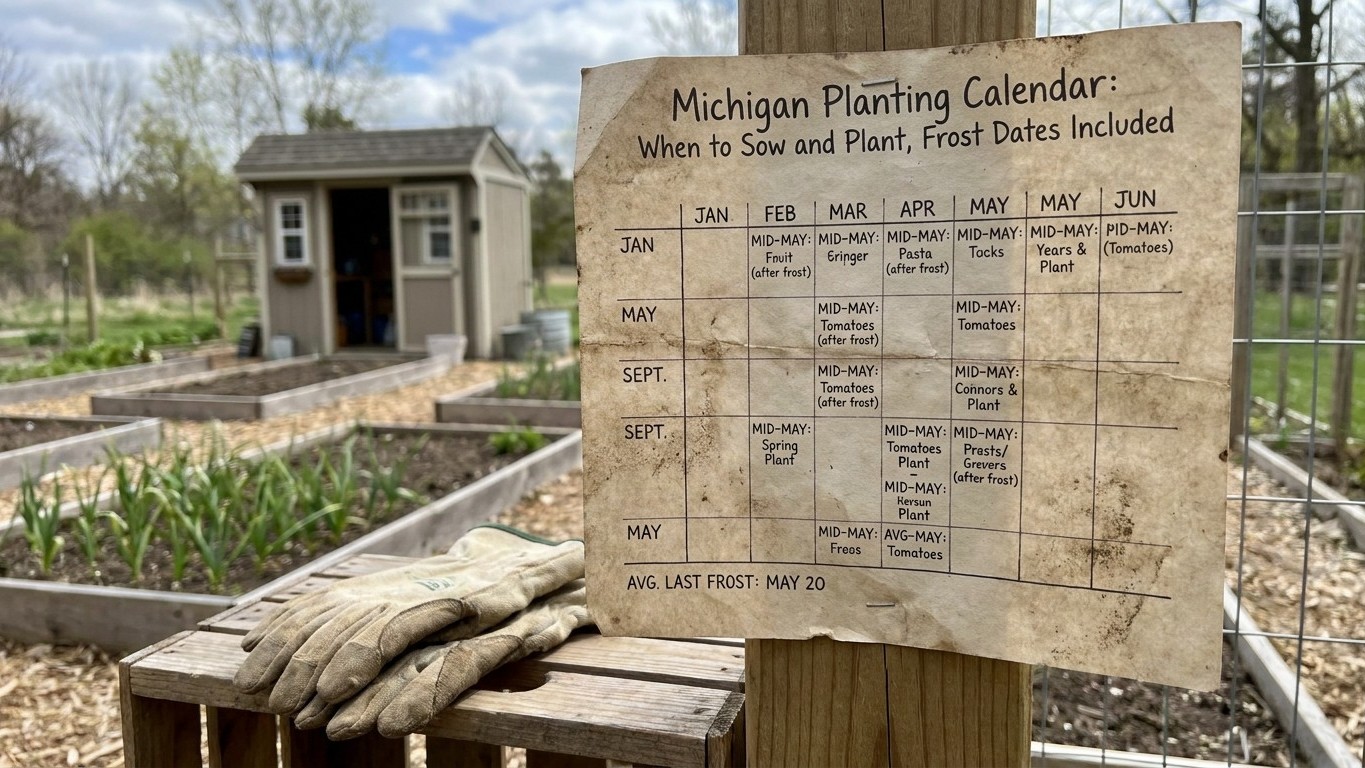

Michigan’s last spring frost date is the single number that decides when you can safely put tomatoes in the ground, and near Detroit that’s around April 30, with the rest of the Lower Peninsula running a week or two later. Everything in your planting schedule, cool-season crops, transplant dates, the fall cutoff, is built off that date and its fall counterpart. So before you plant anything, look up the frost window for your own county rather than relying on the Detroit-area number, since a spot even thirty miles inland can lag well behind it.
The frost window in Michigan

Every planting date in this calendar hangs off two numbers: the last spring frost and the first fall frost. Everything else, cool-season timing, transplant dates, the fall planting cutoff, is arithmetic built on those two anchors.
Spring and fall dates near Detroit
Near Detroit, MSU Extension’s frost-free date records put the last spring frost around April 30, one of the earlier last-frost dates in the state, thanks to the moderating effect of Lake Erie and the heat held by a large metro area. Move away from that lake-warmed corridor and the date slides later. Across most of the rest of the Lower Peninsula, MSU Extension’s data puts the last frost in early to mid May, and inland or higher-elevation counties tend to sit at the late end of that window rather than the early end, which makes it worth checking What to Plant in Michigan in April before your own frost date arrives, then following up with What to Plant in Michigan in June once the warm-season crops are ready to go in. Minnesota gardeners work with a similarly wide spread between warmer metro pockets and colder inland counties, and the Minnesota Planting Calendar walks through that state’s version of the same math.
The first fall frost is the other bookend. MSU Extension’s Michigan Garden Calendar places it between October 6 and October 21 for zone 6a, which covers much of the southern Lower Peninsula including the Detroit area. That two-week spread matters in practice: a crop needing 75 days to mature finishes with room to spare if the frost lands on the 21st, and gets caught short if it lands on the 6th instead, which is exactly why it’s worth checking What to Plant in Michigan in August to time your last succession plantings, then What to Plant in Michigan in October before deciding what goes in the ground for a fall harvest, and then following up with What to Plant in Michigan in November to see what still has time to finish before the season closes out, or, if you’re planning ahead for next year, starting with What to Plant in Michigan in January to see how the calendar begins.
What the window means for your growing season
Between those two dates sits the growing season length that determines what you can grow and how many rounds of a crop fit into a year. From an April 30 last frost to an October 6 first frost is roughly 159 days. Stretch the fall end to October 21 and the season runs closer to 174 days. That range describes the Detroit area specifically, and since the season actually starts taking shape earlier in the year, it’s worth first checking What to Plant in Michigan in September before mapping out what comes next.hecking What to Plant in Michigan in February before moving on to What to Plant in Michigan in March and what April brings; from there, checking What to Plant in Michigan in May rounds out the picture of how the season builds toward its warmest stretch.st.com/michigan/garden/planting-calendar/june/”>What to Plant in Michigan in June rounds out the picture as the season moves into full swing, and checking What to Plant in Michigan in July shows how that same season fills out as summer heat sets in, andst.com/michigan/garden/planting-calendar/april/”>What to Plant in Michigan in April helps map out the rest of your schedule, and later on, once the growing season winds down, What to Plant in Michigan in December/michigan/garden/planting-calendar/august/”>What to Plant in Michigan in August for the second half of the season. A garden in the northern Lower Peninsula or the Upper Peninsula, where the last frost typically arrives later, works with a noticeably shorter window on the spring side at least, sometimes by a month or more.
None of these dates are guarantees. They are averages built from years of weather records, which means roughly half of all years see a frost land later than the “last” spring date or earlier than the “first” fall date. Treat the window as the range to plan around, not a promise the weather intends to keep.
Cool-season crops
Peas, spinach, lettuce, and the brassica family (kale, cabbage, broccoli) tolerate light frost and can go into the ground while there’s still a real chance of one more freeze. Peas in particular prefer cool soil and go in as soon as the ground can be worked, which in the Detroit area often lines up with the weeks right before the April 30 average last frost. Farther out in the state, where the last frost slides into early or mid May, that same “as soon as the soil can be worked” window simply arrives later on the calendar, not later relative to the frost date itself.
Direct-sown roots and greens
Spinach and lettuce seed germinate at soil temperatures too cool for tomatoes or beans, and both crops handle a frost fine once they’ve sprouted. Root crops such as carrots, beets, and radishes are usually sown two to three weeks before the last frost date, since their seed also germinates in cool soil and the seedlings shrug off a light freeze. Radishes move fast enough that a Detroit-area gardener can often fit two sowings before the soil warms past the point where warm-season crops take over the bed.
Transplanted brassicas
Cabbage, broccoli, and kale started indoors are typically set out a few weeks before the last frost rather than after it, because mature transplants tolerate cold better than seed does and because these crops actually head up better in cool weather. A hard freeze can still damage exposed transplants, so keeping a frost cloth or row cover on hand through the last stretch of the cool-season window is worth the trouble regardless of what the average date says.
The common mistake with cool-season crops isn’t planting too early, it’s planting too late and pushing them into the heat of an early Michigan summer, when lettuce bolts and spinach turns bitter fast. Watch the extended forecast rather than a fixed date, and get cool-season crops in as soon as the soil is workable instead of waiting on the calendar.
Warm-season crops

Tomatoes, peppers, squash, beans, and corn all die at frost temperatures, so the last spring frost date is the outer limit for setting them outside, but it isn’t the real target. Warm-season vegetables also need warm soil, not just frost-free air, to germinate or root well. Soil still in the 40s slows a tomato transplant to a stall and can rot squash seed outright before it ever sprouts. Most Michigan gardeners wait one to two weeks past the last frost date to let the soil catch up, which for the Detroit area’s April 30 average points to a transplant window in mid May.
Counting back for tomato transplants
Seed packet days-to-maturity figures are counted from transplant, not from seed, and they shift by a week or two depending on the season’s weather, so treat them as a planning range rather than a fixed count. Take Sakura, a 55-day indeterminate cherry tomato with intermediate resistance to nematodes and high resistance to tomato mosaic virus and both common races of fusarium wilt. Set out in mid May, it ripens its first fruit in early July, leaving roughly 90 days of margin before a Detroit-area fall frost. A longer-season variety runs a tighter race. San Marzano II, a 78-day paste tomato, doesn’t ripen until late July from that same mid-May transplant date, leaving about 67 days of margin, still comfortable but with far less cushion if the summer turns cool and cloudy.
Start tomato and pepper seed indoors six to eight weeks before that mid-May transplant date, which puts the seed-starting window at late March to early April for most of the state. Squash, beans, and corn are usually direct-sown instead, since they grow fast enough from seed and dislike root disturbance, so those go into warmed soil around the same mid-May-to-early-June point.
Comparing tomato varieties by season length
All of the varieties below are set out in mid May by the same soil-warmth logic above. The table shows how their catalogue days-to-maturity numbers translate into a first-ripe date and how much margin each leaves before a Detroit-area fall frost.
| Variety | Days from Transplant | Type | Key Disease Resistance | First Ripe (calculated) | Margin Before Fall Frost |
|---|---|---|---|---|---|
| Sakura | 55 | Indeterminate | Nematodes (I), Tomato Mosaic Virus (H), Fusarium Wilt races 1,2 (H) | Early July | ~90 days |
| Edox | 55 | Indeterminate | Nematodes (I), Tomato Mosaic Virus (H), Fusarium Wilt races 1,2 (H) | Early July | ~90 days |
| Valentine | 55 | Indeterminate | Early Blight (I) | Early July | ~90 days |
| Glacier | 55 | Determinate | None listed | Early July | ~90 days |
| Sun Gold | 57 | Indeterminate | Tobacco Mosaic Virus (H), Fusarium Wilt race 1 (H) | Early July | ~88 days |
| Supersweet 100 | 60 | Indeterminate | Verticillium Wilt (H), Fusarium Wilt race 1 (H) | Mid July | ~85 days |
| Juliet | 60 | Indeterminate | Late Blight (I), Early Blight (I) | Mid July | ~85 days |
| Amalfi | 68 | Determinate | Nematodes (I), Late Blight (I), Early Blight (I) | Late July | ~77 days |
| Cherokee Purple | 72 | Indeterminate | None listed | Late July | ~73 days |
| Big Beef Plus | 72 | Indeterminate | Nematodes (I), Gray Leaf Spot (H), Tomato Mosaic Virus (H) | Late July | ~73 days |
| Tiren | 75 | Indeterminate | Verticillium Wilt (H), Tomato Mosaic Virus (H), Fusarium Wilt race 1 (H) | Late July | ~70 days |
| Granadero | 75 | Indeterminate | Nematodes (I), Verticillium Wilt (H), Tomato Mosaic Virus (H) | Late July | ~70 days |
| San Marzano II | 78 | Indeterminate | None listed | Late July | ~67 days |
| Celebrity Plus | 78 | Determinate | Nematodes (I), Gray Leaf Spot (H), Tomato Mosaic Virus (H) | Late July | ~67 days |
The fall planting window
Working backward from the first fall frost tells you the last safe date to start a fall crop, the same way the last spring frost tells you the earliest safe date in spring. MSU Extension’s Michigan Garden Calendar puts that first fall frost between October 6 and October 21 for zone 6a, which covers the Detroit area and much of southern Michigan. Count back from the early end of that range, October 6, since a fall crop that only just makes it has no cushion if the frost arrives on schedule instead of late.
Counting back from the first fall frost
Take a crop’s days to maturity, add roughly two weeks to account for the slower growth of shortening fall days, and count that total back from October 6. A 60-day fall crop needs about 74 days of growing time by that math, which puts its planting date in late July for a Detroit-area garden. Push the same crop into a county where the first fall frost typically runs closer to October 21, and there’s an extra two weeks of room to plant later, or to gamble on a slightly longer-season crop instead.
Fast crops fit this window comfortably. A second round of radishes, spinach, lettuce, and bush beans all mature well within 60 days and can go in through mid to late summer. Crops that take 80 days or more, most winter squash and many dry beans among them, are usually a single spring-planted crop in Michigan rather than a fall one, since there isn’t enough runway left after midsummer to finish them.
Crops that improve after a light frost
Kale, Brussels sprouts, carrots, and parsnips all convert starches to sugars when exposed to a light frost, which is why gardeners often leave them in the ground past the first fall frost rather than rushing to pull them. Spinach behaves the same way and can often be picked well into fall under a simple row cover. A hard freeze is a different matter and will still kill or badly damage most of these crops, so a cover earns its keep once nighttime lows start dropping hard.
Reading a planting calendar properly
A state-wide planting calendar, this one included, is built from averaged data collected at specific weather stations, mostly at airports and in cities. It is a starting point, not an instruction sheet for your particular yard. Elevation, lake proximity, and even the pavement around you all shift your real frost dates away from the regional average, sometimes by a week or more in either direction.
Michigan’s Great Lakes shoreline delays spring warm-up but also holds heat later into fall, which is why some lakeshore fruit-growing regions can push a frost-sensitive planting later than an inland county at the same latitude. Urban areas like Detroit run warmer than surrounding farmland because pavement and buildings hold heat overnight, which is part of why the Detroit-area last frost date runs earlier than the state average. A low spot in your own yard, where cold air pools on a still night, can run several degrees colder than a patch of ground fifty feet away on higher ground, and no published average captures that kind of micro-variation.
The scale of these differences becomes obvious when you compare regions with genuinely different climates. A gardener working from the Yukon Planting Calendar, where the frost-free season is measured in weeks rather than months, has to work an entirely different set of crops and timings than a Michigan gardener does, even though both are following the same basic method of counting from a last-frost date. The method transfers. The dates do not.
The practical fix is to keep your own notes. Write down the date of the actual last frost in your yard every spring for a few years, along with the date the ground becomes workable and the date the first fall frost actually hits. After three or four seasons, your own log will predict your specific garden better than any published average, including this one.
Local help
MSU Extension keeps county-level frost date records and offers soil testing that will tell you far more about your specific garden than any state-wide range can. Contact your county’s MSU Extension office for frost data and planting guidance specific to your area, and to get a soil test that identifies your actual soil temperature and fertility rather than relying on averages. For more on planning a garden through the season, see our broader collection of Michigan guides.
Common questions
Is April 30 the last frost date for the whole state?
No, that date is specific to the Detroit area. MSU Extension’s frost-free date data puts most of the rest of the Lower Peninsula in early to mid May, and northern counties and the Upper Peninsula typically run later still. Check your own county through MSU Extension rather than assuming the Detroit date applies to you.
I already set out my tomatoes and a frost is forecast, what do I do?
Cover them. A bedsheet, cardboard box, or plastic bucket set over each plant before dark traps ground heat and can carry a transplant through a light frost, though plastic touching the leaves directly can still cause damage where it makes contact. Pull the covers off again in the morning once temperatures climb back above freezing so the plants don’t cook underneath.
How far apart should I plant a spring and fall crop of the same vegetable?
Space them by counting forward and backward from your local frost dates rather than by a fixed number of weeks. A quick-maturing crop like radishes or lettuce can often fit a spring round right after the last frost and a second round in late summer timed to finish before the first fall frost, with a gap in between where summer heat makes that crop bolt or turn bitter anyway.
What USDA hardiness zone is Michigan in?
It depends on where you are. MSU Extension’s Michigan Garden Calendar places the Detroit area and much of the southern Lower Peninsula in zone 6a, with its October 6 to October 21 average first fall frost. Northern Michigan and higher elevations run colder, so check the USDA hardiness zone map or your county MSU Extension office for the number that applies to your specific location.
Can I go by the days-to-maturity number on the seed packet exactly?
Treat it as a starting range, not an exact countdown. Packet numbers are counted from the transplant date for most vegetables, they’re measured under favorable conditions, and a cool or cloudy stretch of summer weather can push actual ripening a week or two past the printed number in either direction.
Related guides
- Indiana Planting Calendar: When to Sow and Plant, Frost Dates Included
- Minnesota Planting Calendar: When to Sow and Plant, Frost Dates Included