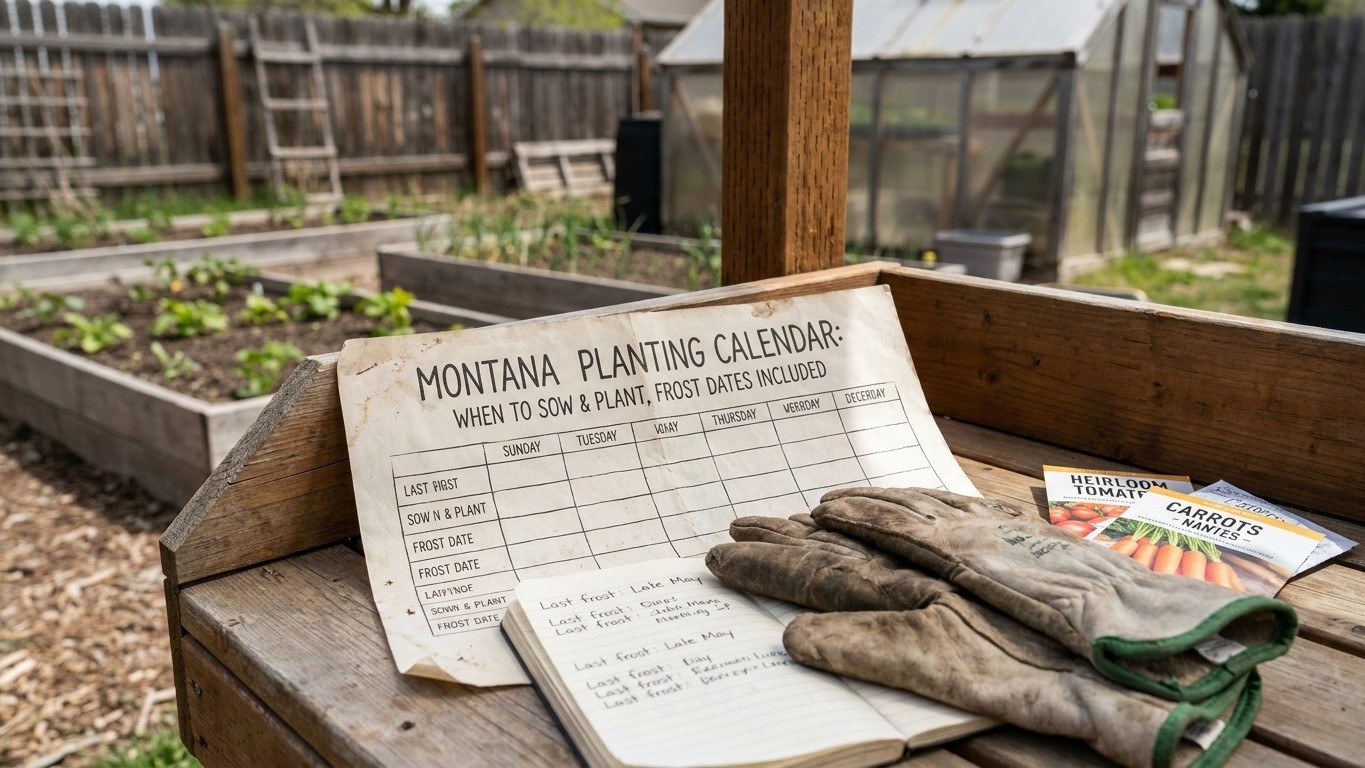

April 29 to May 10 is the last-frost window for Billings, and it’s tempting to treat that as Montana’s answer. It isn’t. That range comes from one valley, one of the mildest in the state, and it falls apart fast once you climb elevation or drop into a colder drainage. The real work isn’t memorizing those dates — it’s figuring out how far your own ground sits from Billings, and adjusting the whole calendar from there.
The frost window in Montana

NOAA’s 1991-2020 climate normals put the last spring freeze near Billings somewhere between April 29 and May 10, and the first fall freeze between October 1 and October 14. Those two ranges are the backbone of every planting decision that follows. Everything from when you sow peas to when you pull the last tomato off the vine traces back to this window: What to Plant in Montana in February can help you get seeds started indoors well before that window opens, What to Plant in Montana in March can help you prepare before that spring frost date arrives, What to Plant in Montana in June shows what to put in once that frost window has closed, What to Plant in Montana in July covers the peak of that growing season once the frost risk has passed, knowing what to plant in Montana in October helps you time that final harvest before the freeze arrives, What to Plant in Montana in November covers what’s left to do once that first freeze has passed, and What to Plant in Montana in December rounds out the year once the garden has gone fully dormant.
Billings sits in one of Montana’s milder valleys, and that matters. The same NOAA data set that produces these dates would look very different for a town at higher elevation or tucked into a colder mountain drainage. Treat the April 29 to May 10 window as a starting point for the Yellowstone Valley, not a statewide fact. Higher basins and mountain towns can see frost arrive weeks earlier in fall and linger weeks later in spring, and some high valleys carry a frost risk in almost any month of the year.
How the season length works out
Do the arithmetic on the season length and the range matters as much as the dates themselves. Counting from the latest possible spring frost, May 10, to the earliest possible fall frost, October 1, gives a conservative season of about 144 days. Counting from the earliest spring frost, April 29, to the latest fall frost, October 14, gives a generous season of about 168 days. Plan your garden around the shorter end of that range if you want a margin of safety, and treat the longer end as a bonus in years when frost cooperates. Once that spring window opens, What to Plant in Montana in April can help you get the earliest crops in the ground, at the height of summer What to Plant in Montana in August can guide you through the second wave of plantings, and as the season starts closing, What to Plant in Montana in September can help you decide what still has time to mature before the first frost.
That 144-to-168-day window is long by the standards of a place like Newfoundland and Labrador, where a much shorter and cooler season shapes an entirely different planting calendar, but it runs short next to a milder coastal or southern state. Within Montana itself, the range is what you work with. A gardener in a low-lying valley with good air drainage might consistently see the early end of the spring frost window and the late end of the fall one. A gardener in a frost pocket, where cold air collects at night, should expect the opposite on both ends.
Cool-season crops
Peas, spinach, lettuce, brassica transplants and root crops all tolerate a light frost, which is why they go into the ground early — see What to Plant in Montana in May for the specific varieties and timing into the ground well before the last spring frost date rather than after it. These crops germinate in cool soil and their foliage handles a dip below freezing without dying back, so there is no reason to wait for warm weather to sow them.
Timing from the frost window, not the calendar
Peas and spinach are the hardiest of the group and typically go in about six weeks before the last frost. Counting six weeks back from the Billings-area window of April 29 to May 10 lands the sowing date in mid-to-late March. Lettuce, carrots, beets and radishes are slightly less frost-tolerant and are usually sown about four weeks ahead, which counts back to early-to-mid April. Brassica transplants such as broccoli and cabbage started indoors follow a similar four-week rule for setting out, though the seed itself needs a tray five to six weeks earlier than that.
None of these dates are fixed points. They are ranges built on a frost window that is itself a range, and soil condition matters as much as the calendar. Cold, waterlogged soil in March will rot pea seed before it germinates no matter what the date says. Wait for the ground to be workable, meaning it crumbles rather than smears when you squeeze a handful, before you put seed in it.
- Peas and spinach: about six weeks before the last frost window, roughly mid-to-late March near Billings
- Lettuce, carrots, beets, radishes: about four weeks before, roughly early-to-mid April
- Brassica transplants (broccoli, cabbage, kale): seed indoors five to six weeks before setting out, then transplant on the four-week schedule above
A second sowing of lettuce, spinach and radishes two to three weeks after the first stretches the harvest window and hedges against a cold snap that damages the earliest planting. Succession sowing costs nothing but a little seed, and it is the simplest insurance available against an unpredictable spring.
Warm-season crops

Tomatoes, peppers, squash, beans and corn have no frost tolerance at all, and a single night at or near freezing kills seedlings outright. But waiting only until the last frost date has passed is not enough on its own. Soil temperature drives germination and root growth in warm-season crops more than air temperature does, and soil in Montana warms slowly even after the air stops freezing at night. Direct-sown bean and squash seed can sit in cold soil for weeks without germinating, then rot before it ever sprouts.
That is why the transplant window for tomatoes and peppers usually falls a week or two after the last frost date rather than right on it. For the Billings area, with a last frost window of April 29 to May 10, setting transplants out in mid-to-late May gives the soil that extra stretch of time to warm and gives you a buffer if the late end of the frost window slips later still.
Counting back for indoor starts
Tomatoes and peppers are started indoors six to eight weeks before that transplant date, not before the last frost date itself. Counting six to eight weeks back from a mid-May to late-May transplant window puts the indoor sowing date at roughly mid-March to mid-April. Start earlier than that and the seedlings get leggy and root-bound on a windowsill long before the garden is ready for them.
Days-to-maturity figures on a seed packet are counted from the transplant date, not from seed, and they shift by a week or two depending on how warm the season runs. Here is how a range of tomato varieties stack up against Billings-area frost dates when transplanted in the mid-to-late May window:
| Variety | Days to maturity | Type | First ripe (calculated) | Margin before fall frost |
|---|---|---|---|---|
| Sakura | 55 | Indeterminate | Mid July | 75 days |
| Edox | 55 | Indeterminate | Mid July | 75 days |
| Valentine | 55 | Indeterminate | Mid July | 75 days |
| Glacier | 55 | Determinate | Mid July | 75 days |
| Sun Gold | 57 | Indeterminate | Mid July | 73 days |
| Supersweet 100 | 60 | Indeterminate | Late July | 70 days |
| Juliet | 60 | Indeterminate | Late July | 70 days |
| Amalfi | 68 | Determinate | Late July | 62 days |
| Cherokee Purple | 72 | Indeterminate | Early August | 58 days |
| Big Beef Plus | 72 | Indeterminate | Early August | 58 days |
| Tiren | 75 | Indeterminate | Early August | 55 days |
| Granadero | 75 | Indeterminate | Early August | 55 days |
| San Marzano II | 78 | Indeterminate | Early August | 52 days |
| Celebrity Plus | 78 | Determinate | Early August | 52 days |
Every variety on that list ripens with weeks to spare before the earliest fall frost date near Billings, even the 78-day varieties like San Marzano II and Celebrity Plus. That margin matters more in a cooler mountain valley, where the growing season runs shorter than it does around Billings, and a 78-day tomato may not finish reliably.
Peppers behave like tomatoes and go out on the same mid-to-late May schedule. Squash, beans and corn are usually direct-sown rather than transplanted, and because their seed is cheap and fast-growing, most gardeners simply wait until the soil has warmed and the frost date has clearly passed rather than starting them indoors at all.
The fall planting window
Fall planting works backward from the first frost instead of forward from the last one. Near Billings, NOAA’s 1991-2020 normals put that first fall freeze between October 1 and October 14. To plant a fall crop successfully, count the days-to-maturity figure on the seed packet backward from the earlier end of that window, October 1, then add another one to two weeks of margin because plant growth slows as daylight shortens and nights cool, even before a frost actually hits.
Working an example
Take a fall crop of lettuce or spinach with roughly 50 days to maturity. Fifty days plus a two-week margin is 64 days. Counting 64 days back from October 1 lands the sowing date around late July. Counting the same 64 days back from the later end of the frost window, October 14, lands it around mid-August. So the realistic sowing window for that crop, given how much the fall frost date itself varies, is late July to mid-August near Billings. A quicker-maturing crop, or a gardener willing to cover plants against an early frost, can push that window later still.
Root crops and hardy greens are worth the extra planning because several of them actually improve after a light frost rather than being ruined by it. Kale, carrots and spinach convert stored starches into sugars when nights turn cold, which is why a carrot pulled in October often tastes sweeter than one pulled in August. Brussels sprouts follow the same pattern and are commonly left in the garden until after the first hard frost for that reason.
Cold frames and row cover extend this window further by trapping a few degrees of heat around the plants, which can be the difference between losing a crop to an early frost and stretching the harvest another two or three weeks. That protection is worth more in fall than in spring, because a fall crop that gets a frost-covered reprieve is often finishing rather than just starting, and there is less growing season left to lose if the weather turns.
Reading a planting calendar properly
A statewide planting calendar, including this one, is built on data from a single reference point, in this case the Billings area. Treat every date on this page as a starting estimate, not an instruction, once you leave the valley it was measured in. Elevation is the biggest variable in Montana. Gain a few thousand feet and the growing season can shrink by weeks on both ends, with frost arriving earlier in fall and lingering later in spring.
Large bodies of water change the picture too. A garden near Flathead Lake or another sizable body of water often runs a bit milder than a garden the same distance from any water at all, because water releases stored heat slowly and buffers the temperature swings that cause frost. Urban areas do something similar on a smaller scale. Pavement and buildings hold heat overnight, so a garden in the middle of a town can run a week or two milder than an exposed rural plot nearby, even at the same elevation.
None of this is unique to Montana. Nevada’s growing conditions swing just as hard between its low desert valleys and its high mountain basins, which is part of why a state-wide planting calendar for Nevada carries the same kind of caveats this one does. A single reference station never speaks for an entire state with this much variation in terrain.
What to track instead
Keep a simple log of the date frost actually hits your own garden each spring and fall, for a few years running. That record will tell you more about your yard’s real frost window than any regional average, because it accounts for your specific elevation, slope and exposure. A cheap soil thermometer, checked at planting depth rather than the surface, tells you when the ground is actually ready for warm-season seed regardless of what the calendar says.
Local help
County-level frost dates, soil testing and cultivar recommendations for your specific part of Montana are available through the Montana State University Extension Service, which maintains county offices across the state. A soil test through your local extension office is worth the small fee before you plant anything, since it tells you what a statewide calendar cannot: whether your ground needs lime, nitrogen or anything else before seed goes into it. Browse our other Montana guides for more on gardening across the state’s varied growing regions.
Common questions
What zone is Montana for gardening?
Montana spans a wide range of growing conditions from low valley floors to high mountain basins, and the right way to plan is by your local frost dates rather than a single statewide zone number. Check the frost history for the weather station closest to you, since a figure that fits Billings can be well off for a mountain town a hundred miles away.
Can I plant tomatoes before the last frost date if I cover them?
Row cover or a cloche buys a few degrees of protection, not full frost immunity, so it can help you push a bit earlier than the last frost window but it will not protect a tomato seedling from a hard freeze. Soil temperature is the bigger limiter anyway. Tomato roots barely grow in cold soil even if the air above them stays frost-free.
What happens if I plant too early and lose my seedlings to frost?
Most seed catalogs and garden centers restock through late spring, so replanting warm-season crops after a late frost is inconvenient but rarely fatal to the season. It does cost you weeks of growing time, which matters more for a longer-season variety like San Marzano II or Celebrity Plus than for a fast one like Sakura or Glacier.
How do I find the exact frost dates for my town, not just Billings?
NOAA’s climate normals are published by weather station, so search for the station nearest your town rather than relying on the Billings figures used here. The Montana State University Extension Service can also help translate that data into a planting plan for your specific county.
Do I need to start everything from seed indoors?
No. Peas, spinach, lettuce, carrots, beets, radishes, beans, squash and corn are all typically direct-sown straight into the garden bed. Indoor starting is mainly worth the effort for slower warm-season crops like tomatoes and peppers, which need a head start most Montana growing seasons can’t give them if sown directly outdoors.
Related guides
- North Dakota Planting Calendar: When to Sow and Plant, Frost Dates Included
- South Dakota Planting Calendar: When to Sow and Plant, Frost Dates Included
- Nevada Planting Calendar: When to Sow and Plant, Frost Dates Included