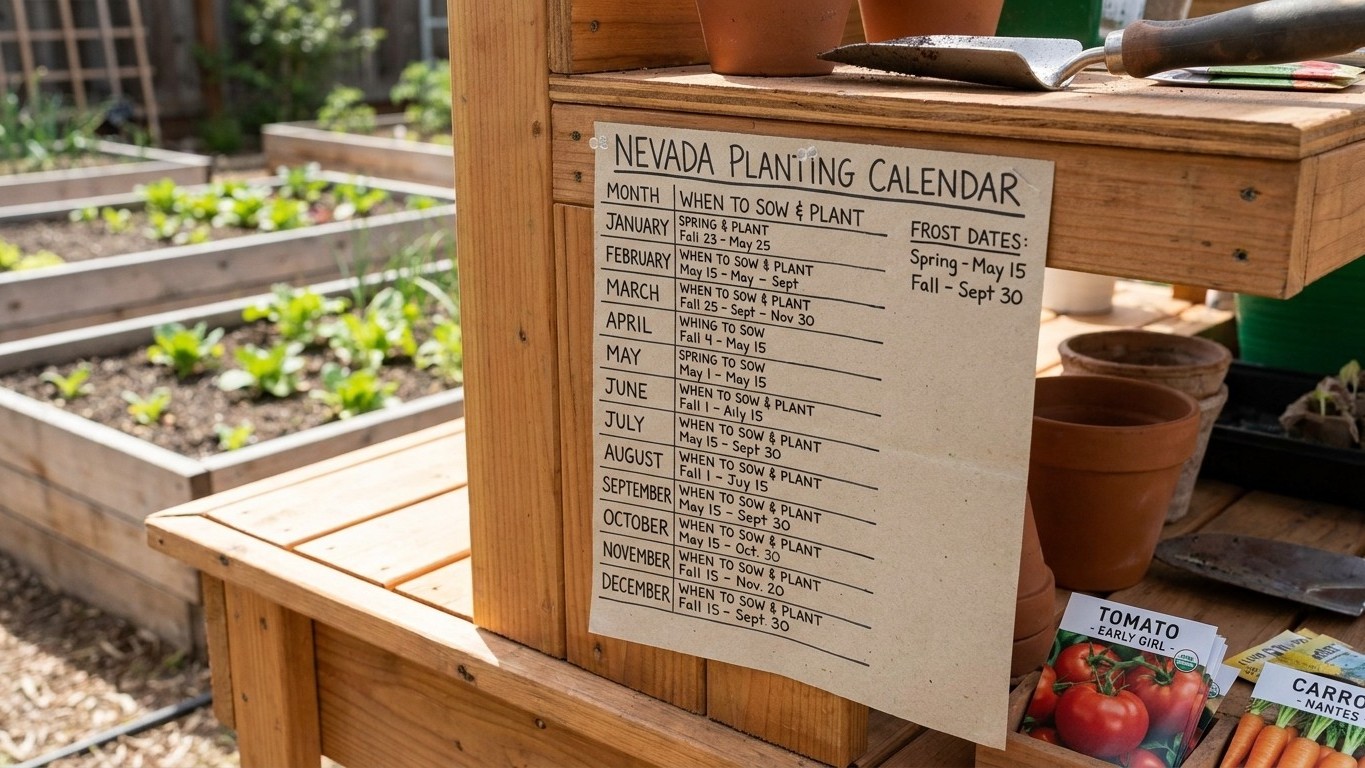

Nevada does not run on one frost date. NOAA’s 1991-2020 climate normals put the Las Vegas area’s last spring freeze between January 7 and February 1, and its first fall freeze between December 8 and December 23, but that reading comes from a desert valley wrapped in an urban heat island. A garden in Reno, Carson City, or anywhere at elevation runs on a completely different calendar. Before sowing anything, call your county office of UNR Extension and get the frost table for your actual town.
The frost window in Nevada

Your last freeze date isn’t one number for the whole state — it swings by months depending on whether you’re in a desert valley or up in elevation, and that swing decides everything about when seeds go into your ground. So before you plant a single row, find the freeze dates for your own town, not the nearest big city’s. Everything else in this calendar builds from that.
Why the Las Vegas numbers don’t travel
Las Vegas sits in a low desert bowl, and decades of pavement, rooftops and reflected heat have pushed its measured frost dates later in fall and earlier in spring than almost anywhere else in the state. Reno, Carson City and anywhere else at elevation frost months earlier in fall and hold frost months later in spring than what the Las Vegas record shows. A calendar built on the Las Vegas number and used in Elko or Ely would put tender crops in the ground while the soil is still frozen solid.
Run the arithmetic at the two far ends of Las Vegas’s own range and the frost-free stretch works out to somewhere between roughly 310 and 350 days, depending on which edge of each range you land on in a given year. That is one of the longest growing seasons anywhere in the continental country, and it belongs entirely to the valley floor around the airport gauge. Move up a few thousand feet, or north toward Washoe or Carson Valley, and the frost-free count on your own thermometer could run to less than half of that. This is exactly why a statewide planting calendar can only ever be a starting point, and why the county-level number from UNR Extension is the one worth building a season around — see What to Plant in Nevada in January for how that plays out at the start of the season, What to Plant in Nevada in February for how it carries into the next month, What to Plant in Nevada in March for how it guides the early transition, What to Plant in Nev, and later in the heat of summer What to Plant in Nevada in July shows how the same frost logic shapes a very different set of choices, and What to Plant in Nevada in December for how the same variation shapes the season’s final stretchada in April for how it shapes the spring rush, What to Plant in Nevada in May, and What to Plant in Nevada in August for how it carries into late summer, and What to Plant in Nevada in November for how the same logic applies as the season winds down> for how it carries into the height of the season, What to Plant in Nevada in June for how it holds through the peak of summer, What to Plant in Nevada in September for how it shifts as the season winds down, or What to Plant in Nevada in October for how it shapes the tail end.
Cool-season crops
Peas, spinach, lettuce, the brassica family and most root crops tolerate a light frost because their growing points sit low or underground, and a few degrees below freezing does not reach the tissue that matters. The trigger for sowing these crops is not a date on a calendar. It is the last spring freeze for your specific location, worked backward by a few weeks.
Timing by frost, not by month
- Peas and spinach: direct-sow as soon as soil can be worked, several weeks ahead of the last frost date for your area.
- Lettuce and other leafy greens: tolerate light frost once true leaves form, so an early start under cover is low-risk.
- Brassicas (broccoli, cabbage, kale): started indoors and transplanted a few weeks before the last frost, since young transplants handle a freeze better than direct-sown seedlings.
- Carrots, beets, radishes and turnips: direct-sown once soil has thawed and can be raked to a fine tilth, again ahead of the last frost.
In a location where NOAA’s normals genuinely put the last freeze in early spring, like the Las Vegas record used here, this whole cool-season window compresses into a short number of weeks before the desert heat arrives and bolts lettuce and spinach outright. In a location where the last freeze runs weeks or months later, that same window stretches out and gives more room for a second or third succession sowing. Either way, the crop goes in relative to your frost date, not a fixed week on the calendar, which is the single habit that separates a working planting schedule from a guess copied off a seed packet.
Warm-season crops

Tomatoes, peppers, squash, beans and corn are killed outright by frost, so the last freeze date sets the earliest possible transplant day. But soil temperature, not the frost date alone, is what actually determines whether a warm-season transplant survives its first two weeks in the ground. Tomato roots stall in cold soil even when the air above them is frost-free, and squash and bean seed will simply rot before it germinates if the soil hasn’t warmed enough.
Soil temperature and the count-back math
Gardeners who start tomatoes and peppers from seed indoors typically count back six to eight weeks from their intended transplant date, then adjust that start date once their own soil has warmed enough to actually take a seedling. In a climate as extreme and early as the Las Vegas record used in the FACTS above, where NOAA’s normals put the last freeze at January 7 to February 1, a transplant date of late January to mid February becomes workable once soil warmth catches up, which is unusually early by national standards and specific to that desert heat island. Anywhere else in Nevada, that same arithmetic has to start from your own county’s last-freeze range, not this one.
The table below runs that count-back arithmetic for the tomato cultivars in our catalog, using the Las Vegas transplant window as the example. Each figure is the catalog’s published days-to-maturity added to the transplant date, shown as a range rather than a single day, because a week or two of seasonal variation is normal.
| Variety | Days to maturity | Habit | Set out | First ripe | Margin before fall frost |
|---|---|---|---|---|---|
| Sakura | 55 | Indeterminate | Late Jan to mid Feb | Mid April | 241 days |
| Edox | 55 | Indeterminate | Late Jan to mid Feb | Mid April | 241 days |
| Valentine | 55 | Indeterminate | Late Jan to mid Feb | Mid April | 241 days |
| Glacier | 55 | Determinate | Late Jan to mid Feb | Mid April | 241 days |
| Sun Gold | 57 | Indeterminate | Late Jan to mid Feb | Mid April | 239 days |
| Supersweet 100 | 60 | Indeterminate | Late Jan to mid Feb | Mid April | 236 days |
| Juliet | 60 | Indeterminate | Late Jan to mid Feb | Mid April | 236 days |
| Amalfi | 68 | Determinate | Late Jan to mid Feb | Late April | 228 days |
| Cherokee Purple | 72 | Indeterminate | Late Jan to mid Feb | Late April | 224 days |
| Big Beef Plus | 72 | Indeterminate | Late Jan to mid Feb | Late April | 224 days |
| Tiren | 75 | Indeterminate | Late Jan to mid Feb | Early May | 221 days |
| Granadero | 75 | Indeterminate | Late Jan to mid Feb | Early May | 221 days |
| San Marzano II | 78 | Indeterminate | Late Jan to mid Feb | Early May | 218 days |
| Celebrity Plus | 78 | Determinate | Late Jan to mid Feb | Early May | 218 days |
Notice how much margin every one of these leaves before Las Vegas’s first fall freeze of December 8 to 23. That slack is what makes a low desert valley forgiving of a late transplant or a slow start. In a shorter, cooler Nevada season, the same cultivars still work, but the margin shrinks, and a short-season pick like Sakura, Sun Gold or Juliet, all at 55 to 60 days, becomes the safer bet over a 78-day cultivar like San Marzano II or Celebrity Plus.
Squash, beans and corn are typically direct-sown rather than transplanted, and all three need soil in the mid-60s Fahrenheit or warmer to germinate reliably, a threshold that has nothing to do with air temperature or the calendar date. A soil thermometer pushed two inches into the bed on a few consecutive mornings tells you more than any date on this page.
The fall planting window
Fall planting works backward from the first fall freeze, not forward from summer. Using the Las Vegas figures from NOAA’s normals, that freeze lands between December 8 and December 23. To find a safe fall sowing date, take a crop’s days-to-maturity, add a couple of weeks to account for the slower growth of shortening autumn days, and count back from whichever end of that freeze range you want to plant against.
Which crops actually improve after frost
Kale, Brussels sprouts, carrots, parsnips and spinach all sweeten after a light frost, because the plant converts stored starches to sugars as a kind of natural antifreeze. These are the crops worth timing deliberately to catch that first cold snap rather than racing to beat it. Lettuce, on the other hand, has no such benefit and turns to mush at the first hard freeze, so it needs to be harvested or covered before that point.
Root vegetables sown for a fall harvest benefit from Nevada’s typically dry autumn air, since wet, humid conditions are what causes storage rot in carrots and beets more often than cold does. A frost-hardened root left in the ground under a layer of mulch can often be harvested weeks past the first freeze, well into the period when Las Vegas’s own December 8 to 23 window has already passed, though gardeners at elevation should treat that as a bonus, not an assumption, given how much earlier their own ground freezes solid.
Second and third succession sowings of quick crops like spinach and radish are worth counting back from the first frost too, not just the traditional spring planting. A radish maturing in three to four weeks can go in the ground right up until it’s cutting things close against your local first-freeze date, which for the Las Vegas example above is early to late December, and for higher, colder parts of the state comes far sooner.
Reading a planting calendar properly
A statewide planting calendar is a starting point, not an instruction. Nevada’s elevation runs from below 500 feet near the Colorado River to well over 6,000 feet in mountain valleys, and that difference alone can shift a frost date by months. Add in local effects like Lake Tahoe’s moderating influence on nearby basins, or the reflected heat of a paved urban lot, and two gardens twenty miles apart can carry genuinely different frost calendars.
What to watch in your own yard
Keep a simple log of the date your own garden’s soil actually thaws, and the date frost actually kills your most tender plant each fall and spring, for two or three years running. That local record will tell you more than any published normal, because it captures your specific slope, soil type and exposure to wind. A late cold snap after weeks of warm weather is common enough in the high desert that experienced Nevada gardeners often hold back their most tender transplants a week or two past the earliest date the numbers would technically allow.
Gardeners across the state line in Utah face a similar spread of elevation and microclimate, and the same logic of checking a personal record against a published normal applies there too, as laid out in our Utah Planting Calendar. At the opposite extreme, a grower working from our Northwest Territories Planting Calendar is contending with a frost-free window measured in weeks rather than months, a useful reminder of just how wide the range gets across a single continent.
Local help
For the actual frost dates, soil test results and planting windows for your county, contact UNR Extension. Its county offices publish local guidance that accounts for the elevation and microclimate differences this page can only describe in general terms, and a soil test through the same office will tell you more about your garden’s readiness than any calendar date. For more on gardening across the state, browse our full set of Nevada guides.
Common questions
Is the Las Vegas frost date the same as the Nevada frost date?
No. The Las Vegas figures used on this page come from a single NOAA weather station in an extreme desert urban heat island, and they run months earlier for the last freeze and later for the first freeze than most of the rest of the state. Treat them as one data point, not a statewide answer.
How do I find the actual frost date for my town?
Contact your county office of UNR Extension, which publishes local frost data and soil testing services. That office is the only reliable source for a number specific to your elevation and microclimate, since Nevada’s terrain varies too much for one figure to cover the whole state.
Can I plant tomatoes as early as the Las Vegas table suggests?
Only if you garden in that same low desert heat island. The transplant window shown in the tomato table on this page is calculated from Las Vegas’s unusually early last-freeze range, and it does not apply to Reno, Carson City or any garden at meaningful elevation, where the same cultivars need a much later start date.
What if I get a late frost after I’ve already planted?
Cover tender transplants with a sheet, frost cloth or overturned bucket overnight, and remove the cover as soon as temperatures rise the next morning. A late cold snap after a run of warm weather is common enough in Nevada’s high desert that many experienced growers hold their most tender crops back a week or two past the earliest technically allowable date.
Do fall crops really taste better after a frost?
Some do. Kale, Brussels sprouts, carrots, parsnips and spinach convert stored starches to sugars in response to cold, which measurably sweetens them. Lettuce does not get this benefit and should be harvested or protected before a hard freeze rather than left out to catch one.
Related guides
- Oregon Planting Calendar: When to Sow and Plant, Frost Dates Included
- Idaho Planting Calendar: When to Sow and Plant, Frost Dates Included
- Utah Planting Calendar: When to Sow and Plant, Frost Dates Included