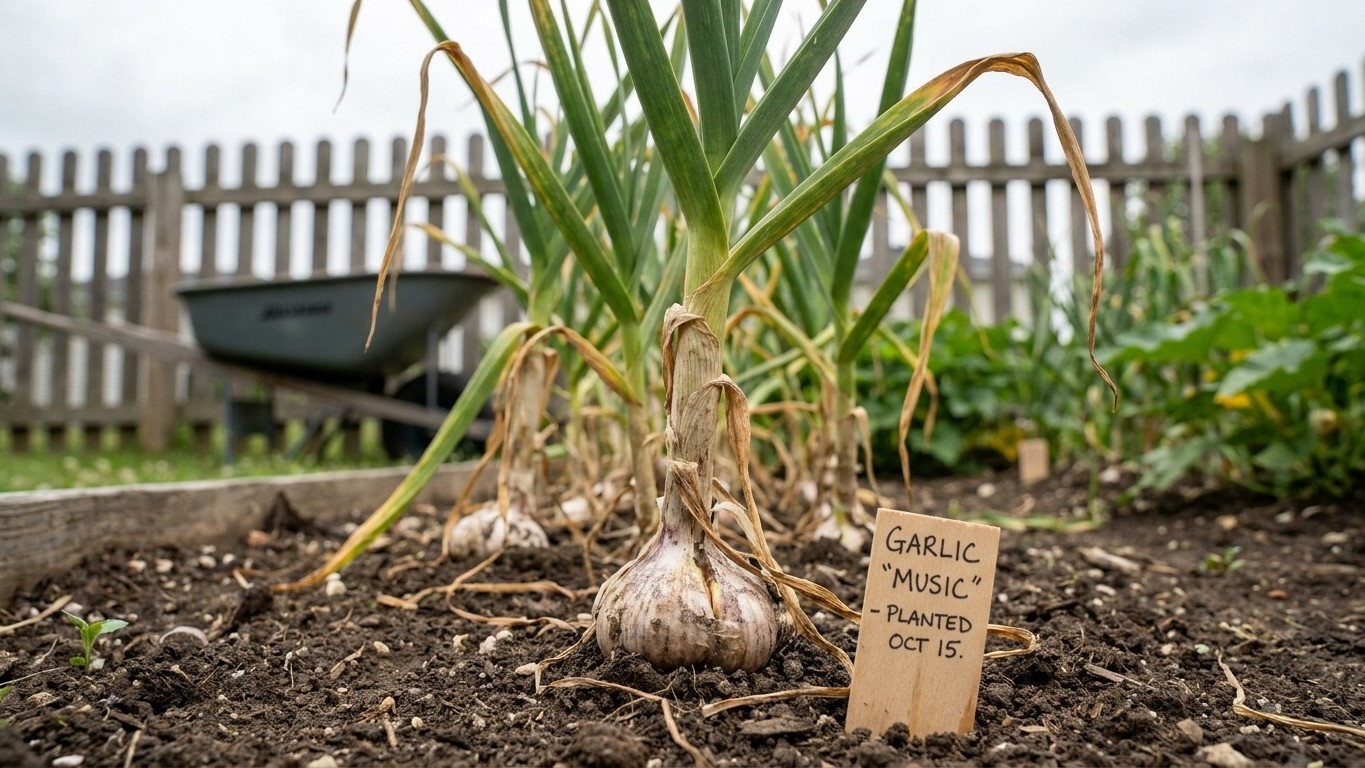

Garlic planted in Indiana gets more than enough cold to split into a full head of cloves. NOAA’s National Centers for Environmental Information puts the first fall freeze at the Indianapolis station between October 21 and October 30, using its 1991-2020 climate normals, and the winter that follows runs long enough to blow past the six to eight weeks below 40°F that University of Georgia Extension publication C854 sets as the minimum for clove division. Plant a hardneck variety in the weeks before that October freeze window, and get mulch ready to lay once the soil starts to firm up for winter.
Will garlic get the cold it needs in Indiana

Garlic is not like most bulbs you tuck into the ground and forget. A clove planted without enough sustained cold stays a single rounded bulb the following summer, with no seam dividing it into cloves at all. University of Georgia Extension publication C854 puts the minimum at six to eight weeks with soil temperatures below 40°F, and that number is the one figure that decides whether a garlic planting is worth the bed space.
Indiana clears that bar without much drama. NOAA’s NCEI 1991-2020 climate normals put the first fall freeze at the Indianapolis station between October 21 and October 30, and from that point the state settles into a real Midwestern winter that holds well below 40°F for months, not weeks. Even accounting for the fact that southern Indiana counties run milder and see their first freeze later than the Indianapolis reference point, and northern counties see theirs earlier, the whole state sits far enough north and far enough from any moderating coastline that the six-to-eight-week chilling threshold is met almost everywhere garlic is planted here.
That means the two workaround options this crop sometimes needs, refrigerating cloves before planting to fake a cold snap, or falling back on a softneck that tolerates a shorter chill, are not something an Indiana grower generally has to reach for. They matter more in states where winters run mild and short. If you’re still weighing which type to plant, it’s worth reviewing Garlic Varieties That Suit Indiana Winters before committing to hardneck over softneck. Here the question is less whether the cold arrives and more whether the clove is in the ground early enough to root before that cold locks the soil solid, which is the timing problem the next section deals with.
If you are planting a very small, sheltered dooryard bed against a heated foundation wall, or gardening in an unusually mild microclimate, it is still worth treating a softneck as your safety option rather than assuming every hardneck clove will divide cleanly. But for the state as a whole, cold is not the limiting factor here. Timing and drainage are.
When to put the cloves in
Knowing When to Plant Garlic in Indiana matters here: garlic planted too early pushes soft green top growth that a hard freeze then shreds. Planted too late, the clove sits in cold, wet soil without rooting first and rots before it ever gets going. The target is a window where roots form but leaves stay minimal, and that window is set by the first fall freeze, not by a date on the calendar.
NOAA’s NCEI 1991-2020 climate normals put that first freeze at the Indianapolis station somewhere in the range of October 21 to October 30. Rather than pin the planting date to one day inside or around that range, treat the whole window as the anchor and count back from it: garlic wants three to five weeks of rooting weather before the ground starts to lock up, which is why late September to early October is the planting target for the varieties covered below across most of the state.
That said, this is an Indianapolis-centered figure, and Indiana is a long state north to south. Southern counties along the Ohio River run milder and see their first freeze later than Indianapolis by roughly two weeks or more, which gives those gardeners a bit more slack to plant into October. Northern counties, and anywhere with more exposure to Lake Michigan’s lake-effect cooling, see frost earlier and should lean toward the front of the late-September window rather than the back of it. Elevation plays a smaller role, but a low frost pocket in a valley will freeze before a slope a few hundred feet up the same hillside.
What moves the date
A few site factors shift the safe window earlier or later than the general guidance:
- Low-lying beds and frost pockets freeze first, so plant those earlier in the window
- Raised beds and containers lose heat faster than ground soil and should also go in on the early side
- Heavy clay holds cold and wet longer into fall, so wait for it to drain before planting rather than working it wet
- A south-facing slope with good air drainage can push a week or so later than a low, shaded bed
Missing the window on the late side is worse than missing it early. A clove that goes in a week or two ahead of schedule with some minor leaf growth generally survives the freeze fine once mulched. A clove planted into ground that is already cold and saturated struggles to root before winter locks it in place.
Which types suit Indiana
Hardneck and softneck garlic are not interchangeable, and the choice is really a question about the winter each type expects. Hardneck varieties want a real cold season to trigger clove division and to produce the curled flower stalk, called a scape, that gets cut off in early summer. Softneck types tolerate mild winters better and store considerably longer in the pantry, which is why they dominate supermarket shelves, but they do not need Indiana’s cold the way hardnecks do.
Given the winter this state actually delivers, hardneck is the type that makes the most of it, and it is worth naming real cultivars rather than shopping by the vague label alone. German White is a reliable, big-cloved hardneck that catalogues generally list for planting the same late September to early October window as the rest of this list. Duganski and German Red both carry a stronger, hotter flavor and are worth growing side by side to compare. Chesnok Red and Georgian Crystal are two more hardnecks from the same closed list of proven catalogue varieties worth trying in a cold-winter state, and Georgian Fire and Bavarian Purple round out a planting if you want a spread of flavors from one bed. Fall Festival and Ivan are two more hardnecks on the same list, both set out in that same late-September-to-early-October window.
Softneck is not out of place here either, particularly if long storage matters more to you than scape harvest. Inchelium Red and Lorz Italian are both softnecks on this same catalogue list, along with Early Red Italian and Italian Late, and all four go into the ground on the same late September to early October schedule as the hardnecks. A grower a state over in Iowa, covered in our guide to growing garlic in Iowa, faces an even colder winter and leans harder toward hardneck for that reason. Indiana’s winter is milder than Iowa’s but still cold enough that hardneck is the type that rewards the effort here, with softneck as a legitimate second bed for storage rather than a compromise.
Soil and bed preparation
Garlic sits in the same patch of ground for eight to nine months, through freeze, thaw, and the wet stretch of early spring, so the bed has to drain well before a single clove goes in. Standing water is the single fastest way to lose a garlic planting, and it does its damage well before any fungal disease gets a foothold. If water pools on the surface an hour after a hard rain, that bed needs raising or amending before October, not after.
Work compost or well-rotted manure into the top six to eight inches a few weeks ahead of planting, giving it time to settle rather than sitting loose and fluffy around the clove. A loose, well-drained loam is the target: heavy clay benefits from raised rows or a raised bed frame that lifts the root zone a few inches above the surrounding grade, since that is often the difference between a clove that roots cleanly and one that sits in a cold, saturated pocket all winter.
Getting the pH and fertility right
Garlic does best in soil that is neither strongly acidic nor strongly alkaline, and the only reliable way to know where a given bed stands is a soil test rather than a guess. A soil test also flags whether nitrogen, phosphorus, and potassium levels need building up before planting, since garlic is a long-season crop that draws on the bed for most of a year. Purdue Extension runs soil testing services for exactly this reason, and that is worth doing well before the October planting window rather than scrambling to amend once the cloves are already in the ground.
Avoid working fresh, un-composted manure into a garlic bed close to planting time. It carries too much nitrogen too fast, which pushes soft leaf growth right when the goal is root establishment, and fresh manure can also introduce weed seed and pathogens that a garlic bed does not need for the eight months it will occupy that ground.
What the climate here favours, and what it does not
Garlic disease pressure tracks air and soil temperature closely, and the threshold data published by UC IPM in its Onion and Garlic pest management guidelines, UC ANR Publication 3453, give a way to see which diseases Indiana’s climate favors and which it does not. One caution matters before any of the numbers: those published thresholds are soil temperatures, and the figures below are monthly mean air temperatures, so this section describes a tendency, not a measured infection risk in any actual garden.
White rot, caused by the fungus Sclerotium cepivorum, has a published range of 50 to 75°F. Indianapolis-area mean air temperatures fall inside that range in five months of the growing season, September, October, April, May, and June, including one month at the pathogen’s published optimum. That is the widest window of any disease on this list, and it means the region’s spring and fall temperatures sit squarely in the zone where white rot is most active if it is present in the soil at all.
Fusarium basal rot, caused by Fusarium oxysporum f. sp. cepae, has a published range of 59 to 90°F, and Indiana’s mean air temperatures fall inside that range in four months, September, May, June, and July. Pink root, caused by Setophoma terrestris, has a narrower published optimum of 75 to 85°F, and only July’s mean air temperature here lands inside it, at the pathogen’s own optimum point. Southern blight, caused by Sclerotium rolfsii, needs an optimum of 86 to 95°F, and no month of Indiana’s growing season reaches a mean that high, which means the disease runs less active here through an ordinary season, though a hot, humid stretch inside any single month can still create conditions closer to its optimum than the monthly average shows.
None of this predicts disease in any one garden. A pathogen has to be present in the soil or on the seed clove for any of this to matter, and the single most effective step against all four of these is planting clean, disease-free seed stock rather than reusing bulbs of unknown origin from a grocery store. Crop rotation away from onions and garlic for several years, and avoiding waterlogged beds, both reduce pressure regardless of what a monthly temperature average says.
Getting it through the winter
Mulch is what separates a garlic bed that comes through an Indiana winter cleanly from one that heaves half its cloves out of the ground by March. Lay four to six inches of straw or shredded leaves once the ground has cooled but before it freezes solid, generally right after planting or within a week or two of it. That timing matters: mulch laid too early while the soil is still warm can trap heat and moisture right around the clove and encourage rot before winter dormancy even sets in.
The mulch is doing two separate jobs. It insulates the soil against the sharpest temperature swings, and it prevents the freeze-thaw cycles that cause heaving, where repeated freezing and thawing of the top few inches of soil physically pushes a shallow-planted clove upward until part of it sits exposed above grade. A clove that heaves out over winter is exposed to cold, drying wind with no soil around it, and it rarely recovers fully even if you push it back down in spring. Planting at the recommended depth, generally two to three inches of soil over the top of the clove, gives the mulch enough to work with and reduces how much heaving can move it in the first place.
Come spring, pull the mulch back gradually rather than stripping the bed bare the first mild day. Leave a thin layer in place to suppress weeds and moderate soil moisture, and only clear it fully once new green shoots are well up and the risk of a hard freeze has passed for the season. Pulling mulch too soon after a late warm spell exposes new growth to exactly the kind of cold snap the mulch was protecting against all winter.
Harvest and curing here
Garlic tells you when it is ready far more reliably than any date on a calendar does. Watch the lower leaves: when the bottom third to half of them have browned and dried back while the upper leaves are still green, the bulb has generally finished sizing and it is time to lift a test bulb or two to check. Each leaf roughly corresponds to a wrapper layer around the bulb, so leaves dying back too fast or too early is worth investigating rather than ignoring, since it can signal disease or drought stress rather than normal maturity.
Pull a test bulb and cut it in half across the middle. The cloves should fill out distinctly with a clear wrapper still intact around each one. Waiting too long past this point causes the wrappers to split and the cloves to separate in the ground, which ruins storage life even if the flavor is unaffected.
Curing in Indiana’s summer humidity
Curing is where a lot of a season’s garlic gets lost after the hard part is already done. Bulbs need three to four weeks in a warm, dry, well-ventilated space out of direct sun, with air moving freely around them rather than piled in a heap. A humid Indiana summer stretch slows this process down considerably compared with a dry climate, and garlic left to cure in a stagnant, humid garage or shed is prone to mold and neck rot rather than curing cleanly. A box fan running on low in the curing space makes a real difference during the muggiest weeks of July and August.
A grower in Pennsylvania, covered in our guide to growing garlic in Pennsylvania, deals with a similarly humid curing season and relies on the same fix: moving air rather than just dry heat. Once cured, trim roots and stems, brush off loose soil without washing the bulbs, and store in a cool, dark, well-ventilated spot rather than a sealed container.
Local help
County-level frost dates, soil test results, and planting timing all vary across a state this size, and the fastest way to get numbers specific to your own ground is through Purdue Extension. Its county offices run soil testing and can speak to local frost timing more precisely than a single statewide reference point ever will.
Common questions
Can I Plant Garlic in spring in Indiana instead of fall?
You can, but expect small, undivided bulbs rather than a full head of cloves. Garlic needs the sustained cold of a real winter to trigger clove division, and a spring-planted clove misses most or all of that chilling period, which is why fall planting is standard practice here.
How deep should I plant garlic cloves in Indiana?
Two to three inches of soil over the top of the clove is the general target, with the pointed end facing up. Shallower planting leaves cloves more exposed to winter heaving, which is a bigger risk in a cold-winter state than in a mild one.
Do I need to remove the mulch before the ground freezes?
No, mulch should go down before or shortly after the ground starts to cool, not after it freezes. The point of the mulch is to buffer the soil against the freeze-thaw cycling that causes heaving, so it needs to be in place ahead of that cycling, not applied afterward.
Why did my garlic come up with only one big round bulb and no cloves?
That is a classic sign of insufficient cold before or during the growing season, sometimes called a rounded bulb or a single. It usually means the cloves went in too late to root and chill properly, or came from planting stock that never had a real winter itself.
Should I cut the scape off my hardneck garlic?
Yes, cutting the curled flower stalk off once it forms redirects the plant’s energy into bulb size rather than the stalk. This applies to hardneck varieties only, since softneck types generally do not produce a scape at all.