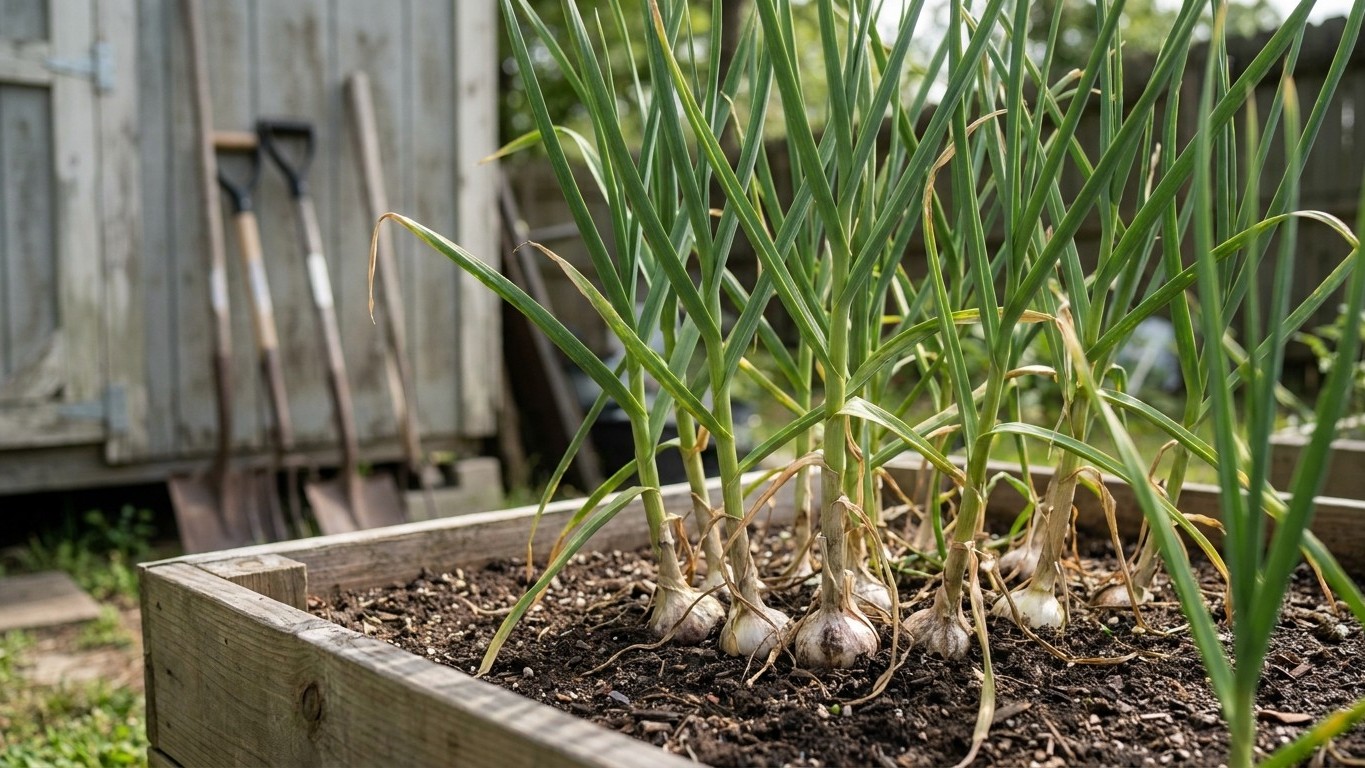

Garlic grows in Louisiana, but the state’s mild winters change how you have to grow it. NOAA’s 1991-2020 climate normals, measured at a station near New Orleans, show 0.0 weeks of air temperatures below 40°F during the growing season, well short of the six to eight weeks University of Georgia Extension’s publication C854 says garlic needs to split into cloves. Buy softneck seed garlic and refrigerate the cloves for several weeks before you plant, rather than trusting the ground to supply the cold on its own, and check When to Plant Garlic in Louisiana to time it right.
Will garlic get the cold it needs in Louisiana

A garlic clove does not divide into a full head just because you planted it. It divides because a period of sustained cold tells the plant to differentiate one bulb into several cloves, the same signal that makes tulips and daffodils bloom on schedule. Skip that cold exposure and the clove grows into a single round bulb at harvest, not much bigger than the one you planted, with no wrapper of cloves inside it.
What the numbers say
NOAA’s 1991-2020 climate normals, recorded at a reference station near New Orleans, put the amount of time the growing season spends below 40°F at 0.0 weeks. University of Georgia Extension’s publication C854 lists six to eight weeks below that mark as what garlic needs to fully split into cloves. Louisiana’s coastal parishes fall far short of that threshold, and even the state’s northern parishes, which run several degrees colder in a typical winter, aren’t represented in this particular reading. Treat every part of the state as short on natural chilling until you’ve checked your own winter against a local record.
This is not a reason to skip garlic. It is a reason to supply the cold yourself instead of waiting on the sky to do it.
Two ways around a mild winter
- Refrigerate the cloves before planting. Break the bulbs apart, keep the individual cloves in a paper bag in the refrigerator for several weeks before you set them out, then plant as usual. This substitutes for the chilling the ground won’t provide.
- Plant softneck varieties, which evolved in milder Mediterranean and Central Asian climates and need less cold to divide than hardneck types bred for colder regions. A softneck clove planted with no refrigeration at all will still usually divide in south Louisiana, even if the heads run smaller than a catalog photo promises.
Hardneck garlic is not off-limits here, but it is the riskier bet without pre-chilling. If you want to try one anyway, refrigerate the cloves and treat the first year as a trial rather than your whole seed stock. Checking a guide to Garlic Varieties That Suit Louisiana Winters can help you choose which type is worth that first-year risk.
When to put the cloves in
No reliable frost anchor here
Most garlic guides tell you to plant a set number of weeks before the first fall frost. That approach does not work well in Louisiana. NOAA’s 1991-2020 climate normals put the first fall freeze near New Orleans somewhere between December 17 and January 8, but a 32°F freeze only occurs in 86.8 percent of years at that station. That means roughly one winter in seven never sees a freeze at all before the window closes, and the window itself straddles the New Year, which makes counting backward from a frost date useless as a planting rule here. Louisiana simply does not offer the kind of reliable frost anchor that a grower farther north counts on, the way growing garlic in Maine genuinely revolves around the first hard freeze of the year.
Plant instead by the drop in soil temperature and by the practice growers actually use in this state: late November to mid December. That window gives the clove several weeks to root into the soil while it is still workable and before the wettest stretch of winter sets in, without pushing much top growth before the days shorten. Roots need soil contact and moisture to establish, not cold, so the timing here is about getting the clove settled rather than about beating a freeze that may not come.
What moves the window
Elevation and distance from the Gulf both shift this window. Parishes farther from the coast and at slightly higher elevation cool off earlier in the fall and can lean toward the earlier end of the range. Parishes close to the coast, where the Gulf keeps soil warm well into December, often do better planting toward the later end, since a clove set into still-warm soil in early November can push excess leaf growth before winter slows it down.
Which types suit Louisiana
Softneck varieties for this climate
Hardneck and softneck garlic are not interchangeable, and winter is the reason. Hardneck varieties send up a woody flowering stalk called a scape and generally need a real cold season to divide fully, and they store only a few months after curing. Softneck varieties skip the scape, tolerate a mild winter far better, and store for many months longer, which is why braided garlic in a grocery store is almost always softneck.
Louisiana’s winters favor softneck garlic, plainly, given the near-absence of the sustained cold hardneck types are bred for. Four softnecks are worth planting here: Early Red Italian, Inchelium Red, Italian Late, and Lorz Italian. All four are set out late November to mid December in this territory, the same window as every hardneck on this list, since the calendar constraint here comes from soil temperature and day length, not from the variety’s chilling needs.
Hardneck: possible, but harder work
Hardneck varieties are not ruled out, they just ask more of the grower. If you want to try one, refrigerate the cloves for several weeks before planting to make up the chilling difference, and pick from Bavarian Purple, Blue Music, Chesnok Red, Duganski, Fall Festival, Georgian Crystal, Georgian Fire, German Red, German White, or Ivan. A grower in a state where hardneck is the natural default, such as growing garlic in Saskatchewan, doesn’t have to think about any of this. Louisiana growers do.
| Variety | Type | Set-out window (Louisiana) | Storage after curing |
|---|---|---|---|
| Early Red Italian | Softneck | Late Nov. to mid Dec. | Long |
| Inchelium Red | Softneck | Late Nov. to mid Dec. | Long |
| Italian Late | Softneck | Late Nov. to mid Dec. | Long |
| Lorz Italian | Softneck | Late Nov. to mid Dec. | Long |
| Chesnok Red | Hardneck | Late Nov. to mid Dec. | Shorter |
| German White | Hardneck | Late Nov. to mid Dec. | Shorter |
Soil and bed preparation
Garlic sits in the same patch of ground for six to seven months, through whatever rain the winter brings, so drainage matters more than almost anything else you do before planting. A clove sitting in saturated soil will rot before any fungus even gets involved. Raised beds or ridged rows solve this in the heavy clay soils common across much of Louisiana, lifting the root zone above standing water after a hard rain.
Work compost or well-rotted manure into the bed a few weeks before planting, not the day of, so it has time to settle and stop competing with the clove for nitrogen as it breaks down. Loosen the soil at least eight to ten inches deep. Garlic roots run shallow but wide, and compacted clay stops them from spreading before the plant has any top growth to show for it.
Skip fresh, high-nitrogen manure this late in the year. It pushes soft leaf growth right when you want the plant’s energy going into rooting, and soft growth going into a humid Louisiana winter is exactly what invites the fungal pressure covered next.
What the climate here favours, and what it does not
UC IPM’s Pest Management Guidelines for onion and garlic, UC ANR Publication 3453, publish the temperature ranges that let four major garlic diseases build up. Those thresholds are measured in soil, not air, and soil lags behind air temperature and swings far less, so the figures below describe a tendency toward disease pressure, not a forecast of infection. A monthly average also hides a lot of variation. A month that averages 65°F still holds days near 50 and days near 80.
Fusarium basal rot and white rot: wide windows
Measured against Louisiana’s growing season, Fusarium basal rot‘s published 59-90°F range overlaps eight months here, September through November and again March through July, including two months at the pathogen’s stated optimum. That is the widest window of the four diseases UC IPM tracks, and it means seed stock free of Fusarium oxysporum f. sp. cepae matters more in this state than fungicide choice does, since the climate rarely closes the door on it entirely.
White rot‘s 50-75°F range overlaps seven months, October through April, with two of those at its optimum. Sclerotium cepivorum, the pathogen behind it, survives in soil for years once introduced, so the real safeguard is not planting infected cloves or bulbs sourced from an infested field, since the climate here will not stop it once it arrives on its own.
Pink root and southern blight
Pink root sits at its 75-85°F optimum in four months of the growing season, September and again May through July. Setophoma terrestris rarely kills a plant outright but stunts roots and cuts bulb size, and Louisiana’s warm shoulder seasons keep it in play at both ends of garlic’s time in the ground.
Southern blight is the one disease on this list that gets a break here. No month of the growing season reaches its 86-95°F optimum on average, so Sclerotium rolfsii runs less active in Louisiana than it would in a hotter climate. Less active is not the same as absent, and a genuinely hot stretch of summer can still push conditions into range even when the monthly average does not.
Getting it through the winter
Louisiana’s winter is a lesson in moisture management more than cold protection. Lay a mulch of straw or shredded leaves over the bed once the cloves are planted, thick enough to suppress weeds and buffer soil temperature swings, but loose enough that water drains through instead of sitting against the clove. Because the state’s winter delivers rain more than hard freezes, a mulch that stays soggy invites rot faster than the cold ever will.
Heaving, where repeated freeze-thaw cycles push a shallow-planted clove up out of the ground, is a real risk in a state with a genuine winter freeze. It matters less here, given how rarely the ground freezes hard enough to heave anything. That does not excuse shallow planting. Set cloves with about two inches of soil over the tip regardless, since a clove sitting too near the surface dries out and gets exposed by nothing more than a hard rain washing soil away from it.
Pull mulch back partway in late winter once new leaves push through, so the crown doesn’t sit under a wet mat that keeps the fungal pressure described above active longer than it needs to be. A thin layer left in place through spring still suppresses weeds without holding excess moisture against the stem.
Harvest and curing here
Lift garlic by reading the plant, not the calendar. Pull a bulb once the lower third to half of the leaves have browned and died back while the upper leaves are still green. Pull too early and the wrappers haven’t formed around the cloves. Wait too long and the head splits apart in the ground or the wrappers rot away, leaving bare cloves that won’t store.
Curing matters more in Louisiana’s humidity than it does in a dry climate, because bulbs that would air-dry in a week in a low-humidity state can sit damp two or three times that long here, and a damp bulb molds before it ever reaches storage. Cure in a shaded, covered space with strong airflow, a fan aimed across the bulbs if the air is still, rather than the traditional hang-in-the-barn approach that works fine in a drier region.
Spread bulbs in a single layer rather than piling them, and check the layer every few days for any bulb going soft or moldy so it doesn’t spread to its neighbors. Trim roots and cut stems back only once the outer wrappers have gone fully papery and the neck has tightened down, a sign the moisture inside the bulb has dropped enough for storage.
Local help
For county-level planting guidance and a soil test before you commit a bed to garlic, contact the LSU AgCenter, the state’s land-grant extension service.
Common questions
Can I grow hardneck garlic in Louisiana at all?
Yes, but plan on refrigerating the cloves for several weeks before planting to make up for the chilling the winter won’t provide. Even with that step, expect smaller heads than a hardneck grower would get in a genuinely cold state.
Why did my garlic come up as one big clove instead of a head?
That’s a bulb that never divided, almost always because it didn’t get enough sustained cold after planting. Refrigerate your seed cloves before the next planting, or switch to a softneck variety that needs less chilling to split.
Since Louisiana winters are so mild, can I just Plant Garlic in spring?
No. Garlic is a fall-planted crop everywhere, including here, because the plant needs the fall and winter months to establish roots before it bulbs up the following summer. A spring-planted clove runs out of cool growing weather before it has time to size up.
Do I need to cut the scape on hardneck varieties?
Cutting the curling scape once it appears redirects the plant’s energy into the bulb instead of the stalk, and most growers do it for that reason. It’s not required for the plant to survive, but skipping it usually means smaller bulbs at harvest.
Can I plant garlic from the grocery store?
It’s not a good idea. Grocery garlic is often treated to slow sprouting, may not be a variety suited to fall planting, and can carry soilborne diseases like white rot into a bed that then stays contaminated for years. Buy seed garlic from a supplier that sells it specifically for planting.