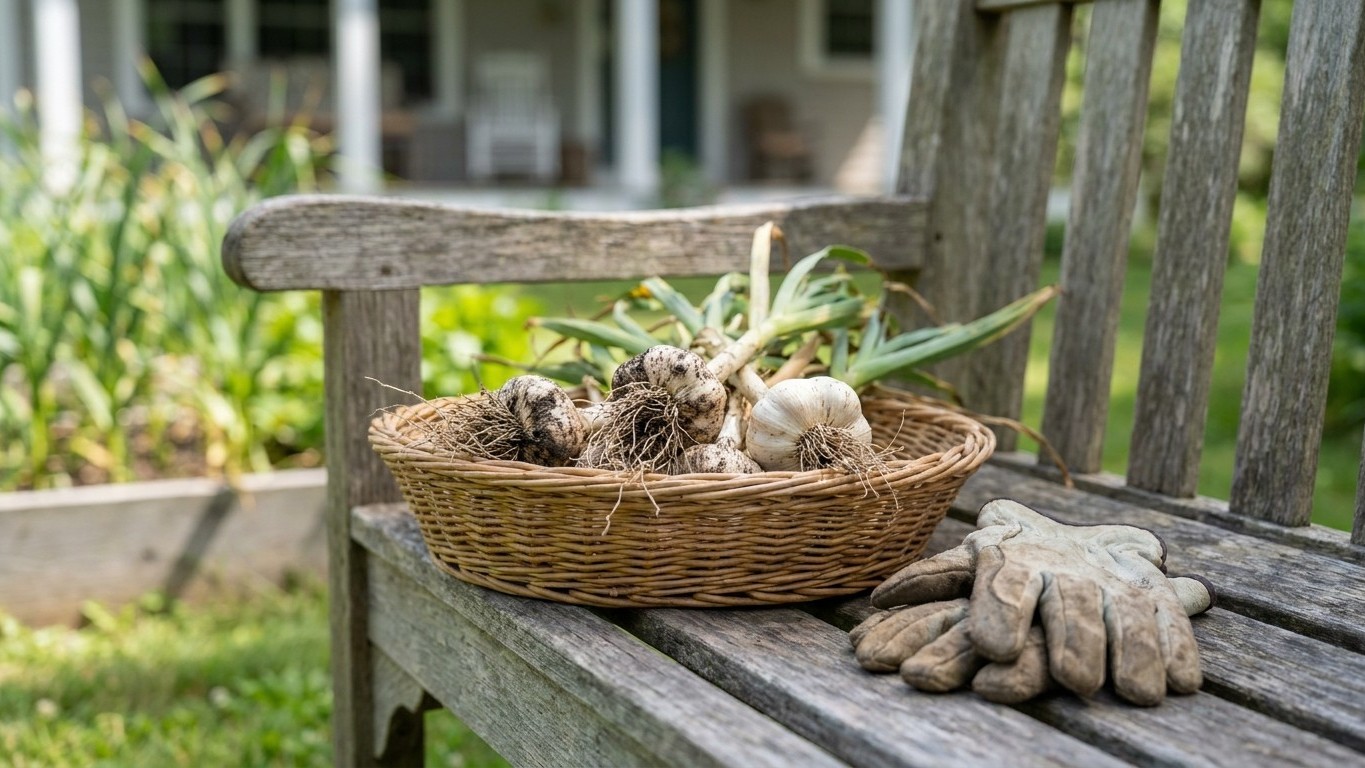

Twenty-six weeks of cold below 40°F is what Manchester racks up in a typical year — more than three times the six-to-eight-week vernalization stretch a clove needs to split into cloves instead of growing into one solid round bulb by July. That’s the real difference here: growers in milder states have to sweat the timing, hoping the cold holds long enough. New Hampshire doesn’t have that worry. Only a sheltered dooryard, a south-facing wall, or an early insulating snow changes the math.
Will garlic get the cold it needs in New Hampshire

Garlic does not divide into cloves on its own. A planted clove needs a sustained stretch of cold, what growers call vernalization, or it grows into the ground as a single round bulb the following summer, no wrapper layers, no separate cloves. University of Georgia Extension publication C854 sets that requirement at six to eight weeks of temperatures below about 40°F after planting and before the soil warms again in spring.
New Hampshire clears that bar with room to spare. NOAA’s 1991-2020 climate normals, measured at the Manchester station, show 26.1 weeks below 40°F across the year, more than three times what garlic asks for. That figure comes from one reference station near the state’s warmer, lower-elevation south. Higher ground in the Whites and the North Country runs colder and longer, so if Manchester alone clears the threshold, most of the rest of the state does too.
The only growers who need to think twice are those in an unusually sheltered dooryard, a south-facing slope, or anyone starting garlic indoors and moving it out late, none of which is typical practice for this crop here. If your own site runs mild for its exact spot, whether from a heat-holding wall, a lake, or an early snow cover that insulates the ground before the cold fully sets in, two options fix it: refrigerate the cloves at 35°F to 40°F for six to eight weeks before planting to force vernalization artificially, or plant a softneck type, which tolerates a shorter chill than hardneck garlic does; see Garlic Varieties That Suit New Hampshire Winters for guidance on which types suit each situation. Growers in warmer states like New Jersey lean on that refrigeration step routinely, since their winters do not reliably clear the threshold on their own; see Growing Garlic in New Jersey: Planting Dates, Varieties and Winter Cold for how that works in a climate where cold is the scarce resource instead of the given.
When to put the cloves in
There is no fixed calendar date for this. The anchor is the first fall frost, and NOAA’s 1991-2020 climate normals put that date, at the Manchester station, somewhere between October 13 and October 26. That is a ten-day-plus window even at one station, not a single day, and stations elsewhere in the state, especially at elevation or in the North Country, typically see frost arrive earlier than Manchester does. For a fuller breakdown of When to Plant Garlic in New Hampshire, timing shifts by region. A large lake or the seacoast can push it later locally by holding warmth into the fall.
Garlic wants to go into the ground with enough time to grow roots before the soil locks up, but not so early that it pushes a lot of leafy top growth heading into winter, which is what happens if you plant into warm soil in early September. Working back a few weeks from that Manchester frost window lands squarely on late September to early October, the set-out range for every variety here. Root growth, not leaf growth, is the goal at planting: a clove that has rooted well but shows little green above ground going into winter is in the right place.
Adjust from that Manchester-based window using your own site rather than the calendar. Southern New Hampshire and the Merrimack Valley can often plant toward the later half of that range. The Monadnock region, the Lakes Region away from the lake itself, and anywhere above roughly 1,000 feet should plant toward the earlier half, since frost and hard ground both arrive sooner there than they do at the airport station the NOAA figures come from. If you are unsure which half of the window your own soil falls into, a soil thermometer pushed a few inches down is a better guide than the date on the calendar.
Which types Suit New Hampshire
Hardneck garlic sends up a flowering stalk called a scape, keeps for a few months after harvest, and needs a real winter to perform well. Softneck garlic never sends up a scape, braids easily, and stores considerably longer in a home pantry, but it wants a milder winter than hardneck to do its best. New Hampshire’s winters, with 26.1 weeks below 40°F at Manchester and colder still further north, sit squarely in hardneck territory, and that is the type most growers here rely on for a full, well-divided head.
Hardneck varieties for this territory
Hardneck options on the closed list for this territory include Bavarian Purple, Blue Music, Chesnok Red, Duganski, Fall Festival, Georgian Crystal, Georgian Fire, German Red, German White, and Ivan. All of them set out in the same late September to early October window discussed above.
Softneck varieties, where a spot calls for one
Softneck still has a place here, particularly in a sheltered raised bed, a warmer valley garden, or simply for the grower who wants braid-quality storage garlic that lasts well into the following winter. Inchelium Red and Lorz Italian are the most widely available softnecks on this list, alongside Early Red Italian and Italian Late. They use the same planting window as the hardnecks.
| Variety | Type | Set-out window |
|---|---|---|
| Early Red Italian | Softneck | Late Sept. to early Oct. |
| Inchelium Red | Softneck | Late Sept. to early Oct. |
| Italian Late | Softneck | Late Sept. to early Oct. |
| Lorz Italian | Softneck | Late Sept. to early Oct. |
| Bavarian Purple | Hardneck | Late Sept. to early Oct. |
| Blue Music | Hardneck | Late Sept. to early Oct. |
| Chesnok Red | Hardneck | Late Sept. to early Oct. |
| Duganski | Hardneck | Late Sept. to early Oct. |
| Fall Festival | Hardneck | Late Sept. to early Oct. |
| Georgian Crystal | Hardneck | Late Sept. to early Oct. |
| Georgian Fire | Hardneck | Late Sept. to early Oct. |
| German Red | Hardneck | Late Sept. to early Oct. |
| German White | Hardneck | Late Sept. to early Oct. |
| Ivan | Hardneck | Late Sept. to early Oct. |
Soil and bed preparation
Drainage decides more garlic crops than cold does. A clove sits in that same spot through five or six months of freeze, thaw, and snowmelt, and standing water over winter rots it long before any disease organism gets involved. If a bed holds a puddle for more than an hour after a heavy rain, build it into a raised bed or mounded row before planting, rather than fighting drainage all winter.
Work compost or well-rotted manure into the top several inches a few weeks ahead of planting, giving it time to settle rather than sitting fresh and hot against the cloves. Garlic wants a loose, crumbly soil it can push roots through easily in the cool weeks before freeze-up. A pH test is worth doing before planting rather than guessing, since garlic performs best in soil that is neither strongly acidic nor alkaline, and a home test kit or a lab test through your local extension office will tell you where you stand and what, if anything, to add.
Clear the bed of perennial weeds before planting, not after. Garlic occupies that ground for nine to ten months, through a season when you cannot till or hoe without disturbing the cloves, so any weed root left in the soil in October has all winter and spring to establish before you can touch it again. Skip a heavy nitrogen feed at planting time. Nitrogen pushes leafy growth, which is exactly what you do not want heading into a cold winter, and it is better saved for a spring feeding once new growth resumes.
What the climate here favours, and what it does not
Reading the disease pressure honestly
UC IPM’s Pest Management Guidelines for onion and garlic (UC ANR Publication 3453) give published temperature ranges for the main soil-borne garlic diseases, and it is worth checking New Hampshire’s growing-season air temperatures against them, with a caveat up front: those published thresholds are soil temperatures, and the figures below are monthly mean air temperatures from one reference station. Soil lags air by weeks and swings far less. A month with a warm average can still hold plenty of cool days, and a single month above a threshold is a tendency toward disease pressure, never a diagnosis.
With that said, white rot (Sclerotium cepivorum) has the widest opening here. Its published range of 50°F to 75°F falls inside New Hampshire’s growing-season air-temperature mean in five months, September, October, May, June, and July, including one month at the pathogen’s published optimum. Fusarium basal rot (Fusarium oxysporum f. sp. cepae) fits its 59°F to 90°F range in three months, September, June, and July. Neither of these numbers means an infection is coming. Both pathogens spread mainly through infected seed stock and contaminated soil, not through weather alone, so buying clean, certified seed garlic matters more than any air temperature reading.
Two other diseases common in warmer garlic country barely register here. Southern blight (Sclerotium rolfsii) has a published optimum of 86°F to 95°F, and no month of New Hampshire’s growing season reaches a mean air temperature inside that band at the reference station. Pink root (Setophoma terrestris) shows the same pattern, with its 75°F to 85°F optimum unreached in any month. Outside its optimum a pathogen is less active, not absent, so rotating garlic out of any bed that has grown onions or garlic in the last few years is still worth doing regardless of what the thermometer says.
Getting it through the winter
Mulch is what stands between a planted clove and a New Hampshire winter’s freeze-thaw cycles. Lay it on after the ground has started to cool but before a hard freeze sets in, straw or shredded leaves both work, spread thickly enough to hide the soil surface completely. The mulch is not there to keep the ground warm. It is there to keep the ground’s temperature steady, since repeated freezing and thawing is what heaves a shallow-planted clove up out of the soil and exposes it to drying wind and cold air directly.
A clove planted too shallow is far more vulnerable to heaving than one planted at proper depth, so depth at planting time matters as much as mulch does after the fact. Leave the mulch in place over winter rather than pulling it off at the first mild spell. In spring, once new green shoots are visibly pushing through, pull the mulch back gradually rather than stripping it in one go, so the emerging shoots are not shocked by a sudden swing back to cold, exposed soil on a late frost night.
New Hampshire’s winter is a genuinely cold one by garlic’s standards, which is a much easier problem to manage than the alternative. Growers in places with real Arctic winters face a different set of decisions entirely, snow cover as the main insulator rather than straw, and a much shorter window to work with in fall; see Growing Garlic in Alaska: Planting Dates, Varieties and Winter Cold for how that plays out at the extreme end. New Hampshire’s winter cold is not the risk. Wet feet and heaving from a shallow planting are the more common ways a bed fails here.
Harvest and curing here
Lift garlic by reading the plant, not the calendar. The signal to watch is the lower leaves turning brown and dying back while four to six upper leaves are still green. Each green leaf corresponds to a wrapper layer around the bulb, so pulling too early, when most leaves are still green, means an underdeveloped head with thin wrappers, and waiting until every leaf has browned means the wrappers have started to split and the bulb no longer stores well. Cut the scapes off hardneck varieties as they curl, well before harvest, so the plant’s energy goes into the bulb instead of the stalk.
Curing is where a lot of a good crop gets lost, and New Hampshire’s summer humidity makes it less forgiving than a dry climate would. Move the whole plant, bulb and stalk together, out of direct sun immediately after lifting and into a shaded, well-ventilated spot, a porch, a barn, or a garage with the door open and a fan running. Good airflow matters more than heat here. Cure for several weeks until the outer wrappers are fully dry and papery and the neck has tightened down hard, checking a bulb or two along the way rather than guessing by the calendar, since a humid stretch of weather can slow curing considerably compared to a dry one.
Local help
County-level frost dates, soil testing, and current disease advisories change from one part of New Hampshire to another, and a state-wide figure from a single Manchester weather station will not fit every garden exactly. UNH Extension is the place to check those specifics for your own county before you finalize a planting date or a variety order, and they can also run a soil test that tells you what this section can only describe in general terms.
Common questions
Can I still plant garlic if the ground already froze?
Once the ground is frozen solid, cloves cannot root before winter sets in, and rooting before dormancy is what the fall planting window exists for. If you missed the window, the more reliable path is refrigerating the cloves over winter and planting in very early spring instead, accepting that the bulbs will likely come in smaller than a properly fall-planted crop.
Is store-bought garlic okay to plant?
It can sprout, but it is a poor choice for a New Hampshire planting bed. Grocery garlic is often treated to slow sprouting, is rarely labeled by variety so you cannot match it to this territory’s hardneck-leaning climate, and carries a higher risk of introducing soil-borne diseases like white rot into a bed you will replant for years. Certified disease-free seed garlic from a named cultivar costs more for a reason.
Do I need to pull the mulch off completely once spring starts?
No, and stripping it all at once is a common mistake. Pull it back gradually once green shoots are visibly emerging, leaving a thinner layer in place, so a late cold snap does not hit exposed soil and young shoots directly.
My yard seems warmer than the rest of town, does that change anything?
It might shift your planting date toward the later end of the late-September-to-early-October window, but it is very unlikely to take you below the six to eight weeks of chill garlic needs, since New Hampshire clears that threshold several times over even at the state’s warmer reference station. A sheltered microclimate changes timing far more than it changes whether garlic will divide into cloves at all.
Can I grow garlic in a raised bed or container instead of the ground?
Raised beds work well here and often drain better than native soil, which matters more in a wet fall than any other single factor. Containers are riskier over a New Hampshire winter because the soil around the roots is exposed to cold air on more sides than an in-ground planting, so a container left outdoors without extra insulation around its sides can freeze harder than the surrounding garden bed.