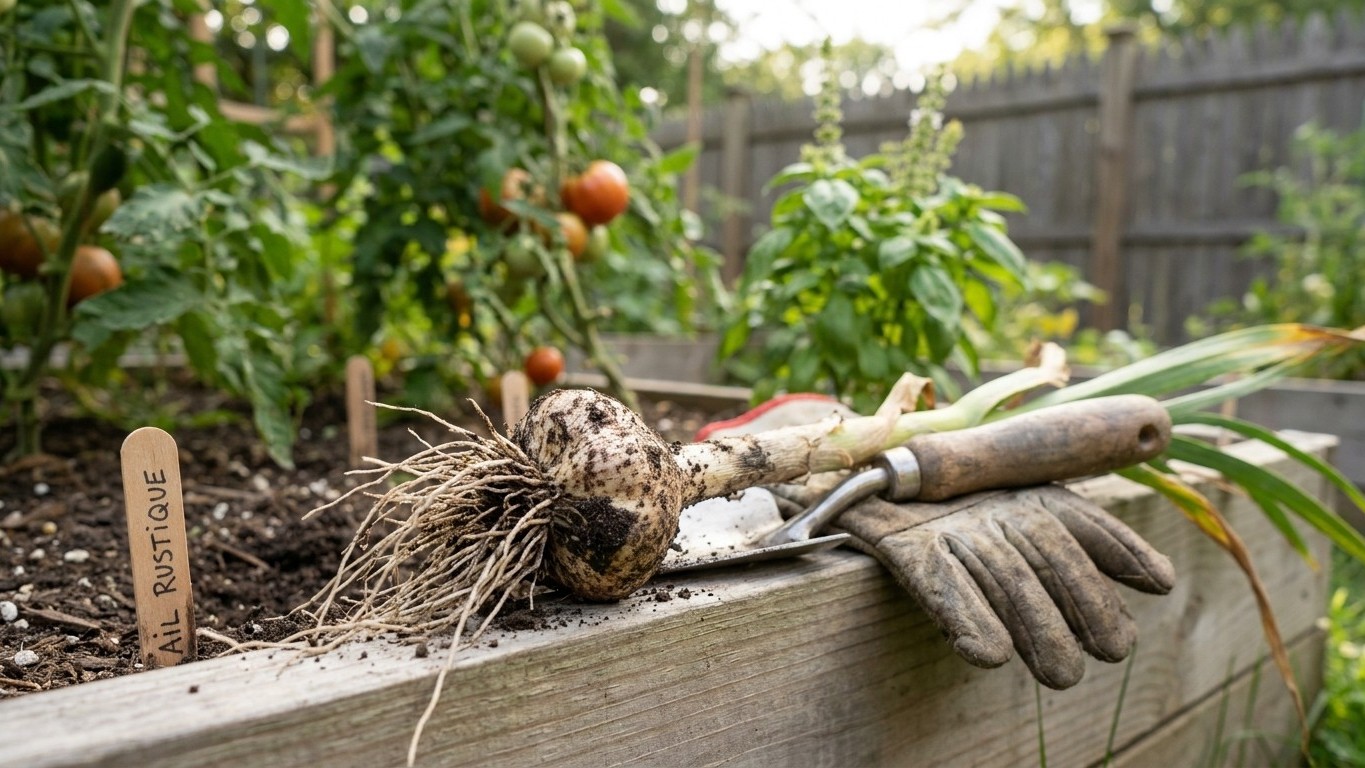

When’s the right time to get garlic into the ground here? Mid October through late October, and that holds no matter what corner of the state you’re standing in. Pick a week in that stretch and get your cloves in before the ground shuts down for winter. Your own yard might nudge that earlier or later than a neighbor’s — clay soil, higher ground, a spot near the coast all shift things a little — but that three-week stretch is where you start, and the rest comes down to reading your own patch of dirt.
The short answer for New Jersey

Plant garlic cloves in New Jersey from mid October through late October. That window holds for every cultivar on the catalogue list, softneck or hardneck, because the fall planting rule for garlic doesn’t change by variety. Cloves need a few weeks of workable, cooling soil to push roots before the ground shuts down for winter, then a long cold spell afterward to trigger the bulb to divide into cloves. If you haven’t settled on a variety yet, Garlic Varieties That Suit New Jersey Winters walks through how softnecks like Inchelium Red and hardnecks like Chesnok Red perform against a New Jersey winter.
The anchor for that window is Newark’s first fall frost, which NOAA’s National Centers for Environmental Information puts at November 4 to November 16 in its 1991-2020 climate normals. Mid-to-late October lands three to four weeks ahead of that range, which is enough time for roots to establish while the soil is still workable but has already cooled enough to stop pushing top growth.
Why this date is a range, not a day
Treat November 4 to November 16 as a midpoint, not a promise. NOAA’s normals are built from three decades of data at Newark’s reporting station, and by definition half the years in that record saw frost arrive after the range closed, not before it. A grower who waits until the very end of October, banking on a mild fall, is gambling against those odds every other year.
That figure also comes from a single station. Newark sits at low elevation, close to the coast, and surrounded by a lot of pavement, all of which tend to push its frost date later than a lot of the rest of the state sees. Treat the range as a starting point and adjust for your own ground, which the next section walks through.
Working it out for your own garden
Start from Newark’s frost window and move backward by the few weeks garlic needs to root before winter dormancy sets in. Counting back three weeks from November 4 lands in mid October; counting back four weeks from November 16 lands in late October. That’s why the catalogue guidance for every variety on the list, from softnecks such as Inchelium Red and Lorz Italian to hardnecks such as Chesnok Red, Duganski and Bavarian Purple, converges on the same mid-to-late October window regardless of which type you plant.
That backward count is a starting point, not a fixed calendar day. Frost dates shift with the weather every year, and soil temperature lags behind air temperature by days to weeks, so a warm October stretches the workable window later while an early cold snap shortens it.
Cold is the part of this calculation New Jersey doesn’t need to worry about. University of Georgia Extension bulletin C854 puts garlic’s vernalization requirement at roughly six to eight weeks of temperatures below 40°F after planting, needed for the clove to split into a full bulb. Newark’s own climate normals show air temperatures below 40°F for an average of 21.8 weeks across the growing season, according to NOAA, more than double what garlic requires. Even a planting on the late side of the window still generally clears that threshold here, and most of New Jersey shares a similar cold-winter pattern.
Adjusting for your site
- Higher elevation cools faster in fall, so gardens up in the Highlands or along the Kittatinny Ridge often see ground frost earlier than Newark’s data suggests.
- Coastal ground along the Jersey Shore and around Cape May holds warmth longer into fall, which can push the safe planting window a bit later than Newark’s own range.
- Heavy clay soil cools and drains slower than sandy loam, so cloves set in clay sit in wetter ground heading into winter, which raises the odds of rot if planting is delayed too close to a wet spell.
- Dense, built-up areas hold heat, so a garden in a town center may run a week or so warmer than an open rural plot a short distance away.
None of these adjustments come with a precise number for every county. The honest approach is to note your own garden’s frost history from the past few years, compare it against Newark’s Nov. 4 to Nov. 16 range, and shift your planting week accordingly. If you’re still working out bed placement or soil prep, Growing Garlic in New Jersey covers that groundwork before this step.
What changes across New Jersey
New Jersey’s climate is not one thing, and Newark’s frost window describes only the reference station it comes from, near the coast and at low elevation in the northeastern part of the state.
Regional differences to watch
The northwest corner of the state, through Sussex and Warren counties and along the Kittatinny Ridge, sits at higher elevation and further from the ocean’s moderating effect. Cold air pools in these valleys earlier in the fall, so gardeners there should expect their own first frost to arrive ahead of Newark’s window, not on top of it, and should lean toward the early half of the mid-to-late October planting range.
The Pine Barrens and much of interior South Jersey sit on sandy, fast-draining soil that cools quickly once nights turn cold, even at low elevation. That combination can bring an early frost to low-lying sandy ground even where the surrounding region stays mild.
The immediate coast, from Sandy Hook down through Cape May, and the Delaware Bay shore, stay warmer into fall because open water holds heat longer than land. Gardeners in these strips can often work a bit later into October than the Newark figure implies, though they should still watch their own local reports rather than assume a fixed number of extra days.
Between these extremes sits most of the state’s population, along the Route 1 corridor and the Raritan and Delaware valleys, where conditions run closer to what Newark’s station records, since the terrain and distance to the coast are broadly similar.
The mistakes this climate punishes
New Jersey’s winters are cold enough that vernalization is essentially not in doubt here, so the mistakes worth worrying about sit on the other side of the calendar: planting too late for roots to establish, planting too shallow, and setting up disease-friendly conditions with poor drainage or old seed stock.
Planting late into the frost window
Cloves need three to four weeks of workable soil to grow roots before winter shuts growth down. A clove pushed into cold, wet ground in the first days of November, right as Newark’s frost window opens, hasn’t had time to anchor itself and is far more likely to heave out of the ground during a winter freeze-thaw cycle than one planted in mid October.
Planting too shallow
Frost heave is a real risk in New Jersey’s freeze-thaw winters, and a clove set only a shallow inch or two down is much easier for the ground to push back up than one set deeper with a mulch layer on top to buffer the swings between freezing and thawing.
Ignoring soil-borne disease pressure
Garlic planted into New Jersey’s fall soil is planted into a window when several soil fungi are also active. According to the UC IPM Pest Management Guidelines for onion and garlic, UC ANR Publication 3453, white rot (Sclerotium cepivorum) has a published soil temperature range of 50-75°F, and Newark’s mean air temperature falls inside that range in five months of the growing season, including September and October, right when fall garlic goes in. Fusarium basal rot (Fusarium oxysporum f. sp. cepae) shows a similar overlap into that same fall stretch. These are air-temperature counts measured against soil-temperature thresholds, so they describe a possibility, not a forecast: soil lags air and swings less than a monthly average shows, and a cold New Jersey winter does not exclude either disease. Both travel on infected seed cloves and in contaminated soil regardless of climate, so the real defense is buying clean seed stock and rotating out of any bed that has grown onions or garlic recently, not counting on cold weather to sterilize the ground.
Checking this against your county
Newark’s frost window is a single reference point, not a state-wide rule, and New Jersey’s counties span coastal plain, sandy pine barrens and mountain ridge within a couple hours’ drive of each other. Before you settle on a planting week, check your own county’s frost data against Newark’s through the Rutgers Cooperative Extension service, at njaes.rutgers.edu, which tracks county-level agricultural conditions across the state’s different growing zones. If your county’s typical first frost runs earlier than Newark’s Nov. 4 to Nov. 16 range, shift toward the early half of mid October. If it runs later, you have more room to lean into late October instead.
Common questions
Can I still Plant Garlic in New Jersey if I missed October?
You can push into early November, but the odds shift against you the longer you wait. Cloves planted right as Newark’s frost window opens have had less time to root, and a heavier mulch layer becomes more important to keep the ground from heaving them out over winter.
What happens if frost hits before my garlic has rooted?
Garlic tolerates a light frost on unrooted cloves better than most crops, since the clove itself is protected underground and roots continue growing in soil that hasn’t fully frozen yet. The bigger risk isn’t the first frost, it’s a hard freeze locking the ground before roots have had any time at all to establish.
Does hardneck garlic need a colder winter than softneck to grow well in New Jersey?
Both types get more than enough cold here, since Newark’s winter runs well past the six-to-eight-week vernalization requirement either type needs. The difference between hardneck and softneck in New Jersey comes down to flavor, storage length and scapes, not whether the winter is cold enough.
Should I mulch garlic right after planting or wait until the ground freezes?
Most growers wait until the ground has cooled and the top inch or so is starting to firm up before laying mulch, rather than mulching immediately after planting. Mulching too early while the soil is still warm can trap heat and moisture around the clove, which favors the same soil fungi that are already more active during New Jersey’s fall shoulder season.
Some gardeners also time this by the Moon: when to plant garlic by the moon, as almanac tradition rather than fact.