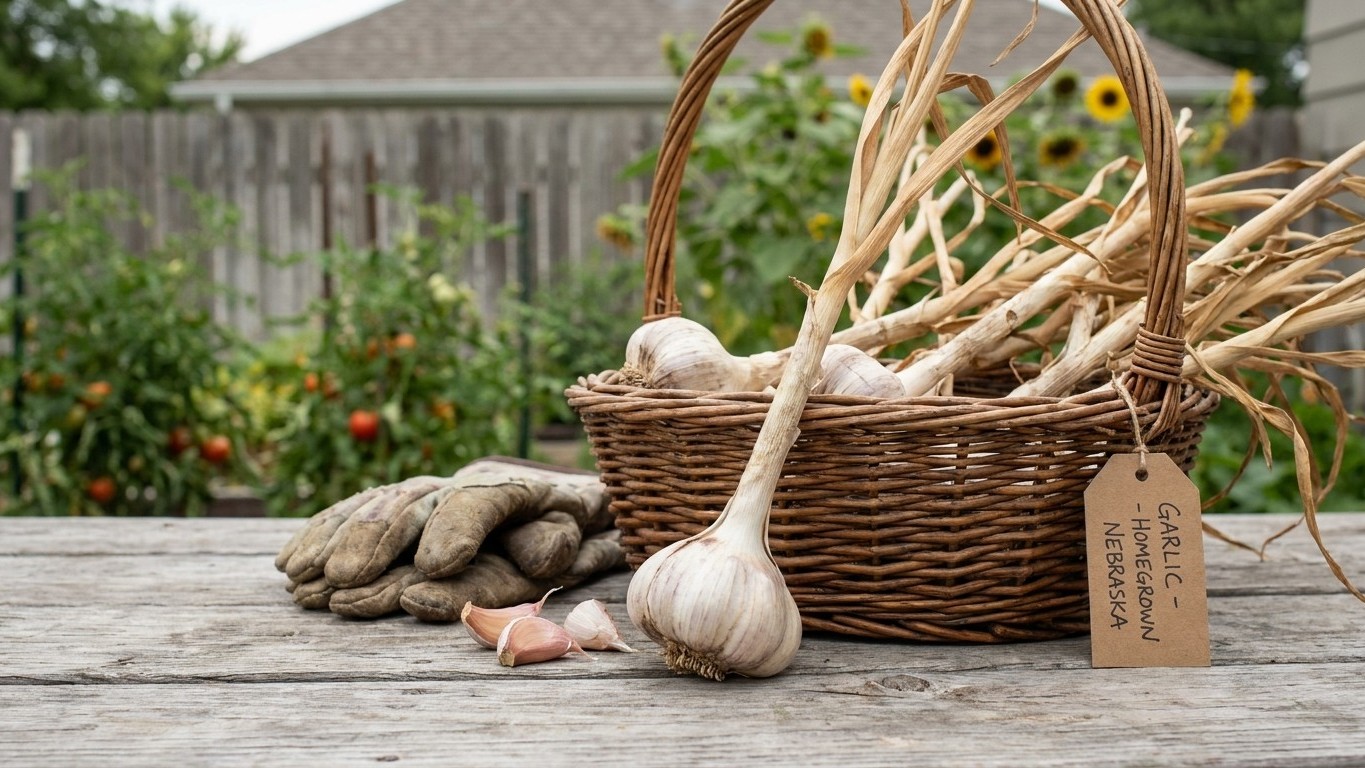

Nebraska winters hand garlic exactly what it needs without anyone having to arrange it. Six to eight weeks below 40°F is the minimum a clove requires before it will split into a full head, and this state clears that mark easily, with hard freezes arriving by mid to late October and cold holding on well into the new year. Skip that chill and you don’t lose the crop, you lose the division — one round bulb instead of a cluster of cloves.
Will garlic get the cold it needs in Nebraska

Garlic clove is not planted the way onion seed is scattered and left to grow. Each clove has to sit through a real cold spell before it will split into a full head next summer. University of Georgia Extension publication C854 puts that requirement at six to eight weeks with temperatures below 40°F. Skip that stretch and you don’t lose the crop outright, you lose the multiplication: the grower lifts one smooth, round bulb where a divided head of cloves should have been.
Nebraska’s continental winter clears this requirement without much drama. The first fall freeze already lands in mid to late October at the Omaha reference station per NOAA’s normals, and from there the state runs a long, hard winter with repeated stretches well below 40°F clear into the new year. That’s a longer and colder run than the minimum C854 describes, which is exactly why garlic is a traditional autumn crop here rather than an experiment. Nebraska gardeners do not need to engineer cold artificially the way growers in mild-winter states do.
The one place this breaks down is planting stock that spent the fall somewhere warm, or a clove held indoors too long before going in the ground. If you buy seed garlic from a warm-climate source or start it late enough that it barely roots before hard freeze, treat it the same way a grower in a mild state would: refrigerate the cloves at 35-40°F for four to six weeks before planting to force the vernalization that a short or late-arriving winter would otherwise skip. That refrigeration step is insurance, not a requirement for most Nebraska plantings, and it matters far more in places like Nevada, where the cold season is short and unreliable, than it does here. A grower comparing notes with someone in a milder state can see how different the calculation is in Growing Garlic in Nevada: Planting Dates, Varieties and Winter Cold.
The second option, growing softneck instead of hardneck, matters more for storage habits and kitchen use than for surviving the winter, since Nebraska’s cold is enough for either type. That distinction, along with a closer look at Garlic Varieties That Suit Nebraska Winters, gets its own section below.
When to put the cloves in
Garlic planted in fall needs two things that pull in opposite directions: enough time to root into the soil before it freezes solid, and not so much time that the shoot pushes well above ground before winter hits. Anchor your calendar for When to Plant Garlic in Nebraska on NOAA’s 1991-2020 first fall freeze range for the Omaha station, October 15 to October 26, and count backward.
Working out the window
Most garlic growers set cloves two to four weeks ahead of the first killing frost. Counting Back From the October 15-26 range lands the planting window in late September to early October, which is why every variety listed below carries that same set-out window. Treat October 15-26 as a midpoint for the state’s eastern reference station, not a safe date to plan around. A freeze can arrive on either side of that range in any given year, and the only way to know your own risk is to track the pattern in your county.
- Set cloves too early and excess top growth before winter gets damaged by hard freezes, weakening the plant going into spring.
- Set cloves too late and roots don’t establish before the ground locks up, which can push the whole clove up out of loose soil over winter.
- Mulch timing (covered further down) is what buys you flexibility at either edge of that window.
Elevation moves this window more than anything else in Nebraska. The Panhandle sits meaningfully higher than the Omaha reference station and tends to see its first frost earlier in the season, so growers out there should lean toward the early end of the late September to early October range rather than the late end. Anyone gardening near a large reservoir may see a similar effect in reverse, since a big body of water holds heat into fall and can push the first local frost a little later than the open-country pattern around it.
Which types suit Nebraska
Hardneck and softneck garlic are not interchangeable, and the choice here is shaped by climate more than by taste. Hardneck garlic wants a real winter, producing a flowering stalk called a scape and storing for a few months after harvest. Softneck garlic tolerates milder winters, skips the scape, and stores considerably longer in a pantry or braid. Nebraska’s winters, established above as clearing the six-to-eight-week chill requirement with room to spare, suit hardneck varieties especially well, and that’s the type most Nebraska growers plant.
Among hardnecks, Duganski and German Red are both reliable choices for a cold, long winter, with the kind of hardiness that a genuinely hard freeze rewards rather than punishes. German White and Chesnok Red round out the porcelain and purple stripe types worth trying in a first planting. Growers who want more variety in the bed can add Georgian Crystal, Georgian Fire, Blue Music, or Bavarian Purple. Fall Festival and Ivan are also hardneck options worth sourcing if you want to compare flavor and clove size side by side. All of these are set out on the same late September to early October window described above.
Softneck garlic is not off the table here. It handles Nebraska’s winter cold without difficulty, and its longer shelf life is worth having if you cook with garlic year-round. Inchelium Red and Lorz Italian are both solid softneck picks, and Early Red Italian and Italian Late fill out the softneck side of the bed. The tradeoff runs the other way from what many gardeners expect: it isn’t that softneck struggles in Nebraska’s cold, it’s that hardneck rewards it with bigger cloves and stronger flavor, which is why most seed catalogs aimed at cold states lean hardneck by default.
| Trait | Hardneck | Softneck |
|---|---|---|
| Winter cold tolerance | Excellent, needs a real winter | Good, tolerates mild or cold winters alike |
| Storage life | Shorter, a few months | Longer, often into the following spring |
| Scape production | Yes, cut for eating before it hardens | No scape |
| Clove count and size | Fewer, larger cloves per head | More, smaller cloves per head |
A grower in a genuinely severe winter climate, like parts of Growing Garlic in Wisconsin: Planting Dates, Varieties and Winter Cold, faces a similar hardneck-leaning calculation, though the mulch demands there run heavier than what most of Nebraska needs.
Soil and bed preparation
Garlic sits in the same patch of ground for eight to nine months, through freeze, thaw, and spring rain, so the bed has to handle water before anything else. Standing water rots a clove faster than any disease in this climate will, and it does it silently, underground, well before you’d notice a problem on the leaves. If your planting site holds puddles for more than a few hours after a heavy rain, raise the bed or move the planting somewhere else.
What to do before the cloves go in
Work compost or well-rotted manure into the bed a few weeks ahead of planting, not the same day, so it has time to settle rather than sitting in loose pockets around the clove. Garlic prefers loose, crumbly soil it can push roots through easily, so break up compaction with a fork rather than leaving a hard-packed surface from summer’s previous crop. A raised bed or raised row helps in any spot with heavy clay, since it lifts the root zone above the water table during Nebraska’s wetter spring stretches.
Test your soil’s pH and nutrient levels before you plant rather than guessing, especially if this bed has never grown garlic or onions before. A soil test costs little and tells you exactly what the bed is short on, instead of you adding fertilizer on a hunch and either wasting it or overfeeding the crop. Clear the bed of the previous season’s crop debris too, since old plant material sitting on the surface through winter gives fungal spores a place to overwinter close to next year’s cloves.
What the climate here favours, and what it does not
UC IPM’s Pest Management Guidelines for Onion and Garlic (UC ANR Publication 3453) publish the temperature ranges several major garlic diseases need to be active, and those ranges can be checked against Nebraska’s growing-season air temperatures to see which months open a window for each pathogen. These published thresholds are soil temperatures, while the figures below are air temperatures, so a month landing inside a disease’s range is a tendency worth watching, not a confirmed infection.
| Disease | Published range | Months in range (growing season) | Note |
|---|---|---|---|
| White rot (Sclerotium cepivorum) | 50-75°F | 5 (September, October, April, May, June), including 1 at the published optimum | Widest window of the four |
| Fusarium basal rot (Fusarium oxysporum f. sp. cepae) | 59-90°F | 4 (September, May, June, July) | Overlaps white rot at the shoulders of the season |
| Pink root (Setophoma terrestris) | 75-85°F optimum | 1 (July), at the published optimum | Narrow window, midsummer only |
| Southern blight (Sclerotium rolfsii) | 86-95°F optimum | 0 | Outside its optimum here, not eliminated |
White rot carries the widest window in Nebraska’s growing season, with five months landing inside its published range and one of those at the disease’s own optimum, per UC IPM’s figures. Fusarium basal rot follows with four months in range, split between early fall and the heart of summer. Pink root only lines up with its optimum in July, and southern blight never reaches its 86-95°F optimum here at all going by the growing-season averages, though a temperature window closing is not the same as a pathogen being absent from the state.
None of this predicts an outbreak in any one garden. A count of months in range describes a climate, not a diagnosis, and infected seed garlic can introduce any of these pathogens to soil that would otherwise never favor them. The single best defense against all four is planting certified disease-free seed garlic and rotating away from onions and garlic in that bed for several years, which matters more than any month-by-month temperature table.
Getting it through the winter
Mulch is what lets a Nebraska grower plant at the edge of the late September to early October window without worrying too much about an early cold snap. Lay several inches of straw or shredded leaves over the bed once the ground has cooled but before it freezes hard, so the mulch insulates the soil rather than just sitting on top of frozen ground doing nothing. A shallow-planted clove is the one most at risk from frost heave, where repeated freeze-thaw cycles push the clove partway out of the soil and expose it to cold air and drying wind. Planting at a proper depth in the first place, then mulching over it, is the real fix, not a single thick layer applied after the fact.
Spring pullback
Leave the mulch in place through the coldest months. In early spring, once new green shoots start pushing up and hard freezes are clearly behind you, pull the mulch back so the soil can warm and the shoots aren’t smothered. Pulling it too early risks exposing new growth to a late cold snap, while leaving it too long can trap moisture against the shoots and invite rot right at the point where they’re most tender. Most growers rake it to the side rather than removing it completely, since a thin layer left around the base still suppresses weeds through spring.
Harvest and curing here
Garlic tells you when it’s ready through its leaves, not through a date on the calendar. When the lower third to half of the leaves have browned and dried back while the upper leaves are still green, the bulb has finished sizing and it’s time to lift. Pulling too early leaves cloves undersized and a papery skin that hasn’t fully formed, while waiting too long lets the wrapper split and the individual cloves separate in the ground, which shortens how long the head will keep.
Curing is where a lot of an otherwise good crop goes wrong, and Nebraska’s summer swings between hot, dry stretches and humid spells make this step less forgiving than it looks. Cure the whole plant, roots and leaves still attached, in a shaded spot with good airflow rather than direct sun, which can scorch the bulbs right through the papery wrapper. Good airflow matters more than heat: a humid stretch slows curing and raises the risk of mold setting in on the neck, so a fan or an open-sided space beats a closed, still shed even if the shed is cooler. Three to four weeks is typical before the necks are fully dry and the bulbs are ready to trim and store.
Local help
County-level frost dates, soil test results, and planting recommendations specific to your part of the state go beyond what a single reference station can tell you. University of Nebraska-Lincoln Extension runs county offices across the state that can pull local data and answer questions a general guide like this one can’t, including soil testing services worth using before you commit a bed to garlic for the season.
Common questions
Can I plant garlic in spring in Nebraska instead of fall?
You can, but expect smaller heads with fewer, smaller cloves, since spring-planted garlic misses most or all of the cold period that triggers division. Fall planting timed to the frost window described above is what produces a full head of cloves rather than a single round bulb.
What happens if I miss the late September to early October planting window?
Get the cloves in the ground as soon as you can afterward, even into November, rather than holding them until spring. A late-planted clove that gets even a few weeks of root growth before hard freeze usually does better than one held indoors all winter and planted in spring.
Do I need to refrigerate garlic before planting in Nebraska?
No, not for garlic planted on the usual fall schedule, since the state’s winter already clears the chilling period garlic needs. Refrigeration before planting matters mainly for growers in mild-winter states or for stock that was stored somewhere warm right up until planting.
Why did my garlic only produce one round bulb instead of a head of cloves?
That’s a sign the clove didn’t get enough sustained cold, usually from planting too late for meaningful root and chill exposure, or from seed stock that spent the fall somewhere warm before you got it in the ground. It’s rarely a variety problem in a climate like Nebraska’s.
Should I remove the scape on hardneck garlic?
Yes, cut the scape once it curls, since leaving it on diverts energy from bulb sizing into the stalk. The scapes themselves are edible and worth using in the kitchen rather than discarding.