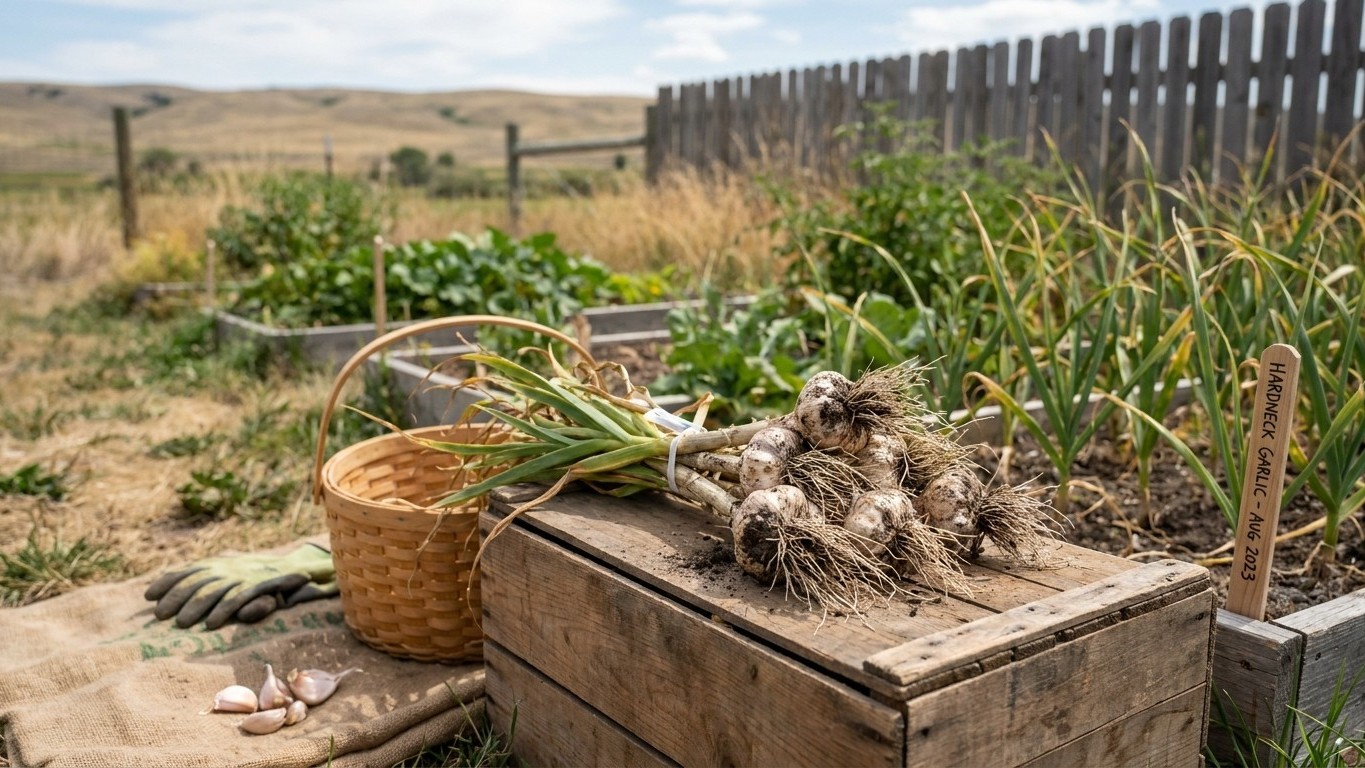

Thirty weeks of sub-40°F cold roll through a typical Wyoming winter near Cheyenne, and garlic only needs six to eight of them to split into separate cloves instead of forming one solid, useless bulb. That gap is the whole story here. In milder states, growers sweat over whether their winter gets cold enough long enough; in Wyoming, the question flips, because the cold arrives with room to spare almost everywhere in the state, mountain valley or river bottom alike.
Will garlic get the cold it needs in Wyoming

A garlic clove needs weeks of temperatures under 40°F after it goes into the ground, or it never splits into separate cloves at all. Skip that cold requirement and you dig up one round, undivided bulb next summer instead of a head you can actually cook with. This is the question most generic planting guides skip past, and it’s the first thing worth checking before you order seed garlic and figure out When to Plant Garlic in Wyoming for a specific climate.
How Wyoming’s cold measures up
Near Cheyenne, NOAA’s climate data puts winter temperatures below 40°F at roughly 30.4 weeks a year. University of Georgia Extension publication C854 sets the actual requirement for clove division at six to eight weeks of cold after planting. Wyoming’s winter clears that minimum several times over, so cold is not the limiting factor for garlic here the way it is in much milder states.
That 30.4-week figure comes from one reference point near Cheyenne, and the rest of the state does not sit at the same elevation or in the same weather pattern. Higher basins and mountain valleys run colder and longer still. Lower, more sheltered river valleys will still clear the six-to-eight-week threshold, just with less to spare. Nowhere in Wyoming is a grower likely to fall short of the cold garlic needs, which is a rare thing to be able to say plainly about this crop.
If you’re still not sure
Growers in far colder territory, such as Yukon, contend with a different problem entirely, keeping seed cloves from freezing solid before they’ve even rooted (see Growing Garlic in Yukon: Planting Dates, Varieties and Winter Cold). Wyoming’s cold is real but rarely at that extreme, so it works with garlic rather than against it.
If you buy seed garlic that has spent weeks sitting in a warm truck or on a heated store shelf, refrigerate the cloves for several weeks before planting just to make sure the vernalization clock has actually started. That’s the safety net for stock of uncertain history. The other option, if cold is ever a genuine worry in a particular garden, is to lean toward softneck garlic, which needs less cold to perform well. Wyoming’s growers aren’t forced into that choice for lack of cold, but it remains available, and choosing among the Garlic Varieties That Suit Wyoming Winters can still come down to taste and storage life rather than climate.
When to put the cloves in
NOAA’s 1991-2020 climate normals put Cheyenne’s first fall freeze, the point air temperature drops to 32°F, somewhere between September 24 and October 5. That’s a range, not a single date, and the actual frost in any given year can land anywhere inside it or slightly outside. Use the middle of that window, late September, as an anchor point for planning, not as a date to circle on the calendar and count on exactly.
Reading the frost window
Garlic wants two things that pull against each other: enough time in the ground to grow roots before the soil freezes hard, and not so much time that it pushes real top growth before winter arrives. Counting back two to four weeks from that late-September anchor lands the planting window in early to mid September for the Cheyenne area, which is also why every variety in this territory’s catalogue is timed to that same stretch.
Local growers here also watch the soil rather than the calendar for a second confirmation. Once the top few inches of soil feel reliably cool through the middle of the day, not just cool in the early morning, that’s as good a planting signal as a date on a chart.
What shifts the date
Elevation is the big variable in Wyoming. A garden a few thousand feet higher than Cheyenne’s reference station sees its first freeze earlier, sometimes by weeks, and should plant on the early edge of the window or slightly ahead of it. A garden in a lower, more sheltered valley can push later. Wind exposure matters too: an open, wind-scoured plot loses ground heat faster than a garden with a windbreak nearby, even sitting at the same elevation.
If your county extension office publishes its own local frost date, use it in place of the Cheyenne figure. Cheyenne is one station in a state with enormous variation in terrain, and a date measured there won’t fit a garden in the Bighorn Basin or up against the Snowy Range the same way.
Which types suit Wyoming
Garlic splits into two types, hardneck and softneck, and the difference matters more here than it does as a matter of taste. Hardneck garlic needs a real cold season to perform, sends up a curling flower stalk called a scape, and stores for a few months after harvest. Softneck garlic tolerates milder winters that never get properly cold, skips the scape entirely, and stores far longer, sometimes eight months or more under the right conditions.
Hardneck varieties for Wyoming’s cold
Wyoming’s long, cold winter plays directly to hardneck’s strengths without punishing softneck either. Hardneck is the safer default choice for most of the state, since it’s bred for exactly this kind of winter and tends to produce larger, easier-to-peel cloves when it gets the cold it wants. The catalogue lists ten hardneck varieties suited to this territory, all set out on the same early-to-mid-September schedule:
- Bavarian Purple
- Blue Music
- Chesnok Red
- Duganski
- Fall Festival
- Georgian Crystal
- Georgian Fire
- German Red
- German White
- Ivan
Softneck options if you want them
Softneck still has a place, particularly for a grower who wants a braidable harvest or a bulb that keeps into late winter without special storage. Early Red Italian, Inchelium Red, Italian Late and Lorz Italian are all softneck varieties in the same catalogue, planted on that same early-to-mid-September window. Inchelium Red has a reputation for adapting well outside its native growing range, and Lorz Italian is a reliable, mild-flavored keeper.
For comparison, a state with a milder or shorter cold season leans harder toward softneck out of necessity rather than choice. Nebraska’s growers work with a shorter run of cold and plant a higher share of softneck varieties as a result (see Growing Garlic in Nebraska: Planting Dates, Varieties and Winter Cold). Wyoming’s growers get to choose based on storage needs and kitchen preference instead, because the winter here supports either type comfortably.
Soil and bed preparation
Garlic sits in the same bed for nine to ten months, through freeze, thaw, and spring mud, so drainage has to be right before anything else matters. Standing water kills a garlic clove faster than any disease does, rotting it in place well before the ground even fully freezes. If your bed holds water after a heavy rain or spring snowmelt, raise it. A mounded row or a framed raised bed a few inches above grade solves most drainage problems in heavier Wyoming clay soils.
Working the bed
Work compost or well-rotted manure into the top few inches of soil weeks before planting, not the same day. Fresh, uncomposted manure carries too much nitrogen too fast and can burn young roots or push soft, disease-prone growth right when the plant should be settling in quietly for winter. Garlic prefers soil that’s fertile but not freshly hot with nutrients, and giving amendments time to mellow matters as much as adding them in the first place.
Clear the bed of weeds and old crop debris before planting, since garlic can’t out-compete an established weed the way a fast, leafy summer crop can. A clean bed at planting time stays far easier to manage through a Wyoming winter than one you’re still weeding come snowmelt.
Test soil pH if you haven’t in the last few seasons. Garlic does best in soil that isn’t strongly acidic or alkaline, and a simple test tells you whether lime or sulfur is worth adding before you plant rather than guessing after a disappointing harvest. Your county extension office, covered further down, can run this test and tell you what your particular bed actually needs.
What the climate here favours, and what it does not
UC IPM (UC ANR Publication 3453) publishes the temperature ranges where four major garlic diseases become active. Matching Wyoming’s growing-season air temperatures against those ranges shows where the real pressure sits and where it mostly doesn’t. One caution before the numbers: those published thresholds are soil temperatures, and the figures below are air temperatures, so this is a tendency worth watching, not a line that gets crossed on a given day. A monthly average also hides the swing inside it. A month averaging within range still holds plenty of days both colder and hotter than that average.
| Disease | Pathogen | Published range | Months in range here |
|---|---|---|---|
| White rot | Sclerotium cepivorum | 50 to 75°F | 4 (September, May, June, July), including 1 at the optimum |
| Fusarium basal rot | Fusarium oxysporum f. sp. cepae | 59 to 90°F | 2 (June, July) |
| Southern blight | Sclerotium rolfsii | 86 to 95°F (optimum) | 0 |
| Pink root | Setophoma terrestris | 75 to 85°F (optimum) | 0 |
Where the pressure sits
White rot carries the most pressure of the four in this territory, with four months of the growing season, September and then May through July, falling inside its published range, including one month sitting at the pathogen’s actual optimum. That’s the disease worth watching hardest here, and it survives in soil for years once established, so the real defense is starting with clean seed garlic rather than trying to treat an infected bed later.
Fusarium basal rot has a narrower window, two months in early summer, and Southern blight and pink root never reach a month at their published optimum anywhere in Wyoming’s growing season.
What a zero month doesn’t mean
That last pair is genuinely good news for a Wyoming grower. It does not mean either disease is impossible here. Infected seed garlic carries a pathogen regardless of what the local climate favors, and an unusually hot week can push conditions toward a pathogen’s range even in a month whose average sits outside it. Buying certified disease-free seed garlic remains the actual defense, not the local temperature pattern.
Because white rot’s resting structures can persist in soil for many years once introduced, rotating garlic and other alliums like onions and leeks away from a bed where you’ve seen the disease does more long-term good than any spray. A rotation of a few years, paired with clean seed stock, keeps this particular pressure in check better than reacting to Wyoming’s temperature pattern alone.
Getting it through the winter
Mulch is what turns Wyoming’s long, cold winter from a threat into an asset. A generous layer of straw or shredded leaves, thick enough that you can’t see soil through it, insulates the bed against sharp temperature swings and slows the freeze-thaw cycles that heave shallow-planted cloves right out of the ground. Wait until the ground has started to cool and firm up before mulching, not right after planting. Mulch too early and you trap warmth that encourages top growth before winter, growth that then gets damaged by the first hard freeze anyway.
Mulch timing and heaving
Heaving, not the cold itself, is the real winter risk here. Repeated freezing and thawing through a Wyoming winter can work a clove upward until its top sits exposed at the soil surface, where it dries out or gets injured by the next cold snap. A solid mulch layer moderates those swings enough to prevent most of it, and planting at a proper depth in the first place, rather than barely tucking cloves under the surface, gives you a buffer if some heaving happens regardless.
Leave the mulch in place through the coldest months. Once you see the first green shoots pushing up in spring, pull the thickest part of it back so the ground can warm and the shoots aren’t fighting through a dense mat. A thinner layer left in place after that still suppresses weeds and holds soil moisture through the drier months ahead, which matters in a state where spring moisture can be unreliable from one year to the next.
Wind matters as much as cold in an open Wyoming garden. A mulch layer that isn’t held down, whether by extra weight, snow cover, or a nearby windbreak, can blow clear off the bed in a single gusty week and leave cloves exposed right when they need the cover most. Weighing mulch down with a lightweight row cover or extra straw pinned at the edges is worth the effort in an exposed plot.
Harvest and curing here
Read the plant, not the calendar. Garlic is ready to lift when the lower third to half of the leaves have browned and died back while the upper leaves are still green, not when a date on a chart says it should be. Pull too early and the wrapper hasn’t fully formed around the cloves. Pull too late and the bulb can split open in the ground, which shortens how long it keeps in storage.
Wyoming’s growing season runs from that early-to-mid-September planting through the following summer, and by the time harvest arrives the plant will tell you clearly enough if you check it every few days once the lower leaves start turning. Lift the whole bulb gently with a fork rather than pulling it by the stem, since a snapped stem still needs curing and a torn root plate invites rot in storage.
Curing in a dry climate
Wyoming’s air runs dry for most of the growing season, which actually works in a curing garlic‘s favor. Cure bulbs somewhere shaded, with good airflow and out of direct sun, for a few weeks until the outer wrappers turn papery and the necks dry out fully. Never cure garlic in direct sunlight, since it can scald the outer cloves even in a climate this dry.
The main risk in a dry climate isn’t mold, it’s curing too fast and too hard, which can leave cloves slightly shriveled if airflow is very high and humidity very low. A shaded porch, an open-sided barn, or a covered rack out of direct sun all work better than a hot, closed shed. If you hit a stretch of unusually humid weather during curing, which happens even in a generally dry state, spread the bulbs out further and increase airflow rather than counting on the climate to do all the work.
Local help
Cheyenne’s frost data is a single reference point in a state where elevation swings from under 4,000 feet to well over 10,000. For a planting date, soil test, or disease history specific to your own county, contact the University of Wyoming Extension at uwyo.edu/uwe. Local offices also track pest and disease reports, which matters more than a statewide temperature average once a soilborne disease like white rot shows up in a particular county.
Common questions
Can I Plant Garlic in spring instead of fall in Wyoming?
Not if you want a properly divided bulb. Garlic needs the cold weeks after fall planting to split into cloves, and a spring planting misses that window entirely, usually producing a small, undivided bulb or none at all.
What if I miss the early September to mid September planting window?
Plant as soon as you can rather than waiting for next year. Cloves put in late still root to some degree before the ground freezes, though with less established roots they’re more prone to frost heaving, so mulch heavier than you would for an on-time planting.
Do I need to cut the scapes off hardneck garlic?
Yes, for bulb size. Cutting the curling scape once it forms redirects the plant’s energy into the bulb instead of the flower stalk, and the scapes themselves are edible, good chopped into a stir-fry or blended into a pesto.
Can I just plant garlic from the grocery store?
You can, but it’s a gamble. Grocery garlic is often treated to slow sprouting, may not be suited to a cold-winter climate, and can carry soilborne diseases like white rot into a bed that’s been clean for years. Certified seed garlic from a known source costs more but avoids all three problems.
How long will Wyoming-grown garlic actually keep in storage?
It depends on the type. Softneck varieties like Inchelium Red or Lorz Italian generally outlast hardneck varieties in storage, sometimes by several months, while hardneck types like German Red or Chesnok Red are better used within a few months of curing. Store either type somewhere cool, dry, and dark, and check bulbs occasionally through winter for any that are softening.