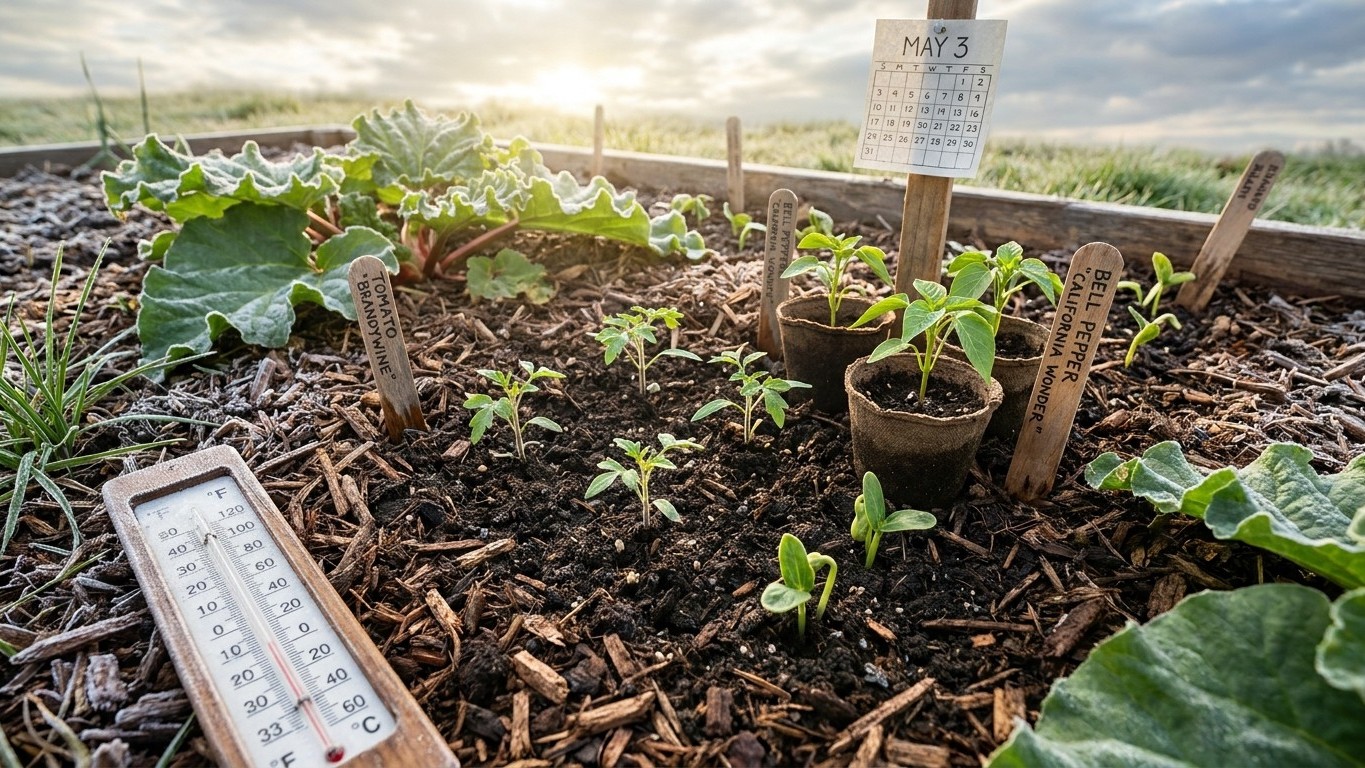

Maryland’s growing season runs on three numbers: a hardiness zone that spans 5b to 8a, a last spring frost that lands somewhere between April 3 and April 16, and a first fall frost arriving October 26 to November 5. Put together, those figures set the real boundaries of what you can grow here, and where the state’s zone map is more range than rule.
How long your season really is

Subtract the frost dates and you get the number that actually runs your garden: a frost-free window of roughly 190 to 210 days, depending on where in the state you’re standing. That’s the figure to plan around, not the calendar month.
Two hundred days sounds generous, and for most vegetables it is. But long-season crops, the ones that need 100+ days just to reach maturity after transplant, start eating into your margin fast. A pepper variety that needs 75 days to fruit, planted after your last frost risk clears in mid-April, might not finish before that first fall frost shows up, which is why understanding the timing behind Growing Peppers in Maryland matters as much as picking the right variety. Shorter-season staples fare better under this same margin, which is part of why Growing Potatoes in Maryland remains one of the more forgiving options for gardeners working with a tighter window, and why quick, cool-tolerant crops like those covered in Growing Carrots in Maryland leave even more room for error, a margin shared by fast-maturing greens, since Growing Spinach in Maryland often fits comfortably into even a shortened window, though root crops aren’t all equally forgiving, since Growing Parsnips in Maryland means budgeting for a much longer maturity window before that first fall frost matters. Add a rainy spring that delays transplanting, or a cool stretch that slows fruit set, and a “tight but doable” crop turns into one that never ripens, though root crops like beets tend to handle these hiccups better than most, which is part of why Growing Beets in Maryland stays a reliable choice even in an unpredictable season, a margin also enjoyed by warm-season staples with moderate maturity windows, since Growing Sweet Corn in Maryland typically fits comfortably within the state’s frost-free stretch without pushing the calendar to its limits. This is exactly why long-season melons, certain dry beans, and late-maturing winter squash varieties, including pumpkins, are a gamble in Maryland, not a safe bet, a risk that’s central to Growing Pumpkins in Maryland, and it’s part of why knowing When to Carve a Pumpkin in Maryland depends so heavily on your local frost timing. Perennial crops sidestep this yearly guessing game entirely, which is why Growing Asparagus in Maryland is worth considering for gardeners who’d rather invest in a bed that keeps producing for years than replant a tight-window crop every season.
The other thing worth saying plainly: April 3 to April 16 and October 26 to November 5 are averages, not guarantees. NOAA builds these dates from a 30-to-70% probability band, which means in roughly half of all years, frost arrives later in spring or earlier in fall than the stated range. Plant tender crops right at the early edge of that spring window and you’re betting on the better half of history repeating itself. It usually does. Not always.
Location inside the state matters more than the statewide range suggests. Western Maryland, Garrett and Allegany counties especially, sits at higher elevation and runs weeks later on both ends of the frost calendar. The Eastern Shore, moderated by the Chesapeake Bay, tends to run milder and can push both dates in the opposite direction. If you garden in Oakland versus Salisbury, you are not working with the same season at all, even though both fall inside “Maryland” on a map.
What the summer does to a garden here
Baltimore’s climate record shows an average of 24.6 days a year at or above 90°F. That’s not a headline number like a summer average temperature. It’s a count of how many days your garden spends under real heat load, the kind that changes plant behavior rather than just making you sweat on the porch.
Above roughly 90°F, tomato flowers stop setting fruit. The plant keeps growing, keeps blooming, but pollen becomes less viable and blossoms drop without producing anything. Lettuce and spinach bolt, sending up a flower stalk and turning bitter, in that same heat. Cool-season crops that were fine in May become nearly impossible to keep going through late July and August. Almost 25 days of that kind of heat each year isn’t an occasional bad week. It’s a built-in dead zone in the middle of the growing season.
That reshapes how a Maryland garden actually works, whether you plan for it or not. Instead of one long, uninterrupted growing season, most gardeners here end up running two: a spring push for cool-weather crops that wraps up before peak heat, and a second planting in late summer for a fall harvest, with the hottest weeks in between mostly given over to heat-tolerant crops or covered ground. Treating April through October as one continuous window, planting lettuce in June because “it’s still spring-ish,” is one of the more common ways a Maryland garden underperforms.
On the other end, the coldest month’s average daily minimum in Baltimore sits at 25.4°F. That figure, not the record low from some unusual cold snap, is what decides whether a perennial, shrub, or overwintering crop actually survives here. It’s the number behind the hardiness zone rating, and it’s why a plant tagged for zone 7 can struggle in the colder pockets of western Maryland even though it thrives 100 miles east.
What tends to go wrong in Maryland
The University of Maryland Extension’s Home and Garden Information Center tracks a specific set of pests that show up consistently in home gardens across the state, and a handful of them account for most of the damage reports.
Squash vine borer and squash bug both target the same plant family, but at different points. Squash vine borer moths lay eggs at the base of squash and zucchini stems in early-to-mid summer, and the larvae tunnel inside, causing a plant that looks healthy one week and collapses the next. Squash bugs work more slowly, sucking sap from leaves through summer and leaving yellow speckling that spreads into wilted, blackened foliage. Colorado potato beetle shows up early in the season on potato and eggplant leaves, stripping foliage down to the veins if populations build unchecked.
Tomato and tobacco hornworms are a mid-to-late summer problem, large green caterpillars that can strip a tomato plant of leaves in a matter of days, usually noticed only once the damage is already visible. Brown marmorated stink bug, an invasive species now well established statewide, feeds on a wide range of vegetables and fruit through summer, leaving cat-facing scars and discolored patches on tomatoes and peppers. Spotted lanternfly, more recently established, targets certain trees and grapevines rather than typical vegetable crops, but has become common enough that Maryland Extension flags it as a species home gardeners should know how to identify.
None of this is a full list, and pressure from any given pest varies a lot depending on where in the state you garden. The point isn’t to memorize every insect Maryland has ever recorded. It’s to recognize the few that actually show up in most home gardens, so a sudden collapsed squash plant or a stripped tomato reads as a known problem rather than a mystery.
Where to check before you plant
Everything above is a state-level average, and Maryland covers enough ground, from Appalachian ridges in the west to Atlantic coastline in the east, that a state-level average is a rough guide at best. A planting calendar built around frost dates for the state’s center can be three weeks off for a gardener in Garrett County or on the lower Eastern Shore, and three weeks is the difference between a tomato that ripens and one that gets caught by frost.
The University of Maryland Extension is the land-grant service for the state, and its Home and Garden Information Center publishes planting guidance, pest identification resources, and seasonal tips built specifically for Maryland conditions. Beyond the statewide site, each county runs its own extension office, and that’s the better resource for anything hyperlocal: your actual frost risk, soil type, and which pests are causing trouble in your area this particular year.
Think of this as the frame, not the picture. It tells you the season’s real length, where the heat squeezes the calendar, and which pests to expect in general terms. The specifics for your ten-mile radius, and for the exact crop you’re planning to grow, belong to your county extension office and to the crop-specific guidance built for Maryland’s actual range of conditions.
Where to Go Next for the Specifics
Everything above is about the climate math that shapes what grows here — but each crop and planting has its own calendar, and that’s worth working out separately. If you’re thinking about getting cloves in the ground this fall, the guide to growing garlic in Maryland lays out why hardneck varieties do well away from the Bay’s edge, where winter delivers the six to eight weeks below 40°F that a clove needs to split into a full head instead of staying small. For the lawn, most advice assumes a climate that doesn’t match Maryland’s mix of nearly a month of 90°F-plus days and winters dropping into the low 20s, so the piece on Maryland lawn care works through what to plant and feed given that squeeze. And if tomatoes are the plan, don’t treat the last-freeze date as a single circled day — the rundown on growing tomatoes in Maryland explains why that date is really a probability band, and why it stops applying once you’re out of the Baltimore corridor and into places like Garrett and Allegany counties.