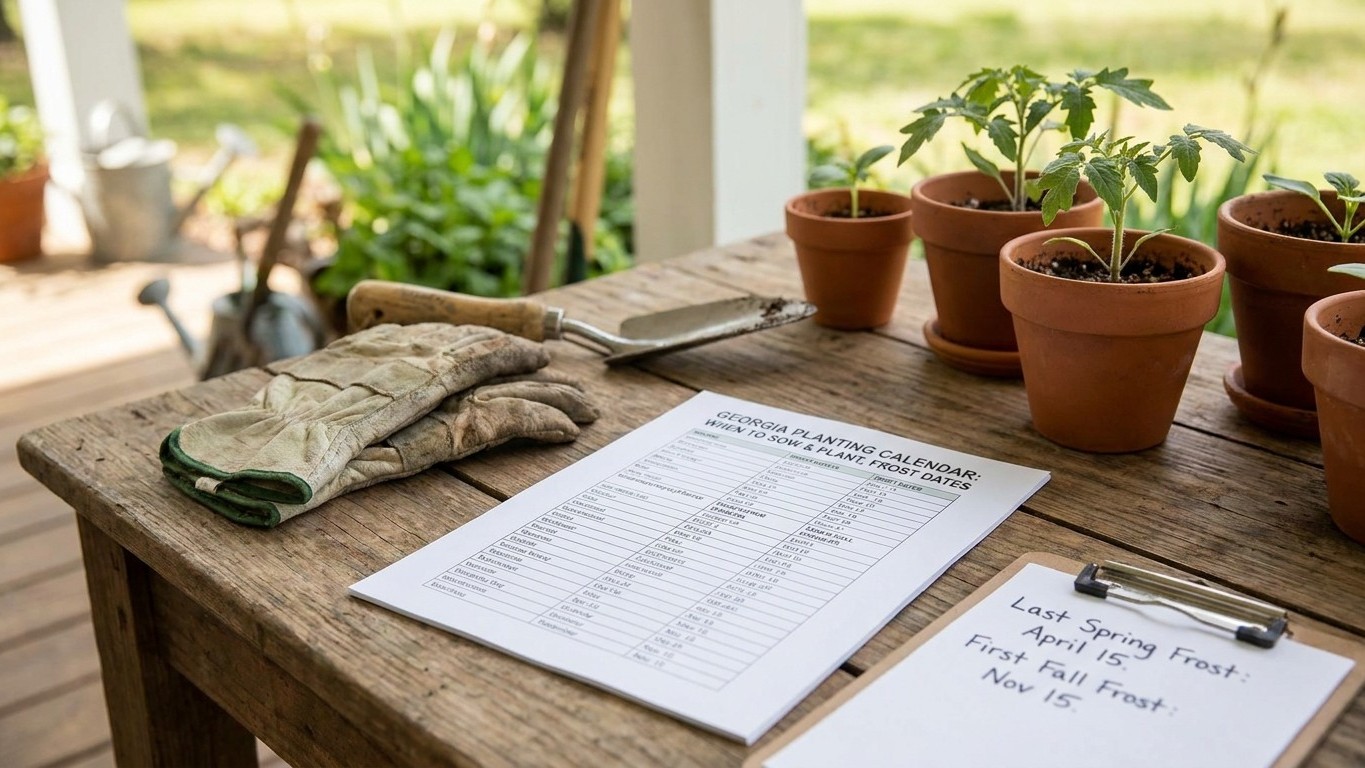

Station USW00013874 sits at Atlanta’s airport, and that single detail matters more than most planting charts admit. Pavement and jet exhaust keep that spot warmer than the pastures and ridgelines an hour north, so the freeze data pulled from it — a last spring frost hovering near month’s end in March, a first fall frost creeping into early December — describes one runway, not the whole state. Mountain counties and shaded coves run on their own clock entirely.
The frost window in Georgia

NOAA’s NCEI records these freeze dates at station USW00013874, near Atlanta’s airport. The 30 to 70 percent probability band for a 32°F freeze puts the last spring frost between March 11 and March 29, and the first fall frost between November 13 and December 1. Those aren’t single dates you can bank on. They’re a range built from three decades of weather, and any given year can land early, late, or dead center.
How long is the growing season?
Counting from the latest possible spring frost (March 29) to the earliest possible fall frost (November 13) gives a conservative frost-free window of about 229 days. Counting from the earliest spring frost (March 11) to the latest fall frost (December 1) stretches that to roughly 265 days. Most seasons fall somewhere between those two figures, which is still enough time to grow nearly anything sold in a seed catalog, including long-season tomatoes and winter squash.
Elevation changes everything
The Atlanta figures come from an urban airport, and pavement and buildings hold heat that a rural yard doesn’t have. North Georgia and the mountain counties freeze several weeks earlier in fall and thaw later in spring than what NOAA records near Atlanta. The coastal plain in the south runs the opposite direction, with a milder, longer frost-free stretch on both ends. If you garden in Rabun or Union County, or down near Camden or Glynn, treat the Atlanta dates as a rough middle point, not your actual planting signal. For a month-by-month breakdown tailored to the state’s timing, see What to Plant in Georgia in April, What to Plant in Georgia in November, What to Plant in Georgia in December, What to Plant in Georgia in October, What to Plant in Georgia in September, What to Plant in Georgia in August, What to Plant in Georgia in June, What to Plant in Georgia in July, What to Plant in Georgia in May, What to Plant in Georgia in February, What to Plant in Georgia in January, or What to Plant in Georgia in March.
Cool-season crops
Cool-season vegetables go in the ground before the last frost because they tolerate a light freeze without damage, and several of them actually taste better after one. Peas, spinach, lettuce, the brassica family (cabbage, broccoli, kale, collards), and root crops like carrots, beets, and turnips all fall into this group.
What goes in before frost
- Peas: direct sown while soil is still cool, tolerates a hard freeze once established
- Spinach and lettuce: germinate poorly in warm soil, so early planting is an advantage, not a risk
- Brassica transplants: cabbage, broccoli, and kale seedlings handle a light frost with little more than cosmetic damage
- Carrots, beets, and turnips: direct sown early, since the seedlings are frost-tolerant even though the roots are still forming
Timing by frost date, not calendar
The mistake most new gardeners make is planting cool-season crops by a fixed date on a printed calendar instead of watching their own last frost window. Since NOAA’s normals put that window anywhere from March 11 to March 29 near Atlanta, and earlier or later depending on where you are in the state, the safer approach is to watch your local forecast and soil temperature rather than assume a specific week. Cool-season crops generally go in while there’s still real frost risk on the table, which is the entire point of choosing them for this slot.
Warm-season crops

Tomatoes, peppers, squash, beans, and corn need more than an absence of frost. They need warm soil, because cold, wet ground rots seed and stunts transplants even when the air temperature looks fine. This is why experienced gardeners in Georgia wait past the last frost date itself before setting out warm-season transplants, giving the soil time to catch up to the air.
Why soil temperature matters more than the calendar
A tomato transplant set into soil that’s still cold from a wet March will sit and sulk for weeks, sometimes losing more time than if you’d waited another ten days. That’s the reasoning behind pushing transplant dates a bit later than the bare frost-free date, especially in a state where the last frost window itself runs over two and a half weeks.
Count-back timing for indoor starts
Working from NOAA’s last frost window of March 11 to March 29, a transplant date of late March to mid April gives the soil a couple of extra weeks to warm past that range before tender seedlings go in the ground. If you’re starting seed indoors rather than buying transplants, most tomato and pepper varieties need roughly six to eight weeks of indoor growth before they’re ready to set out, which puts seed-starting indoors somewhere in early to mid February for a late March to mid April transplant date.
Catalog days-to-maturity figures are counted from the transplant date, not from seed, and they shift by a week or two depending on how warm or cool the season runs. Here’s how several named tomato cultivars line up against Georgia’s frost window when set out late March to mid April:
| Variety | Days to maturity | Habit | Disease resistance | First ripe | Margin before fall frost |
|---|---|---|---|---|---|
| Sakura | 55 | Indeterminate | Nematodes, Tomato Mosaic Virus, Fusarium Wilt 1&2 | Early June | 160 days |
| Edox | 55 | Indeterminate | Nematodes, Tomato Mosaic Virus, Fusarium Wilt 1&2 | Early June | 160 days |
| Valentine | 55 | Indeterminate | Early Blight | Early June | 160 days |
| Glacier | 55 | Determinate | None listed | Early June | 160 days |
| Sun Gold | 57 | Indeterminate | Tobacco Mosaic Virus, Fusarium Wilt 1 | Early June | 158 days |
| Supersweet 100 | 60 | Indeterminate | Verticillium Wilt, Fusarium Wilt 1 | Mid June | 155 days |
| Juliet | 60 | Indeterminate | Late Blight, Early Blight | Mid June | 155 days |
| Amalfi | 68 | Determinate | Nematodes, Late Blight, Early Blight | Mid June | 147 days |
| Cherokee Purple | 72 | Indeterminate | None listed | Late June | 143 days |
| Big Beef Plus | 72 | Indeterminate | Nematodes, Gray Leaf Spot, Tomato Mosaic Virus | Late June | 143 days |
| Tiren | 75 | Indeterminate | Verticillium Wilt, Tomato Mosaic Virus, Fusarium Wilt 1 | Late June | 140 days |
| Granadero | 75 | Indeterminate | Nematodes, Verticillium Wilt, Tomato Mosaic Virus | Late June | 140 days |
| San Marzano II | 78 | Indeterminate | None listed | Late June | 137 days |
| Celebrity Plus | 78 | Determinate | Nematodes, Gray Leaf Spot, Tomato Mosaic Virus | Late June | 137 days |
Every one of these carries well over 130 days of margin before the fall frost window even opens, which tells you Georgia’s season length is rarely the limiting factor for tomatoes here. Disease pressure and summer heat stress are the bigger threats, which is why the resistance codes in that table matter as much as the maturity date.
The fall planting window
Fall planting means counting backward from the first frost instead of forward from the last one. With NOAA’s first fall frost window near Atlanta running November 13 to December 1, you add the crop’s days to maturity plus a margin, because growth slows as daylight shortens through September and October even before any frost arrives.
Counting back from first frost
A crop that takes 60 days to mature in the long days of June can easily take 75 to 80 days in the shortening days of September, which is why fall planting guides always build in extra time beyond the seed packet number. Counting back from the earliest edge of the fall frost window, November 13, gives you the least margin for error. Counting from the latest edge, December 1, gives you the most room, but you shouldn’t plan around the generous end of the range if you garden anywhere colder than the Atlanta station itself.
Crops that improve after frost
Several fall crops actually get better after a light freeze, because cold triggers the plant to convert stored starches into sugars.
- Kale and collards: sweeter and less bitter after the first light frost
- Brussels sprouts: firm up and improve in flavor with cold exposure
- Carrots left in the ground: sweeten noticeably once soil temperatures drop
- Turnips and parsnips: similar sugar conversion under cold soil
That means a light frost is not a disaster for a fall garden the way it would be for a summer one. It’s often the point.
Reading a planting calendar properly
A state-wide planting calendar, including this one, is a starting point built from one weather station’s thirty-year average. It is not an instruction sheet for your specific yard. Georgia spans coastal plain, piedmont, and mountain terrain, and the frost timing NOAA records near Atlanta simply does not hold across all of it.
What varies within Georgia, and beyond it
Elevation is the biggest factor. Every rise in elevation delays spring warming and speeds up fall cooling, which is why north Georgia counties can be weeks behind the Atlanta dates in spring and weeks ahead of them in fall. Urban heat is the opposite effect: pavement, buildings, and reduced tree cover around Atlanta’s airport station keep it measurably warmer than surrounding rural land, which is part of why this same NOAA dataset shows different results for stations even a short drive outside the metro area.
The same logic applies across state lines. A gardener working from the Kentucky planting calendar is working from a colder, shorter-season climate normal than Georgia’s, and someone using the North Dakota planting calendar is working with a frost window that closes months earlier in fall. None of these calendars transfer directly to a different state, or even to a different corner of the same one.
What actually works is watching your own garden. Keep a simple record of your last spring frost and first fall frost for a few years, note how your soil warms compared to the general date, and adjust your own personal calendar from there. A five-dollar soil thermometer tells you more about when to plant tomatoes than any date on a chart.
Local help
For county-level planting dates and an actual soil test rather than a general estimate, contact the UGA Extension office for your county. USDA NIFA lists UGA Extension as Georgia’s land-grant university extension service, and its county agents can tell you how your specific soil, elevation, and microclimate compare to the Atlanta-area figures used in this guide. For more on planning around Georgia’s growing conditions, our Georgia guides cover topics from soil amendments to regional variety picks.
Common questions
Is it safe to plant tomatoes right after the last frost date?
Technically yes, but the soil is usually still too cold for good root growth right at that point. Waiting an extra week or two past NOAA’s last frost window, into the late March to mid April range, generally gives tomato transplants a faster start than planting the moment frost risk clears.
Why does my neighbor plant earlier than the frost date says I should?
Microclimate differences add up fast. A south-facing slope, a wall that holds heat, or a low spot that collects cold air can shift your effective frost date by a week or more compared to a house just down the street, let alone compared to the Atlanta airport station NOAA uses for its normals.
Can I trust a fall frost date to know when to stop harvesting?
Not entirely. NOAA’s first fall frost window (November 13 to December 1 near Atlanta) marks the 30 to 70 percent probability band for a 32°F freeze, meaning frost can arrive before or after that window in any given year. Cold-hardy crops like kale and carrots also keep producing well past a light frost, so the date isn’t a hard stop for everything in the garden.
Do I need different planting dates for north Georgia versus south Georgia?
Yes. NOAA’s Atlanta-area figures do not represent the whole state. The mountains and north Georgia counties see frost weeks earlier in fall and later in spring than Atlanta, while the coastal plain in the south runs milder on both ends, so a gardener in either region should shift the Atlanta dates rather than use them directly.
How many days of margin do I actually need before frost for a fall crop?
More than the seed packet’s days-to-maturity number by itself. Shortening daylight in September and October slows growth well before any frost arrives, so a crop is usually best sown early enough to mature near or before the earliest edge of your fall frost window, not the latest edge.
Some gardeners layer an older custom on top of frost dates: planting by the moon, which we explain as almanac tradition, not fact.
Related guides
- Florida Planting Calendar: When to Sow and Plant, Frost Dates Included
- Alabama Planting Calendar: When to Sow and Plant, Frost Dates Included
- Kentucky Planting Calendar: When to Sow and Plant, Frost Dates Included
- Forcing Spring Bulbs Indoors in Georgia
- When to Sow Pumpkins in Georgia
- When to Sow Sweet Corn in Georgia