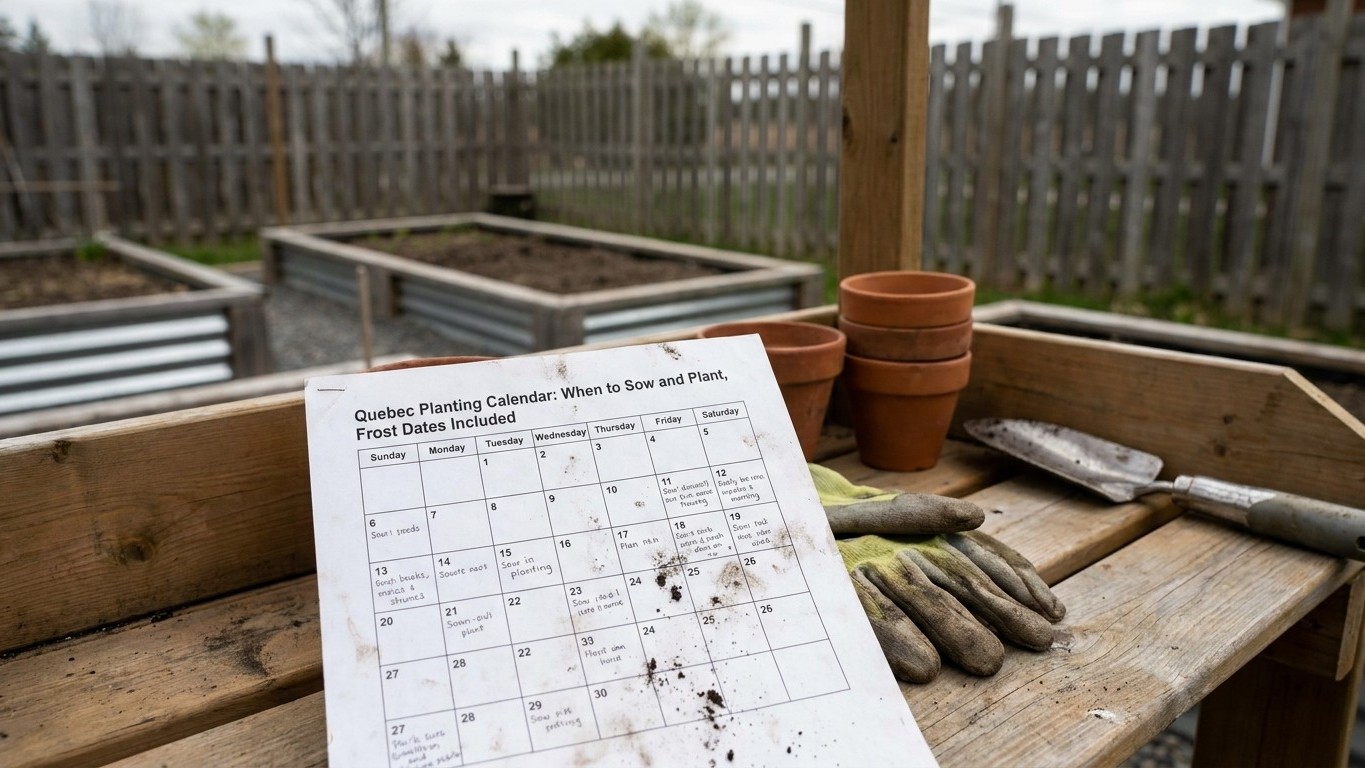

May 6 and October 5: those two dates, averaged from three decades of Montreal-area records, are the hinge everything else on this page swings from. Subtract one from the other and you get roughly five months of safe growing — but that number belongs to the St. Lawrence lowlands alone. Push north into the Laurentians or the Saguenay, or simply climb in elevation, and frost lingers later in spring while arriving sooner in fall, shrinking that window before you’ve even opened a seed packet — which is exactly why knowing What to Plant in Quebec in March matters before the real frost math even begins.
The frost window in Quebec

Every planting decision in this province starts with those two dates. Environment and Climate Change Canada’s 1981-2010 normals, drawn from the Montreal/St-Hubert A station, set the mean last spring freeze at May 6 and the mean first fall freeze at October 5. Counting the days between them gives a mean frost-free season of about 152 days, call it five months, though that figure describes the Montreal area specifically and not the province as a whole.
That distinction matters more here than almost anywhere else in eastern Canada. Quebec stretches from the milder St. Lawrence lowlands around Montreal up through the Laurentians, the Saguenay, and the north shore, and elevation or latitude pushes both frost dates further apart from the Montreal average the farther you travel. Higher and northern districts see their last spring frost arrive later and their first fall frost arrive earlier, which shortens the usable season by weeks compared to the reference station. If you garden outside the Montreal region, treat May 6 and October 5 as a starting reference, not your local answer.
What a mean date actually tells you
A mean last-frost date is the midpoint of a spread, not a cutoff line. Half the years on record had their last frost before May 6, and half had it after, sometimes by a week or more. That is why serious growers in this province plant heat-loving crops out a little later than the raw mean would suggest, and why a calendar built only around May 6 will occasionally cost you a full flat of tomato seedlings to a late cold snap.
The same logic runs in reverse in autumn. October 5 is the average date of the first fall freeze, but a killing frost arriving in late September is not unusual in a cooler year, particularly away from the Montreal lowlands. Anyone gardening in the Laurentians, the Eastern Townships uplands, or points further north should assume thei[r season ends earlier than the mean suggests, which makes knowing What to Plant in Quebec in September especially useful for timing that final round of crops before frost.]r real fall frost date sits earlier than the reference figure, not later — which makes it worth planning ahead starting with What to Plant in Quebec in January, followed by What to Plant in Quebec in February, and then What to Plant in Quebec in April, moving on to What to Plant in Quebec in May, and later checking What to Plant in Quebec in August before the season turns, then planning ahead with What to Plant in Quebec in June, and closing out the season with What to Plant in Quebec in Octoberuebec in June before the season peaks, then continuing with What to Plant in Quebec in July at the height of the season, checking What to Plant in Quebec in November before the season closes out, and later What to Plant in Quebec in December once the ground is fully dormant.
Cool-season crops
Cool-season vegetables tolerate a light frost and germinate in soil too cold for tomatoes or squash, which is why they go in the ground well before May 6 rather than after it. The trick is timing them to soil condition, not to a date on a wall calendar.
Peas, spinach and lettuce
Peas and spinach are usually the first seeds in the ground each spring in this climate, sown as soon as the soil can be worked with a spade rather than a pick. Both germinate in cold soil and shrug off a light frost on young leaves. Loose-leaf lettuce follows the same logic: it can go in several weeks ahead of the mean last frost and still come through fine, though a hard, sustained freeze will still knock it back if it lands on very young seedlings.
Brassicas and roots
Cabbage, broccoli and kale seedlings started indoors can be transplanted out well before the last frost, since mature brassica plants handle temperatures that would kill a tomato outright. Root crops behave a little differently: carrots, beets and radishes are direct-sown rather than transplanted, and they need soil that has warmed and dried enough to be raked into a fine bed, so they tend to go in a few weeks after peas rather than alongside them. None of these crops should wait for May 6. Held back to the mean frost date, they lose weeks of the cool, moist spring weather they actually prefer, and lettuce and spinach in particular will bolt to seed once summer heat arrives.
Radishes are worth sowing in short, repeated batches through this window rather than all at once, since they mature quickly and go woody or split if left in the ground too long once the weather warms.
Warm-season crops

Tomatoes, peppers, squash, beans and corn are the crops the whole frost calendar exists to protect, and they need more than a frost-free night to thrive. Soil temperature drives germination and root growth in this group far more than air temperature does, which is why gardeners who transplant tomatoes into cold, wet soil right at the mean frost date often watch them sit and sulk for two weeks while a bed planted a week or two later, into warmer ground, catches up and passes them.
Waiting past the mean date
Because May 6 is only the average, and frost arrives later than that in roughly half of all years, most gardeners in the Montreal area hold warm-season transplants until well into May rather than setting out on the mean date itself. Beans and squash can be direct-sown once the soil has warmed and the frost risk has clearly passed for the season, while corn wants similarly warm ground to germinate at all.
Counting back for indoor starts
Tomatoes and peppers are started indoors roughly six to eight weeks before they go into the garden. Counting back from a mid-May transplant target puts indoor sowing somewhere in mid-to-late March for most tomato varieties, with peppers often started a week or two earlier since they’re slower to size up. That’s an arithmetic range, not a fixed date, and it shifts with however early or late your own spring runs.
The table below shows how several catalogue tomato varieties line up against Quebec’s frost window, set out in mid-May and counted forward by their published days-to-maturity from transplant. The margin column is the gap between each variety’s expected first ripe fruit and the mean October 5 fall frost, which is why short-season varieties carry more slack than long-season ones.
| Variety | Days to maturity | Type | First ripe (calculated) | Margin before fall frost |
|---|---|---|---|---|
| Sakura | 55 days | Indeterminate | Mid July | 83 days |
| Edox | 55 days | Indeterminate | Mid July | 83 days |
| Valentine | 55 days | Indeterminate | Mid July | 83 days |
| Glacier | 55 days | Determinate | Mid July | 83 days |
| Sun Gold | 57 days | Indeterminate | Mid July | 81 days |
| Supersweet 100 | 60 days | Indeterminate | Mid July | 78 days |
| Juliet | 60 days | Indeterminate | Mid July | 78 days |
| Amalfi | 68 days | Determinate | Late July | 70 days |
| Cherokee Purple | 72 days | Indeterminate | Late July | 66 days |
| Big Beef Plus | 72 days | Indeterminate | Late July | 66 days |
| Granadero | 75 days | Indeterminate | Early August | 63 days |
| Tiren | 75 days | Indeterminate | Early August | 63 days |
| San Marzano II | 78 days | Indeterminate | Early August | 60 days |
| Celebrity Plus | 78 days | Determinate | Early August | 60 days |
Several of these carry useful disease resistance for a humid Quebec summer. Amalfi resists Nematodes, Late Blight and Early Blight at an intermediate level, while Big Beef Plus and Celebrity Plus both carry high resistance to Tomato Mosaic Virus alongside intermediate nematode resistance. Sakura, Edox and Glacier all resist Fusarium Wilt races 1 and 2 at a high level, which is worth knowing if a bed has grown tomatoes in the same spot for several years running. Remember that every days-to-maturity figure on a seed packet is counted from transplant, not from seed, and that real-world timing can shift by a week or two either side depending on how the season runs.
The fall planting window
Working backward from the mean first fall frost on October 5 tells you the last realistic sowing date for anything you want to harvest before the season ends. Take a crop’s days to maturity, add a margin of a week or two for the slower growth that comes with shortening daylight in September, and count back from October 5 to find the sowing window.
Working backward from October 5
A fast root crop or leafy green sown in mid-to-late summer has time to mature before that mean frost date arrives, provided its days-to-maturity plus the growth-slowdown margin fits inside the remaining weeks. Longer-season crops don’t get a second chance in fall the way they do in spring, since there’s no equivalent of “wait for warmer soil” once the days are shortening and the frost risk climbing. Anything with a long maturity window needs to already be in the ground by mid-summer to make use of the full frost-free season this table describes.
Crops that improve after frost
Several cool-season crops actually taste better after a light frost rather than being damaged by it. Kale, spinach and carrots left in the ground through a first light freeze convert stored starches to sugars, which sweetens them noticeably compared to the same crop harvested in warm weather. That’s a reason to leave a fall planting in place past October 5 rather than racing to pull everything the moment frost is forecast, provided the crop in question is one that tolerates cold rather than one that will simply die at first touch of ice.
Because the October 5 figure is a mean drawn from the Montreal-area station, gardeners further north or at higher elevation should plan their fall sowing on an earlier assumed frost date, the same caution that applies to the spring figure in reverse.
Reading a planting calendar properly
A provincial planting calendar built on two dates from one weather station is a starting point, not an instruction sheet for your specific yard. Quebec covers river valleys, upland plateaus, and shoreline microclimates along the St. Lawrence and its tributaries, and each of those settings shifts the practical frost dates away from the Montreal reference in its own direction.
What actually varies your local dates
Elevation is the biggest factor: gardens sitting higher than the surrounding land lose heat faster on clear nights and see frost settle in before it reaches the valley floor. Proximity to a large body of water works the opposite way, moderating both spring and fall temperature swings and often delaying the first fall frost compared to inland sites at the same latitude. Urban areas hold heat overnight from pavement and buildings, which is why a downtown garden can run measurably warmer than an open field a few kilometres outside town. None of these local effects show up in a single-station average, and none of them are things a printed calendar can know about your yard.
The other risk a calendar can’t capture is the late cold snap: a spring that runs warm for three weeks and then drops back below freezing for one night in mid-May, right after gardeners have been lulled into transplanting early. Watching your own soil, your own microclimate, and the extended forecast in the two weeks around your expected transplant date will tell you more than any date on this page. The same caveat about single-station averages applies wherever you compare regional calendars, whether you’re checking Quebec’s numbers against the neighbouring Saskatchewan planting calendar or a U.S. reference like the Indiana planting calendar, since every one of them is anchored to a single reporting station.
Local help
For county-level frost data, regional soil testing, and cultivar advice suited to your specific district, the province’s agriculture ministry is the better authority than any single-station calendar. Le Ministère de l’Agriculture, des Pêcheries et de l’Alimentation du Québec runs the provincial extension service, and it’s worth checking their resources before you finalize planting dates for a garden well outside the Montreal area. Our broader Quebec guides hub is a good next stop for crop-specific pages that build on the dates covered here.
A local soil test in particular will tell you far more about your actual planting window than a frost-date table ever can, since cold, wet clay warms weeks slower than a sandy loam bed in full sun even at identical latitude and elevation.
Common questions
Is May 6 safe to plant tomatoes outside in Quebec?
No. May 6 is Environment and Climate Change Canada’s mean last frost date for the Montreal-area station, which means frost arrives later than that in roughly half of all recorded years. Most gardeners wait until well into May before setting out warm-season transplants, and gardeners further north or at higher elevation should wait longer still.
Why did my seedlings stall after transplanting even though there was no frost?
Cold soil is the usual cause, not cold air. Tomatoes, peppers and squash root poorly in soil that’s still chilly even on frost-free nights, and transplants set into cold ground often sit without growing for a week or two while later-planted seedlings, into warmer soil, catch up.
How much later does the last frost run in the Laurentians or up north compared to Montreal?
There’s no single figure for this, since the Montreal-area normal comes from one station and higher or northern districts consistently run behind it by an amount that varies with elevation and latitude. Check with the provincial agriculture ministry or a nearby weather station for a figure specific to your district rather than assuming a fixed offset from the Montreal date.
Can I still start a fall garden if I missed the early-summer sowing window?
It depends on the crop’s days to maturity measured against how many weeks remain before your expected first fall frost. Fast crops like radishes and loose-leaf lettuce can still go in quite late, but anything with a long maturity window needs enough runway before frost risk climbs, so check the packet’s days-to-maturity against your remaining season before sowing.
Do I need to cover plants if frost is forecast close to the mean date?
Yes, if a frost is forecast and your plants are tender warm-season crops. A bedsheet, row cover, or overturned bucket over individual plants overnight is usually enough to get a marginal planting through a light, short frost, though it won’t help against a hard, prolonged freeze.
Related guides
- Ontario Planting Calendar: When to Sow and Plant, Frost Dates Included
- New Brunswick Planting Calendar: When to Sow and Plant, Frost Dates Included
- Saskatchewan Planting Calendar: When to Sow and Plant, Frost Dates Included